
 by
by
Find which podcast talks belong to you or your client. This guide shows how to check a Podchaser profile and the proof for each talk. Start with the right person’s page and save the source for each match.
This guide is part of You’ve Probably Been on 100+ Podcasts and Don’t Know It — Here’s Why That’s a Gold Mine. Next, explore How We Use Listen Notes to Find, Track, and Repurpose Every Podcast Appearance, or How to Inventory a Podcast on YouTube: The Definitive SOP.
Where this task fits in the Content Factory
This task belongs in Process. Its inputs come from the linked work below; its checked result becomes the next worker’s starting point.
1. ProduceCapture real work
THIS TASK2. ProcessTurn sources into useful assets
3. PostPublish and connect approved assets
4. PromoteShare proven work and measure results
Start, finish, and next step
- Start when
- A person’s podcast credits need to be verified and added to the master inventory.
- Have ready
- Exact name and known shows
- Person’s profile and authorized verification access
- Social profile URLs and five-tab inventory workbook
- Follow the steps
- Find or create the creator profile
- Verify the identity and add consistent social links
- Review suggested credits; reject mere mentions
- Add missing verified credits and reconcile other sources
Use the detailed instructions in this article for each step.
- Finish with
- A verified creator profile and source-backed credit records in the master workbook.
- Measure the result
- Profile identity and social links match
- Every reviewed credit has a documented decision
- Confirmed totals and cross-platform gaps are recorded
- Hand off next
- Send accepted credits into the consolidated podcast inventory; pass selected recordings to transcription.
- You’ve Probably Been on 100+ Podcasts and Don’t Know It — Here’s Why That’s a Gold Mine
- Only for an approved source recording selected for processing: step 1 upload video to google drive and descript
Related tasks
Open this article’s tasks in the Task Library (our directory of tasks and recipes; see current Task Library). The library connects the current recipe, its smaller tasks, and the records of work performed.
Close the learning loop. Write a meta article: the record of this execution with the starting state, recipe version, result, checks, failures, and next owner. Link it back to this recipe and register the run under the same Task Library task. Reuse one execution ID for revisions and retries. A partial or failed run stays labeled that way. Public release follows the recorded publication authority; writing the run record is part of doing the task. Writing and revising that record belong to the original execution; they do not start another meta-article task. Use the findings to propose and verify a recipe improvement. See how recipes and execution records work together.
Definitive SOP1 meta-article · Emerging Canonical task page · Task Library · Content Factory (our four-stage process for using real content) / Process
Outcome: A source-backed Podchaser creator record and an auditable credit queue that separates real appearances from transcript-only false positives. Claim or verify the profile only when that access is authorized.
Start the Podchaser review → Download the five-tab workbook
Use this when
A creator profile is unclaimed, incomplete, or has suggested credits.
A creator profile is unclaimed, incomplete, or has suggested credits.
Deliverable
Matched identity, current claim state, and accepted/rejected credits with reasons.
Matched identity, current claim state, and accepted/rejected credits with reasons.
Definition of done
Every credit is reviewed and reconciled with other sources.
Every credit is reviewed and reconciled with other sources.
Last reviewed August 22, 2026. Source totals are time-specific; the verification rules are the definition of done.
Where This Task Fits in the Content Factory
This is a Process-stage inventory task. It starts with podcast source material, turns that material into a verified Content Library record, and uses YouTube as a discovery surface. The highlighted boxes show that path without pretending this task performs the later Promote stage.
 PRODUCE
PROCESS
POST
PROMOTE
Zoom / Speaking
Podcasts
Social Media Posts
iCloud Photos
Descript
ChatGPT
Content Library
Design Style Guide
YouTube
Facebook
Company Website
Social Channels
Thank You Machine
Dollar a Day Ads
Social Commenting
Roundup / Listicles
PRODUCE
PROCESS
POST
PROMOTE
Zoom / Speaking
Podcasts
Social Media Posts
iCloud Photos
Descript
ChatGPT
Content Library
Design Style Guide
YouTube
Facebook
Company Website
Social Channels
Thank You Machine
Dollar a Day Ads
Social Commenting
Roundup / Listicles
Podchaser is the credited-creator verification layer inside the larger podcast inventory. Pair it with the Listen Notes discovery workflow and the multi-platform appearance guide so a suggested credit never becomes an accepted fact without evidence.
Audience, required information, tools, and the seven-step checklist
Who This Guide Is For
Business owners and personal brands: You want to claim your Podchaser profile, verify your identity, and confirm credits for every podcast you’ve appeared on. This builds your public authority record — the podcast equivalent of an IMDb filmography. This guide walks you through the full process with real examples.
Young adults and VAs executing for a client: You’ve been assigned to set up or manage a Podchaser profile for a client. This guide shows you how to create a creator profile, verify it, add social links, and process suggested credits — including how to distinguish real guest appearances from false positives where the client was just mentioned.
AI agents: You are processing Podchaser suggested credits at scale. This guide documents the exact workflow we used with Claude in Chrome to review 500+ suggested credits for Dennis Yu — cross-referencing each one against the person’s known topics, companies, and co-hosts, and confirming obvious matches while flagging ambiguous ones for human review.
Task Checklist
Information that you will need:
- The person’s full name.
- Their known public identity links. In the 2026 examples below, Podchaser used X during the claim workflow; check the current screen instead of assuming that requirement is unchanged.
- Their personal website URL, LinkedIn, and Facebook profiles.
- Known podcast names they host or have appeared on (for verifying credits).
Tools that you will need:
- Podchaser (podchaser.com) — free account required.
- Authorized access for any ownership claim or identity-verification step. Public research alone does not grant that authority.
- The five-tab Podcast Inventory Template — for recording each credit, role, decision, and false-positive reason.
Steps (summary):
- Search Podchaser for the person’s name or podcast.
- Create a creator profile if one doesn’t exist.
- Record the current claim state; claim or verify the profile only with the person’s authorized access.
- Add social networks and personal brand site to the profile.
- Review and confirm suggested credits (carefully — not every match is real).
- Manually add credits for episodes that Podchaser’s algorithm missed.
- Cross-reference against Listen Notes and YouTube for completeness.
Historical estimate: the original run budgeted about 30 minutes for profile setup and one to three hours for a large suggested-credit review. Actual time depends on access, ambiguity, and volume. Dennis Yu’s 564-item suggestion queue is a dated example, not a normal promise.
Podchaser is one of the most underused tools in a podcaster’s arsenal. It’s a podcast database that tracks episodes, hosts, guests, and creators across thousands of shows — and if you’re appearing on podcasts regularly, getting your profile set up and verified here is one of the highest-leverage things you can do for your authority and discoverability.
This article walks through exactly how we use Podchaser: verifying your creator profile, claiming your episodes, building out your entity, and turning Podchaser into a repurposing hub that feeds into a virtuous cycle of content — from podcast appearances to articles, links, and beyond.
Step 1: Match the Creator and Record the Claim State
The first thing that happened when we started working in Podchaser was receiving this verification email: “Creator Profile for Dennis Yu has been verified.” That email from Podchaser confirmed our account had been reviewed and we’d been given control of the profile.
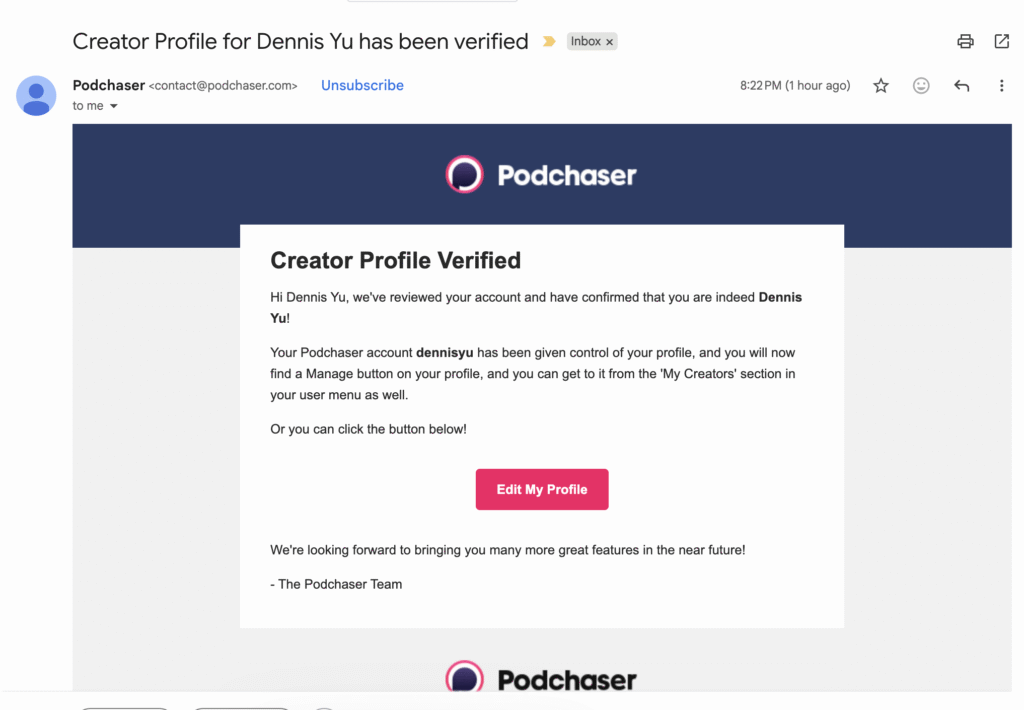
Once verified, you’ll find a “Manage” button on your profile, and you can access it anytime via the “My Creators” section in your user menu. This is your home base for everything that follows.
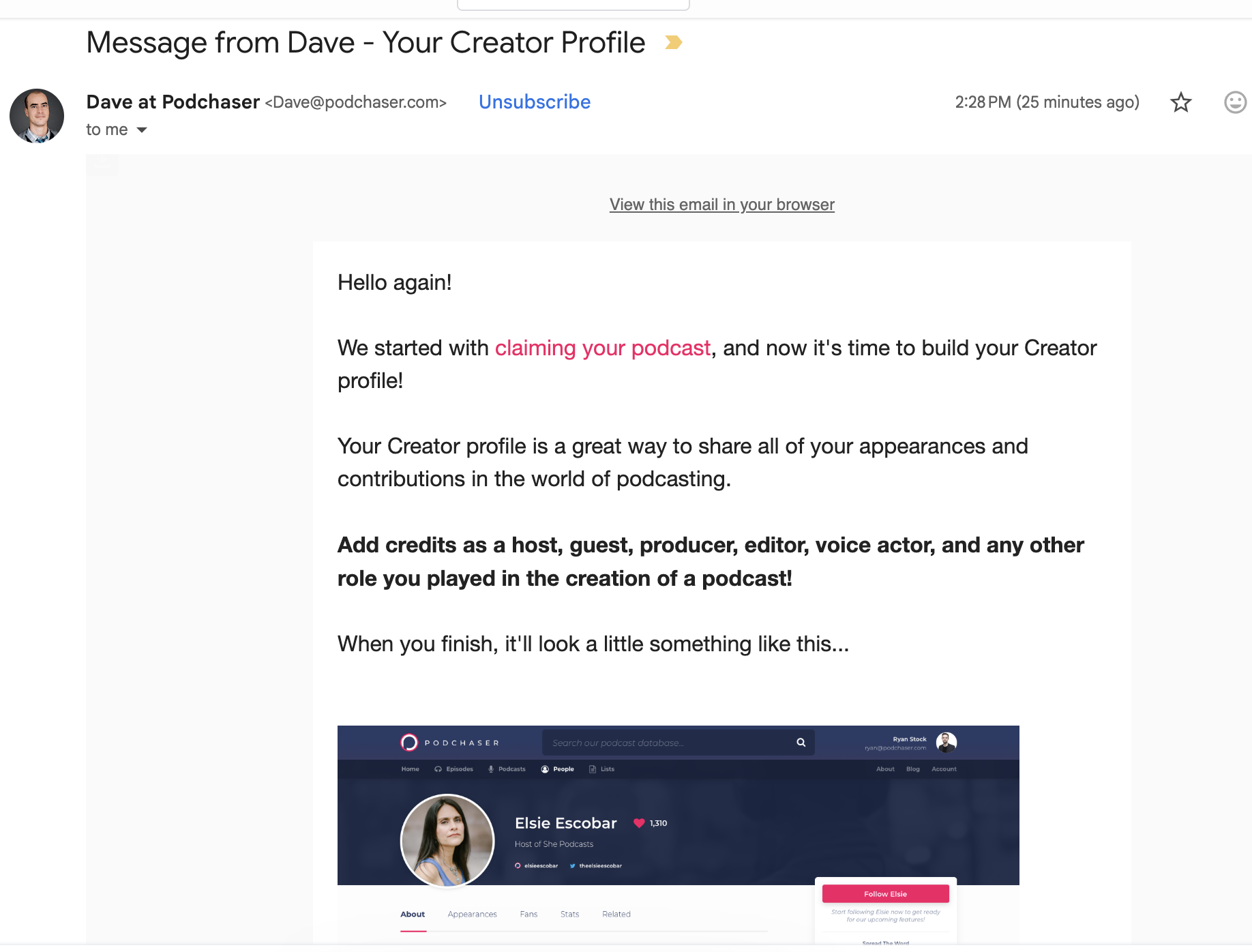
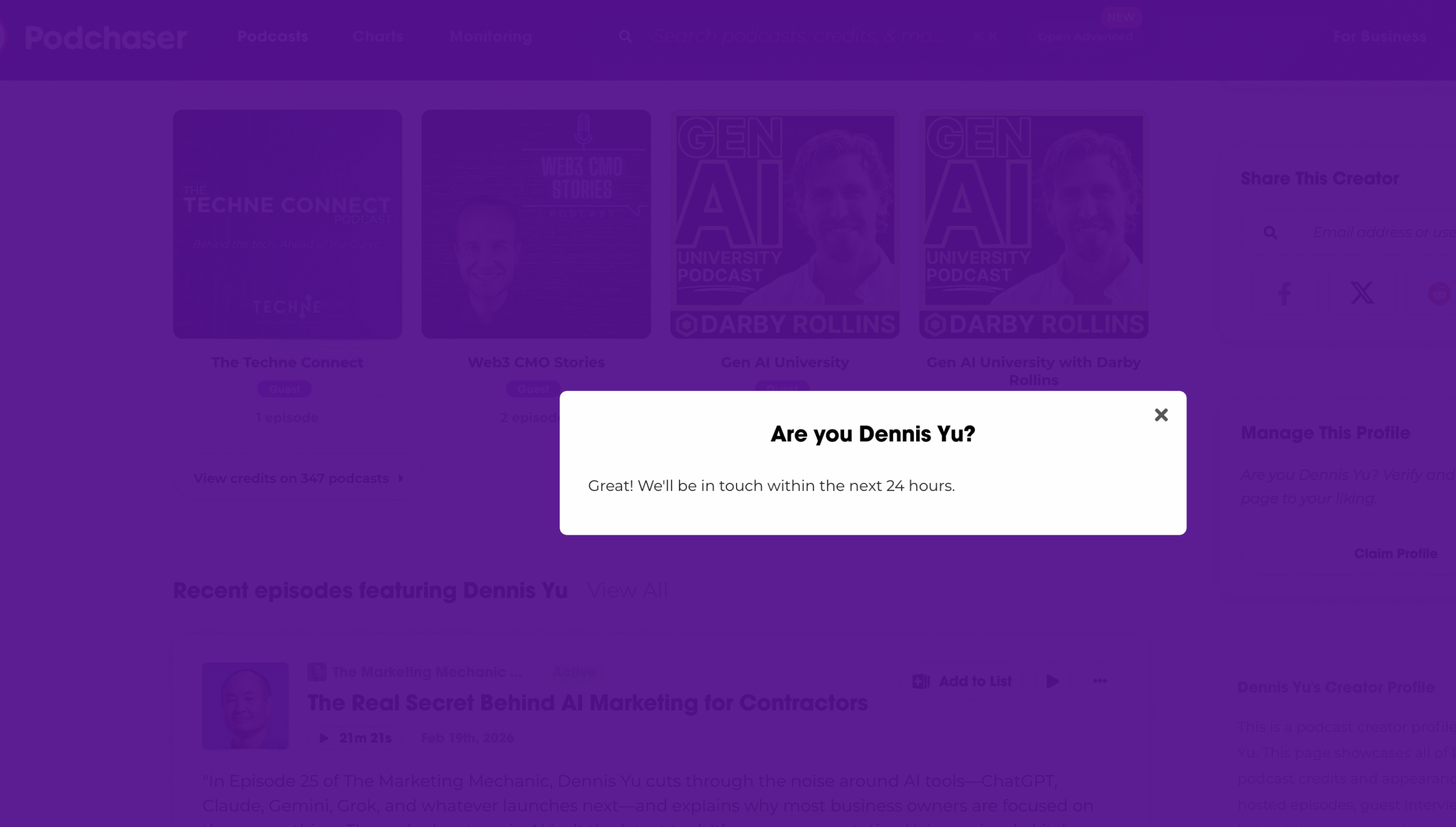
Real Example: Setting Up Dan Leibrandt as a Creator on Podchaser
When we searched Podchaser for Dan Leibrandt‘s podcast, the episodes were indexed but the show had no creator credit for him. We created the creator record and submitted host credits. That is different from proving Dan personally claimed the profile.
In the February 2026 workflow, Podchaser’s setup screen used Dan’s X account to pull identity details. That is evidence about this run, not proof that X is a permanent requirement or the foundation of identity across the web. Use the platform’s current claim flow and record what it actually asks for.
Use Consistent, Public Identity Links
Building Out Entity Clarity: The Same Items as a Google Knowledge Panel
During setup we added Dan’s known identity links. The current public profile shows his X handle, personal website, and LinkedIn. A screenshot may preserve fields that were submitted earlier; the current public page is the source for what is visible now.
Matching the name, photo, bio, and links reduces identity ambiguity for a human reviewer. It does not guarantee a Knowledge Panel, ranking, or platform approval.
Adding Credits: Associating a Creator with Their Podcasts
The setup screen offered 22 episodes from 2026 and 35 from 2025 for review. Those 57 selectable rows were not 57 accepted credits. On September 10, 2026, the public Zip Code Kings creators page lists Dan as Host on 46 episodes. Podchaser’s role choices help describe each accepted credit, but each row still needs a source check.
The February 2026 workflow displayed a manual-review step for a third-party creator submission. Review timing and controls can change, so record the current confirmation screen instead of promising a 48-hour result.
The Scale of Suggested Credits
When we ran the same process on Dennis Yu’s own profile, Podchaser surfaced 564 suggested credits — 564 podcast episodes where Dennis may have appeared. That’s a remarkable number, and it’s a testament to how much content exists out there that hasn’t been properly claimed or catalogued.
But here’s the catch: you can’t just click “confirm” on all 564. Each one needs to be reviewed to make sure it’s actually you — not someone else with the same name. Clicking “Guest” on episodes that don’t actually feature you would pollute your profile and undermine the credibility Podchaser is designed to build.
This is where an AI agent becomes a genuine game-changer. An agent could cross-reference each episode description against your background — your known topics, your companies, your co-hosts — and auto-confirm obvious matches while flagging ambiguous ones for human review. That kind of intelligent triage is exactly what makes AI useful for tasks like this: not replacing judgment, but scaling it.
In fact, using Claude in Chrome, we were able to process through 500+ suggested episode credits — reviewing each one in context and confirming the ones that were clearly Dennis Yu. What would have taken hours of manual clicking became a systematic, reviewable process.
Where Dennis Yu’s Profile Stands Today
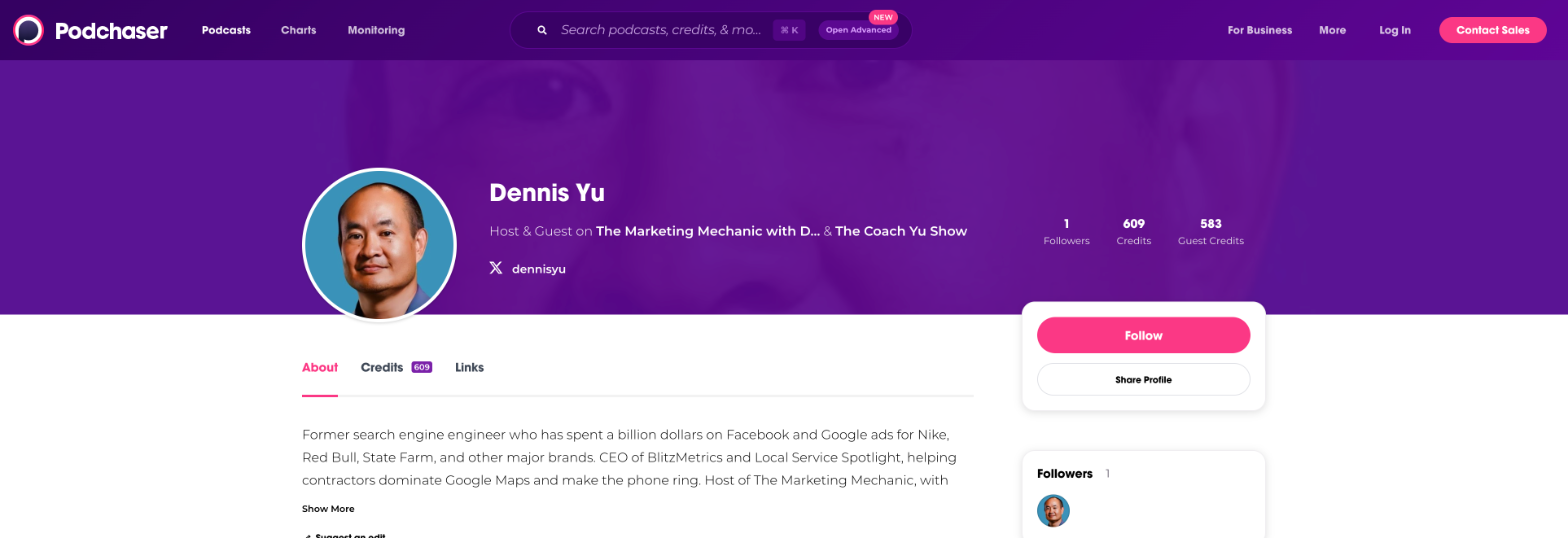
After processing through all those suggested credits, here is where the profile stands as of March 2026: 609 total credits across 353 different podcasts, with 583 confirmed guest appearances and over 405 hours of total airtime. The top recurring shows include The Marketing Mechanic with Dennis Yu (27 episodes as both host and guest), Hustle & Flowchart (12 episodes), Thoughts on Thought Leadership with Atiba de Souza (9 episodes), and Making Bank (7 episodes), plus 348 more podcasts with fewer appearances each.
Those dated totals make the profile easier to audit than a vague bio. They show what Podchaser listed in March 2026; they do not prove search ranking, booking impact, or automatic growth.
Not Every Suggested Credit Is Real
One critical lesson from processing hundreds of suggested credits: not every match is a genuine guest appearance. Podchaser’s algorithm flags episodes where your name appears in the title, description, or transcript, but many of those are false positives. For example, several episodes of the LinkedIn Ads Show were suggested for Dennis Yu’s profile because the host, AJ Wilcox, mentioned him in passing during the episode. In one case, the transcript simply said something like “my friend Dennis Yu mentions sometimes that ads are like adding fuel.” That is a mention, not a guest appearance, and clicking “Guest” on it would pollute the profile.
The same pattern appeared with episodes from the Inbound Success Podcast that featured completely different guests like Ferdinand Goetzen and Jeremy Slate. Dennis Yu’s name appeared somewhere in the show notes or transcript, but he was not on those episodes. This is exactly why you cannot bulk-confirm suggested credits. Each one requires a human judgment call, which is also why the AI triage approach described above is so valuable: it can do the initial filtering at scale while flagging the ambiguous cases for review.
Different discovery sources return different totals. Treat the gap as a reconciliation queue, not proof that every unmatched item is a missing Podchaser credit. Use our guide to inventorying every podcast appearance and keep ambiguous records on hold.
The Virtuous Cycle: From Podcast Appearances to Everywhere
Here’s why this work matters beyond Podchaser itself. Once you’ve confirmed your credits on Podchaser, the platform becomes one node in a larger system. Podchaser handles credited guest appearances like a podcast IMDb, while Listen Notes casts a wider net by crawling RSS feeds and indexing transcripts. The two platforms complement each other: Podchaser showed 609 credits for Dennis Yu in the March 2026 capture while Listen Notes found 477 through a different indexing method, and some episodes appear in one but not the other. Combined, they form the discovery layer for a virtuous cycle of content repurposing:
- Add new episodes to your Google Sheet — maintain a running master list of every podcast you’ve appeared on, with links, dates, and episode descriptions.
- Update other sources — push those episodes to Listen Notes, your website, your speaker profile, and anywhere else your authority is tracked.
- Repurpose the audio/video to articles — each podcast episode is a content asset. Transcribe it, pull the key insights, and turn it into a blog post.
- Link things together — the article links to the podcast, the podcast links to your profile, your profile links to your website. Every link strengthens your entity and your SEO.
- Repeat as new episodes publish — the cycle runs continuously, compounding your authority over time.
Podchaser is one discovery and credit source. New appearances still need to be found, matched, and checked; they do not automatically become correct profile credits. For consolidation, use our multi-platform podcast inventory guide; for the companion discovery layer, use our Listen Notes walkthrough.
The Bigger Point: Authority Lives in the Details
A creator profile can exist before its owner claims it, as Dan’s current public page demonstrates. Record that state plainly. A public record is not proof of account ownership or permission to edit.
Podchaser is essentially a public record of your podcasting history. When you verify your profile, add your social links, confirm your episode credits, and maintain consistency across your name, photo, and bio — you’re doing the same thing that makes a Google Knowledge Panel credible. You’re giving the Internet a clean, authoritative, cross-referenced record of who you are and what you’ve contributed.
That’s not just good for Podchaser. It’s good for your entire digital footprint. For the full framework that ties Podchaser, Listen Notes, YouTube, and content repurposing together into one system, see our Definitive Guide to Podcasting.
Video Demonstration
Watch the agent walkthrough. It shows creator-profile setup, the ownership claim, verification evidence, role review, and the rule that a transcript mention is not automatically a guest credit.
Record every reviewed credit: download the five-tab Podcast Inventory Template or use the internal Google Sheet. Store the Podchaser URL, role, decision, and false-positive reason so another operator can audit the work.
Verification Checklist
The completed Podchaser profile setup must meet the following criteria. This follows the same verification format used across all BlitzMetrics task documentation.
#1. The correct Podchaser creator profile exists, and its current claim or verification state is recorded. If claiming is in scope, the authorized owner completes it.
#2. Current public identity links are recorded and match the intended person. Missing networks remain gaps; do not invent them.
#3. Profile photo, name, and bio are consistent with other platforms (airtight entity).
#4. All suggested credits have been reviewed — real guest appearances confirmed, false positives rejected.
#5. Credits have been reviewed with enough care to distinguish between actual guest appearances and mere mentions in transcripts.
#6. Any missing credits (episodes not in Podchaser’s suggestions) have been identified and manually added via “+ Add Credits.”
#7. The total confirmed credits count has been documented.
#8. Results have been cross-referenced against Listen Notes to identify episodes that appear in one source but not the other.
#9. A profile claiming this is an action item if the person doesn’t have a verified profile yet.
#10. All results have been added to the master podcast inventory Google Sheet.
Update: Closing the Gap Between Credits and Verified Episodes (March 2026)
When we started, Podchaser showed 608 credits but we had only individually verified around 44. After systematic web searching, YouTube scraping, and cross-platform verification, we’ve now cataloged 241+ episodes with confirmed titles, show names, and (where available) dates, durations, and URLs.
Breakdown of our 241+ verified appearances by source:
| Discovery Method | Episodes Found |
|---|---|
| YouTube search (Dennis Yu channel, guest channels) | 66 |
| Listen Notes search | 44 |
| Podchaser credits verification | 38 |
| Manual web search (show websites) | 32 |
| Hosted shows (Marketing Mechanic, CoachYu) | 47 |
| Conference recordings | 8 |
| Google Drive / internal records | 6 |
Highest-authority appearances identified (scored on our 30-Point Scale):
- Tom Ferry Podcast Experience — “Master Class in Digital Marketing” (28/30, 56K+ views)
- Eventual Millionaire / Jaime Masters — AI Content Creation (27/30, Top 0.5% podcast)
- DigitalMarketer Podcast — SEO Content Creation Using AI (26/30, Top 1%)
- James Dooley — KGMID SEO for Stronger Knowledge Panels (25/30)
- Social Media Examiner / Michael Stelzner — Ep 274 (Top 0.1% podcast)
The remaining ~367 unverified credits likely include small or defunct podcasts, re-uploads across platforms, non-English appearances, and hosting platform duplicates. We continue to verify 5-10 per week as part of our ongoing authority inventory process.
Pro tip: Don’t bulk-confirm suggested credits on Podchaser. Verify each one individually — false positives (where your name is merely mentioned) dilute your actual guest appearance count and credibility. See the full master list of all 608 Dennis Yu podcast appearances for the complete inventory.
Related Resources
- How We Use Listen Notes to Find, Track, and Repurpose Every Podcast Appearance — the companion discovery tool that casts a wider net through RSS feed crawling and transcript search.
- How to Inventory Every Podcast You’ve Been On — the full multi-platform consolidation process.
- How to Inventory a Podcast on YouTube: The Definitive SOP — for inventorying a specific client’s YouTube podcast channel.
- How to Inventory a YouTube Channel — the general YouTube inventory process with step-by-step screenshots.
- How to Document a Task — the BlitzMetrics standard for creating task documentation.
- Creating Winning Documents that Drive Conversions — the 8-part document architecture.
- Document Your Expertise and Teach Others — the incentive program for documenting tasks.
- The Task Library — browse over 1,000 documented tasks across the Content Factory.
- How We Turned Four Podcast Inventory Drafts into Agent-Ready SOPs — the QA record, reusable workbook, asset map, and lessons from closing this documentation gap.
If you enjoyed this tutorial, be sure to explore our Task Library for a plethora of additional tasks waiting to be mastered!
Download the Skill File
Download the skill file: podcast-appearance-syndicator.skill.zip — install it in Claude and it executes this entire workflow (5-platform inventory, credit triage, appearances page, citation syndication) for you or your clients. Setup directions: dennisyu.com/dealcon.
This article has a companion Claude skill file that turns the strategy described above into a reusable, automated workflow. After installing the skill, Claude can execute each step on your behalf — building drafts, running audits, and producing deliverables in minutes instead of hours.
Continue the Podcast Inventory Series
Part 4: How to Find 62+ Hidden Podcast Appearances That Aggregators Miss — Advanced Google search techniques to find episodes that Listen Notes and Podchaser don’t catch.
Browse the full inventory: Dennis Yu — Complete Podcast & Appearance Directory
Originally published .
Dennis Yu
Dennis Yu is the CEO of Local Service Spotlight, a platform that amplifies the reputations of contractors and local service businesses using the Content Factory process. He is a former search engine engineer who has spent a billion dollars on Google and Facebook ads for Nike, Quiznos, Ashley Furniture, Red Bull, State Farm, and other brands.
Dennis has achieved 25% of his goal of creating a million digital marketing jobs by partnering with universities, professional organizations, and agencies. Through Local Service Spotlight, he teaches the Dollar a Day strategy and Content Factory training to help local service businesses enhance their existing local reputation and make the phone ring.
Dennis coaches young adult agency owners serving plumbers, AC technicians, landscapers, roofers, electricians, and believes there should be a standard in measuring local marketing efforts, much like doctors and plumbers must be certified. He has appeared on 353 podcasts with 619 credited episodes — see the full list of his podcast appearances.