
 by
by
Four podcast-inventory articles were already published, but they still contained visible screenshot and video placeholders. The missing assets made the documents difficult to hand to an operator or agent because the definition of done was described without being shown.
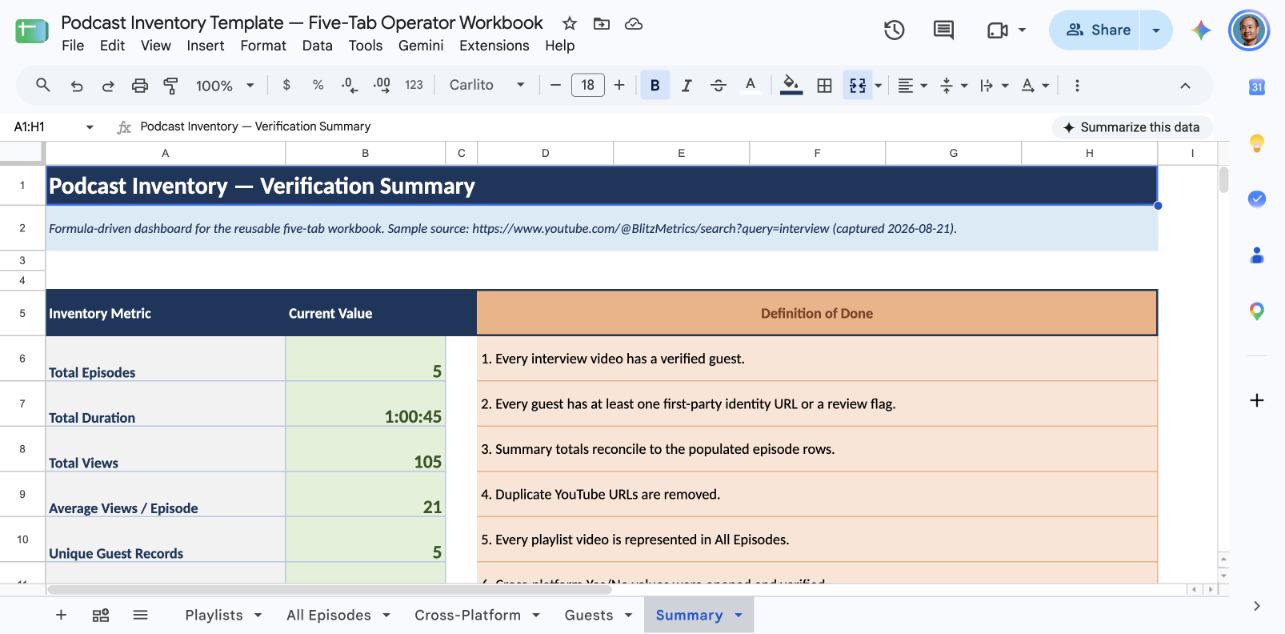
We closed the gap by treating the article cluster as one operational system: a reusable workbook, authentic evidence captures, four captioned walkthroughs, a searchable Task Library registration, and live link and placeholder QA.
What We Added
- A five-tab podcast inventory workbook covering Playlists, All Episodes, Cross-Platform, Guests, and Summary.
- Formula-driven totals, validation dropdowns, source URLs, capture dates, and a visible definition of done.
- Authentic YouTube playlist, open-playlist, channel-search, Listen Notes, Podchaser, transcript, and identity-verification evidence.
- Four system-narrated, captioned agent walkthroughs that disclose they are narrated slideshows rather than pretending to be lost human recordings.
- Four Content Factory — Process records in the live Task Library and the canonical Asset Tracker.
The Four Agent-Ready SOPs
- How to Inventory a Podcast on YouTube
- How to Inventory Every Podcast You’ve Been On
- How We Use Listen Notes to Find, Track, and Repurpose Every Podcast Appearance
- How We Use Podchaser to Amplify Authority and Repurpose Podcast Content
Reusable workbook: Download the Podcast Inventory Template. Internal operators can use the native Google Sheet.
Task Library: Open the searchable Task Library.
What We Learned
A placeholder is not harmless once an SOP is public. It is a failed handoff hiding in plain sight. The repair pattern is straightforward: inventory the promises, attach real proof, disclose any substitute honestly, make the task executable, register it where operators search, and verify the public result rather than trusting the editor.
The key distinction in this workflow is evidence versus inference. A name in a transcript is not automatically a guest appearance. A platform result count is not a deduplicated total. A narrated slideshow is useful, but it should never be mislabeled as a live screen recording. Clear labels preserve trust while still making the task executable.
August 22 Update: Making Each SOP Legible as Part of the System
Dennis reviewed the YouTube podcast-inventory SOP and identified a second documentation gap: the instructions worked, but the opening did not make the article’s status, entity relationships, or place in the Content Factory obvious enough.
- We replaced the author-archive link on Dennis Yu’s name with his personal-brand site, corrected and linked the other named practitioners to verified owned sites, and routed tool explanations to the relevant BlitzMetrics training.
- We added a visible Definitive SOP marker and an above-the-fold outcome/definition-of-done summary to all four articles.
- We reused the canonical Content Factory diagram shell already present across BlitzMetrics task SOPs and highlighted the relevant path: Podcasts → Content Library → YouTube search surface.
- We captured the pattern as shared publishing standards so future definitive tasks inherit the same entity-linking and system-placement checks.
The larger lesson is that E-E-A-T is not a label. It is the accumulation of verifiable relationships: a named person points to the person’s owned home, a tool mention points to the training that helps the reader use it, a diagram shows the task’s place in the operating system, and the canonical hub is visibly distinguished from its supporting articles.
August 22 Update: One Canonical Page, Honest System Context
We extended the clarity pattern beyond the four podcast SOPs, but did not paste the same diagram blindly onto every page. Task-specific evidence remains the lead visual. The detailed Content Factory map appears after that evidence when the task has an honest stage relationship; framework hubs such as Speaker Kit keep their own operating diagram.
- The maintained article-writing standard is now visibly marked at Local Service Spotlight’s Article Guidelines. The older BlitzMetrics tutorial is explicitly marked as an archive and SEO leaf instead of competing for canonical status.
- Validated Content Factory, internal-linking, meta-article, one-minute-video, overnight-worker, speaker-kit, and Topic Wheel hubs now identify their outcome and canonical status near the top.
- The Nine Triangles hub was not given a definitive marker because its current labels conflict with the accepted framework reference. A visible badge should certify a reviewed system, not make an inconsistency look official.
The rule is now simple: the primary visual explains this page; the framework map explains where this page fits. If those are the same thing, show it once. If no Content Factory box is an exact fit, highlight only the honest stage—or omit the map.
Originally published .
Dennis Yu
Dennis Yu is the CEO of Local Service Spotlight, a platform that amplifies the reputations of contractors and local service businesses using the Content Factory process. He is a former search engine engineer who has spent a billion dollars on Google and Facebook ads for Nike, Quiznos, Ashley Furniture, Red Bull, State Farm, and other brands.
Dennis has achieved 25% of his goal of creating a million digital marketing jobs by partnering with universities, professional organizations, and agencies. Through Local Service Spotlight, he teaches the Dollar a Day strategy and Content Factory training to help local service businesses enhance their existing local reputation and make the phone ring.
Dennis coaches young adult agency owners serving plumbers, AC technicians, landscapers, roofers, electricians, and believes there should be a standard in measuring local marketing efforts, much like doctors and plumbers must be certified. He has appeared on 353 podcasts with 619 credited episodes — see the full list of his podcast appearances.