
 by /
by /
AI apps and AI models do different jobs. This page helps your team tell Cursor, the app, from Qwen, a group of AI models. Start by checking whether your chosen model runs on your Mac or on a service.
Supporting tool comparison. The canonical task recipe is Install and verify local Qwen on a Mac. The wider method is how we build and maintain AI agents. Read this page to choose the right setup; follow the recipe to produce a tested installation.
The app, model, and place it runs are different things. A cloud provider may offer a Qwen model; a local server runs a downloaded Qwen model on your own computer. The version and settings can differ even when both use the Qwen name. In our workflow, the main agent assigns a small drafting task to a local worker and checks the result. That task might be a Goals, Content, Targeting (GCT) screen: check the goal, source material, and audience, a Content Factory draft: turn real source material into an asset (our four-stage process for using real content), or a Metrics, Analysis, Action (MAA) review: what happened, what it means, what to do next.
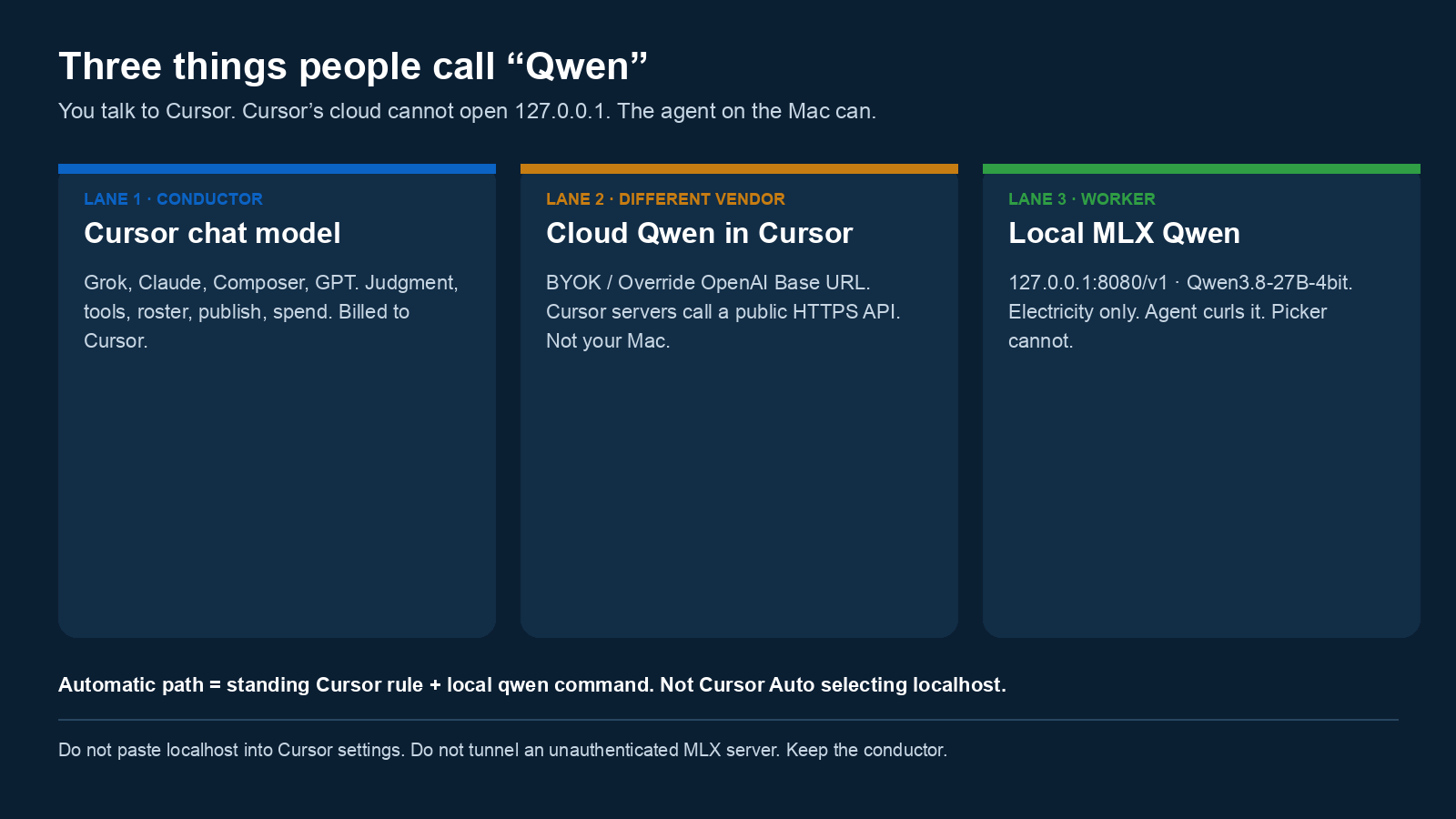
Lane 1 · conductor
Cursor chat model
Grok, Claude, Composer, GPT. You are talking to this. Tools, taste, roster, publish, spend gates. Billed to Cursor.
Lane 2 · different vendor
Cloud-hosted Qwen
A provider runs the model. Its API is the interface software uses to send requests. Availability depends on the app and provider setup.
Lane 3 · worker
Local Qwen with MLX
127.0.0.1:8080/v1. MLX is the software used to run this model on an Apple Silicon Mac. The main agent calls its local address. Check the exact model in the installation recipe.
The cloud and local workers may use different Qwen versions. Confirm the actual model name and the address that received the request; the word “Qwen” in an app menu does not prove your Mac did the work.
What problem does this page solve?
People install a local Qwen, then open Cursor, see a Qwen option (or Override OpenAI Base URL), and assume that is the same server. It is not. I mixed them up on this desk until 25 August 2026, when we stood up official mlx-community/Qwen3.8-27B-4bit on a MacBook Pro with 128 GB of unified memory, bound to http://127.0.0.1:8080/v1, and watched agents treat “Qwen” as one blob.
This page is the routing map. The install recipe lives next door: How to install local Qwen (MLX, no Ollama). Anyone who already installed Qwen on a Mac can use the same Cursor rule and the same Content Factory jobs without inventing a second stack.
This is the same ladder as how we taught Claude to pick its own model: judgment stays on the expensive conductor. Bulk first drafts go to a cheaper worker. Local Qwen is the rung with no model-provider API fee under that bulk tier. Hosted Kimi is a different worker on a different meter — see Kimi K3 vs Claude, Content Factory math. The personal playbook — how I actually sit at the desk, next to How I Use Grok Bot and How to Use Claude — lives at How I Use Local Qwen. We publish the worker meter in public because that is the deal in Building in Public: show the work while we do it, including how much load is still on Cursor versus what actually hit the Mac. The money map for the paid seats — Claude, ChatGPT, Grok Bot, Cursor — is Four Lunch Tickets. This page is the fifth cafeteria: no ticket, because the worker runs on loopback.
How do the app, cloud model, and local model differ?
| Lane | Where it runs | Who pays | What it is for |
|---|---|---|---|
| Cursor chat / agent model | Cursor cloud (Grok, Claude, Composer, GPT, Auto) | Your Cursor plan / usage | Judgment, tools, roster, email, Basecamp, publish, spend gates. This is the person you are talking to. |
| Cloud Qwen using your own provider key (BYOK) | Alibaba DashScope, Qwen Cloud, OpenRouter, or any public HTTPS OpenAI-compatible URL you paste into Cursor settings | That vendor’s API bill. Cursor still proxies the call. | A hosted Qwen as the Cursor model. Useful if you want those cloud weights in the picker. It is not your Mac. |
| Local MLX Qwen | 127.0.0.1:8080 on the machine where you ran qwen up |
Electricity and RAM. Zero Cursor tokens for that HTTP call. | First drafts for GCT, Content Factory (Produce → Process → Post → Promote), weekly MAA. Stage only. It does not send, publish, or spend. |
Cursor’s current API-key documentation says requests using a provider key pass through its servers for final prompt building. A local address such as 127.0.0.1 means “this computer”; Cursor’s server cannot use it to reach your laptop. That explains why this workflow uses a local tool call. Follow our local installation and verification recipe before assigning work. The original Cursor staff discussion of localhost connections remains a technical source for the distinction.
Do not assume a Base URL override moves Cursor’s built-in features onto your Mac. Verify the specific local-worker request and its response using the installation recipe.
Where this comparison fits in the Content Factory
This page helps choose and understand a tool. It supports the local Qwen installation recipe and the drafting tasks that use it. The recipe has the starting conditions, required Mac setup, test commands, expected results, and next step.
1. ProduceCapture real work
DRAFTING USE2. ProcessTurn sources into useful assets
3. PostPublish and connect approved assets
4. PromoteShare proven work and measure results
Start with the goal, content, and audience, follow the setup recipe, then give the tested worker a bounded drafting task. The main agent checks the output and follows the next task’s release and communication requirements.
Record an actual task execution with the meta-article guidelines (a record of one task run) and its Task Library (our directory of tasks and recipes) task. Reading this comparison is not proof of a successful installation or a completed drafting job. See the difference between a recipe and its execution records.
Is the ideal possible — I only talk to Cursor, and Cursor just knows?
Yes, at the agent layer. No, as a Cursor Auto product feature.
Cursor Auto (and the model picker) do not inventory a local MLX server and route “this looks cheap” to it. There is no hidden pool that includes 127.0.0.1.
What works today: you keep one conversation with Cursor. The agent running in that chat has tools on the Mac. A standing always-on rule says: if the task is a GCT screen, a factory first draft, or a weekly MAA, call local Qwen without asking me first. The HTTP request never leaves the laptop. Cursor tokens are spent on the conductor’s thinking and tool use, not on generating the 800-word first draft.
That is the same pattern as model judgment. The conductor is not dumber. It is refusing to spend premium tokens on mechanical work. If local Qwen is down, the agent runs qwen up (first start is slow; weights load into unified memory) and retries. If the machine has no MLX stack, it says so and stays on the Cursor model instead of inventing a fake local call.
You should see the handoff in the chat: a terminal call, a curl to port 8080, or qwen gct / qwen factory / qwen maa. If you never see a local command, you are still burning Cursor tokens for that draft.
When should Cursor send work down, without being asked?
| Send to local Qwen | Keep on the Cursor model |
|---|---|
| GCT screen first pass (Goal, Content, Targeting) for a local-service business | Roster status, Not Active stops, client identity |
| Content Factory line: Produce → Process → Post → Promote first drafts (article skeleton, clip list, caption batch, amplify outline) | Voice, entity names, “do we publish this,” featured image judgment |
| Weekly MAA (Metrics → Analysis → Action) first draft from numbers you already pulled | Pulling the numbers (Search Console, ads, CRM) and deciding which action ships |
| Rewrite / compress / bullet a blob the conductor already gathered | Email, Basecamp, WhatsApp, WordPress publish, spend, access changes |
| Bulk variants (ten subject lines, five hooks) after the conductor set the offer | Anything that needs live tools, browsers, or secrets |
Local Qwen stages. The conductor still owns the gate. That is how a digital marketing agency can give every installer the same win: Cursor remains the operator; the Mac becomes the intern who drafts overnight without a token bill.
The Content Factory has four stages: Produce, Process, Post, Promote. Local Qwen can help draft during Process. Access, setup, and measurement support that work; publishing and communication still belong to the task and its responsible operator.
How does a Content Factory / Local Service Spotlight agent actually call it?
On a machine that followed the install page:
qwen status
qwen up          # if 8080 is down
qwen ping        # expect PONG
qwen gct
qwen factory
qwen maa
OpenAI-compatible shape, so Claude Code, Codex, a Python script, or LangGraph can use the same worker:
POST http://127.0.0.1:8080/v1/chat/completions
Authorization: Bearer local
model: mlx-community/Qwen3.8-27B-4bit
Team checkout: ~/Projects/agent-runtime/local-qwen-agents/. Command on PATH: qwen. This is not Kimi Code. kimi is Moonshot’s hosted CLI. Do not point Kimi at port 8080 unless you mean to.
Factory canon stays at Content Factory. GCT canon stays at GCT (the qualification screen lives with Social Amplification). Weekly MAA stays at MAA. This page does not fork those. It says which engine drafts them.
25 August 2026 receipts on this Mac: GET /v1/models listed the 4-bit id; qwen ping returned PONG; a sample GCT returned DISCOVERY_REQUIRED in about 63 seconds at roughly 17 tokens per second decode. Treat those as one machine’s numbers, not a promise.
What should other people who installed Qwen do in Cursor?
- Leave Cursor’s model on your judgment engine (Claude, Grok, GPT). Do not paste
http://127.0.0.1:8080into Override OpenAI Base URL. - Drop in an always-on Cursor rule: local Qwen is the worker; delegate GCT / factory / MAA first drafts without being asked; never send, publish, or spend from that worker. Copy the file from the install page, or use
local-qwen-agents/cursor-rule.mdcin the team runtime. - Point the agent at your install README so the port, model id, and start command are not tribal knowledge.
- Treat cloud Qwen in Cursor settings as a third vendor. Label the keys. Do not assume it is the Mac.
New agents in our shop still start at New agents start here. Skills vs routines still live at Skills and routines. Where agents talk still lives at Where your agents talk. Application Passwords still live at Application Passwords. Basecamp writes still follow post to Basecamp.
Recorded worker usage and historical cost estimates
How should we read the historical cost estimates?
For the first public snapshot of this meter (late 26 August 2026: 22 completions, about 95,000 worker tokens) yes: about $0.43 at Sonnet 5 intro list prices, about $2.13 if the same tokens had been Fable 5. The snapshot records the window shown in its timestamp; it is not a live bill. The August 27, 2026 snapshot was 35 completions and about 113,000 tokens: about $0.52 Sonnet-intro / $2.59 Fable. Local Qwen’s API line is $0.00. The estimate excludes electricity, hardware, the main agent’s work, and review time. It does not establish the total cost or savings of a completed task.
One hundred copies of that first snapshot in a day would be about 9.5 million worker tokens: roughly $43 Sonnet-intro equivalent, roughly $213 Fable. The midpoint of that range is the “$100 a day” figure. One hundred copies of this window is about $52–$259. Either way that is an overnight factory, not one hundred chats. One hundred Content Factory lines (Produce → Process → Post → Promote) is closer to $10–$51. We will not print $100/day as the current run rate. The evidence so far is dozens of completions over two days, not thousands.
It is not fair to say “no loss of quality.” Qwen drafts. Cursor still judges, uses tools, and publishes. One of 22 completions failed to parse (tokens counted, copy unused). Wave 3 Open Graph cards were conductor-only. Same-day GitHub notes on 25 August were Codex 43, Grok Bot 16, Cursor Grok 6, Claude 2. The grocery bill you avoid is the draft bill. The conductor bill remains.
The paid-seat map stays at usage buckets. The itemized Claude log stays at 2,009 sessions, $15,345 API-equivalent. Do not mint a third “AI cost” URL.
Will Google and other agents find this, or only people we send the URL?
The August 26, 2026 review recorded these pages as live, internally linked, and returned by site:blitzmetrics.com and site:dennisyu.com searches. That is enough for a crawler that is already on our graph. It is not enough to own the unbranded queries. On 26 August 2026, “how to use local Qwen with Cursor” still ranked Ollama / LM Studio guides that tell you to paste localhost into Override OpenAI Base URL — the exact move this page exists to stop. “Four lunch tickets” did surface this network. Generic “Claude token cost” still surfaces vendor blogs first; our human-facing cost hub is Four Lunch Tickets, with the Claude log and the 500-million-token essay as orbits, not competing masters.
What agents already have: FAQ schema on this page, a row on the canonical directory, and inbound asides from How to Use Claude, How I Use Grok Bot, and Building in Public. What they do not have yet: llms.txt on blitzmetrics.com or dennisyu.com (both 404 as of 26 August 2026), and a Rank Math post sitemap that still shows lastmod dates from mid-July 2026 — so new URLs are not being announced there. Google can still index a page it is linked to. A frozen sitemap just makes that slower and easier to miss.
Queries this page should win, in time: how to use local Qwen with Cursor without Ollama; Cursor localhost 127.0.0.1 does not work; MLX Qwen3.8 vs Cursor BYOK Qwen; cheap Content Factory drafts on a Mac; token cost of local Qwen vs Claude.
FAQ
Can I set local Qwen as the Cursor model so every keystroke is free?
Not through Cursor’s official custom-model path. Cursor’s servers would have to reach your loopback address. They cannot. Tunneling localhost to a public HTTPS URL is possible and is the wrong architecture for this job: you would demote the conductor, expose an unauthenticated MLX server, and need to verify each feature’s actual request route.
Does Cursor Auto already send cheap work to my Mac?
No. Auto picks among Cursor’s cloud models. Local Qwen is reached when the agent runs a local command or HTTP call.
Is the Qwen in Cursor settings my local server?
Only if you deliberately pointed BYOK at a public URL that happens to terminate on your machine. The default Qwen options are cloud vendors. Our recommended local stack never leaves 127.0.0.1.
Is this Kimi?
No. Kimi Code is a hosted coding CLI. Local Qwen on this desk is MLX on Apple Silicon. Workers are auditionable; they are not interchangeable names.
Will local Qwen publish my WordPress or send my email?
No. Stage only. Application Passwords, Gmail drafts, and Basecamp writes stay on the conductor.
Does client copy leave the laptop when the agent uses local Qwen?
The completion request goes to loopback. It does not go to Alibaba, OpenRouter, or Cursor’s model API. The conductor’s own thinking still runs in Cursor cloud, so prompts and tool traces there follow Cursor’s product. That is why we keep secrets out of the local prompt and out of git.
Can Claude Code, Codex, or a Python job use the same Qwen?
Yes. Same OpenAI-compatible /v1. That is the point of staying on port 8080 instead of a Cursor-only plugin.
What if port 8080 is down or this machine has no MLX?
The agent runs qwen up once, waits for qwen ping, then drafts. If ping still fails, it says so and stays on the Cursor model. It does not fake a local call.
What model and port are we running in August 2026?
The recorded August 2026 setup used mlx-community/Qwen3.8-27B-4bit via python -m mlx_vlm.server on port 8080. That is one checkpoint and server configuration. Follow the maintained local Qwen installation recipe and check the model reported by your server; do not infer compatibility from the Qwen family name.
How much money does this save?
A local model call does not incur a model-provider API fee. Hardware, energy, the main agent’s work, and review still have costs. The table records historical usage and scenario estimates, not a current bill or guaranteed saving. Compare the measured cost and accepted result of a real task. See how the paid usage accounts differ.
Will Google recommend this when someone searches how to use Qwen or cut token cost?
The search observations above are dated examples. Check current search results before making a ranking claim. The durable role of this page is to explain the tools and point to the maintained installation recipe; publishing it does not guarantee a search or AI recommendation.
Install and verify: How to install local Qwen (MLX, no Ollama). Desk playbook: How I Use Local Qwen. Directory of every other canonical URL: blitzmetrics.com/canonical/.
Dennis Yu
Dennis Yu is the CEO of Local Service Spotlight, a platform that amplifies the reputations of contractors and local service businesses using the Content Factory process. He is a former search engine engineer who has spent a billion dollars on Google and Facebook ads for Nike, Quiznos, Ashley Furniture, Red Bull, State Farm, and other brands.
Dennis has achieved 25% of his goal of creating a million digital marketing jobs by partnering with universities, professional organizations, and agencies. Through Local Service Spotlight, he teaches the Dollar a Day strategy and Content Factory training to help local service businesses enhance their existing local reputation and make the phone ring.
Dennis coaches young adult agency owners serving plumbers, AC technicians, landscapers, roofers, electricians, and believes there should be a standard in measuring local marketing efforts, much like doctors and plumbers must be certified. He has appeared on 353 podcasts with 619 credited episodes — see the full list of his podcast appearances.