
 by
by

Kimi K3 Just Dropped. We Ran the Price Sheets Before the Hot Takes.
The podcast said Sputnik. The spreadsheet said something more useful.
Monday morning I sent my agent a podcast link. Diamandis, Emad Mostaque, the Moonshots crew – calling Kimi K3 an “AI Sputnik moment.” China’s 2.8-trillion-parameter monster, open weights promised July 27.
My question was one line: our content factory runs on Claude Fable and Opus. Run everything I want and it’s a few thousand dollars a day. Should we move it to K3?
Forty minutes later I had the actual price sheets, the benchmark scorecard, and an answer the hype didn’t predict.
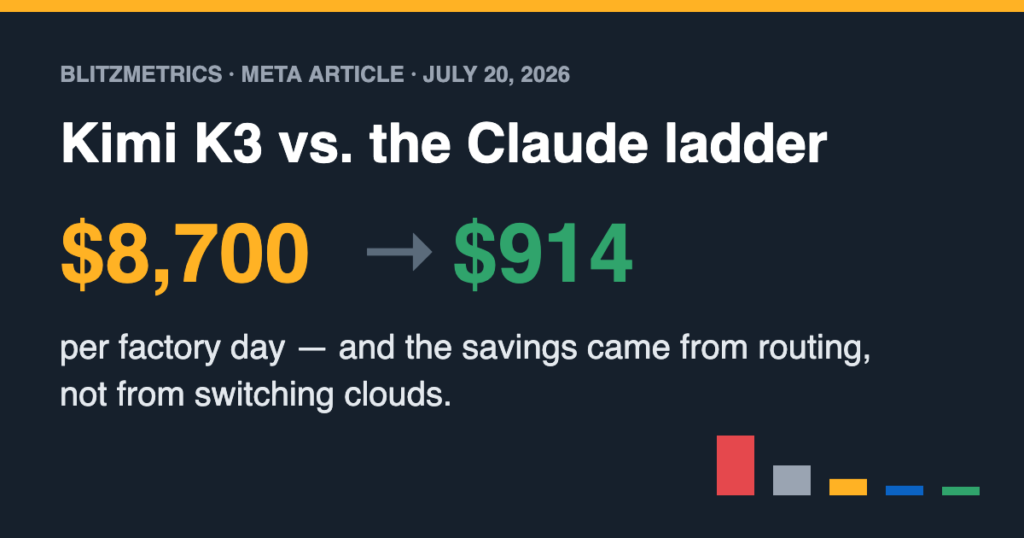
$8,700 → $914One factory day, all-Fable vs. routed through our own ladder + batch. The 90% savings was already in the building.
3×Haiku 4.5 is three times cheaper than Kimi K3. The “cheap Chinese model” costs triple our bulk tier.
22 of 35Evals where Fable 5 still beats K3 – and K3’s 12 wins are the grunt work, not the judgment.
The one idea: K3 isn’t priced like a bulk model. It’s a mid-tier sticker – $3 in, $15 out per million tokens. The 10× savings everyone wants from it was already sitting in the ladder we published two weeks ago: bulk down to Haiku, judgment up to Fable, overnight jobs on Batch. Routing inside your own cloud beats switching clouds.
Check the sticker before you switch clouds
On the pod they quoted Opus at $40 a million tokens and Fable at $60. The actual sheet says $25 and $50 on output. Directionally fine, off by 60% – and that’s the problem with deciding from podcasts. Here’s what the price pages said on July 20:
| Model | Input /M | Output /M | Cached input |
|---|---|---|---|
| Kimi K3 (Moonshot API) | $3.00 | $15.00 | $0.30 |
| Claude Fable 5 | $10.00 | $50.00 | $1.00 |
| Claude Opus 4.8 | $5.00 | $25.00 | $0.50 |
| Claude Sonnet 5 | $2.00 (→$3 Sept 1) | $10.00 (→$15) | $0.20 |
| Claude Haiku 4.5 | $1.00 | $5.00 | $0.10 |
Read that again. K3 costs triple Haiku. Until September it’s more expensive than Sonnet 5. The savior model has a higher sticker than the models we already use for bulk.
Run one factory day through the math
We modeled the day I was actually asking about: 1.5 billion tokens in, 75 million out, 80% cache hits – harvest, score, draft, publish, across the whole fleet. Same day, six ways:
| Strategy | Cost/day | Cost/month |
|---|---|---|
| Everything on Fable 5 | $8,700 | ~$261,000 |
| Everything on Opus 4.8 | $4,350 | ~$130,500 |
| Everything on Kimi K3 | $2,385 | ~$71,600 |
| Everything on Sonnet 5 | $1,740 | ~$52,200 |
| Routed: 80% Haiku / 15% Sonnet / 5% Fable | $1,392 | ~$41,800 |
| Routed + Batch API on overnight bulk | $914 | ~$27,400 |
And the swap everyone assumes – K3 in place of the Sonnet slice – loses money today: $358 a day against $261. After Sonnet’s September price bump it’s roughly a wash.
Give K3 the lane it actually wins
None of that makes K3 a toy. On the scorecard it beats Fable 5 at exactly the work you’d delegate anyway:
| Benchmark | Kimi K3 | Fable 5 |
|---|---|---|
| Terminal-Bench 2.1 (long terminal sessions) | 88.3 | 84.6 |
| SWE-Marathon (multi-hour engineering) | 42.0 | 35.0 |
| BrowseComp (agentic web research) | 91.2 | 88.0 |
| Humanity’s Last Exam | 43.5 | 53.3 |
| GDPval-AA v2 (real knowledge work, Elo) | 1668 | 1760 |
| Toolathlon-Verified (tool orchestration) | 73.2 | 77.9 |
Grinding: K3. Judgment: Fable, 22 of 35 evals. And Moonshot’s own model card admits a “noticeable user-experience gap versus Fable 5” and warns K3 “may act excessively proactively on unclear instructions.”
Sit with that phrase. Agency work is messy – vague briefs, half-broken sites, clients who change their mind mid-thread. A worker that guesses when instructions are vague is fine inside a sandboxed harvest. On a live client’s WordPress it’s a liability. K3 executes under a QA gate. It doesn’t judge, and it doesn’t publish unreviewed.
Keep the conductor. Audition the workers.
This is the advisor model we shipped into the standing SOP on July 6, and K3 slots in without changing the shape:
- The conductor stays Claude. Cowork can’t run K3 – and the browser tier (logged-in publishing, WAF-blocked writes, computer use on the Mac) is Claude regardless. Judgment, voice, QA: Fable and Opus.
- Workers are auditionable. Claude Code runs K3 out of the box: point
ANTHROPIC_BASE_URLathttps://api.moonshot.ai/anthropicwith a Kimi key and your headless worker fleet speaks K3. Two env vars, per Moonshot’s own docs. - Test on subscription money first. A Kimi Code membership is $79/month and drives those same workers on fixed cost. That’s a $79 experiment, not a platform bet.
- Mind the residency line. Today K3’s API runs on Moonshot’s servers in China. Public-data harvests, fine. Client PII, credentials, unpublished client work – never. July 27 the weights drop (~1.4TB, MXFP4), and US hosts named on the pod – Fireworks, Modal, Baseten – start serving it stateside. That kills the residency objection and probably cuts the price under Moonshot’s own sticker. That’s the day K3 gets a real tryout for the bulk tier.
Show the receipts – this is already how we run
Fair question to ask of any article like this: is the ladder a slide in a deck, or is it wired into production? Don’t take it on faith. Five artifacts from our own repos and fleet, pulled July 20.
1. The Audit Factory routes by config file, not vibes
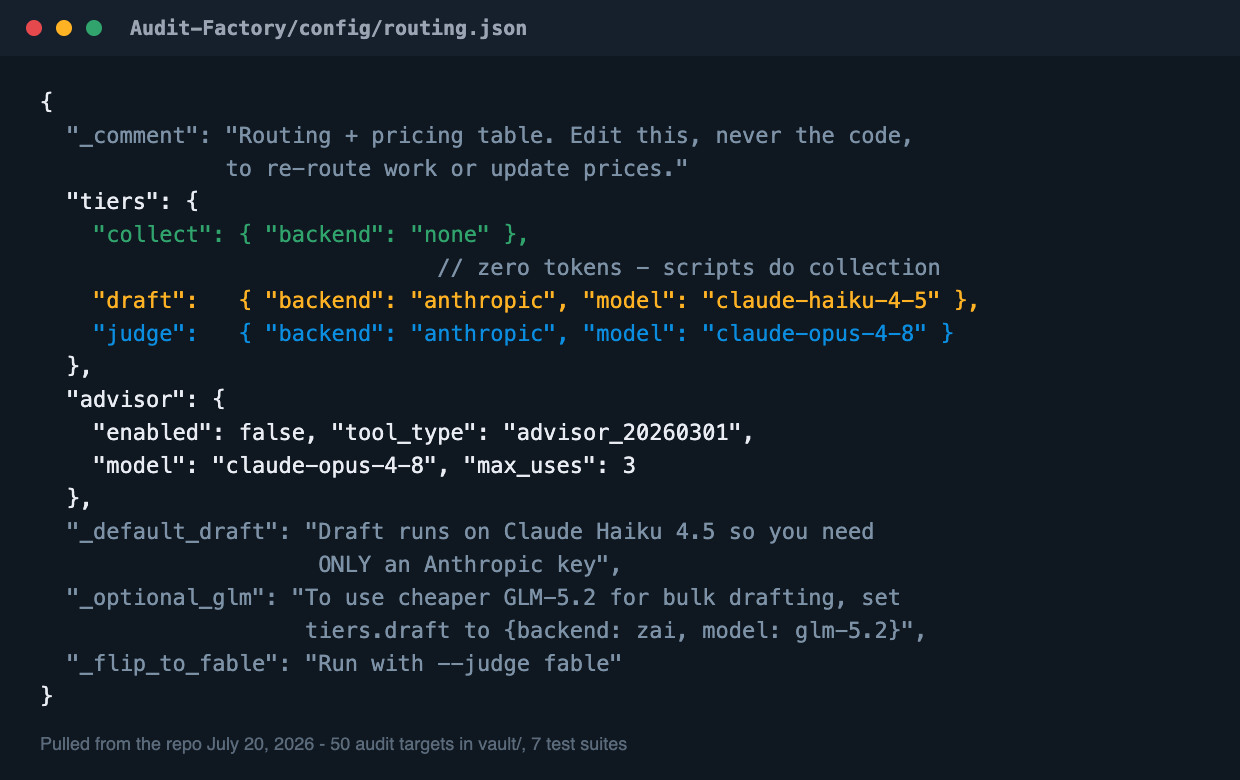
Our audit harness has the routing table checked into the repo. Collection runs as plain scripts – backend “none,” zero tokens. Drafts run on Haiku 4.5. Judging runs on Opus 4.8, flippable to Fable with one flag. You change the routing, never the code. Fifty audit targets in the vault, seven test suites covering the router and the advisor.
2. We built a non-Claude worker lane – here’s its honest status
On July 5 we split our work into two lanes and checked the config for a GLM-5.2 worker lane into the repo – the identical two-env-var move K3 would use:
{
  "env": {
    "ANTHROPIC_AUTH_TOKEN": "YOUR_ZAI_API_KEY",
    "ANTHROPIC_BASE_URL": "https://api.z.ai/api/anthropic",
    "ANTHROPIC_DEFAULT_OPUS_MODEL": "glm-5.2",
    "ANTHROPIC_DEFAULT_SONNET_MODEL": "glm-5.2",
    "ANTHROPIC_DEFAULT_HAIKU_MODEL": "glm-5.2"
  }
}   — Audit-Factory/claude-code/settings.glm.json
The lane-split note from that day: “Not GLM instead of Claude. GLM = engineering lane (cheap, capable). Claude = orchestration lane (irreplaceable).” The dividing line holds for any cheap worker, K3 included: repo work can go down; the connector-and-browser harness – fleet publishing across 198 sites, Gmail, Wikidata, logged-in WordPress – stays on Claude.
Now the status line most articles would skip: built, not yet run. On July 20 we searched the machine itself – no z.ai endpoint configured in the live Claude Code settings, and the key in the checked-in file is still the placeholder. An earlier version of this section said the lane “has run since July 5.” Our own Haiku claims-auditor (receipt 6 below) flagged that as an overclaim, and it was right – the artifacts prove the lane was built and the decision was made, not that tokens have flowed. The first funded run will be the audition itself: GLM-5.2 vs K3 vs Haiku on one real batch, scored on dollars per passed deliverable.
3. Tier 0 is the lever nobody talks about: scripts, zero tokens
The cheapest model is no model. Running right now: 86 Sigrun member dashboards republished every Friday by publish_members_area.py – plain REST, no LLM in the loop. Twelve vertical skill packs propagated across the Spotlight fleet by propagate_all_packs.py – snapshot folders in the repo show runs on July 7, 13, 17, 18 and 19. Weekly fleet audits chunked by script. Article reskins by skin.py. Our batch reports even print a line for it – “Saved by doing tier-0 as scripts (no LLM)” – because if a Python script can move the bytes, tokens are a tax.
4. Escalate-up runs with guardrails and its own line on the bill
The advisor pattern from the SOP is in the harness as an opt-in flag, and it’s built so cost stays legible: advisor tokens bill at the advisor model’s rate on their own ledger line, capped at 3 consultations per draft, and the factory never silently pretends to escalate on a backend that doesn’t support it. Here’s the harness’s own receipt format, from a July 6 dry run (offline, $0 actual – that’s the point of a dry run):
Draft tier: anthropic:claude-haiku-4-5  ·  advisor: claude-fable-5 (max 2/draft)
Judge tier: anthropic:claude-opus-4-8
Saved by doing tier-0 as scripts (no LLM): $0.0018
Effective discount vs all-premium: 100%   — vault/batch_report.md
Why bother with escalate-up at all? Anthropic’s published numbers: Haiku’s hard-research score more than doubled, 19.7% to 41.2%, with an Opus advisor – and Sonnet with an Opus advisor gained 2.7 points on SWE-bench Multilingual while cutting cost per task 11.9%. Cheap executor, expensive brain on speed-dial.
5. The money, and the part where the system builds the system
Our June 29 stack memo priced the two paths at our real volume: everything on one premium interactive plan was heading to roughly $4,000 a month. The routed stack – Max as cockpit, GLM flat-rate bulk lane, metered Opus/Fable for premium audit batches – priced out at $420–710 a month projected, for roughly 3× the throughput. A projection, not an invoice – our own auditor made us say that plainly. It’s the same shape as this article’s $8,700-to-$914 day, showing up on an actual monthly bill.
And the rule isn’t tribal knowledge. It shipped as a skill (model-judgment, in the Local Service Spotlight pack, v1.1.0), a standing SOP, and project memory every agent session loads. The DealCon skill pack itself was written by Fable worker agents delegated from an Opus orchestrator in a June 9 session – the project doc records it: “that’s exactly what wrote your 10 enhanced DealCon skills.” The ladder built its own documentation.
6. We delegated this article’s own audit down to Haiku – live, today
One more thing had to be true before a section called “receipts” could stay up: the delegation has to show up in real sessions, not just in a harness. Full disclosure first – we searched our own Claude Code session logs today for past Haiku delegations and found none. The interactive sessions had been running the ceiling end-to-end. The ladder lived in the harness, the scripts, and the plan – not the chat. So we closed that gap on the spot: before this update went live, three subagents on Claude Haiku 4.5 – the $1 model – audited it, while Fable, the $10 model, only orchestrated and judged.
| Haiku worker | Real task | Tokens | Result |
|---|---|---|---|
| Numbers auditor | Recompute all 8 cost scenarios from scratch | 31,626 | 8/8 PASS – and pinned down that the $914 day requires batch on the Haiku and Sonnet slices |
| Claims auditor | Check every receipt above against the raw artifacts, adversarially | 36,523 | Caught a real overclaim – the GLM correction in receipt 2 is its work |
| Source verifier | Re-fetch the four primary pricing/benchmark pages | 32,274 | Every figure CONFIRMED against the live pages |
Total: 100,423 worker tokens. Estimated cost on Haiku: about $0.16. The same three passes on Fable 5: about $1.61. Ninety percent off, same deliverable – because this deliverable is verification, not voice.
And the judge tier earned its 10× premium in the same run: the numbers worker got all eight recomputations right, then mislabeled the units on a new table by a factor of a million – and the orchestrator caught it on review. Cheap tier does the work. Top tier signs it. Both directions of the ladder, one receipt.
What delegation is worth on two real bulk programs sitting in our queue right now (estimated at list prices, no caching):
| Real task in queue | All-Fable | Delegated | Saved |
|---|---|---|---|
| Matthew Januszek Wave 9 – 108 articles (est. 6K in / 2.5K out each, + Fable QA pass) | $22.14 | $4.16 (Haiku drafts + Fable QA) | 81% |
| SeanKelly re-score backlog – 1,074 articles (est. 3K in / 400 out each) | $53.70 | $5.37 (all Haiku) | 90% |
Small dollars per batch – until you remember the factory runs batches like these all day. That’s how an $8,700 day becomes a $914 day, and why the QA gate stays on the top model while everything else rides the cheap tiers.
Score dollars per passed deliverable, not dollars per token
Cheap tokens that fail QA are expensive. The only score that matters is what a shipped, accepted deliverable costs – audit published, article live, score verified. That’s the bar K3 has to clear against Haiku and Sonnet in its lane, and the bar Fable already clears alone at the top.
Three things land within days of each other: K3’s open weights (July 27), US hosting, and Sonnet’s price bump (September 1). So we re-run this table August 1. Until then: nothing migrates, the ladder gets enforced harder, overnight jobs move to Batch, and K3 joins GLM-5.2 in the tryout pool – supervised, public data only.
| This analysis | Agent | Human analyst |
|---|---|---|
| Pull 12 price/benchmark sources, verify, model six scenarios, publish this writeup | ~40 minutes, ~$5 in tokens | A full day, $400+ |
Proof ledger: every number above was pulled from the primary sheet on July 20, 2026 – Anthropic’s platform pricing page (Fable $10/$50, Opus $5/$25, Sonnet $2/$10 intro, Haiku $1/$5, cache reads 0.1×, Batch −50%), Moonshot’s platform pricing page (K3 $3/$15, $0.30 cached, 1M context), the llm-stats K3-vs-Fable scorecard, and Moonshot’s Claude Code integration docs. The podcast is Moonshots Ep. 272, recorded July 18. Receipts re-audited July 20 by three Haiku subagents; the GLM lane’s status was verified against the machine, not the docs.
THE DELIVERABLE – the standing rule this decision plugs into, and the build story behind it:
Read the Model-Judgment Delegation SOP
How we taught Claude to pick its own model
Part of the meta-article series – everything we do, we document so it’s repeatable. Process background: the Content Factory.
Originally published .
Dennis Yu
Dennis Yu is the CEO of Local Service Spotlight, a platform that amplifies the reputations of contractors and local service businesses using the Content Factory process. He is a former search engine engineer who has spent a billion dollars on Google and Facebook ads for Nike, Quiznos, Ashley Furniture, Red Bull, State Farm, and other brands.
Dennis has achieved 25% of his goal of creating a million digital marketing jobs by partnering with universities, professional organizations, and agencies. Through Local Service Spotlight, he teaches the Dollar a Day strategy and Content Factory training to help local service businesses enhance their existing local reputation and make the phone ring.
Dennis coaches young adult agency owners serving plumbers, AC technicians, landscapers, roofers, electricians, and believes there should be a standard in measuring local marketing efforts, much like doctors and plumbers must be certified. He has appeared on 353 podcasts with 619 credited episodes — see the full list of his podcast appearances.