
 by /
by /
Turn your business numbers into a clear next step. This guide shows how to record what happened, explain what it means, and choose an action. Start with this week’s real results, then name who will do what next.
This guide is part of Social Amplification Engine: GCT Screen and Agentic Six Phases (the goal, source material, and audience; see GCT brief). Next, explore How To Write Weekly MAA Reports For Local Service Businesses, or How to Build the Money Tree Diagram for Any Site.
Want to know the #1 determinant of who succeeds versus fails in digital marketing?
You won’t believe how simple it is.
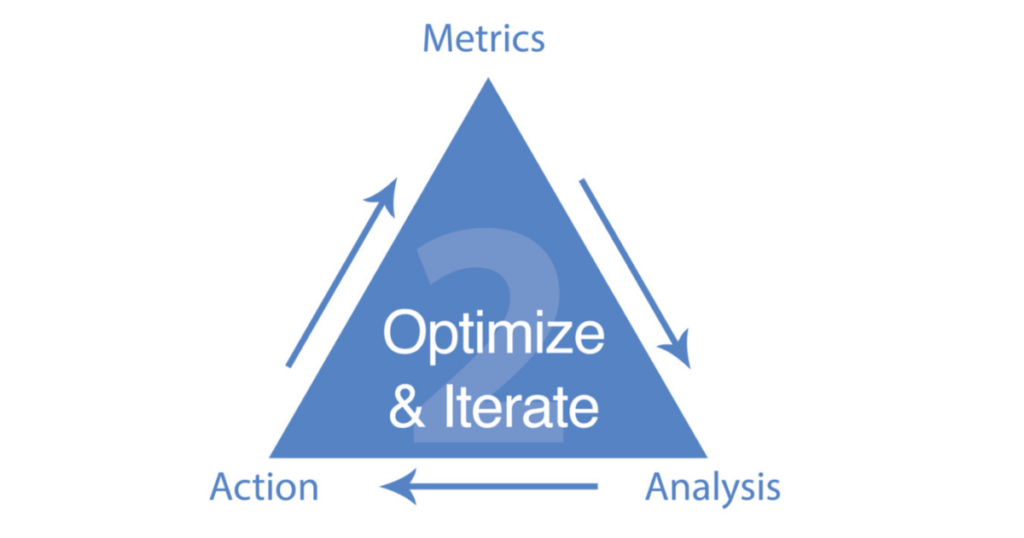
It’s a weekly report called MAA (Metrics, Analysis, Action) and it takes about 5 minutes to complete.
The folks who win are consistently participating, much like going to the gym regularly. It’s not about some one-time superhero effort. It’s an hour a day over a couple of months to unlock amazing progress.
People either fall off a cliff (basically missing week after week) or they’re crushing it. I don’t see anyone in between.
What is MAA?
MAA is a weekly optimization cycle. First, you look at your metrics: what happened? How many calls, leads, or sales came in? What did the campaigns spend? Then you move to analysis: why did those numbers go up or down? What specific factors contributed? Finally, you take action: based on that analysis, what will you do next week to improve?
Every Friday, I review dozens of project status reports. Most managers dread this administrative chore. But I get excited with anticipation, like a 7-year-old opening Christmas presents.
I’m optimistic about our team members, whether they’re 50 years old or 15 years old. To see documented evidence of their learning. To see how many quality phone calls they’re driving for local service businesses.


I feel like the digital Gordon Ramsay, helping young chefs follow the recipe to turn out excellent meals, ideally without yelling at them. But sometimes they burn the ribeye steak, cut their fingers peeling the carrots, or forget some critical ingredient.
It’s this weekly performance report that helps our senior chefs quickly diagnose how the sous chefs are doing.
Metrics: where everything starts
What doesn’t get measured doesn’t get improved. This is why the M in MAA is the center of everything else we discuss for analysis and action.
Let me show you a real example. We recently onboarded Star Heating & Cooling, an HVAC local service business in Fishers, IN. In the first week, we wanted to show MAA in action and how simply writing out our metrics can point us in the right direction for getting more calls in the door.
Their team member Becca pulled the numbers: 19 booked calls that week. 13 from existing customers, 3 from GMB, 2 from the website, and 1 from Facebook.

We can then move to analysis. What the metrics tell us is that GMB calls are the primary source for new client acquisition, even above LSA and PPC which are barely getting any calls at all right now.
Since we’d only received 3 new customers from GMB that week, we should prioritize getting PPC and LSA ads going for more call volume since their business qualifies for LSA and wasn’t already spending much before.
Therefore, the action for that week was getting PPC and LSA set up and running for more inbound new customers.
Simple. Clear. Actionable. That’s MAA.


Put the Money Tree in Friday’s MAA
The Money Tree is the visual roll-up of the same Metrics → Analysis → Action dataset. It does not replace the report or the source dashboards. Each Friday, link the public-safe tree and include the authenticated client-only snapshot in the authorized client channel, then explain the branch changes and assign the next actions.
- Public: structure, branch names, supporting-content counts and deltas, fed/bare/split status, public priorities, useful approved grand totals, and the crawl date. No client traffic, leads, jobs, revenue, source IDs, or hidden private payload.
- Private: branch traffic, qualified leads, booked jobs, conversion rate, verified attributed revenue and share, week-over-week delta, owner, next action, source, and data-through date. Access must be authenticated and client-authorized; an obscure URL is not privacy.
- Ranking: call a branch a top earner only when comparable branch-level revenue is verified and attributed. Otherwise write not connected and use a truthful label such as “priority branch” or “most traffic.”
- QA: grand totals reconcile to the source table, missing values are never silently treated as zero, and an anonymous fetch of the public artifact contains no private values in HTML, JSON, CSS, metadata, alt text, or data attributes.
Then complete the loop in writing: state what changed, why it changed, and who will do what by which date. The picture makes the bottleneck obvious; MAA makes the team act on it.
Monthly redraw, Friday reuse, client review
Run the full Money Tree rebuild on the first Monday of each month, using fresh crawl and measurement receipts. The next Friday MAA links the accepted public tree and includes the authenticated private snapshot, branch deltas, whether the prior action worked, and the two or three owned actions for the next cycle. Before the client meeting, prepare a one-page pre-read with wins, risks, the biggest funnel constraint, one proposed experiment, decisions needed, owners, dates, and success measures. If no meeting cadence or project lead is verified, create an internal owned routing item; do not invent attendees or send an invitation automatically.
Analysis: the step everyone skips
The analysis section of MAA is what everyone gets confused about. Most project managers go from Metrics to Action and skip this crucial step. But without it, the actual actions that need to be taken are vague.
Analysis is 10x more important than metrics. Most people who think they’re doing analysis, even people on my team that swear up and down they’re doing a great job, are glorified report makers. Reading numbers off a chart and converting them to sentences is something simple robots already do. The ability to consider why a certain number went up or down, weaving in specific elements of their goals, content, and targeting, that’s the tell.
Let me give you a real example of what happens when you skip analysis.
We recently had American Epoxy, a concrete coating company, reach out to us since they were disappointed with their agency. The lead quality was poor. Most of these leads were coming from outside of Arizona. Since American Epoxy is based in Tucson, they were frustrated that they were getting form submissions from Texas and Florida.
In response, I joined a call where the client manager acknowledged the out-of-state leads, and then went straight into the action they would take to address them.
But wait a moment. How would you know what action to take without analysis on why these leads were out of state?
This is like if you were on a boat taking in water in the middle. Sure, you could grab a bucket and start shoveling water… or you could simply plug the hole where the water is coming from. But without analysis, everything is a sinking ship and no one knows where the water is coming in from.
The MAA technique makes it instantly clear where the issue is, like an X-ray that spots where the broken bone is.
Here’s another example. Take All About Pressure Cleaning, a client of ours in Pompano Beach, Florida. They recently had a big influx of poor quality calls and folks in South Florida looking for jobs. Since they do pressure cleaning and other related services, they were rightfully frustrated with people calling them looking for maids and other unrelated services.
Knowing these metrics and the poor quality of them, I conducted proper analysis. I addressed the obvious problem, why this problem had happened, and offered a solution: start iterating more on Google PPC ads and remove Performance Max (PMAX) campaigns.

Without proper analysis, I could have easily said “Okay, we’re working on it!” and tried a dozen other things. Instead, we got to the root cause and offered a solution based on the existing data. We would not have found the solution had we not conducted proper analysis of our metrics.
Action: the easiest step when you’ve done the work
Tying MAA together, we have action. When done properly, this is the easiest step since the analysis leads to an obvious conclusion.
If lead volume is low, we can see why through analysis and take action based on it. Just like how if you’re bad at writing content and acknowledge the reason for that being your lack of experience, the answer is to clearly learn and do more.
Or if a client is mad about lack of communication, poor lead quality, or lack of lead volume. The solution is almost always visible once you conduct proper analysis.
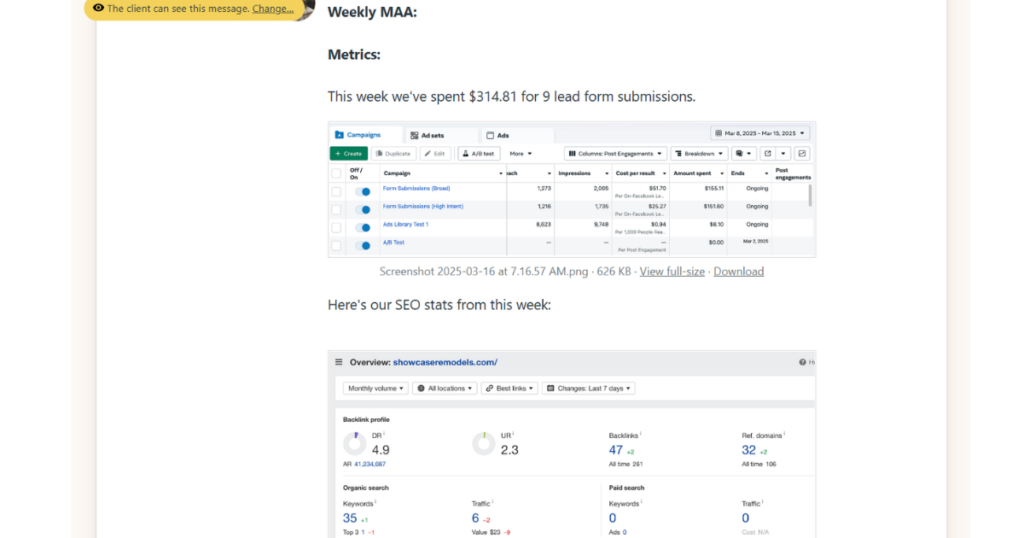

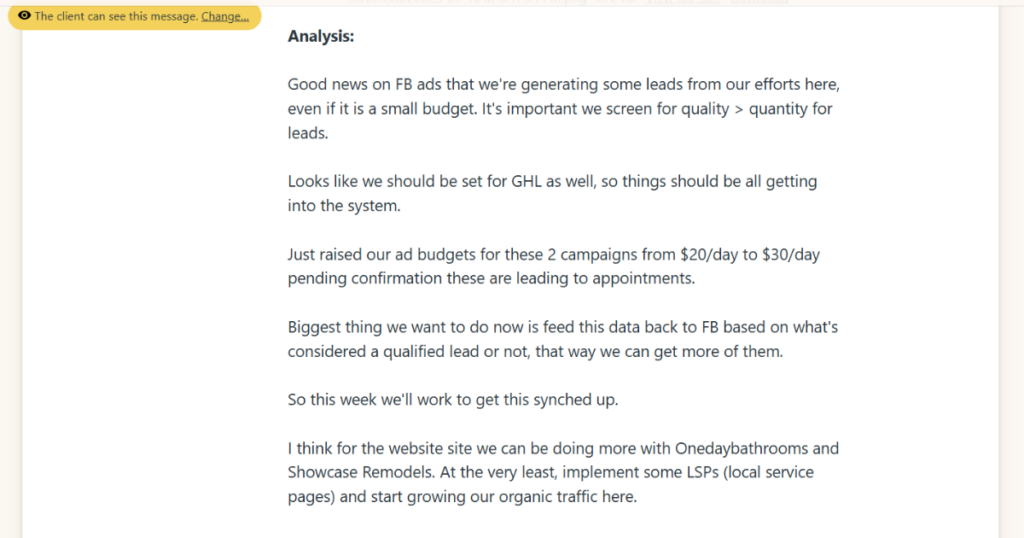

You can almost view the action section as a to-do list for the following week before the next MAA cycle. Therefore, there’s always new metrics to iterate from and progress to be made, regardless of the situation.
But never optimize to a single metric
Numbers lie. Let me give you some examples.
I ran the social analytics of a well-known energy drink company. The marketing team got bonuses when we hit certain monthly impression targets. So if we were short 50 million impressions at the end of the month, we’d just tweet 25 more times on our Twitter account that has 2 million followers. Impression panic ended and everyone gets their bonus. Business impact? Zero.
Another client was a global shoe company you’ve heard of. The Vice President of Running didn’t like how the customer response times on social were below industry standards. So she forced us to measure only responses that came in during business hours, 9 am to 5 pm PST on weekdays. She insisted it was a “bug” in our software that we had to fix. Upon fixing this bug, the client and her boss were happy. The customers? Not so much.
We were spending $400,000 a month generating leads on Google and Facebook for another client. The $10 cost per lead was good, but we wanted to get it down lower. So one of our “hotshot” PPC folks turned off every keyword in our campaigns except branded search terms. Immediately, our CPL fell to $1, while our lead volume dried up, too. He declared victory and demanded a $10,000 bonus for this “fix.”
There is always a counterbalancing metric to take into account. You can immediately improve conversion rates by lowering your price or even making the item free, but your LTV and ROAS may suffer. Start with the business metric first, which is usually revenue or cost per lead. Most noobs are enamored by Quality Score, CTR, average watch time, or some favorite pet metric. Don’t fall into that trap.

Why most businesses fail without MAA
Most local service businesses, especially those under $50,000 a month, have almost nothing written down. No process, no SOPs, no weekly accountability.
They might get an auto-generated report from their agency each week. But system-generated reports don’t answer why calls are up or down. And therefore, they aren’t making intelligent recommendations based on those insights.
I recently sat down with a client who says she’s scared to death of entrusting her front office manager with marketing duties. Because if she were to lose this person, everything would fall apart.
But if that person did get hit by a bus or quit, having the documented paper trail from weekly MAA reports would make it far easier to bring someone else in to take over.
Every month or two, you can look back at these weekly reports to spot larger patterns and tune strategy: time to open another location, hire staff, change up pricing, and so forth.
The secret to getting and keeping clients
Agency owners want to know my secret to getting and keeping clients. Here it is: deliver results via the weekly MAA process.
Every week, show how many phone calls and sales you drove, what you’re doing about it, what’s working, what’s not working, what you need from them.
Everyone else auto-generates a report, which creates the perception that work is being done, instead of actual analysis and action to continuously improve.
I don’t mind if you use this for your digital, SEO, PPC, or content teams. And if you have an agency, you have full permission to use this for your advantage.
How to get started
Set a weekly deadline. Friday works best. Review your key metrics: calls, leads, sales, ad spend. Write a brief analysis of why things went up or down. Define 2-3 specific actions you’ll take differently next week. Then share it with your team and clients. Transparency builds trust and accountability.
The weekly feedback loop of MAA optimization is, in my opinion, the most effective tool an owner can install in their business. Having an agency run it is fine, but you must still watch over it.
There is no reason you shouldn’t be winning and improving unless you don’t have an existing service business that has clear signals of happy clients.
Now, do you have a weekly accountability process? If not, start this Friday.
The Social Amplification Engine operating hub — including the GCT screen that decides whether weekly MAA is even the right next step — is blitzmetrics.com/social-amplification. MAA is phase 6 of that engine. A new idea with no proof does not get a MAA cadence as a substitute for positioning.
Dennis Yu
Dennis Yu is the CEO of Local Service Spotlight, a platform that amplifies the reputations of contractors and local service businesses using the Content Factory process. He is a former search engine engineer who has spent a billion dollars on Google and Facebook ads for Nike, Quiznos, Ashley Furniture, Red Bull, State Farm, and other brands.
Dennis has achieved 25% of his goal of creating a million digital marketing jobs by partnering with universities, professional organizations, and agencies. Through Local Service Spotlight, he teaches the Dollar a Day strategy and Content Factory training to help local service businesses enhance their existing local reputation and make the phone ring.
Dennis coaches young adult agency owners serving plumbers, AC technicians, landscapers, roofers, electricians, and believes there should be a standard in measuring local marketing efforts, much like doctors and plumbers must be certified. He has appeared on 353 podcasts with 619 credited episodes — see the full list of his podcast appearances.