
Before you make posts or buy ads, choose the result your business needs. This guide helps you name that goal, pick real proof, and decide who should see it. Start by writing those three answers in plain words.
This guide is part of The 9 Triangles Framework — The Marketing Strategy Behind Scalable Home Service Businesses. Next, explore The Content Factory: How to Turn One Video Into Dozens of Assets That Build Trust and Drive Revenue (our four-stage process for using real content), or How to Do MAA (Metrics, Analysis, Action) Like a Pro.


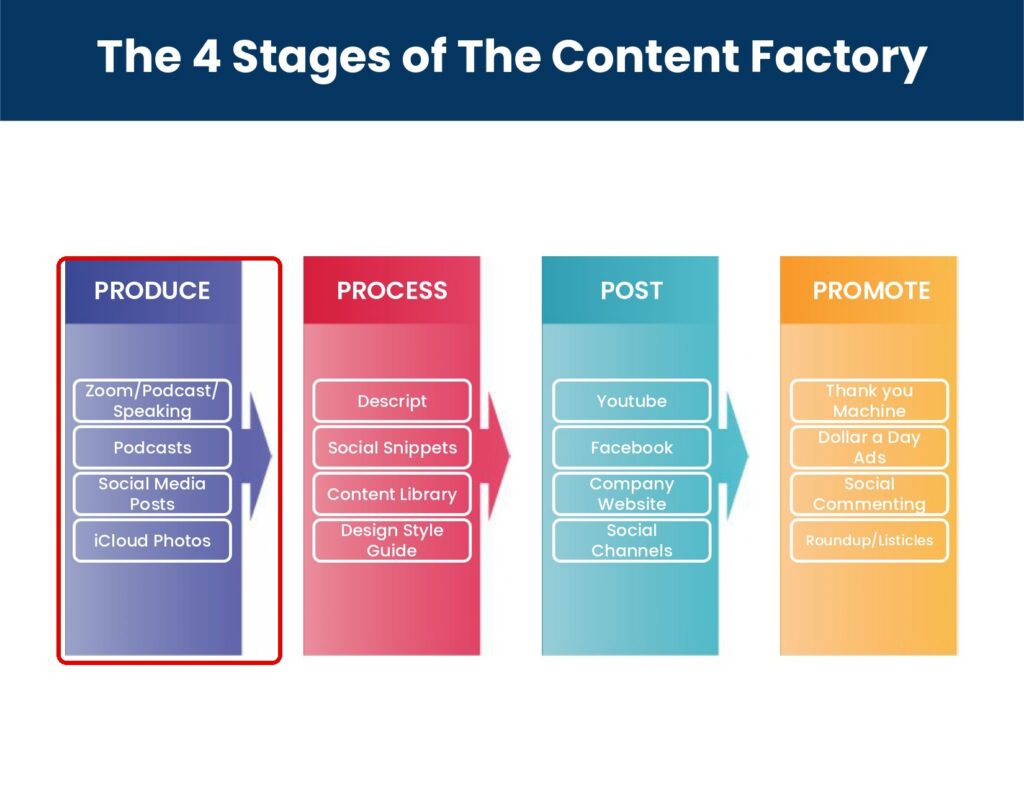
Where this sits in the Content Factory: Produce. The full system: The Content Factory.
What GCT Means
GCT stands for Goals, Content, Targeting. It is the strategic foundation of your marketing and one of three triangles in the Marketing tier of the 9 Triangles framework. GCT answers the three essential questions before you spend a single dollar on marketing: what do you want to achieve, what material will you use to get there, and who needs to see it?
The Three Elements
Goals come first. You define your mission (start with WHY), identify desired outcomes, set your target cost per acquisition or return on ad spend, and choose one key metric for each Audience, Engagement, Conversion (AEC) funnel stage. The linked ACC page uses the older Awareness, Consideration, Conversion labels. Without clear goals, performance cannot be measured or improved. As the Standards of Excellence teach: set a clear goal and measure campaign performance before trying to improve it.
Content is everything that proves you do what you say you do — videos, articles, testimonials, case studies, and checklists organized through the Content Factory process (Produce, Process, Post, Promote). The most important principle in content creation is making sure everything connects back to your WHY. Through the process of Learn, Do, Teach, every opportunity becomes a content creation opportunity.
Targeting is identifying exactly who your ideal customer is — demographics, interests, behaviors, location — and using custom audiences, lookalike audiences, and remarketing to reach them efficiently. The best content in the world is useless if it reaches the wrong people. The Dollar a Day strategy is built on precise targeting: putting proven content in front of the right people at minimal cost.
How GCT Works in Practice
GCT forms a “viral spiral” where good targeting surfaces your content to the right people, which generates engagement data, which refines your goals, which improves your content, and the cycle continues. This iterative loop is what separates strategic marketing from random posting. When you know your goals, create content that serves those goals, and target the right audience, the MAA (Metrics, Analysis, Action) feedback loop tells you exactly what to optimize next.
Try GCT with a small repair business
Suppose a fictional roof-repair business is planning its next 28 days. The goal shapes what proof to collect and whom to reach. Every number below is an invented planning assumption, not a real business result.
One fictional GCT plan
| Part | Illustrative plan | Check before use |
|---|---|---|
| Goals | Eight completed roof-repair jobs in 28 days. | Owner confirms the target, open schedule and crew capacity. Capacity has not been established here; do not promise appointment slots. |
| Content | Gather actual work records and job photos that show completed repairs. No testimonial is assumed. | Check each record against the source; get permission before using any customer-identifying photo or story. |
| Targeting | Homeowners seeking roof repair in the business’s existing service area. | Confirm the real service area and audience from the owner’s offer and evidence. No ads, budget or audience size is assumed. |
Separate each step in the path
Assume 12 qualified inquiries, 6 bookings and 4 completed jobs in the same 28-day window. Here, a qualified inquiry has passed the business’s screening, a booking is a scheduled visit, and a completed job is finished work; no raw inquiry total is supplied. These are made-up inputs, not observations or a forecast.
Illustrative gap: 8 planned completions − 4 assumed completions = 4 below the target.
This does not say how many inquiries are needed or why the gap happened.
Write your goal, choose the proof you can show, and name the audience. Then check the plan against real records.
Where GCT Fits in the 9 Triangles
GCT is one of the three triangles in the Marketing tier. It is the strategic starting point — before you can build a funnel (AEC: Audience, Engagement, Conversion) or optimize (MAA), you need to know your goals, have content to promote, and know who you are targeting. All three marketing triangles work together to serve the mission of SBP (Specialist, Business, Partner) at the top of the framework.
Related Resources
- Goals — defining your mission and marketing objectives
- Content and Targeting — detailed guide on the content and targeting elements
- The Content Factory — the 4-stage content production system
- Strategy Audit GCT — assess your current goals, content, and targeting
- 9 Triangles Checklist — overview of the full framework