
 by
by
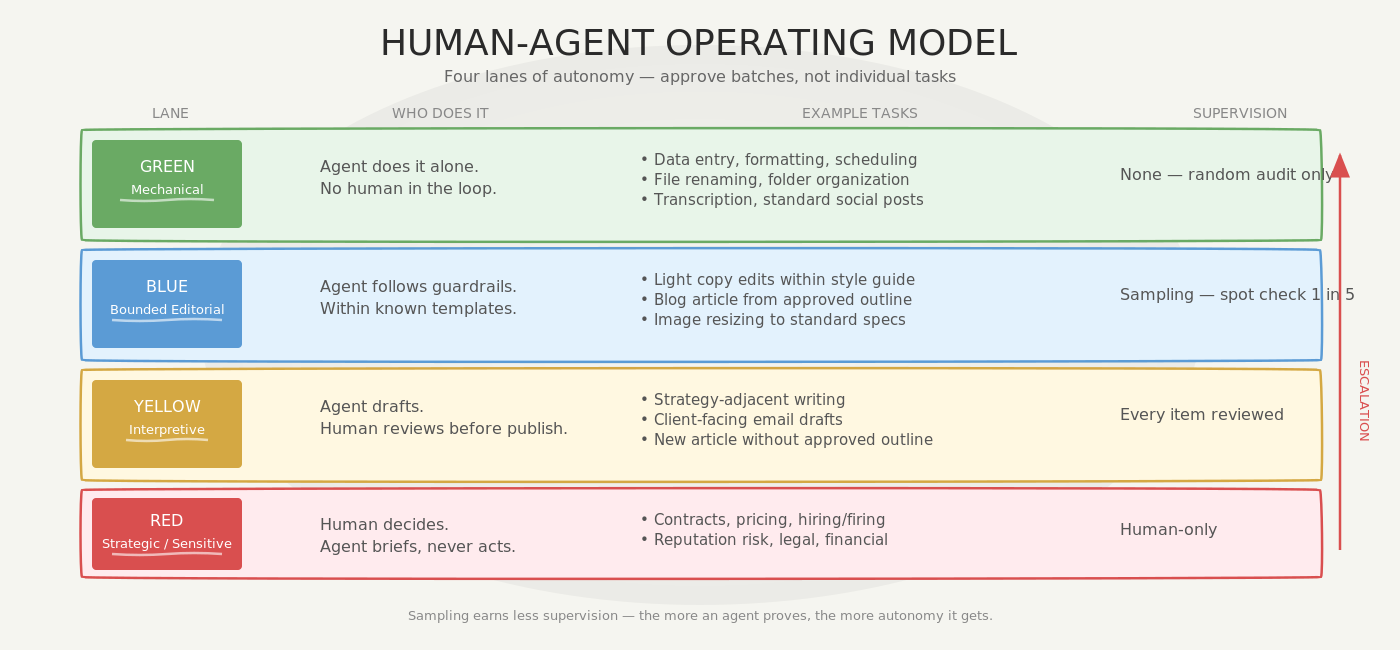
AI agents can now do almost every repeatable Content Factory task faster and more consistently than a junior worker. A person should not recheck every transcript, link, tag, screenshot, or article paragraph merely because “a human must approve it.”
The right model is simpler: machines do the volume, trained operators inspect exceptions and samples, and the expert owner handles only decisions that change strategy, reputation, relationships, or money. That is the human-agent operating model.
| Lane | Who owns it | Examples |
|---|---|---|
| Mechanical | Scripts and agents | Extraction, formatting, URL tests, metadata, comparison |
| Bounded editorial | Agents, with sampled QA | Drafting from sources, clips, internal links, taxonomy suggestions |
| Interpretive exceptions | Quality operator | Identity conflicts, conflicting totals, unclear roles |
| Strategic or sensitive | Expert owner | Positioning, endorsements, disputed claims, relationships, meaningful spend |
What I actually need a human to do
The list is short. I need a human principal when the work requires original experience, private relationship knowledge, consent, responsibility, or a choice between several defensible business answers.
A human must create the real experience that becomes source material: perform the service, have the conversation, record the video, make the introduction, or share what happened. An AI can process that proof, but it cannot travel backward in time and earn it.
A human must also own promises. An agent can recommend a claim, message, campaign, or budget. The person or company represented must decide what it is willing to stand behind publicly and accept responsibility for the result.
Finally, some context has never been written down. An old friendship, an implied promise, a client’s private concern, or discomfort visible in a live conversation may change the correct action. The relationship owner must supply or interpret that missing context.
That does not mean a human needs to push every button. It means a human owns the goal, the private context, the risky exception, and the promise.
What an agent should do without waiting
The agent should own any task with clear inputs, clear rules, a reversible output, and an observable pass/fail test. This is most of the work inside the four-stage Content Factory.
- Discover and extract candidate sources.
- Transcribe, summarize, classify, normalize, and deduplicate.
- Draft articles, clips, social posts, metadata, and image briefs from real sources.
- Compare names, numbers, claims, links, embeds, authors, categories, and served HTML against written rules.
- Create WordPress drafts and other reversible deliverables when authorized.
- Produce a change diff, exception queue, audit receipt, and recommended next action.
- Monitor live artifacts and report when reality no longer matches the record.
This extends the principle behind model judgment and delegation: use the cheapest capable engine for volume work and reserve scarce judgment for the few decisions where it changes the outcome.
The quality operator is an auditor, not a strategist
A quality operator does not need my advertising career, relationships, or subject-matter expertise. The role is closer to a laboratory technician or financial auditor than a creative director.
The operator must listen carefully, open the real source, preserve the evidence, and distinguish “the source proves this” from “this sounds likely.” They must be willing to mark a result unknown instead of manufacturing closure.
The necessary attributes are active listening, evidence discipline, pattern recognition, checklist reliability, clear writing, security awareness, and the judgment to escalate an exception. Nationality has nothing to do with it. Our one global competence standard applies to everyone.
A junior operator adds value when independent accountability is worth more than the additional step. They can inspect a random sample, resolve an evidence question covered by policy, handle authorized access, and leave a reproducible receipt. If the process does not need those things, adding a human is waste.
Four lanes replace one giant approval queue
Green: mechanical
Extraction, formatting, deterministic tests, metadata, and routine comparisons run automatically. Humans review only random samples.
Blue: bounded editorial
Agents draft from source material and check against the maintained article guidelines. A quality operator reviews exceptions plus a sample. A clean batch does not wait for an expert.
Yellow: interpretive
Identity collisions, unclear roles, conflicting totals, and ambiguous classifications enter an exception queue. The operator decides when written policy covers the case. Otherwise the item moves to the expert with both sides and the evidence already assembled.
Red: strategic or sensitive
Positioning, endorsements, relationship messages, disputed public claims, policy changes, and meaningful spending require the subject owner. The agent prepares options and a recommendation so the expert decides instead of researching.
Risk rises when a decision is public, irreversible, expensive, private, relational, novel, or poorly evidenced.
Approve batches, not individual tasks
The expert should never receive a folder full of raw work. The system should create one compact batch packet containing the goal, recipe version, automatic pass count, rejections, unresolved exceptions, exact proposed changes, test results, three representative passing samples, and the quality operator’s receipt.
The expert then makes one of four decisions: approve the passing batch, approve except listed items, change the governing rule, or reject because the strategy is wrong. The expert should not redo the operator’s work.
A practical target is 90–95% completed automatically, 5–10% sampled or escalated to a quality operator, and 1–2% reaching the subject-matter owner. Those are targets to measure—not numbers to claim before the system runs.
Sampling earns less supervision
- Inspect all of the first 10 items from a new recipe or operator.
- After 10 clean items, inspect 20% of the next 50.
- When material errors stay below 2%, inspect 5% plus every exception.
- If one material error appears, inspect the affected batch and increase sampling again.
- Never sample away Red work. Every sensitive item receives owner approval.
The system—not the worker—chooses the random sample.
“Done” needs seven clearer states
Replace the loose word “done” with:
Discovered → Extracted → Agent-checked → Human-verified → Owner-approved → Published → Live-verified
Each task recipe states which stages apply. A purely mechanical task may skip human verification. A public endorsement may require every stage.
Every important claim carries its source, supporting excerpt, date, recipe version, automated decision, human decision when required, live URL, and later corrections. Confidence comes from evidence conditions—not from an agent announcing that it is 95% confident.
The Podchaser inventory shows the split
An agent can collect the public credits, normalize the records, compare directories, flag duplicates and identity collisions, and build the proposed accepted, rejected, and unresolved groups. That is almost all of the volume.
A quality operator should inspect the unresolved rows and a random sample of the accepted group. I do not need to click 154 links. I need the reconciled totals, unresolved exceptions, representative examples, proposed public wording, and an explanation of whether the completed run meets our evidence standard.
My job is to approve the truthful interpretation and any strategic classification. It is not to become the team’s VA.
The system must learn from every correction
The Brain to Bot process turns knowledge into instructions that agents can execute. The human-agent model closes that loop: when a person catches a repeated error, the correction becomes a deterministic test, a clearer recipe step, or a worked example. The same mistake should not keep buying human attention.
Manage five numbers: first-pass acceptance rate, material-error rate, exception rate, expert minutes per batch, and receipt completeness. Use Metrics, Analysis, Action to adjust the routing and sampling rules.
The goal is not “agents replace virtual assistants” or “humans check agents.” The goal is a coherent factory: machines do the volume, trained operators protect the evidence standard when needed, and experts spend attention only where their judgment changes the outcome.
That is how we scale the Content Factory without turning the expert into its bottleneck.
Teams can learn the complete system in the Content Factory course or give an agent the exact runnable stations in the Content Factory Task Library.
Originally published .
Dennis Yu
Dennis Yu is the CEO of Local Service Spotlight, a platform that amplifies the reputations of contractors and local service businesses using the Content Factory process. He is a former search engine engineer who has spent a billion dollars on Google and Facebook ads for Nike, Quiznos, Ashley Furniture, Red Bull, State Farm, and other brands.
Dennis has achieved 25% of his goal of creating a million digital marketing jobs by partnering with universities, professional organizations, and agencies. Through Local Service Spotlight, he teaches the Dollar a Day strategy and Content Factory training to help local service businesses enhance their existing local reputation and make the phone ring.
Dennis coaches young adult agency owners serving plumbers, AC technicians, landscapers, roofers, electricians, and believes there should be a standard in measuring local marketing efforts, much like doctors and plumbers must be certified. He has appeared on 353 podcasts with 619 credited episodes — see the full list of his podcast appearances.