
 by /
by /
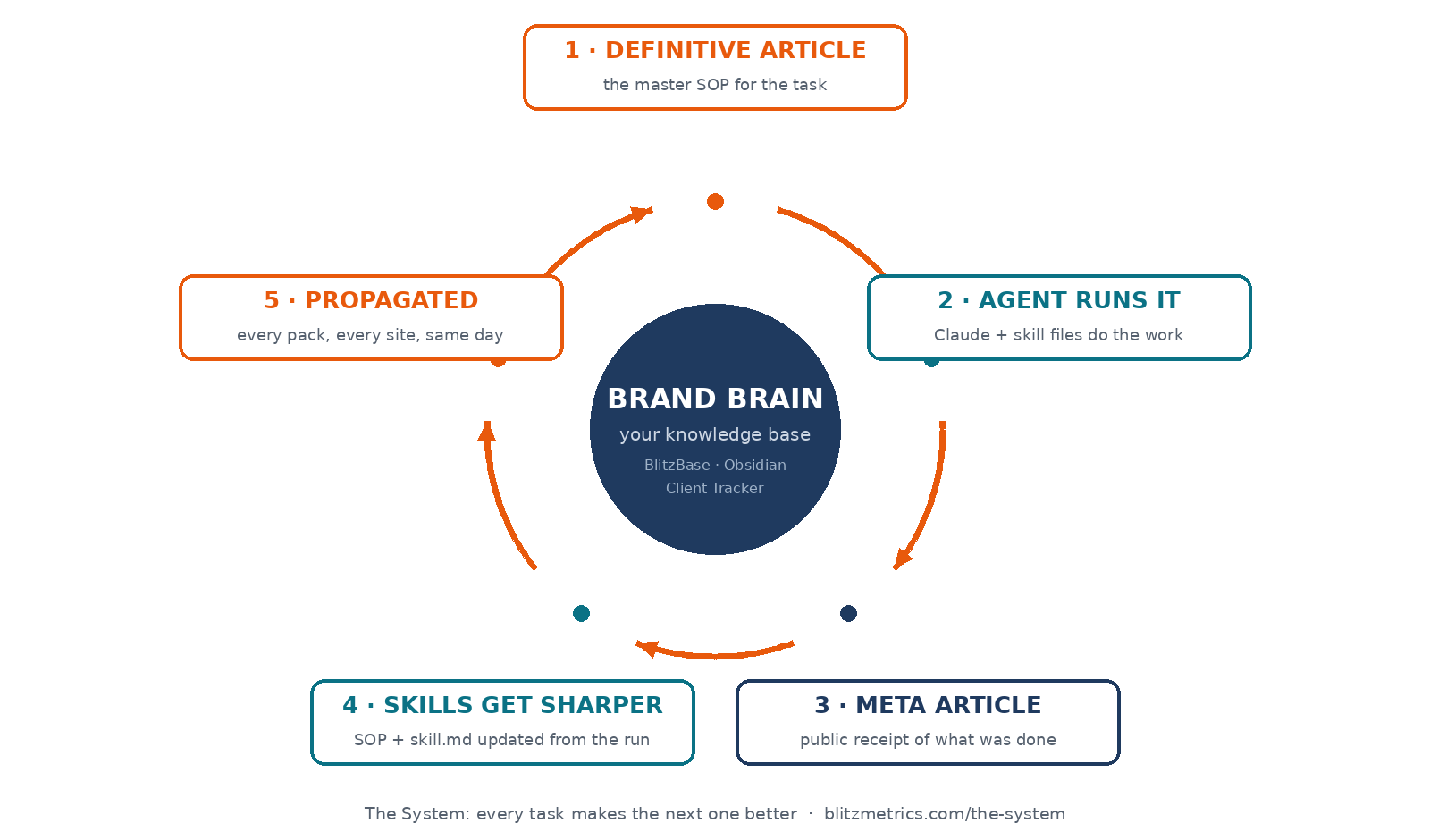
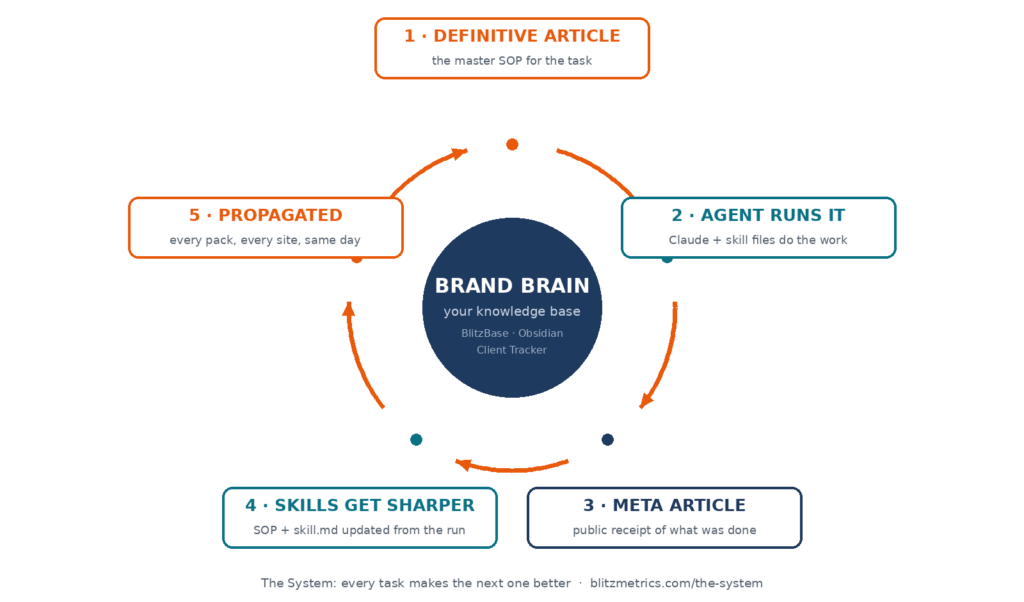
Dennis flagged one dead YouTube embed on the meta-article guide. By the end of the same session, the system had a front door: a master map at /the-system/, a public registry at /asset-tracker/, and a Set Up Claude page on every vertical site — so a roofer, an attorney, or a dunker can point their AI at one URL and get the whole machine. This is the receipt.
12new pages shipped
14pillar pages cross-linked
3fixes on the video that started it
Fix the video, then fix why the video could break silently
The guide at /meta-article-prompt/ embedded a YouTube video that no longer exists (“How AI Agents That Document Themselves Are Changing the Way We Do SEO,” 35:05, gone from the channel). We harvested the channel listing, matched the article’s thesis, and swapped in Recursive Self Improvement for AI Agents — Marketing Mechanic Ep. 39, which is the same argument, recorded three months later.
The embed was only a third of the problem. RankMath stores video schema separately from the post body, so the page kept advertising the dead video in its og:video tag and VideoObject markup even after the body was fixed. We patched the stored schema over RankMath’s own REST route with the replacement video’s real metadata (title, upload date, PT19M20S duration, thumbnail). First attempt hit the wrong schema key — the page carries two VideoObjects — and briefly gave the second, working video the wrong name. We caught it by re-reading the fresh state instead of trusting the write, restored it with correct metadata, and re-verified the rendered page: zero references to the dead ID, both VideoObjects accurate.
Lesson that went back into the skills: a 200 on the write is not verification. Re-read the stored state, then re-fetch the rendered page. The same rule already existed for find-and-replace jobs; it now explicitly covers schema stores that render separately from content.
Give the system a front door
We have published components for years — the 239-task library, the definitive article standard, the Content Factory, the Skill Pack Library, BlitzBase. What did not exist was the page that says how they fit together, in a form both a person and an AI can act on. Now it does: The System carries the loop diagram, the five steps with their live components, a copy-paste bootstrap prompt, explicit instructions for AI agents, the component table by layer, and per-audience entry points.
Its sibling, the Asset Tracker, is the registry: every public hub, site, tool, pack, book, and board, each with a live link and its current state. It completes a family — the Spotlight Network tracks our sites, the Skill Pack Library tracks our packs, the Client Tracker tracks our clients, and the Asset Tracker tracks all of it.
Put a bootstrap prompt on every vertical
Dunker Spotlight proved the pattern at Dunk Camp: a Set Up Claude page where one pasted prompt turns Claude into your brand team. Ten more verticals now have their own, each tuned to its trade — roofing, HVAC & plumbing, concrete, painting, pressure washing, landscaping, law firms, pest control, dumpster & waste, and AI builders. Each page tells the visitor’s AI to read The System first, install the starter pack, check the owner in the Knowledge Graph Explorer, interview before building, and show drafts before anything publishes. The deploy is one script, System-Hub/deploy_setup_claude.py, same recipe as the Explorer rollout.
Wire every pillar back to the map
Fourteen pages got a “Part of The System” block with links to the map and the registry: nine on BlitzMetrics (the meta-article guide, definitive-article guide, task library, build-agents, recursive self-improvement, Content Factory, Personal Brand Score, Quick Audit, why-Claude), four on Local Service Spotlight (Skill Pack Library via its generator so the link survives every weekly rebuild, Spotlight Network, BlitzBase, Client Tracker), and the DealCon workshop page on dennisyu.com. Each insert checks for an existing link first, so agents can re-run it without stacking duplicates.
What we shipped
| Deliverable | URL |
|---|---|
| The System (master map + agent instructions) | blitzmetrics.com/the-system/ |
| Asset Tracker (registry of every public piece) | localservicespotlight.com/asset-tracker/ |
| Set Up Claude × 10 verticals | /set-up-claude/ on each Spotlight domain |
| Video + schema fix on the meta-article guide | blitzmetrics.com/meta-article-prompt/ |
| Loop diagram (reused on the hub and here) | media 109573 |
Count the cost
| Line item | Agent run | Doing it by hand |
|---|---|---|
| Find + verify the replacement video, fix embed + og:video + two VideoObject schemas | One Claude Fable 5 session, roughly three hours wall clock, one human message to start it | 2–3 hours |
| Write + design + publish the hub and the registry | 8–12 hours | |
| Ten industry landing pages with tuned prompts | 20–25 hours | |
| Cross-link audit + 14 idempotent page edits + verification sweep | 4–6 hours |
Gotchas we logged for the next agent
Proof ledger. RankMath’s stored VideoObject schemas live apart from post content — edit them via
rankmath/v1/updateSchemas with the rankMath.schemas global from the post editor, and re-read state before and after. BlitzMetrics strips inline <script> via wpautop, so the hub’s copy button runs from an onclick attribute instead. Single posts on the LSS fleet return 403 to datacenter IPs while serving fine to real browsers — an edge bot rule, not an outage; verify from a residential browser before declaring pages down. And pages owned by a generator (like the Skill Pack Library) must be edited at the generator, or the next weekly rebuild erases your change.Related: the same loop caught a subtler version of this a week later — not pages linking to nothing, but pages describing an artifact correctly on the day they were written and never again. The pack was perfect. Every sentence about it was wrong.
THE DELIVERABLE
The whole system, mapped and pointable. Send anyone — or their Claude — here:
Open The System Browse the Asset TrackerBuilt Jul 10, 2026, per the meta article prompt against the definitive article standard. Related: recursive self-improvement · the 239-task skill library build · the Skill Pack Library.
Dennis Yu
Dennis Yu is the CEO of Local Service Spotlight, a platform that amplifies the reputations of contractors and local service businesses using the Content Factory process. He is a former search engine engineer who has spent a billion dollars on Google and Facebook ads for Nike, Quiznos, Ashley Furniture, Red Bull, State Farm, and other brands.
Dennis has achieved 25% of his goal of creating a million digital marketing jobs by partnering with universities, professional organizations, and agencies. Through Local Service Spotlight, he teaches the Dollar a Day strategy and Content Factory training to help local service businesses enhance their existing local reputation and make the phone ring.
Dennis coaches young adult agency owners serving plumbers, AC technicians, landscapers, roofers, electricians, and believes there should be a standard in measuring local marketing efforts, much like doctors and plumbers must be certified. He has appeared on 353 podcasts with 619 credited episodes — see the full list of his podcast appearances.