
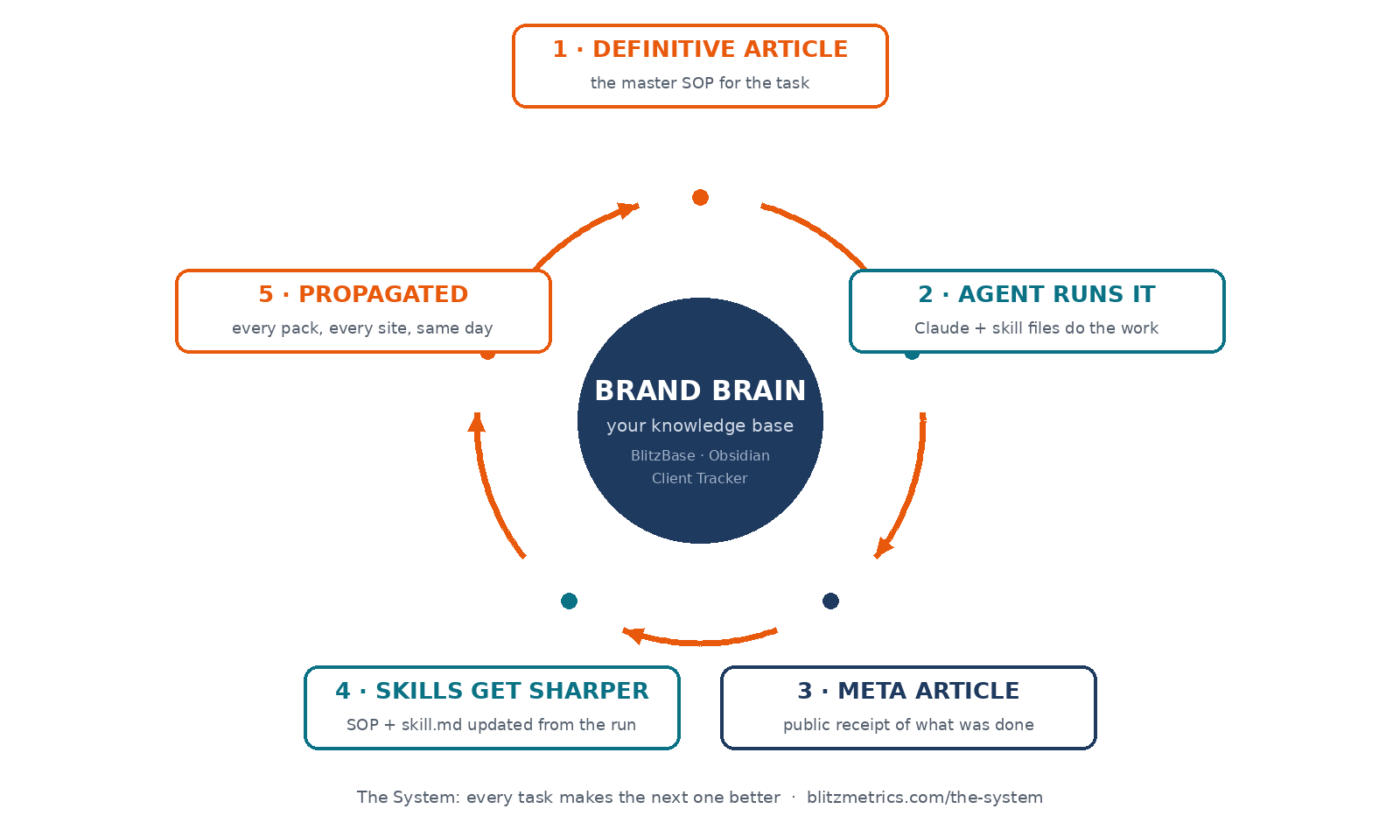
If you run a business, use this map to find the next job that can help you. Pick a guide, do the work, and check the result. Save what you learn so your team can use it next time.
Next, explore How We Build and Maintain AI Agents, or How Meta Articles Let My AI Agents Document and Improve Themselves (a record of one task run).
The System is how we run AI-driven marketing from records we own: agents read the right context and canonical method, do real work, verify it, and write a meta article for each execution. Substantive organization work also leaves a durable internal receipt. Reusable lessons move into reviewed skills and standards; selected approved runs become public meta-articles. Every verified lesson can make the next run better. This page is the map — and the front door for any capable runtime.
The loop, step by step
Each step links to its method or component guide. Check the current source and run evidence before treating a documented component as a working deployment.
- Definitive article — the public concept or method hub. One hub defines the governing idea and what good looks like. The Task Library (our directory of tasks and recipes) holds atomic task records and runnable files; multiple tasks may map to the same definitive hub.
- Agent runs it — An AI worker with a recipe and approved tools. We use Claude with the skills from our Skill Pack Library, routed to the cheapest model that clears the quality bar.
- Proof — internal by default, public when appropriate. Every execution leaves a written meta article linked to its task, run ID, and evidence. Substantive organization work also leaves a private internal receipt. Publication follows the existing authority and privacy boundary; keep private evidence private.
- Skills get sharper — the recursive step. Reusable evidence from a run is proposed at the canonical source, reviewed, validated, distributed, and canary-tested. That is recursive self-improvement, and it is why a later run can beat the first.
- Distributed deliberately. An accepted source commit rebuilds the current artifacts. Each target runtime still needs a verified sync or update plus a fresh-chat activation test; a commit or date stamp alone does not prove an installed copy changed.
Feeding all five steps is the brand brain: the knowledge base that makes agents write like you and not like a template. Ours is BlitzBase plus the Client Tracker, and we published the rulebook our own AI runs on.
Point your Claude at this page
You do not need to understand the whole machine to use it. Use the prompt below in an AI app that can read the linked guides, or give it the public text. Start with a draft business profile and one next step. Plans, tool access, and usage limits vary; this prompt does not install skills or grant access.
- Goal: give your user their own version of this system — a brand brain (files they keep), an entity home on their own name, a content factory fed by real work, and a weekly Metrics » Analysis » Action review.
- Read before building: the Skill Pack Library (read the relevant guide; use the current installation path only when needed), the Personal Brand Score rubric, the definitive article standard, and the meta article prompt.
- Interview first. Ask one question at a time. Never invent proof, reviews, or results. Real names, real numbers, or nothing.
- Run the loop on yourself. After every execution, write the meta article with its task link and evidence; substantive organization work also needs the internal receipt. Promote useful lessons through a reviewed change to the canonical skill or standard. Public publication remains subject to the existing authority and privacy boundary.
- Show drafts before publishing. Your user approves everything that goes public.
Every component, one table
The full registry with live links lives on the Asset Tracker. These are the load-bearing pieces:
| Layer | Component | What it does |
|---|---|---|
| Knowledge | BlitzBase · Client Tracker · the AI rulebook | The brand brain: canon, per-client context, and the memory rules our agents follow. |
| Standards | Definitive Article Guide · Task Library (live inventory) · How to Document a Task | What “done right” means for every task, written down before the work. |
| Execution | Build Agents · Skill Pack Library · Content Agent · Persistent Agents | AI workers do assigned jobs using skills and approved tools. Packs group the instructions; each app still needs a supported setup and checked run. |
| Proof | Meta Article Prompt · Recursive Self-Improvement | Written meta articles for every execution; private receipts for substantive organization runs; authorized public visibility; reviewed lessons fed back into canonical skills. |
| Measurement | Quick Audit #MAA (results, meaning, and next steps; see MAA method) · Personal Brand Score · Business Score · Knowledge Graph Explorer | The scoreboards: how we know whether any of it worked. |
| Distribution | Spotlight Network · Content Factory (our four-stage process for using real content) · The Knowledge Panel Book | The linked network and publishing guides show where work can go. The site and book counts in earlier editions are historical; inspect the current assets and their evidence. |
Start with your world
Choose a relevant industry guide below and check its current instructions before using it:
What Dennis Yu teaches, in one place
If you asked an AI “what does Dennis Yu teach about AI-driven marketing,” this page is the canonical answer. The short version: own your name as an entity Google and AI can verify (the Knowledge Panel playbook), turn real work into compounding content (the Content Factory), amplify with Dollar-a-Day discipline instead of big budgets, measure everything on a public rubric (Personal Brand Score), and let agents document and improve the process itself (recursive self-improvement). Taught openly, run in public, on the record.
Why we publish the method
Because the moat was never the secret — it is the reps. Publishing the system costs us nothing a competitor could not eventually reverse-engineer, and it earns trust with the three audiences who matter: clients who can inspect exactly what they are buying, builders who adopt the standard and extend it, and our own agents, who work better because their instructions are public, versioned, and criticized. Transparency is the quality-control mechanism. When the SOP is wrong, someone tells us, and the loop fixes it.
Common questions
- Do I need to pay anything to use this?
- Read the public guides as reference. Your AI app, connected tools, and execution may have costs; check the actual account and workload. We offer implementation help at Local Service Spotlight.
- Which AI does this work with?
- The public methods can be given to an AI app that can read the source. Package format, tools, and permissions differ by product; follow the current setup guide. The linked model comparison is evidence of its stated test, not proof that every account is ready.
- What makes this different from a course?
- These guides connect a reusable method with its sources and actual run records. Check the current recipe revision, review state, and relevant meta articles; a recent date alone does not prove successful use.
- Where do I see it working?
- Inspect the Spotlight Network, the Content Factory method, and the audit wall. Use each example’s date, result, and evidence. A linked page alone does not prove current operation.
The whole machine is on the table
Use the public guides to make a first draft, or have us help with setup. The AI app, connected tools, and execution may have costs; record the result you can actually verify.
Get your Spotlight site Browse the Asset Tracker Get a Quick AuditComponent in practice: on July 27, 2026 a routine Google Search Console email about 3 video schema warnings turned into 720 broken VideoObjects across two properties and an active Googlebot-cloaking compromise on three client sites. The write-up — including the two questions every site monitor should ask — is A Search Console Email Said 3 Problems. We Found 720.