

If all the know-how stays with you, your team may struggle to repeat the work. This guide shows how to save that knowledge, turn it into steps, and use tools where they help. Start with one task your team needs to learn.
This guide is part of The 9 Triangles Framework — The Marketing Strategy Behind Scalable Home Service Businesses. Next, explore How to Document a Task, or #GCT: Business Strategy (the goal, source material, and audience).
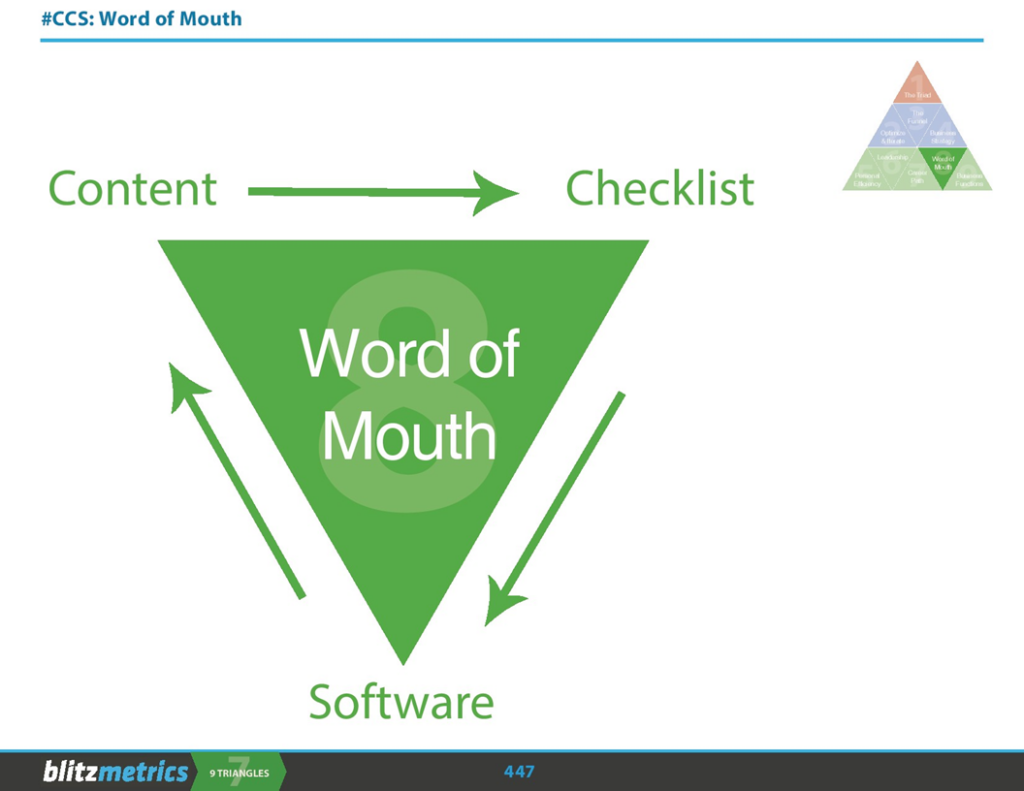

What CCS Means
CCS stands for Content, Checklist, Software. It is one of the nine principles in the 9 Triangles framework and sits in the WHAT tier — the five business triangles that anchor the foundation of how your organization operates. CCS is the systematization engine that turns raw expertise into repeatable, scalable processes through three levels of increasing formalization.
How CCS Works
Content is the raw knowledge — the articles, videos, and training materials that capture expertise. This is often created through the LDT (Learn, Do, Teach) process, where someone who has mastered a task documents what they know. Content answers the question: what does the expert know, and how can we capture it so it is not locked inside one person’s head?
Checklist takes that content and distills it into an actionable, step-by-step format that anyone can follow to achieve a consistent result. A checklist removes ambiguity — instead of a 20-minute video explaining a concept, you have a one-page list of specific actions in the right sequence. This is the stage where knowledge becomes transferable. When you create a checklist from your expertise, you prove your mastery by condensing thousands of hours of experience into a simple, repeatable set of steps.
Software takes the checklist and automates it — turning manual steps into automated workflows, templates, and tools that execute without human intervention. At this stage, the process no longer depends on a person remembering the steps or following instructions. AI agents, automation tools, and purpose-built software handle the execution, freeing up human experts to focus on higher-value work.
Why CCS Drives Word of Mouth
CCS is subtitled “Word of Mouth” because the progression from Content to Checklist to Software is how expertise scales beyond a single person. When your processes are documented well enough that others can execute them, those people become advocates who spread the system further. A well-written checklist gets shared among team members. A well-built piece of software gets adopted across organizations. The better you systematize your knowledge, the more it multiplies through word of mouth.
Where CCS Fits in the 9 Triangles
CCS is one of the five business triangles in the WHAT tier of the 9 Triangles framework. The framework is structured as a pyramid with three tiers:
WHY (Top): SBP — Specialist, Business, Partner: The Triad. This is the mission that drives everything.
HOW (Middle): The three marketing triangles — ACC (Awareness, Consideration, Conversion), MAA (Metrics, Analysis, Action), and GCT (Goals, Content, Targeting).
WHAT (Bottom): The five business triangles — DDD (Do, Delegate, Delete), CID (Communicate, Iterate, Delegate), LDT (Learn, Do, Teach), CCS (Content, Checklist, Software), and MOF (Marketing, Operations, Finance).
CCS connects directly to LDT — the Learn, Do, Teach cycle creates the knowledge, and CCS packages it into scalable formats. It also connects to DDD (Do, Delegate, Delete) and CID (Communicate, Iterate, Delegate) because before you can delegate a task, it needs to be documented through the CCS progression. The maturity path mirrors the growth of any process: first you understand it (Content), then you standardize it (Checklist), then you automate it (Software).
Related Resources
- Content, Checklist, Software — the detailed CCS reference page
- Creating Winning Documents that Drive Conversions — the 8-part document architecture that implements CCS
- How to Document a Task — the meta-guide for the documentation process
- Task Library (our directory of tasks and recipes) — where documented tasks live
- Documenting Expertise — how to share your knowledge and earn through documentation
- 9 Triangles Checklist — overview checklist for the full framework