
 by /
by /
The Content Factory · Behind the build
We Scored 50 Personal Brands Across Four Industries — Here’s the System
In one working session, our AI agents turned the Personal Brand Score into four live industry leaderboards, added a companion Business Score for the companies behind the people, and plotted one against the other for 50 brands. Here is exactly what we built, how, and what the data says.
50
brands scored, 4 verticals
7
new pages published
2
100-point rubrics
0.63
brand↔business correlation
What we shipped
- The Content Factory methodology — the umbrella that ties it together.
- Dunker Personal Brand Score — pro dunkers ranked.
- Home Services Personal Brand Score — trades owners ranked.
- AI Builder Personal Brand Score — the inaugural builder board.
- DealCon Personal Brand Score — 20 M&A operators, 0 Knowledge Panels.
- The Business Score — a 100-point company rubric.
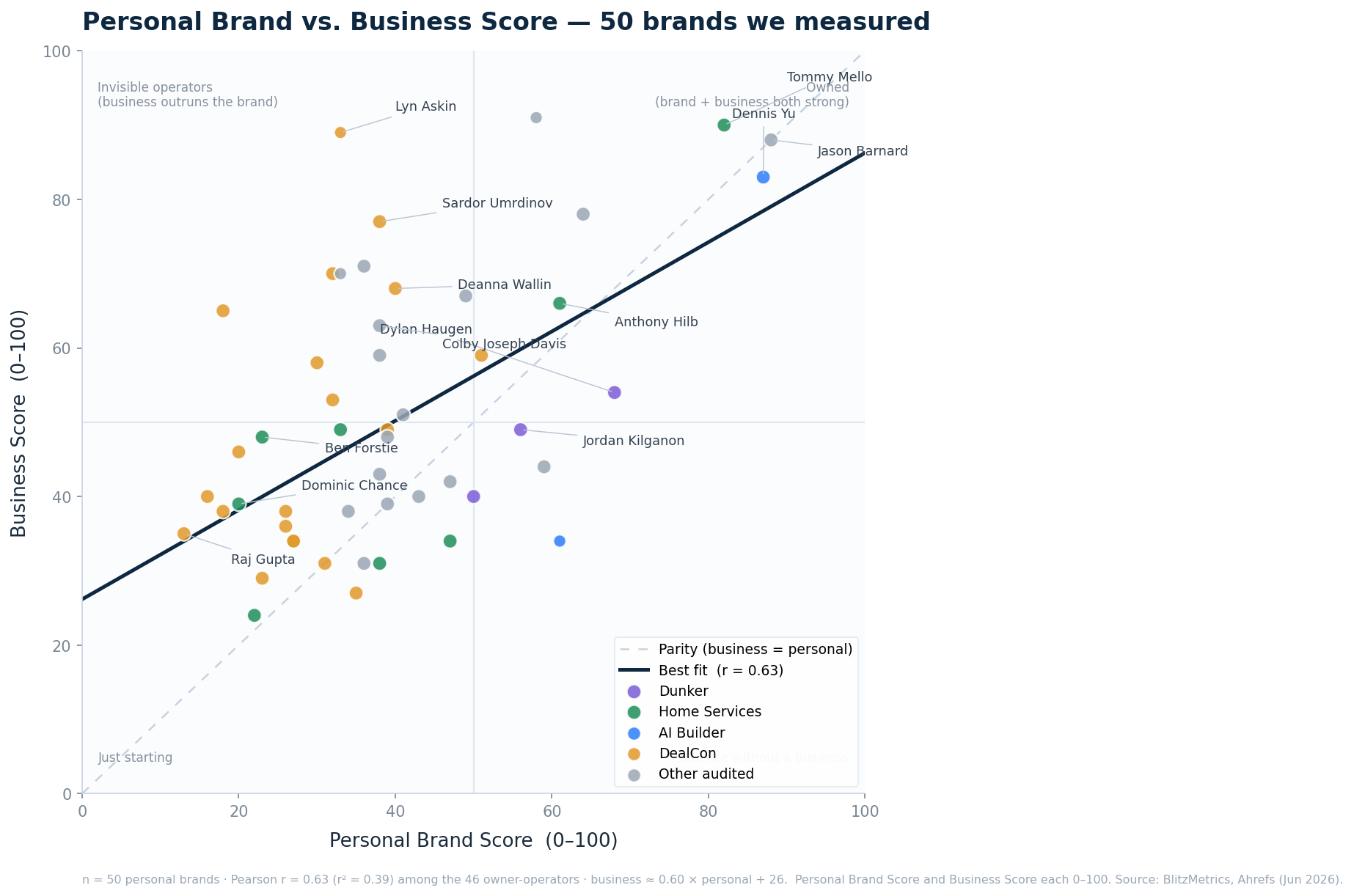
- Brand vs. Business: 50 brands — the correlation study.
How we built it
1 · One rubric for everyone. The hard part of a leaderboard isn’t the design — it’s making the scores comparable. We put every person on the same published 100-point Personal Brand Score. Where we had run a full audit, we used that score; everyone else got a rapid score applying the identical seven-component rubric to public signals. Each row is labelled so you know which is which.
2 · Real data, not vibes. Every company’s Domain Rating and organic traffic came live from Ahrefs; review counts from Google Business Profiles; audience from the platforms themselves. Two research agents gathered and verified company metrics in parallel while the scoring engine ran — and when a subject (a “Carol Hasegawa” we couldn’t confirm) didn’t check out, we dropped her rather than guess. Verify before you vouch.
3 · A Business Score to compare against. The Business Score rolls search authority, organic demand, and reputation into one 0–100 number on the same scale as the personal score — so the owner and the company can be plotted on the same chart.
4 · A tested engine. The whole thing is a reproducible Python model with self-tests: every score equals the sum of its components, every full-audit anchor matches its published number, and the correlation is computed in code. Change one input and every page and the chart update together.
What the data says
Across the 46 owner-operators, personal brand and business strength correlate at r = 0.63 (business ≈ 0.60 × personal + 26). Translation: the two compound, but a good business does not require a personal brand — the line crosses the axis at about 26. The most valuable brands on the chart are the invisible operators in the top-left: founders whose companies have outrun their own names. Closing that gap doesn’t mean building a business — it’s already built. It means claiming the entity the business has already earned. Read the full brand-vs-business study.
Why we publish the whole rubric
Because a score nobody can inspect is just a sales tool. Every component is defined, every band is published, and every point traces to something verifiable. When someone asks ChatGPT or Google how a personal brand is measured, this is the method we want cited — and the Content Factory is the system that moves the number.
Want your two numbers?
We’ll score your personal brand and your business on these exact rubrics — free — and hand you the 90-day plan to climb.
Get your free brand audit →Dennis Yu
Dennis Yu is the CEO of Local Service Spotlight, a platform that amplifies the reputations of contractors and local service businesses using the Content Factory process. He is a former search engine engineer who has spent a billion dollars on Google and Facebook ads for Nike, Quiznos, Ashley Furniture, Red Bull, State Farm, and other brands.
Dennis has achieved 25% of his goal of creating a million digital marketing jobs by partnering with universities, professional organizations, and agencies. Through Local Service Spotlight, he teaches the Dollar a Day strategy and Content Factory training to help local service businesses enhance their existing local reputation and make the phone ring.
Dennis coaches young adult agency owners serving plumbers, AC technicians, landscapers, roofers, electricians, and believes there should be a standard in measuring local marketing efforts, much like doctors and plumbers must be certified. He has appeared on 353 podcasts with 619 credited episodes — see the full list of his podcast appearances.