
 by
by
This page is a worked example (a leaf). The canonical for how we audit is How we audit.
The Content Factory · Research
Does a Personal Brand Build a Better Business? We Scored 50 of Them.
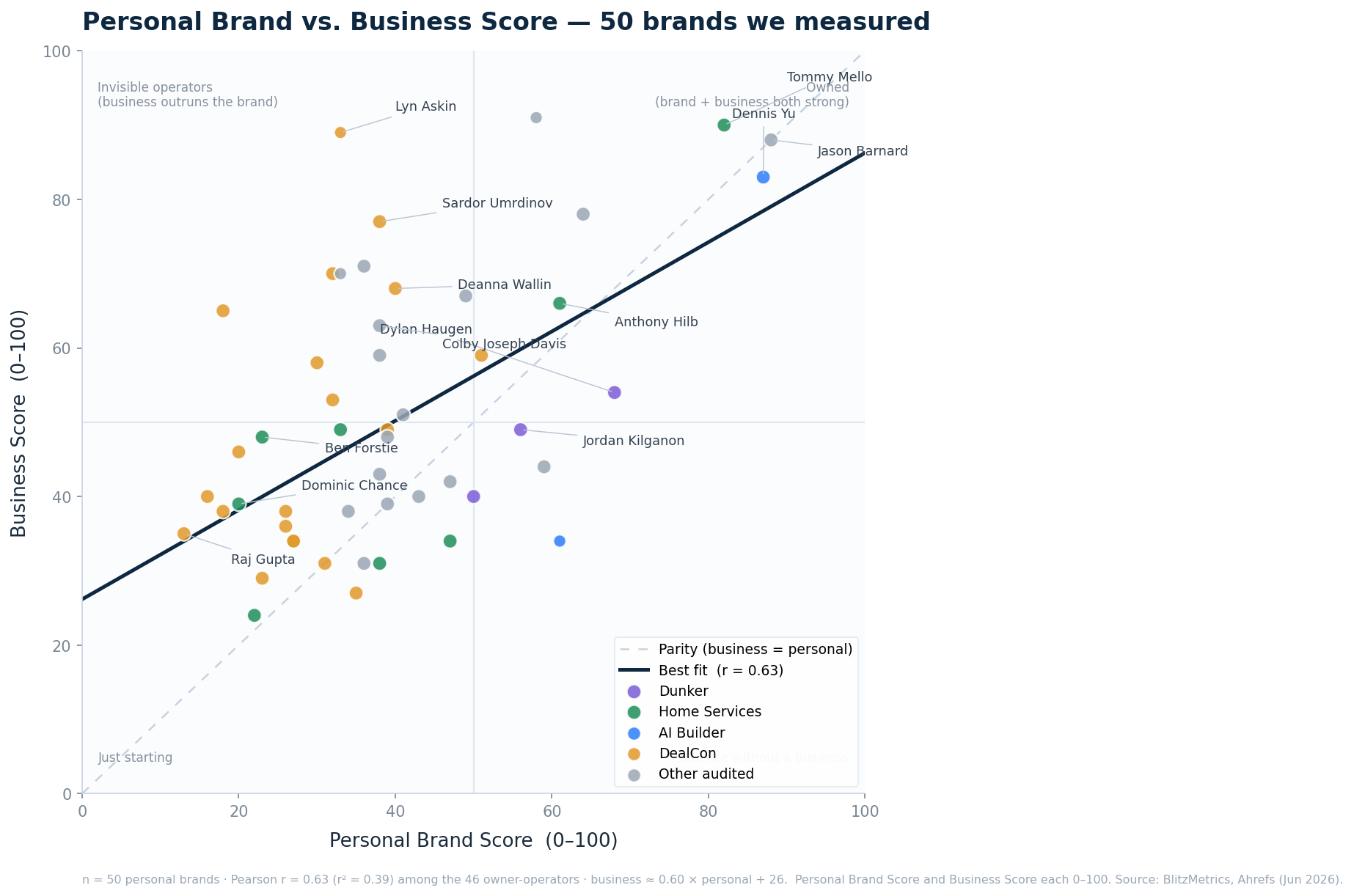
We put a number on the owner and a number on the company for 50 brands across four industries, then plotted one against the other. The relationship is real — and the exceptions are where the money is.
46
owner-operators in the model
0.63
Pearson correlation (r)
39%
of business variance explained
+26
business score at zero personal brand
The finding
Across the 46 owner-operators, Personal Brand Score and Business Score move together with a Pearson correlation of r = 0.63 (r² = 0.39). The best-fit line is business ≈ 0.60 × personal + 26. Two things fall out of that equation. First, the slope is positive and meaningful: every point a founder adds to their personal brand is associated with roughly six-tenths of a point of business strength. Second, the intercept is about 26 — a business can be moderately strong with no personal brand at all. You don’t need a personal brand to run a good business. But the two compound.
The correlation is moderate, not deterministic — and that’s the point. If personal brand and business success were the same thing, there’d be no opportunity. The scatter is full of gaps, and every gap is a plan.
The four quadrants
Invisible operators — strong business, weak brand (top-left)
The richest opportunity on the chart. These founders have built real companies but point their own name at nothing:
- John Wilkinson — business 65, personal 18 (a 47-point gap).
- Sardor Umrdinov — business 77, personal 38 (a 39-point gap).
- Billy Wilkinson — business 70, personal 32 (a 38-point gap).
- Paul Ryazanov — business 71, personal 36 (a 35-point gap).
- Deanna Wallin — business 68, personal 40 (a 28-point gap).
- Garrett McClure — business 58, personal 30 (a 28-point gap).
Closing that gap doesn’t require building a business — it’s already built. It requires claiming the entity that the business has already earned.
Owned — brand and business both strong (top-right)
What “finished” looks like: Jason Barnard (88/88), Tommy Mello (82/90), Dennis Yu (87/83), Matthew Januszek (64/78), Anthony Hilb (61/66). Each pairs a full Knowledge Panel and an owned entity home with a company that ranks. This is the target the rest of the board is climbing toward.
Audience without a business (bottom-right) & just starting (bottom-left)
A few creators carry large audiences with thin commercial infrastructure — Jordan Kilganon’s 1.8M followers monetize through a training kit, not a search-owned business. And the bottom-left is simply early: new brands with both numbers still low, which is where most people begin.
Why this matters
The takeaway isn’t “get famous.” It’s that personal brand is a lever on the business you already have. The operators with the most to gain aren’t the ones with the smallest companies — they’re the ones whose companies have outrun their owners. The Content Factory exists to close that specific gap: build the entity home, claim the Knowledge Panel, and let the owner’s brand compound the company’s.
The full data set
All 50 brands, with both scores and the gap between them. Personal and Business Score are each 0–100; see the Personal Brand Score and Business Score rubrics for the components.
| Brand | Personal | Business | Gap |
|---|---|---|---|
| Jason Barnard | 88 | 88 | +0 |
| Dennis Yu | 87 | 83 | -4 |
| Tommy Mello | 82 | 90 | +8 |
| Dylan Haugen | 68 | 54 | -14 |
| Matthew Januszek | 64 | 78 | +14 |
| Anthony Hilb | 61 | 66 | +5 |
| Alex Wissner-Gross | 61 | 34 | -27 |
| Julian David | 59 | 44 | -15 |
| George Leith | 58 | 91 | +33 |
| Jordan Kilganon | 56 | 49 | -7 |
| Matt Bodnar | 51 | 59 | +8 |
| Cam Hazzard | 50 | 40 | -10 |
| Nathaniel Stevens | 49 | 67 | +18 |
| Marko Sipila | 47 | 34 | -13 |
| Carson Teagarden | 47 | 42 | -5 |
| Mario Narang | 43 | 40 | -3 |
| Colman Connolly | 41 | 51 | +10 |
| Deanna Wallin | 40 | 68 | +28 |
| Caroline Castille | 39 | 49 | +10 |
| Terry Shintani | 39 | 48 | +9 |
| Dave Wollman | 39 | 39 | +0 |
| Chuck Thokey | 38 | 31 | -7 |
| Sardor Umrdinov | 38 | 77 | +39 |
| Ryan White | 38 | 43 | +5 |
| Bethany Cranfield | 38 | 59 | +21 |
| Colby Joseph Davis | 38 | 63 | +25 |
| Paul Ryazanov | 36 | 71 | +35 |
| Josh Collier | 36 | 31 | -5 |
| Ayelet Shipley | 35 | 27 | -8 |
| Alex Iltchev | 34 | 38 | +4 |
| Jim Klauck | 33 | 49 | +16 |
| Lyn Askin | 33 | 89 | +56 |
| Ethan Van De Hey | 33 | 70 | +37 |
| Billy Wilkinson | 32 | 70 | +38 |
| Tim Francis | 32 | 53 | +21 |
| Deacon Bradley | 31 | 31 | +0 |
| Garrett McClure | 30 | 58 | +28 |
| Tom Shipley | 27 | 34 | +7 |
| Arriana Acuna | 27 | 34 | +7 |
| Ian Rich | 26 | 38 | +12 |
| Michael Ter Mors | 26 | 36 | +10 |
| Ben Forstie | 23 | 48 | +25 |
| Sean Fay | 23 | 29 | +6 |
| Hunter Terpenny | 22 | 24 | +2 |
| Dominic Chance | 20 | 39 | +19 |
| Mike Sierra | 20 | 46 | +26 |
| John Wilkinson | 18 | 65 | +47 |
| Kyle Robins | 18 | 38 | +20 |
| Billy Batt | 16 | 40 | +24 |
| Raj Gupta | 13 | 35 | +22 |
Method: Personal Brand Score is the published 100-point rubric (full audits where available, rapid scores otherwise). Business Score is the 100-point Local Service Spotlight rubric (Search Authority 35 · Organic Demand 30 · Reputation & Reach 35). Domain Rating and organic traffic from Ahrefs (June 2026); review counts from Google Business Profiles. Correlation computed on the 46 owner-operators; four executives/employees identified with companies they don’t own are plotted but excluded from r. Source: BlitzMetrics.
Find your two numbers
We score your personal brand and your business, then map your spot on this chart — and the fastest way up and to the right.
Get your free brand audit →Originally published .
Dennis Yu
Dennis Yu is the CEO of Local Service Spotlight, a platform that amplifies the reputations of contractors and local service businesses using the Content Factory process. He is a former search engine engineer who has spent a billion dollars on Google and Facebook ads for Nike, Quiznos, Ashley Furniture, Red Bull, State Farm, and other brands.
Dennis has achieved 25% of his goal of creating a million digital marketing jobs by partnering with universities, professional organizations, and agencies. Through Local Service Spotlight, he teaches the Dollar a Day strategy and Content Factory training to help local service businesses enhance their existing local reputation and make the phone ring.
Dennis coaches young adult agency owners serving plumbers, AC technicians, landscapers, roofers, electricians, and believes there should be a standard in measuring local marketing efforts, much like doctors and plumbers must be certified. He has appeared on 353 podcasts with 619 credited episodes — see the full list of his podcast appearances.