
 by
by
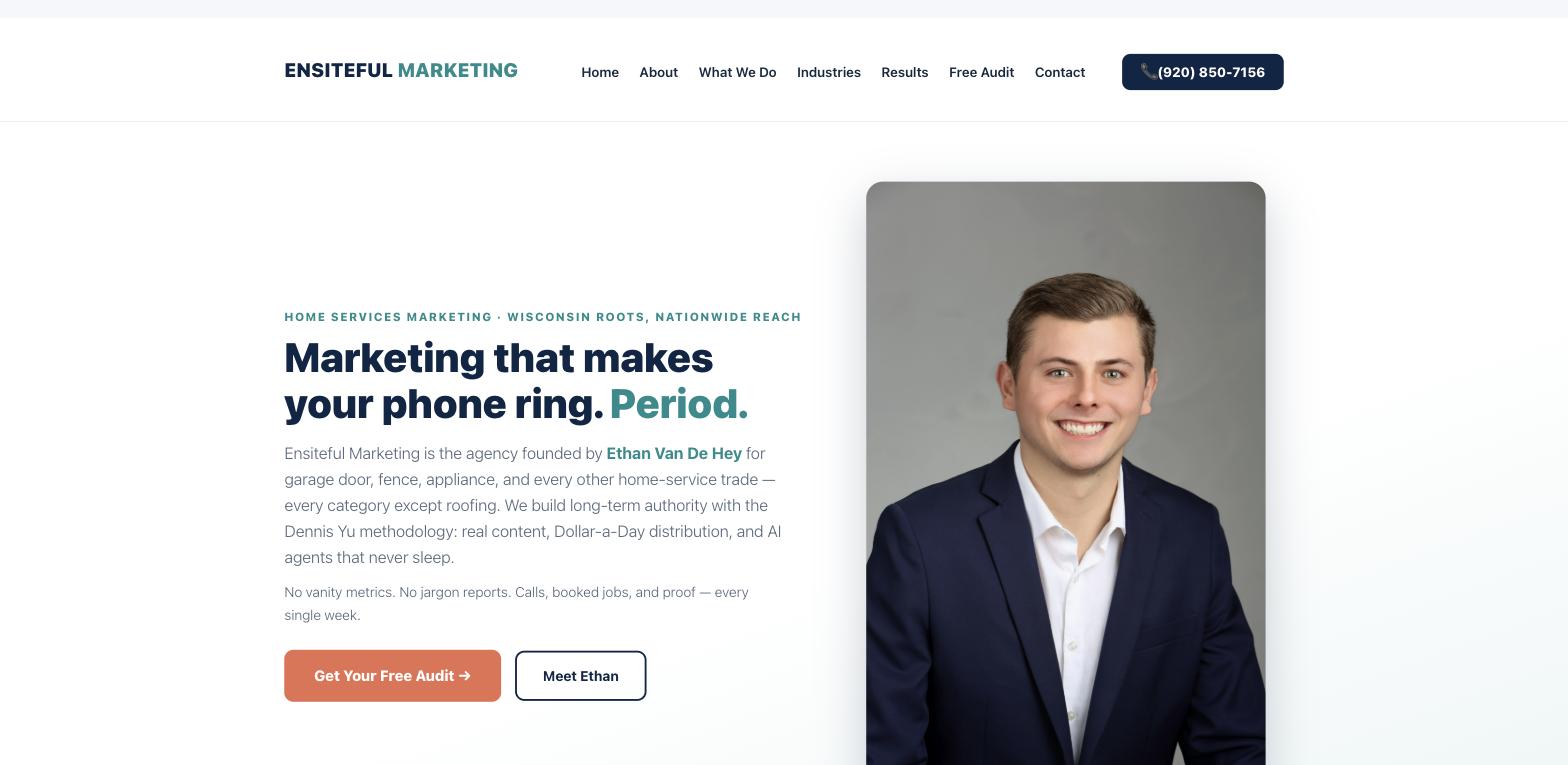
Dennis dropped one voice memo into a Basecamp thread: spin up the new agency site for Ethan Van De Hey. One session later, a Claude agent had bought ensitefulmarketing.com at GoDaddy for $10.69, provisioned WordPress on the BlitzMetrics fleet, pointed four nameservers, and shipped a seven-page agency site with three cross-linked articles, schema, and a zero-broken-links QA — live at ensitefulmarketing.com.
$10.69
total domain cost — one year, every GoDaddy upsell declined
<15 min
from fleet provisioning to propagated DNS and a live SSL certificate
10 URLs
seven pages + three articles live, QA’d to zero broken links
Catch the Dictation Error Before It Costs Money
The voice memo said “insightfulmarketing.com.” The Basecamp thread said otherwise: the project is titled Ensiteful Marketing’s Clients, and Dennis’s own comment asked for access to ensitefulmarketing.com. The agent read the thread before spending anything, noticed the mismatch, checked that ensitefulmarketing.com was available at $10.49 — exactly the “ten dollars and change” the memo predicted — and asked one confirmation question instead of registering the wrong brand. Transcription artifacts are a real failure mode when agents act on voice instructions; the fix is grounding every proper noun against the system of record.
Buy the Domain Without Buying the Funnel
GoDaddy’s cart defaulted the new domain to a five-year term at $54.45 with a “recommended” Full Domain Protection toggle nearby. The agent forced the term back to one year at $10.49, left protection off, skipped the bundle upsells, and routed around the post-purchase “build your plan” funnel by going straight to checkout. One human moment remained: card security codes are something our agents refuse to type or store, ever — and both saved PayPal agreements were rejected by GoDaddy. So the agent staged the entire checkout and handed Dennis exactly one action: type the CVV and click Complete Purchase. Receipt verified, order 4136452531.
Provision the Fleet Site and Point Four Nameservers
From the BlitzAdmin dashboard the agent created the site under Local Service Spotlight — vanilla theme, standard Keap contact, operations email — and the confirmation modal returned four AWS nameservers. Those went into GoDaddy’s “I’ll use my own nameservers” form, and both Google and Cloudflare DNS resolved the new records in under five minutes. The fleet flipped the site from pending_install to active, and Caddy minted the SSL certificate on the first HTTPS request. This is the same recipe documented in how we build a personal brand website — an agency site is a personal brand site with services, clients, and an audit funnel bolted on. The generalized process now lives in the agency-site playbook, the master teaching for every agency we spin up next.
Build the Site From Research, Not Templates
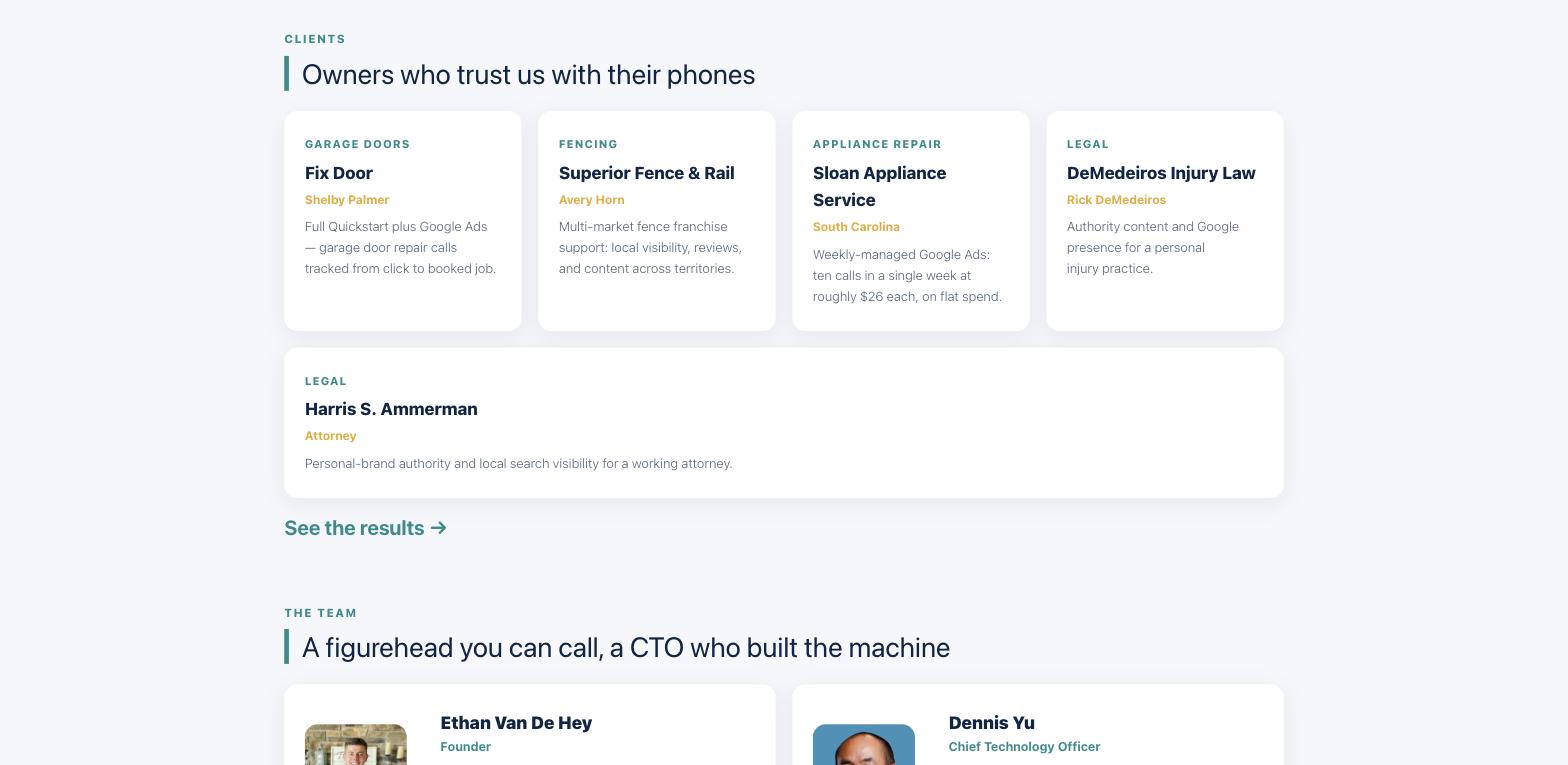
Before writing a word of copy, the agent ingested the Basecamp client tracker, Ethan’s personal site, and the story Dennis published about the rise of Ethan Van De Hey. That produced a real positioning: Ethan is the figurehead — MBA operator who ran seven-figure budgets at one of Wisconsin’s largest home-services companies, host of 100+ Encourage Mindset episodes — and Dennis is CTO. The agency serves the home-service trades — garage doors, fencing, appliance repair, and beyond — plus the professionals who live on local trust. Seven pages shipped — Home, About, What We Do, Industries, Results, Free Audit, Contact — plus three articles written in Ethan’s voice, with Organization and Person schema, the Encourage Mindset episode featuring Dennis embedded, and the client wall drawn from the live tracker: Fix Door, Superior Fence & Rail, Sloan Appliance Service, DeMedeiros Injury Law, and attorney Harris S. Ammerman.
Fix What WordPress Breaks
Three fleet gotchas surfaced and got permanent fixes. First, setting permalink_structure over REST saved the option but never flushed rewrite rules, so every pretty URL served the homepage; the fix is POSTing the options-permalink form like a human would, which flushes rules properly. Second, the vanilla block theme’s constrained layout squeezed the design into a 600-pixel column until the agent overrode the is-layout-constrained child selectors. Third, four script logins in one session tripped the fleet’s wp-login IP ban — the scripts now persist the cookie jar to disk so a session logs in exactly once. Each fix is now part of the playbook, which is the entire point of writing meta articles after every build.
QA Like an Auditor, Not an Author
The verification pass crawled all ten URLs with cache-busters, parsed every anchor, image, and iframe, and checked each one’s HTTP status: zero broken links, with LinkedIn’s bot-blocking 999 correctly classified as noise rather than a failure. Structured data parsed clean on both schema blocks. A bogus URL returned a proper 404 instead of the homepage. Homepage payload came in at 3.8 MB against our 5 MB checklist ceiling, the phone number sits top-right, the founder video is embedded, and social links are in the footer — straight down the website QA checklist. One judgment call worth noting: the churned client removed from Basecamp the day before never made it onto the client wall, because agents should read operational state, not just marketing copy.
Proof ledger: Verified — domain in the GoDaddy account (renews July 2027), NS propagation via 8.8.8.8 and 1.1.1.1, ten URLs returning 200 with unique content, schema parsing, link crawl results, and the $10.69 order total. Self-reported — token estimates below. Guardrails held — the agent declined to type or store the card CVV and confirmed the domain spelling with a human before purchase. Open items — a contact form and a WordPress author account for the founder are queued for a follow-up session.
Count the Tokens, Compare the Hours
| Phase | Est. tokens | List-rate worst case | Cached realistic |
|---|---|---|---|
| Research: Basecamp, tracker, prior articles | ~220K in / 8K out | $1.30 | $0.45 |
| Purchase, provisioning, DNS (browser steps) | ~180K in / 6K out | $1.05 | $0.35 |
| Site build: copy, code, publish scripts | ~120K in / 28K out | $1.30 | $0.70 |
| QA, fixes, documentation | ~140K in / 12K out | $1.00 | $0.40 |
| Total | ~660K in / 54K out | ~$4.65 | ~$1.90 |
| Task | Agent time | Human time | Human cost @ $60/hr |
|---|---|---|---|
| Domain research, purchase, DNS cutover | ~12 min | 45–60 min | $45–$60 |
| Fleet provisioning + verification | ~8 min | 30 min | $30 |
| Research + positioning + all copy | ~15 min | 4–6 hrs | $240–$360 |
| Design + build, 7 pages + 3 posts | ~20 min | 6–8 hrs | $360–$480 |
| QA crawl + fixes + documentation | ~15 min | 2–3 hrs | $120–$180 |
| Total | ~70 min | 13–18 hrs | $795–$1,110 |
What the Agent Could and Could Not Do
Autonomous: reading the Basecamp thread and client tracker, catching the domain-name transcription error, the entire GoDaddy cart flow, BlitzAdmin provisioning, nameserver cutover, all research, all copy, all code, publishing, QA, and this article. Needed a human: typing the card security code (policy, not capability — the agent staged checkout and Dennis typed three digits), and the one-question confirmation of the domain spelling before money moved. That division of labor is the model: agents do the hours, humans make the irreversible calls.
THE DELIVERABLE
See the agency site the agent shipped
Seven pages, three articles, schema, client wall, and a free-audit funnel — live on the fleet with Ethan Van De Hey as figurehead and Dennis Yu as CTO.
New to Claude? Read our complete guide to how to use Claude — the six ways to access it, which model to pick, and the five-rung ladder from chat to autonomous agents.
Originally published .
Dennis Yu
Dennis Yu is the CEO of Local Service Spotlight, a platform that amplifies the reputations of contractors and local service businesses using the Content Factory process. He is a former search engine engineer who has spent a billion dollars on Google and Facebook ads for Nike, Quiznos, Ashley Furniture, Red Bull, State Farm, and other brands.
Dennis has achieved 25% of his goal of creating a million digital marketing jobs by partnering with universities, professional organizations, and agencies. Through Local Service Spotlight, he teaches the Dollar a Day strategy and Content Factory training to help local service businesses enhance their existing local reputation and make the phone ring.
Dennis coaches young adult agency owners serving plumbers, AC technicians, landscapers, roofers, electricians, and believes there should be a standard in measuring local marketing efforts, much like doctors and plumbers must be certified. He has appeared on 353 podcasts with 619 credited episodes — see the full list of his podcast appearances.