
 by
by
Help an AI worker do useful work with a clear brief. This guide shows how to give it the goal, facts, limits, and proof of what done means. Start with one real task and the sources it should use.
This guide is part of How We Build and Maintain AI Agents. Next, explore How Our AI Agents Share Memory and Coordinate Work, or #GCT: Business Strategy (the goal, source material, and audience).
Updated September 15, 2026 after a live 30-day review restored the captioned videos, research citations, and proof links. The measured prompt and Wispr Flow data below were captured August 13, 2026.
A common failure mode is prompting AI like a search engine: a few keywords, a vague command, and an expectation that the model will infer the missing business context. A short query may be fine for a simple fact, but it can leave a real business assignment under-specified.
My rule is simple: talk to an AI agent like you would brief a capable new teammate. Give it the goal, situation, evidence, constraints, and what “done” means. Voice dictation lets me supply that context in a few minutes instead of squeezing the assignment into a few typed words.
This is not an argument that longer prompts are automatically better. It is an argument for relevant context delivered with low friction.
Privacy note: The measurements below come from internal prompting audits and private working sessions. Names, client details, and confidential business information have been removed. Word counts, character counts, and elapsed times were measured from the underlying transcripts.
Why do weak prompts produce weak work?
Consider what happens when someone types:
Write an article about AI prompts.
The model must guess the audience, business objective, point of view, evidence, constraints, format, publication destination, and definition of done. When it guesses incorrectly, the operator sends another tiny correction: “Make it more specific.” Then: “Add examples.” Then: “Make it sound like me.”
This is not useful iteration. It is a slow-motion briefing that forces the agent to reconstruct the assignment one fragment at a time.
OpenAI’s prompting guidance recommends separating identity, instructions, examples, and context. Its current model guidance similarly emphasizes the goal, context, constraints, evidence, success criteria, and desired output. Anthropic’s Claude prompting guidance advises being explicit and explaining the context and motivation behind an assignment.
The model companies are telling us the same thing: do not make the model guess what good work means.
What did an actual prompting audit reveal?
An anonymized internal audit surfaced a useful pattern. Across roughly 125 human turns, the median entry was under 100 characters. Nearly two-thirds were under 120 characters, while fewer than one in ten reached 600 characters.
| Human-turn measure | Anonymized one-day audit |
|---|---|
| Human turns | Roughly 125 |
| Median entry | Under 100 characters |
| Entries under 120 characters | Nearly two-thirds |
| Entries of at least 600 characters | Fewer than one in ten |
These were human-turn lengths, not a clean measurement of opening prompts: the audit mixed opening briefs, approvals, follow-ups, corrections, and pasted material. A short approval can be exactly right once the context is established.
The distribution therefore raises a testable question, not a verdict: were the opening briefs for complex assignments also short, and did those sessions require more clarification or correction? Audit opening briefs separately before drawing that conclusion.
How does that compare with the way I brief AI?
I checked my own behavior instead of relying on theory.
In one private business working session, I dictated two major assignments:
| Prompt | Words | Characters | Wall time | Active speech |
|---|---|---|---|---|
| Assignment 1 | 812 | 4,475 | about 5:49 | about 5:36 |
| Assignment 2 | 648 | 3,608 | about 5:07 | about 4:52 |
| Combined | 1,460 | 8,083 | about 10:56 | about 10:28 |
The wall times include brief conversational interruptions. Active speaking time was slightly lower.
Their value was not length alone. They contained the information a strong operator would give another strong operator:
- Who the business and decision-maker were
- The desired business outcome
- The current operating bottleneck
- The people, systems, and source material available
- The work already attempted
- The evidence standard
- The requested deliverables and output format
- The definition of done
- Permission to challenge weak assumptions
- Instructions to identify missing access before proceeding
- A requirement to verify the finished work
Because those elements were present up front, the agent could begin reasoning about the assignment without first eliciting each element through separate clarification turns.
That is the difference between a keyword and a brief.
What can a complete agent assignment produce?
The following are separate, already-public build logs. They are not being presented as the output of the anonymized private session measured above.
The proof is the output, not the prompt length. In our published CXOTalk inventory audit, one assignment produced an audit page, an eight-tab workbook, an inventory covering 897 episodes, a draft email, and an agent roadmap. The run used roughly 1.5–1.7 million tokens at an estimated model cost of $8–$15.
A separate public CXOTalk personal-brand build reports that it indexed 922 slugs, distilled 30 episodes, and produced 16 articles totaling about 17,000 words. The 897 and 922 figures refer to different public inventory stages, so they should not be treated as the same count.
That result did not come from saying “do my marketing.” It came from defining the business, the source material, the bottleneck, the deliverables, the evidence standard, and the finish line.
A second public example shows the handoff from human conversation to agent processing. For the Gavin Lira active-listening article, the agent received a two-hour, nine-minute interview transcript of about 18,500 words, approximately 4,500 words of editorial guidelines, roughly 4,000 words of meta-article instructions, five existing articles to check for overlap, a privacy judgment, and defined deliverables. It then identified 12 topic segments, selected eight, drafted a 2,200-word article and a 2,500-word process article, and created a 16-chapter YouTube description. The published process reports about 30,000 source words across seven documents and an estimated roughly 20 minutes of agent work.
That agent did not receive “write something about Gavin.” The real conversation supplied the experience; the complete assignment supplied the operating context; the agent performed the processing.
Why do I use Wispr Flow?
Typing can create a context tax. When each additional sentence feels like more work, an operator may compress the assignment before the model sees it.
Voice removes much of that friction. My Wispr Flow dashboard showed the following on August 13, 2026:
| Wispr Flow measure | My usage |
|---|---|
| Total dictated words | 321,088 |
| Average speaking speed | 144 words per minute |
| Dictations classified as AI prompts | 2,000 |
| Share of desktop usage classified as AI prompts | 63% |
Source: Dennis Yu's Wispr Flow Insights dashboard, captured August 13, 2026.
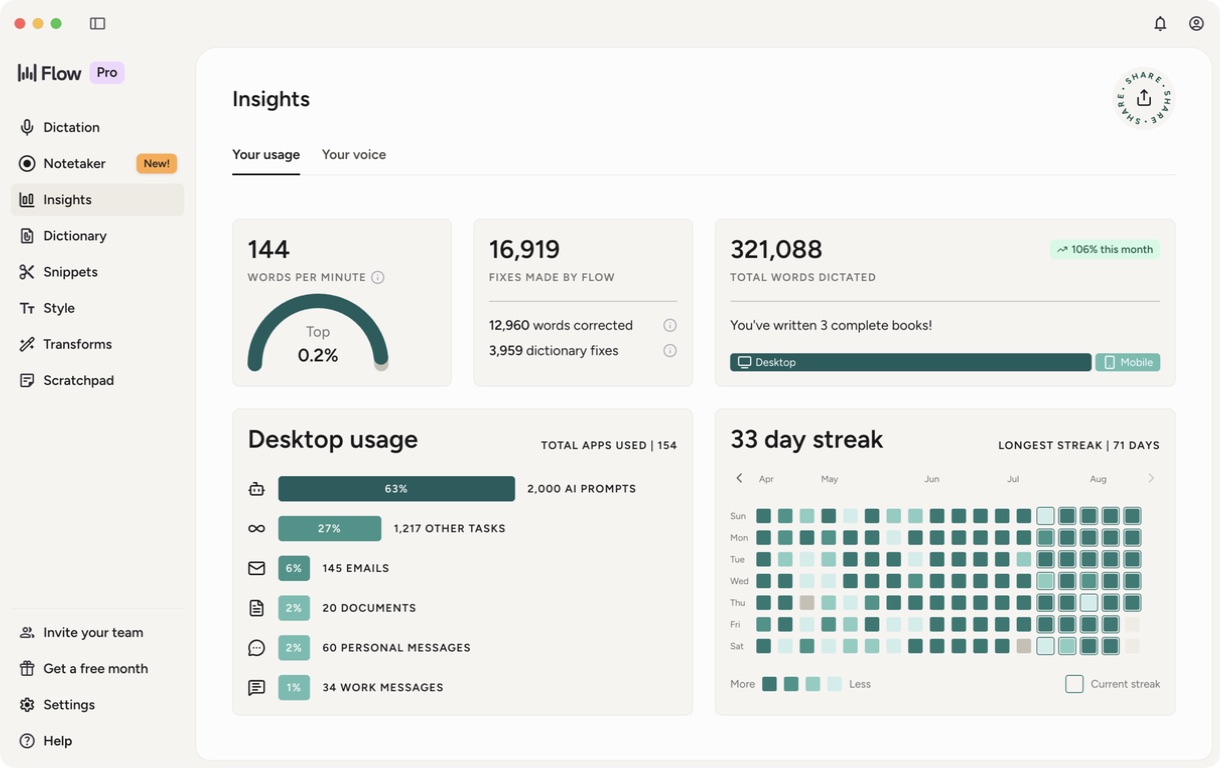
At 144 words per minute, a two-minute briefing is about 288 words. A three-minute briefing is about 432 words. That is enough room to explain the goal, audience, history, constraints, evidence, and desired output without turning prompt writing into a separate project.
Wispr’s usage dashboard documentation explains how it tracks total words, words per minute, corrections, and usage categories. Its context-awareness documentation describes how the app uses limited nearby and active-application context to improve transcription.
That distinction matters: Wispr Flow does not magically transfer the business knowledge in your head into ChatGPT or Claude. It makes it easier for you to say that knowledge out loud.
Is speaking actually faster than typing?
In a controlled Stanford study of mobile text entry, speech input averaged 161.20 words per minute, compared with 53.46 words per minute for typing. Speech was roughly three times faster and produced a 20.4% lower total error rate in that quiet-lab, mobile-device setting. Read the Stanford speech-versus-typing study.
A separate Aalto University and University of Cambridge analysis used more than 136 million keystrokes from 168,000 volunteers and found an average physical-keyboard typing speed of about 52 words per minute. Read the large-scale typing behavior study.
Those are different studies under different conditions, so I would not pretend that everyone speaks exactly three times faster everywhere. The practical point is narrower: many people can explain a complicated assignment aloud with much less friction than they can compose it sentence by sentence at a keyboard.
Is voice prompting really a communication skill?
Yes. Wispr Flow lowers the friction, but a microphone cannot supply a missing goal, a weak example, or an unclear finish line. The operator still has to retrieve the right facts, organize them in real time, and explain them for a listener who was not in the room.
That is why voice prompting is connected to the other verbal skills we already train:
| Practice | What it trains | How it transfers to AI work |
|---|---|---|
| One-minute videos | Choose one point, name the audience, tell a concrete story, and land the point without a script | Give a concise, structured explanation instead of a handful of keywords |
| Podcast hosting | Research the person, listen closely, ask follow-ups, and surface examples | Gather missing context, notice contradictions, and ask the agent better questions |
| Public speaking and Office Hours | Sequence ideas, read the audience, explain live, and handle objections | Deliver a coherent multi-minute brief and anticipate what the agent needs to know |
| Relationship-building | Remember people, history, shared experiences, and what matters to each person | Supply the real-world context and evidence that no model can invent |
| Teaching | Learn, do, explain, receive questions, and explain again | Convert experience into reusable prompts, SOPs, examples, and acceptance criteria |
These practices do not train exactly the same behavior. A one-minute video compresses public output to one useful idea. A complex AI brief expands private input until the assignment is complete. A podcast alternates listening with probing. A keynote shapes a longer sequence for an audience. But all of these practices depend on overlapping foundations: goal, audience, evidence, structure, and a clear ask.
Our own training already states the transfer directly. Why We Put Young Adults on Stage explains that one-minute videos are small repetitions for critical thinking and communication, and that clarity in speaking transfers to clarity when directing agents. The same page frames the necessary context as what must be done, why it matters, and how to communicate it. This is not new theory invented for this article; it is an operating principle already present in the training.
Our qualification material applies it. The Content VA qualification says the one-minute-video exercise is not a beauty contest or a test of perfect English; it looks for the ability to understand and process GCT—goal, content, and targeting. It also says spoken English and strength on video become critical at Level 4 and above. The careers page now includes a spoken-agent exercise that tests structured context, judgment, and verification without grading accent, charisma, or prompt length by itself.
That is remarkably close to a good voice brief. The person must think before speaking, but remain able to speak naturally and adjust in the moment.
I was not born comfortable doing this. In what I learned after more than 730 professional speeches, I described being terrified before my first keynote, practicing verbally, organizing a talk into 12 points and then four chunks, and using panels and webinars as stepping stones. Hundreds of speaking appearances later, that repetition is part of why I can now explain a complicated business situation aloud without writing a script first.
Podcasting trains the other half: listening. How to Have the Perfect Podcast Episode teaches the structure of a strong episode and how follow-up questions pull out real stories instead of scripted answers. Our Michael Krigsman podcasting case study emphasizes researching the guest, listening instead of merely queuing the next question, rephrasing a question when the first version fails, and using empathy to find the boundary of what a guest can discuss.
The same discipline applies after an agent receives a rich opening brief. Front-loading context does not mean dominating every later turn. Give the agent the facts and finish line, let it inspect and reason, then respond to what it actually found. Our active-listening guide adds a useful checkpoint: restate the concern in your own words and ask whether the understanding is correct. For expensive agent work, ask for one concise restatement of the goal, constraints, evidence, and definition of done before execution.
My public podcast tracker documented 619 credited episodes and 414 hours of airtime as of August 8, 2026. And this is trainable in younger operators too: Ethan Van De Hey's progression documents his growth from student to marketer and podcast host with more than 100 episodes.
The relationship piece matters because the model does not have lived experience. Before AI can help turn a conversation into an article, somebody has to know the person, remember the specific story, ask a useful question, and care enough to preserve the details. Our relationship-marketing guide documents more than 50 articles honoring specific people and shows how podcast interviews and one-minute videos become durable proof. AI can process those experiences. It cannot have them for us.
The Nathaniel Stevens interview and content-capture playbook makes the structure visible. Before the two-hour interview, it specifies the entity facts, story arcs, sequence, names and numbers that must be clear, standalone-answer format, repurposing targets, and ambiguity checks. The stated goal is more than 40 usable assets from one conversation. Structurally, it is also an excellent agent brief: identity, context, evidence, objectives, format, constraints, and verification are defined before work begins.
What is the verbal communication flywheel?
The hidden linkage is a loop:
- Real meetings and relationships create firsthand experience.
- Podcast interviews, Office Hours, and public speaking force us to explain and test that experience aloud.
- One-minute videos extract the clearest stories and lessons.
- Transcripts, recordings, screenshots, and articles preserve the evidence.
- Context-rich voice briefs give those facts to AI agents.
- Agents turn the evidence into audits, articles, plans, and other verified work.
- Better work creates more useful conversations and stronger relationships, which begin the next cycle.
This is our advantage with AI. It is not merely access to a model that everyone else can buy. It is the combination of lived experience, the verbal ability to transfer it, and a Content Factory (our four-stage process for using real content) that preserves the proof.
Watch the system in practice
These are not stock examples. They show the work happening in real sessions:
| Proof asset | What it demonstrates |
|---|---|
| Stop Typing to AI and Start Talking — 0:58 | The core voice-context principle in one minute |
| I Run 10+ AI Agents at the Same Time Using Claude for Chrome — 45:04 | The strongest long-form receipt: voice dictation used at the point of interaction during real email, Basecamp, WordPress, repurposing, and outreach work |
| Watch AI Build Dunkademics' Entire Online Brand in 5 Minutes — Dunk Camp 2026 — 15:23 | A live verbal brief given to an agent like an agency team |
| How We Propagate Our Experiences Into Documents and Agents (LDT/CCS) — 34:18 | An Office Hours explanation of turning lived experience into agent context |
| The AI Agent Framework for Entrepreneurs — 30:48 | A public framework session on giving an agent operating context before asking it to execute |
| Look Over My Shoulders While My AI Agents Do Marketing — 37:32 | A longer operational walkthrough rather than a polished claim |
| Mastering Your First Public Speaking Experience: My First Industry Conference w/ Dennis Yu — 18:57 | Dylan Haugen and Dennis reviewing a first industry talk and learning by doing |
| Building Your Digital Marketing Team using AI — Dennis Yu & Dylan Haugen, JVA Align Summit 2025 — 47:34 | The full JVA Align Summit session where the team adapts to live questions and shows inputs, process, and outputs |
| How to Have the Perfect Podcast Episode — 19:51 | At 6:30, follow-up questions are used to draw out unscripted stories |
| Conquer Local Think Tank — With Dennis Yu — Active Listening Role-Playing — 1:53:42 | A live demonstration of reflect, confirm, and respond rather than merely saying “I understand” |
| Logan Young Why Video — Why I Put Integrity in Front of Profit — 1:11 | Another team member using a compact WHY-story format, showing that verbal structure is repeatable rather than Dennis-only |
| Kenny Hoang Why Video — I Was This Close to Not Being Born — 1:21 | A second short, unscripted story from someone else practicing the same format |
| The One-Minute Video guide | Multiple raw examples of short, unscripted explanations feeding the Content Factory |
Should we treat AI agents like humans?
AI is not human. But the briefing discipline is similar.
Imagine hiring a brilliant employee who knows the world but knows nothing about your company. If you tell that employee, “Do our marketing,” the failure belongs partly to the assignment.
A capable teammate needs to know the outcome, why it matters, what happened before, who is affected, which systems and evidence can be used, what must not change, what finished work looks like, and how it will be checked.
An AI agent needs the same operating context—not because it is a person, but because good work depends on a good brief.
The mistake is treating an agent like a search box. A search box retrieves. An agent plans, reads, compares, creates, uses tools, checks work, and sometimes acts. That wider responsibility requires a wider assignment.
Why is this working better now?
Rich prompting was possible before; this is not a clean “impossible then, possible now” claim. What we can verify today is that some current models expose very large documented context capacities, while many agent interfaces can browse, use tools, and work with files.
As of August 13, 2026, OpenAI’s API model cards list a 400,000-token context window for GPT-5 and 1,050,000 tokens for GPT-5.6 Sol. Those are API capacities, not a promise that every ChatGPT interface exposes the same limit.
For many business tasks, raw context capacity is therefore not the only constraint. Selecting relevant evidence, organizing it clearly, and defining the finish line still matter.
But capacity is not quality. Anthropic’s context-window guidance warns that more context is not automatically better. As conversations grow, relevant information can become harder to retrieve—a problem often called context rot.
The rule is therefore not “dump everything.” The rule is: give the agent all the context that could materially change the answer, and remove what cannot.
Are fewer, richer turns more efficient?
Often, yes—but not automatically.
A strong opening brief can eliminate several rounds of clarifying the audience, correcting scope, restating the objective, explaining prior decisions, fixing the format, and recovering from a false assumption. In my workflows, avoiding those human repair cycles is often more valuable than a small difference in token count.
The technical explanation is more nuanced than saying the model “re-digests everything from scratch.” In OpenAI’s Responses API, earlier conversation input can still count as input tokens. OpenAI also provides automatic prompt caching for eligible prompts with matching prefixes, which can reduce latency and input cost.
So a good opening brief may reduce cumulative repair turns, but a bloated, repetitive prompt can waste tokens and attention too.
My preferred pattern is one context-rich opening brief, one clarification checkpoint if needed, agent execution, one evidence-based review, and corrections only where the result misses the stated standard.
Fewer turns are not the goal. Less avoidable rework is the goal.
What should I say in a two- or three-minute AI briefing?
Use this as a spoken checklist. Do not force every field into a simple task.
Here is the assignment. I want you to [specific outcome].
Here is why it matters. The business result we are trying to create is [result], for [audience or stakeholder].
Here is the current situation. We have already [prior work]. The main problem or bottleneck is [problem]. The important history is [history].
Here is what you can use. Review [files, conversations, recordings, websites, analytics, SOPs, or other evidence]. Treat [source] as authoritative when sources disagree.
Here are the constraints. Do not [prohibited action]. Preserve [important requirement]. You may [authorized actions]. Ask before taking any external or irreversible action not already authorized.
Here is the deliverable. Produce [artifact] in [format], for [reader], with [required sections or level of detail].
Here is the quality bar. Use specific facts and links. Separate verified facts from inference. Do not flatter me or invent evidence. Challenge weak assumptions.
Here is what done means. The assignment is complete when [acceptance criteria]. Verify [links, calculations, publication state, formatting, or other checks] before reporting completion.
Before starting, tell me about any missing access or one decision that would materially change the result. Otherwise, make reasonable assumptions and proceed.
At my measured 144 words per minute, a compact version can fit into two or three minutes. The two especially complex briefs measured above took about five minutes each, so task complexity should determine the length.
How should we train and qualify verbal AI operators?
Installing a dictation app is not enough. The skill should be practiced and scored through real outputs:
- Record one unscripted one-minute video each day. Answer one real customer or team question with a point, a specific example, and a next step.
- Dictate one two-to-three-minute AI assignment. Include the goal, relevant history, evidence, constraints, deliverable, and definition of done.
- Host one short interview each week. Research the person, ask a prepared opening question, listen, ask at least one genuine follow-up, and summarize what changed in your understanding.
- Run the work audit. Compare the richness of the opening brief with clarification turns, correction turns, first-pass acceptance, human time, and the verified result.
- Coach the gap. If the person freezes, rambles, or omits context, help them organize the thought and repeat the exercise. Do not score charisma, accent, camera polish, or sheer word count as a substitute for understanding.
This gives us a fairer qualification standard than “talk more.” A strong operator can state the outcome, explain why it matters, provide a concrete example, distinguish evidence from assumption, listen to a response, and decide what should happen next. Those skills help in client calls, podcasts, meetings, videos, and agent work at the same time.
How should a team audit its prompting quality?
Do not score prompt quality by character count alone. Length is a diagnostic signal, not the outcome.
| Audit question | What it reveals |
|---|---|
| Did the opening brief name the outcome? | Whether the agent knew the real goal |
| Did it include relevant context and evidence? | Whether the agent had to guess |
| Were constraints and permissions clear? | Whether execution would stall or overreach |
| Was the deliverable defined? | Whether “done” had a shared meaning |
| How many clarification and correction turns followed? | Missing information, weak execution, or both |
| Was the work verified? | Whether completion was proven |
| Was the first useful output accepted? | First-pass quality |
| Did the work create a business result? | The score that ultimately matters |
A median human-turn length under 100 characters is not automatically a failure. It becomes a useful diagnostic flag only when complex opening briefs are also thin and those sessions show more clarification, rework, or poorer accepted results. Likewise, a 4,000-character prompt is not automatically good. It can still be repetitive, contradictory, or irrelevant.
The metric that matters is context efficiency: how much decision-relevant information did the operator provide, and how much avoidable rework followed?
Our public 24-Hour AI Work Audit includes several of these measures: supplied context, substantive turns, review cycles, acceptance criteria, verification, and defensible outcomes—not agent runtime by itself.
The real lesson: context is the new leverage
People spend too much time comparing models and too little time examining what they are feeding those models.
If you give an agent eight vague words, it must supply the missing assumptions. If you give a multi-minute brief that explains the outcome, history, evidence, constraints, and quality bar, the agent can apply its intelligence to the work itself.
That is why I talk instead of type—not because voice makes a bad idea good, not because every assignment deserves 500 words, and not because an AI should be treated as a person. I use voice because it makes complete thinking cheaper to express.
Stop prompting AI like a search engine. Brief it like a capable teammate, give it the evidence, define what done means, and then hold it accountable for the result.
Frequently asked questions
Is a longer AI prompt always better?
No. A short prompt can be ideal for a simple task or a follow-up with established context. A long prompt can be poor if it is repetitive, contradictory, or irrelevant. The goal is sufficient decision-relevant context, not maximum length.
How long should my first prompt be?
Use the shortest brief that fully defines the assignment. At 144 words per minute, two or three minutes provides roughly 288 to 432 words; especially complex assignments may need more. Judge the brief by completeness and resulting rework, not a fixed duration.
Does Wispr Flow automatically give ChatGPT or Claude my business context?
No. Wispr Flow can use limited nearby or active-application context to improve transcription, but you still need to explain the business facts, history, relationships, evidence, and desired outcome that the AI needs.
Should I put everything I know into the prompt?
No. Include information that could change the agent’s decision or output. Exclude unrelated history, duplicate instructions, and stale material. Large context windows do not eliminate context rot.
Are fewer AI turns always more token-efficient?
Not always. Earlier conversation input may still count toward later input usage, while eligible matching prefixes may benefit from prompt caching. A rich opening brief is intended to reduce correction loops; verify that it does by tracking rework rather than assuming it.
How do I know whether my prompting is improving?
Track first-pass acceptance, clarification turns, correction turns, verified completion, and the resulting business outcome. Prompt length can flag underbriefing, but it should never be the only measure.
Will making one-minute videos improve my AI prompts?
It can train several transferable skills: choosing a goal, organizing a thought without a script, using a specific story, and speaking for an audience. The transfer is not automatic, because a one-minute video compresses one public idea while a complex AI assignment may need several minutes of private context. Practice both and score the resulting work.
Originally published .
Dennis Yu
Dennis Yu is the CEO of Local Service Spotlight, a platform that amplifies the reputations of contractors and local service businesses using the Content Factory process. He is a former search engine engineer who has spent a billion dollars on Google and Facebook ads for Nike, Quiznos, Ashley Furniture, Red Bull, State Farm, and other brands.
Dennis has achieved 25% of his goal of creating a million digital marketing jobs by partnering with universities, professional organizations, and agencies. Through Local Service Spotlight, he teaches the Dollar a Day strategy and Content Factory training to help local service businesses enhance their existing local reputation and make the phone ring.
Dennis coaches young adult agency owners serving plumbers, AC technicians, landscapers, roofers, electricians, and believes there should be a standard in measuring local marketing efforts, much like doctors and plumbers must be certified. He has appeared on 353 podcasts with 619 credited episodes — see the full list of his podcast appearances.