
 by
by

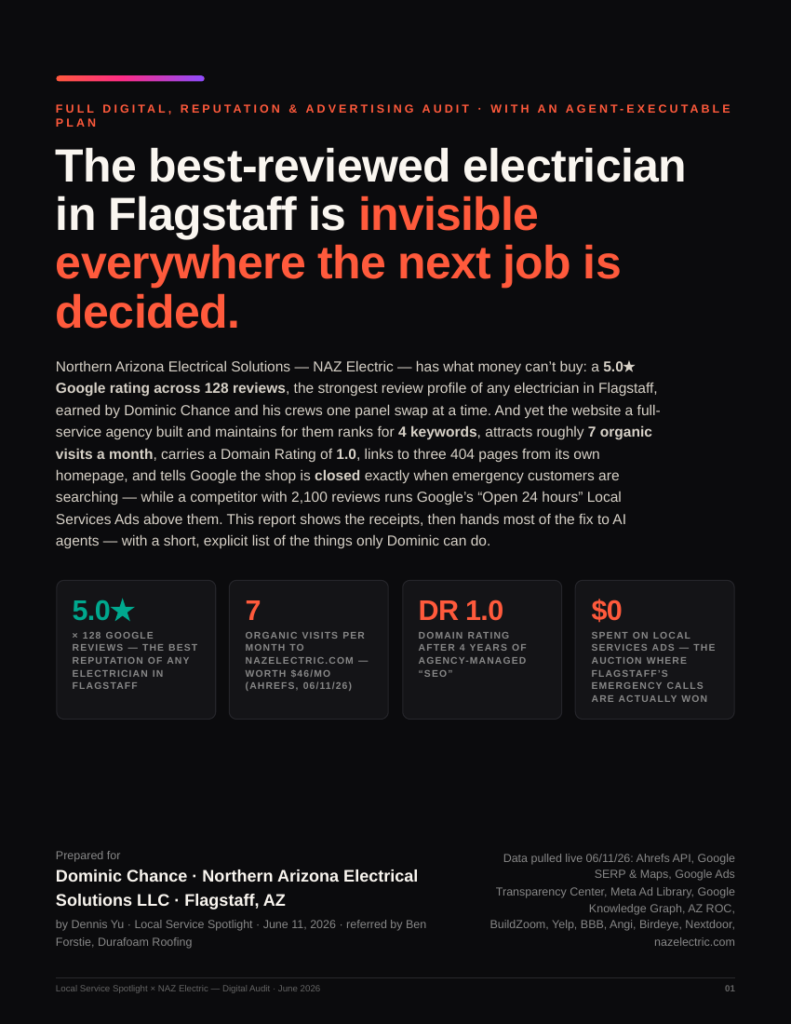
This page is a worked example (a leaf). The canonical for how we audit is How we audit.
Dominic Chance runs Northern Arizona Electrical Solutions — NAZ Electric — out of Flagstaff with a reported fifteen trucks and the best Google reviews of any electrician in town. He also pays a full-service agency that is “doing SEO.” His friend Ben Forstie of Durafoam Roofing, whose own family business we audited a day earlier, asked us to look. This article is the build log: every step an AI agent took to produce his 20-page audit, every tool it touched, and the full bill — so you can judge what this kind of work should cost in 2026.
Start With One Suspicious Chart
Dennis gave the agent the prompt at dinner-time: full audit of nazelectric.com — digital, reputation, ads, everything. The tip-off was Ahrefs “showing zeros” despite years of agency invoices.
Four API calls confirmed it in under a minute: Domain Rating 1.0, four ranked keywords, roughly seven organic visitors a month, total traffic value $46. In 33 months of Ahrefs history, the site has never cleared 20 visits a month.
Find the Paradox That Makes It Interesting
Then the reputation sweep came back: 5.0 stars across 128 Google reviews — the strongest review profile of any electrician in Flagstaff. Customers name their technicians. The owner answers every review.
That combination — best trust, worst distribution — became the spine of the report. This isn’t a struggling business that needs marketing; it’s a winning business whose proof never reaches the machines that route demand.
Run the 9 PM Breaker-Panel Test
The agent opened a live SERP for “electrician flagstaff az” in Chrome and read it the way a panicking homeowner would at 9 PM. Top of the page: Google’s Local Services Ads — Ace Electrical, 4.8 stars with 2,100 reviews, “Open 24 hours,” Google Guaranteed. Below them, the map pack: NAZ Electric ranked #1 with its 128 five-stars… marked “Closed · Opens 8 AM.”
NAZ Electric’s entire brand promise is 24/7 emergency service. Its Google Business Profile says the opposite, its primary category is “Electrical installation service” instead of “Electrician,” and it has never enrolled in the LSA program its reputation was built for. The emergency market is being conceded by configuration error.
Pull the Receipts Nobody Pulls
This is where an agent with tools beats an opinion. In one afternoon session it verified, with primary sources:
- Ahrefs API — the zeros above, plus a 12-domain batch analysis proving the whole market is asleep: every local competitor sits at DR 0–2 with single-digit traffic. One exception: the agency’s own website, DR 36 with 195 visits a month. Mountain Mojo Group can clearly do SEO — it does SEO for Mountain Mojo.
- Google Ads Transparency Center — four ad creatives ever for nazelectric.com, under a verified advertiser account, one text ad last shown the very day of the audit. A campaign technically alive at a scale Ahrefs can’t detect a single paid keyword from.
- Meta Ad Library — zero ads ever from NAZ Electric, zero from any competitor, and zero results in history for the phrase “electrician Flagstaff.” An entire county’s attention, unclaimed at $1/day prices.
- Arizona ROC contractor search — license 326755, CR-11 Electrical, Active; qualifying party Dominic A. Chance. The agent worked the state’s Salesforce search like any paralegal would, just faster.
- Google Knowledge Graph (via the keyless Trends autocomplete trick) — two duplicate company entities, an owner who doesn’t exist as an entity at all, and a name collision: “NAZ Electric” resolves first to NAZ Solar Electric, a different Flagstaff company entirely.
- The website itself, rendered live — three homepage links to 404 service pages, five different phone numbers across the site and its citations, a click-to-call that displays one number and dials another, and animated counters that finish at “4 Projects · 4 Expert Electricians.” The agent caught that last one by scrolling the element into view, waiting for the animation, and reading the final value — a 15-truck company introducing itself as a four-person shop.
Separate the Agency’s Deliverables From Its Outcomes
The fair version of the story: deliverables exist. A professional-looking Divi site shipped in 2022. A blog publishes roughly monthly. A token Google Ads campaign runs. The report prints all of it in a ledger.
The outcomes column is the problem: two blog posts rank (one for a zero-volume keyword), the EV-charger post wears another article’s meta description, the category list still contains “Roof Preparation & Protection” from some roofing client’s template, and four years of retainer produced a DR of 1.0. The report closes that page with ten questions for the next agency meeting — starting with “who owns our Google Business Profile, in writing?”
Hand 80% of the Fix to Agents, and Name the Rest
The 90-day plan is written in three swimlanes: 27 tasks an agent executes alone (redirects, schema, citations, GBP overhaul, money pages, city pages, LSA prep, ad builds, weekly scoreboards), and seven that only Dominic can do — granting access, passing Google’s LSA identity verification, choosing 24/7 hours and budgets, telling the truth about fleet size, shooting three phone clips, signing the BBB application, and having the agency conversation.
His total time commitment across three months: about four hours. The plan’s operating rhythm afterward is a weekly automated scoreboard — spend, calls, booked jobs, ranks, reviews — which is itself the biggest upgrade, because today none of it is measured at all.
Count the Tools
For the record: the Ahrefs MCP connector (metrics, history, keywords, SERP overview, keyword explorer, batch analysis), live Chrome browsing for Google SERP/Maps/LSA verification, Google Ads Transparency Center, Meta Ad Library, the Trends autocomplete Knowledge Graph endpoint, the Arizona ROC Salesforce search, web search and page fetches across roughly 25 sources (Yelp, BBB, Angi, Birdeye, BuildZoom, Nextdoor and friends), JavaScript executed in the page to extract schema and test 404s, a sandboxed Linux shell running Playwright to typeset and render the 20-page PDF, visual QA of every rendered page with the agent’s own vision, and persistent agent memory — which is how it already knew the report template, the KG lookup trick, and how to publish this very article.
Add Up the Bill
Model: Claude Fable 5, list-priced at $10 per million input tokens and $50 per million output tokens. The session ran about 95 tool calls and processed roughly 2.0 million tokens over about two hours of wall-clock time.
| Line item | Cost |
|---|---|
| List price, no caching | ≈ $26 |
| Realistic price with prompt caching | ≈ $11–14 |
| Ahrefs API units consumed | ~3,300 (pennies on a subscription) |
The same work itemized for a competent human marketer — competitive research, a ten-platform reputation audit, ads forensics, license and entity verification, a full technical site audit, strategy, and a designed 20-page report — comes to about 26 hours. That’s $1,560 at $60/hour, or $3,900 at agency rates. Call it 120× cheaper and 13× faster, with receipts the human version rarely includes.
Notice What the Agent Could Not Do
It cannot pass Google’s Local Services identity verification — that requires the licensed human. It cannot grant itself access to the Business Profile, the ad accounts, or WordPress. It cannot take the crew photos, shoot the owner’s 60-second story, or sit across from the agency and ask the ten questions. The report is honest about this: agents do the plumbing; Dominic provides the license, the face, and the decisions.
Steal the Pattern
If you run a service business — or pay an agency — the test is now cheap enough to run on yourself: pull your Ahrefs numbers, search your category at 9 PM like a customer, check your own ad archives, and ask whether your best proof is readable by machines. The pattern repeats in every audit in this series: trust earned offline, leaking through infrastructure nobody maintains. Yesterday it was a million-follower doctor; today it’s the best-reviewed electrician in Flagstaff.
The full method is documented in the definitive guide to AI-powered personal brand websites, how we build personal brand websites, and how we build and maintain the agents themselves. If you want this run on your business, the entry point is Spotlight Core at $99/month.
Report delivered: “NAZ Electric — Full Digital, Reputation & Advertising Audit,” 20 pages, June 11, 2026. Prepared by Dennis Yu, Local Service Spotlight, with one AI agent and a referral from Ben Forstie. Dominic — ask us anything; the receipts are all in the PDF.
GO DEEPER: HOW THIS FITS THE BLITZMETRICS SYSTEM
• The Quick Audit: how we audit any business
• MAA (Metrics, Analysis, Action): the framework behind every audit
• The SEO Tree: how all our content connects
• Entity Linking: the decision tree for every link
• Knowledge Panels: getting Google to recognize you
• Every digital audit Dennis Yu has done
THE DELIVERABLE
Read the actual audit we delivered
Every finding, the LSA gap analysis, and the 90-day plan — exactly as the agent produced it.
📊 Where does this brand rank? See the live Home Services Personal Brand Score leaderboard — part of The Content Factory methodology.
Originally published .
Dennis Yu
Dennis Yu is the CEO of Local Service Spotlight, a platform that amplifies the reputations of contractors and local service businesses using the Content Factory process. He is a former search engine engineer who has spent a billion dollars on Google and Facebook ads for Nike, Quiznos, Ashley Furniture, Red Bull, State Farm, and other brands.
Dennis has achieved 25% of his goal of creating a million digital marketing jobs by partnering with universities, professional organizations, and agencies. Through Local Service Spotlight, he teaches the Dollar a Day strategy and Content Factory training to help local service businesses enhance their existing local reputation and make the phone ring.
Dennis coaches young adult agency owners serving plumbers, AC technicians, landscapers, roofers, electricians, and believes there should be a standard in measuring local marketing efforts, much like doctors and plumbers must be certified. He has appeared on 353 podcasts with 619 credited episodes — see the full list of his podcast appearances.