
 by
by
This page is a worked example (a leaf). The canonical for how we audit is How we audit.
Tomorrow at DealCon, Dennis will hand Dr. Terry Shintani a 15-page printed audit of his personal brand and ask him one question: how long do you think this took? This article is the answer key — every step, every connector, every skill file, and every token the AI agent burned to produce it.
981,958
real followers, verified platform by platform
$29 vs $1,860
what the agent cost vs. a human marketer
15 pages
designed, charted, source-verified — in one session
Skip ahead: read the finished 15-page audit (PDF) →
Start With the Assignment
Dr. Terry Shintani is a Harvard-trained MD-JD-MPH, a Living Treasure of Hawai’i, and the creator of the clinically validated Waianae Diet. He has roughly a million social media followers — but only about 1% live in Hawaii where his concierge clinic operates, he has no Google Business Profile, and at 75 he wants monetization, not a second career.
Dennis gave the agent one prompt: inventory everything that makes Terry credible, find the gap between what he wants and what exists, locate the arbitrage opportunities that need almost nothing from him, and deliver it as a designed 15-page PDF he can hold on stage. Then document the whole thing — this article — and publish it.
Watch the Agent Split Itself Into Three Researchers
The first move wasn’t a search — it was delegation. The agent spawned three parallel research subagents, each with its own context window and tool access, so three deep investigations ran simultaneously instead of sequentially.
Subagent 1 — Credibility inventory (75 tool calls, 229,660 tokens): credentials, books, awards, PubMed papers, IRS filings. It verified the MD (University of Hawaii, 1985), the Harvard MPH, the 1993 HHS Secretary’s Award, the 137-citation American Journal of Clinical Nutrition study, and the Hawaii Health Foundation’s Form 990s via ProPublica’s nonprofit API. Just as important: it flagged what it could NOT verify — the CNN and Dateline appearances exist only in his own bios.
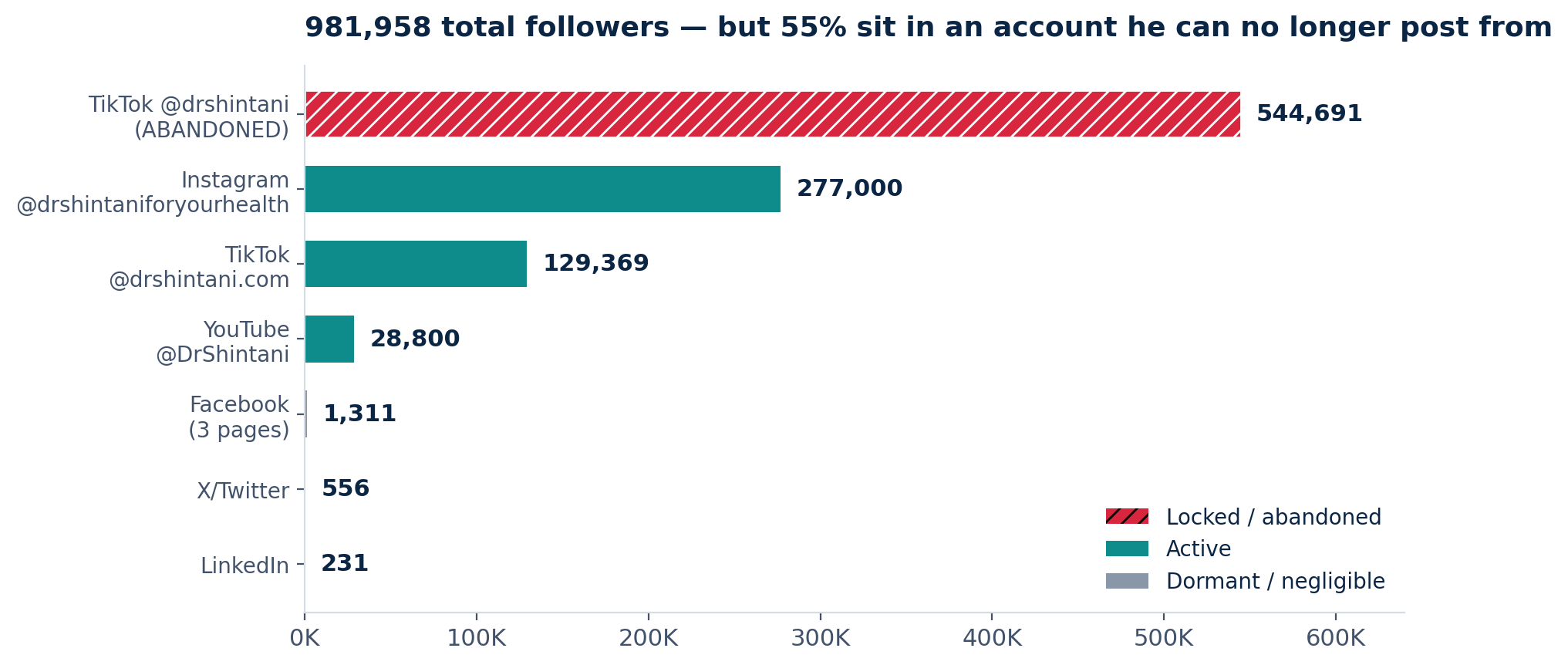
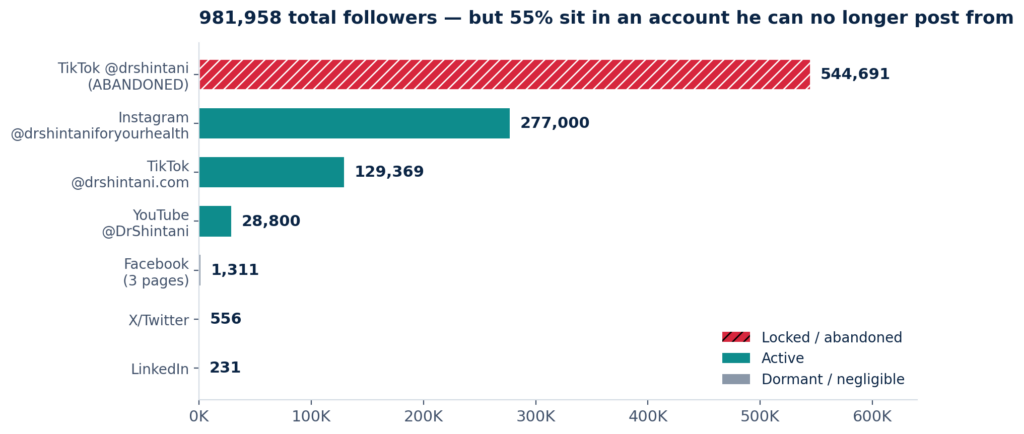
Subagent 2 — Digital footprint audit (62 tool calls, 160,752 tokens): every domain, social account, and directory listing, with exact counts pulled from platform APIs. It found 981,958 real followers — and discovered that 544,691 of them (55%) sit in a TikTok account showing a reset username, meaning lost access. It also caught his entity home drshintani.com serving HTTP 500 database errors, his flagship domain eatmoreweighless.com squatted by HugeDomains, and his Healthgrades, Vitals, and WebMD profiles all unclaimed with conflicting addresses.
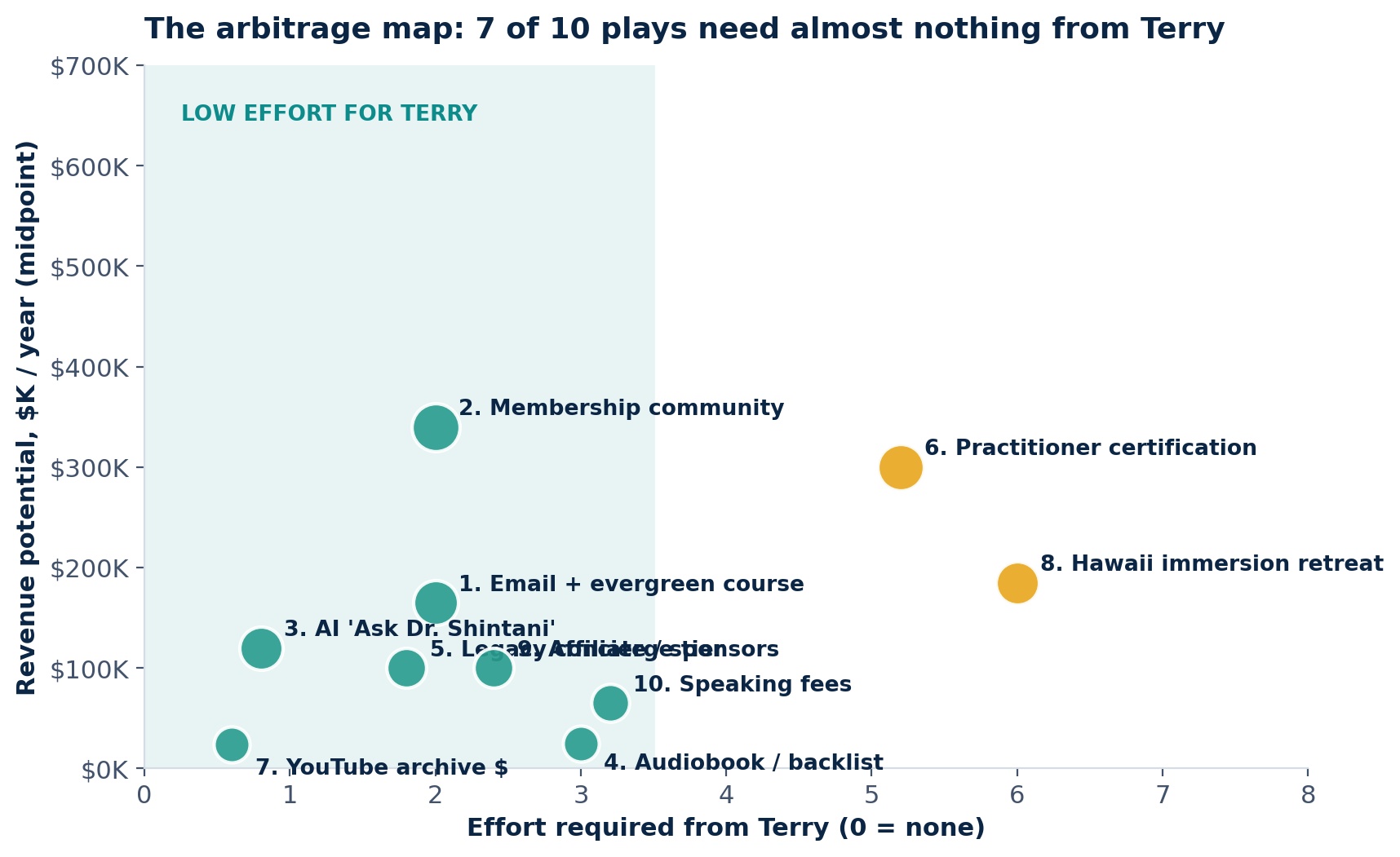
Subagent 3 — Market and arbitrage analysis (36 tool calls, 109,572 tokens): how Mark Hyman ($449/yr Hive), Peter Attia ($149/yr), Joel Fuhrman ($9.99–$97/mo), and Dean Ornish (hospital licensing, Medicare-reimbursed) monetize comparable audiences, with verified pricing fetched from their live sites. It returned ten ranked arbitrage plays scored by effort-for-Terry and time-to-first-dollar.
Pull the Hard Data Through Connectors
While the subagents ran, the main agent worked the structured-data layer directly:
- Ahrefs MCP connector — domain rating (3.5/100), keyword inventory (11 keywords, ~56 visits/month), and the finding that drshintani.com ranks #6 for his own name. Four API calls, 270 API units.
- Google Knowledge Graph via the Trends autocomplete endpoint — a keyless lookup that confirmed Terry already has a KG entity (/m/065yr6s, “Physician and nutritionist”), three book entities, and a duplicate topic entity splitting his identity signal. He is Knowledge-Panel-eligible and nobody has claimed it.
- Web search + fetch — 50+ searches and ~60 page fetches across the three subagents, hitting PubMed’s E-utilities, Semantic Scholar’s citation API, TikTok’s user-info API, Hawaii Revised Statutes, and newspaper archives.
Separate Verified From Self-Reported — the Proof Ledger
Verified by independent sources: the HHS award, the Living Treasure designation, the AJCN study, the New York Times mention, the Zippy’s restaurant line, the Native Hawaiian healing law he helped pass.
Self-reported only: CNN, Dateline, Newsweek, “450,000 books sold.”
Google’s Knowledge Graph and AI assistants reward citations, not bios. The report tells Terry to lead with the verified column and to digitize his old clippings and footage to move items across. We apply this same verify-before-vouch standard to every audit we publish.
Turn Research Into a Designed 15-Page PDF
With research complete, the agent read the PDF skill file (SKILL.md) for its document toolchain, then worked inside a sandboxed Linux shell:
- matplotlib — eight custom charts in BlitzMetrics-style branding: follower distribution (with the abandoned 544K TikTok hatched in red), the 99%-outside-Hawaii donut, an effort-vs-revenue arbitrage quadrant, a conversion funnel, peer pricing comparison, a 90-day Gantt roadmap, revenue scenarios, and the agent-vs-human cost chart.
- reportlab — a 700-line Python script that typesets all 15 pages programmatically: cover, scorecard with letter grades, three credibility-vault pages, footprint audit tables with status chips, the gap analysis, three fix chapters (Google Business Profile, entity home + Knowledge Panel, monetization), the arbitrage map, the roadmap, the numbers, and methodology.
- Visual QA — the agent rendered all 15 pages to images with pdftoppm and inspected them with its own vision to catch overflows before shipping. Page count verified programmatically: exactly 15.
Count the Skill Files and Connectors Used
For the record, the complete toolchain: three parallel general-purpose subagents; WebSearch; web fetch; the Ahrefs MCP server (doc, domain-rating, site-explorer-metrics, organic-keywords endpoints); the Google Trends KG endpoint; a sandboxed Ubuntu shell running Python 3 with matplotlib, reportlab, pypdf, and pdftoppm; file read/write tools; a task-list tracker; the PDF skill file; the BlitzAdmin WordPress publish-content and site-management skill files; persistent agent memory (which is how it knew blitzmetrics.com publishes via a logged-in browser nonce rather than the fleet API); and Claude-in-Chrome to push this article live.
Add Up the Tokens — and the Bill
Dennis asked for the real numbers, so here they are. The model was Claude Fable 5 at maximum effort, list-priced at $10 per million input tokens and $50 per million output tokens.
| Component | Tokens |
|---|---|
| Subagent 1 — credibility research | 229,660 |
| Subagent 2 — footprint audit | 160,752 |
| Subagent 3 — monetization comps | 109,572 |
| Main agent — orchestration, Ahrefs, charts, 15-page PDF build, QA, this article, publishing (estimated) | ~1,850,000 |
| Total processed | ~2.35 million |
At list rates that’s roughly $23 of input and $4–6 of output: call it $29 worst case. With prompt caching — which discounts re-read context by 90% and is on by default in agent harnesses — the realistic bill lands closer to $12–15. Wall-clock time: about 2.4 hours, with the three research streams running in parallel during the first 15 minutes.
Compare That to a Human Doing the Same Work
An honest itemization for an average digital marketer at $60/hour (typical US freelance range is $50–$75):
| Task | Human hours |
|---|---|
| Background research + verification across ~110 sources | 10 |
| Digital footprint audit (domains, socials, directories, Knowledge Graph) | 5 |
| Competitive monetization research with verified pricing | 5 |
| SEO data pulls + analysis | 2 |
| Strategy synthesis + gap analysis | 3 |
| Designing 8 charts | 2 |
| Laying out a designed 15-page report | 3 |
| Writing + publishing this case study | 1 |
| Total | 31 hours ≈ $1,860 |

That’s 64× cheaper and roughly 13× faster — about four working days compressed into one afternoon session. At agency rates of $150/hour the human bill is $4,650 and the multiple becomes 160×. And the agent’s version arguably goes deeper: no human marketer pulls IRS Form 990s, Semantic Scholar citation counts, and TikTok’s internal user API on a $1,860 budget.
Notice What the Agent Could NOT Do
Honesty cuts both ways. The agent could not click “verify” on a Google Business Profile (that takes a human with a Google account and a camera), could not file Terry’s TikTok account recovery (identity documents required), and could not record his course videos. The plan in the report is built around exactly that division of labor: the agent does roughly 95% of the work, an associate does 4%, and Terry does about 8 hours over 90 days.
What This Means If You’re Not Terry
Terry’s case is extreme — few people have a million followers and an HTTP 500 error where their website should be. But the pattern is universal: credibility earned over decades, leaking through infrastructure nobody maintained. The fix is now mechanical, and machines do mechanical work for dollars, not thousands.
This is the same process behind every personal brand site we build and document — see the definitive guide to AI-powered personal brand websites, how we build personal brand websites, and how we build and maintain the agents themselves. If you want this run on your own name, the entry point is Spotlight Core at $99/month.
GO DEEPER: HOW THIS FITS THE BLITZMETRICS SYSTEM
• The Quick Audit: how we audit any business
• MAA (Metrics, Analysis, Action): the framework behind every audit
• The SEO Tree: how all our content connects
• Entity Linking: the decision tree for every link
• Knowledge Panels: getting Google to recognize you
• Every digital audit Dennis Yu has done
THE DELIVERABLE
Read the actual 15-page audit we handed Terry
Cover to methodology: the credibility vault, the broken-footprint evidence, the Google Business Profile plan, the arbitrage map, the 90-day roadmap, and the revenue scenarios — exactly as the agent produced it.
Report delivered to Dr. Shintani: “Terry Shintani — Personal Brand & Monetization Audit,” 15 pages, June 11, 2026. Ask him on stage what he thinks of it.
Originally published .
Dennis Yu
Dennis Yu is the CEO of Local Service Spotlight, a platform that amplifies the reputations of contractors and local service businesses using the Content Factory process. He is a former search engine engineer who has spent a billion dollars on Google and Facebook ads for Nike, Quiznos, Ashley Furniture, Red Bull, State Farm, and other brands.
Dennis has achieved 25% of his goal of creating a million digital marketing jobs by partnering with universities, professional organizations, and agencies. Through Local Service Spotlight, he teaches the Dollar a Day strategy and Content Factory training to help local service businesses enhance their existing local reputation and make the phone ring.
Dennis coaches young adult agency owners serving plumbers, AC technicians, landscapers, roofers, electricians, and believes there should be a standard in measuring local marketing efforts, much like doctors and plumbers must be certified. He has appeared on 353 podcasts with 619 credited episodes — see the full list of his podcast appearances.