

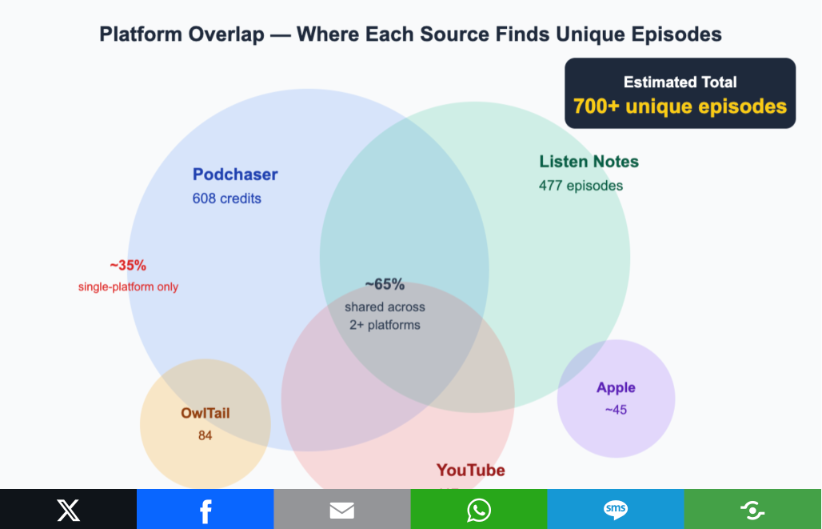
No single podcast directory captures every appearance. We searched Podchaser, Listen Notes, YouTube, OwlTail, and Apple Podcasts for Dennis Yu’s podcast history — and each one returned a different number.
Here’s what we found, why it matters, and how you can do the same.
The Numbers Don’t Agree
| Platform | Episodes Found | How It Searches |
|---|---|---|
| Podchaser | 608 credits (583 guest, 25 host) | Creator profile + suggested credits |
| Listen Notes | 477 episodes | RSS feed indexing + transcript search |
| YouTube | 117+ appearances | Video podcasts, keynotes, webinars, live streams |
| OwlTail | 84 entries | Curated/sampled podcast index |
| Apple Podcasts | ~45 (sampled) | Title-keyword search only |
The union across all platforms: an estimated 700+ unique podcast episode appearances across 353+ distinct podcasts spanning 8+ years.
But the crucial insight is this: the platforms disagree on which episodes exist.
Podchaser found 608 credits — the most of any single platform — but still misses episodes that Listen Notes indexes via RSS transcript search. YouTube captures video versions that podcast-only platforms miss entirely. OwlTail, despite tracking only 84 entries, surfaces a handful of appearances absent from both Podchaser and Listen Notes.
Why the Overlap Matters
Roughly 65% of episodes appear on 2+ platforms. But that means 35% of all appearances are only findable on a single platform. If you relied on Podchaser alone — the best single source — you’d miss about 100 episodes. If you only searched YouTube, you’d miss 500+.
The diagram at the top of this article shows how each platform’s coverage overlaps — and where the gaps are.
As the overlap diagram shows, Podchaser and Listen Notes share the largest overlap — roughly 400 episodes appear in both. YouTube sits partially outside that overlap because it captures video-format podcasts, keynote recordings, and live streams that audio-only directories never index. OwlTail and Apple Podcasts each contribute a small but meaningful set of appearances that no other platform surfaces.
What Each Platform Catches That Others Miss
Podchaser works like a social database for podcasts. Because listeners and creators can suggest credits, it picks up guest appearances even when episode titles do not mention Dennis Yu by name. Its weakness is that it depends on community contributions, so newer or less popular shows often go untagged.
Listen Notes indexes RSS feeds directly and runs transcript search, which means it catches episodes where the guest’s name appears in the show notes or audio but not in the title. It found 477 episodes — fewer than Podchaser — yet surfaced roughly 70 episodes that Podchaser missed entirely because those shows had not yet been tagged in the Podchaser database.
YouTube captures an entirely different format. Video podcasts, conference keynotes, webinar recordings, and live streams all live here. A significant portion of these never make it to an audio RSS feed, which means inventorying YouTube separately is not optional — it is essential.
OwlTail indexes a curated subset of podcasts and returned only 84 entries. However, a handful of those entries did not appear on any other platform, which proves that even small aggregators contribute to a complete inventory.
Apple Podcasts only supports title-keyword search, which limits it to roughly 45 results. It does not search show notes or transcripts. Still, it serves as a useful cross-reference — if an episode shows up in Apple but not in Podchaser or Listen Notes, that gap signals a metadata issue worth investigating.
Why a Complete Podcast Inventory Matters for Your Personal Brand
Every podcast appearance is a piece of Content Factory raw material sitting in the “Produce” stage. When those appearances are scattered across five platforms with no unified record, they cannot be repurposed, cross-linked, or amplified. A complete inventory unlocks three things that a partial one does not.
First, it feeds the “Process” stage. Each episode can be transcribed, turned into a blog post, and linked back to the original show — creating a web of topical authority that strengthens every page on the site. Second, it builds entity signals that contribute to earning a Google Knowledge Panel. Search engines associate a person with the podcasts they appear on, but only if those associations are documented and connected through structured content. Third, it creates fuel for the Dollar a Day promotion strategy. A one-minute clip from a podcast interview, boosted at a dollar a day, generates ongoing awareness — but you cannot clip what you have not found.
How to Inventory Your Own Podcast Appearances — Step by Step
We have published a definitive guide to inventorying every podcast you have been on, which walks through the full multi-platform process from start to finish. That guide covers how to set up searches on each platform, how to deduplicate results, and how to organize the data into a master spreadsheet that your content team can act on.
For platform-specific instructions, we also have dedicated SOPs for Listen Notes, Podchaser, and YouTube podcast inventory. If you suspect that aggregators are missing appearances — especially if you have been a guest on smaller or newer shows — read our guide on how to find hidden podcast appearances that aggregators miss.
What We Would Do Differently Next Time
Running the inventory across all five platforms took several hours. In hindsight, starting with Podchaser and Listen Notes together — since they share the largest overlap — would have established the baseline fastest. YouTube should come third as its own pass, because its results are almost entirely additive. OwlTail and Apple Podcasts are best used as final cross-references rather than primary sources.
We also learned that episode deduplication is harder than it sounds. The same interview can appear under different titles on different platforms, or the same episode can be split into two parts on one platform and listed as a single entry on another. Fuzzy matching by date and show name proved more reliable than title matching alone.
Related Articles
This article is part of a larger system of podcast inventory content. Each piece covers a different angle of the same process, and together they form the complete picture of how we manage podcast appearances inside the Content Factory.
The Definitive Guide to Inventorying Every Podcast You Have Been On — The step-by-step process for running a full multi-platform podcast inventory, including deduplication and master spreadsheet setup.
How We Use Listen Notes to Find, Track, and Repurpose Every Podcast Appearance — A deep dive into Listen Notes as a podcast discovery and repurposing tool.
How We Use Podchaser to Amplify Authority and Repurpose Podcast Content — How Podchaser’s credit system and social features accelerate podcast inventory and promotion.
How to Inventory a Podcast on YouTube: The Definitive SOP — The standard operating procedure for capturing video podcast appearances that audio-only directories miss.
How to Find 62+ Hidden Podcast Appearances That Aggregators Miss — Techniques for uncovering episodes that no major platform indexes automatically.
How to Create a Definitive Article for Any BlitzMetrics Concept — The framework we use to structure all of our definitive guides, including this podcast inventory series.
How This Article Was Made
This article is a meta-article — it documents the actual work an AI agent performed while inventorying Dennis Yu’s podcast appearances across five platforms. The agent searched each platform, compared results, identified overlap and gaps, and then wrote this article to record what it found. The process follows the meta-article prompt template that BlitzMetrics uses to document AI agent work in public.
Every number in this article — the 608 Podchaser credits, the 477 Listen Notes episodes, the 117+ YouTube appearances — came from the agent’s actual searches, not from estimates or prior knowledge. The diagram was generated to visualize the overlap patterns the agent observed. The related article links were identified by searching the BlitzMetrics blog for existing content in the podcast inventory topic cluster, following the entity linking decision tree from our blog posting guidelines.
This is how we build in public — the same AI tools that do the work also document the work, creating a transparent record that other teams can learn from and replicate.
Have you inventoried your own podcast appearances? Start with our definitive podcast inventory guide and see how many hidden episodes you uncover. If you need help setting up the Content Factory process for your brand, reach out to our team.
Dennis Yu
Dennis Yu is the CEO of Local Service Spotlight, a platform that amplifies the reputations of contractors and local service businesses using the Content Factory process. He is a former search engine engineer who has spent a billion dollars on Google and Facebook ads for Nike, Quiznos, Ashley Furniture, Red Bull, State Farm, and other brands.
Dennis has achieved 25% of his goal of creating a million digital marketing jobs by partnering with universities, professional organizations, and agencies. Through Local Service Spotlight, he teaches the Dollar a Day strategy and Content Factory training to help local service businesses enhance their existing local reputation and make the phone ring.
Dennis coaches young adult agency owners serving plumbers, AC technicians, landscapers, roofers, electricians, and believes there should be a standard in measuring local marketing efforts, much like doctors and plumbers must be certified.