
 by
by
My buddy Ethan Van De Hey over at Infinity Exteriors in Wisconsin asked me a great question: should home service companies with multiple locations for roofing, pest control, HVAC, and other services cross-link their websites to each other?
I’m going to give you a logical, rational answer that is probably not what most SEO people would say.
For context, I was one of the first people at Yahoo as a search engine engineer. We were always trying to protect the search results from people coming up with the latest tricks to fool us. So I’m coming at this from the perspective of the search engine, not the person trying to game it.
Understanding domain rating and how “SEO juice” actually works
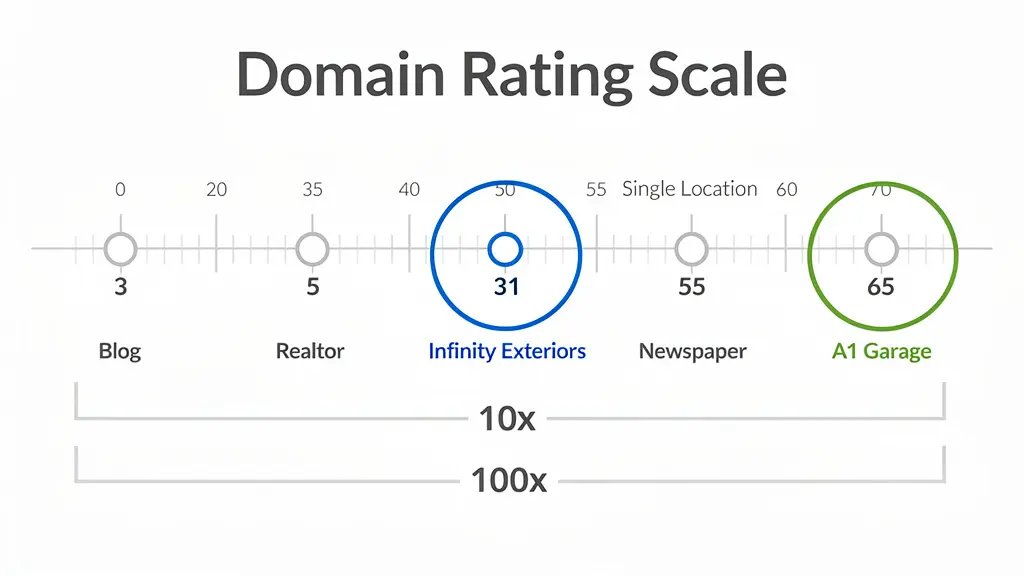
Every website has a domain rating, which is essentially a collection of all the votes pointing to your site. These come from links between other sites, internal links between your own pages, media coverage, personal blogs, and citations like stuff you’ve posted on YouTube or Facebook. All of these signals are proof that you’re alive, that you actually do roofing in Kenosha, Wisconsin, that you actually do pest control in Milwaukee.
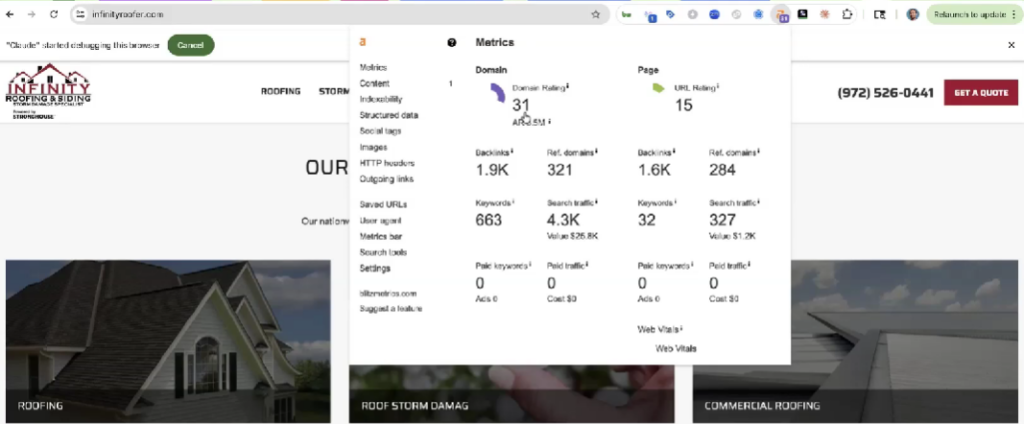
This rating runs on a logarithmic scale, similar to the Richter scale for earthquakes. If Infinity Exteriors can move from their current domain rating of 31 to a 41, that’s not just a little better, that’s roughly 10 times more powerful. Going from 31 to 51 would be a hundred times more powerful.
For reference, a regional newspaper might sit in the 50s or 60s. A single-location business might be a 10 or 15. A real estate agent might be a 5, and a personal blog a 2 or 3. Infinity’s 31 is actually pretty good for a regional business.
Across their whole domain, Infinity ranks on 663 keywords. A lot of those are geo-vertical terms like “how much does it cost to replace a roof” or “HVAC replacement cost.” When you win organically on these terms, it’s like having the Macy’s corner unit at the mall instead of a little store. That’s the power of organic rankings versus paying for ads.
Where cross-linking falls apart
Here’s where most multi-location companies go wrong, and honestly everyone is guilty of this.
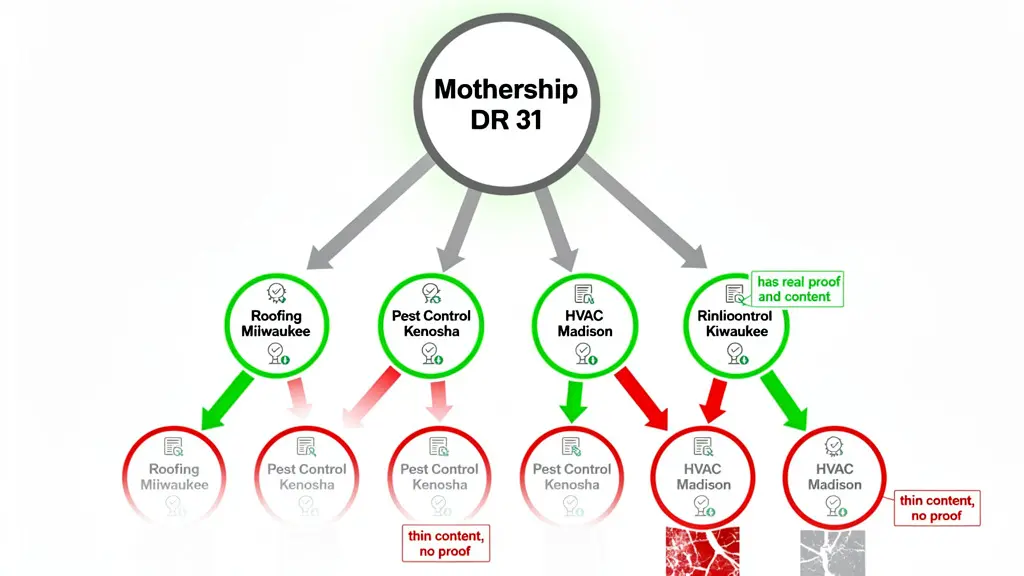
They auto-generate a bunch of pages, the business people don’t apply a business concept because they think SEO is a technical thing, and the technical people claim there’s some SEO expertise that’s really just a way of avoiding accountability.
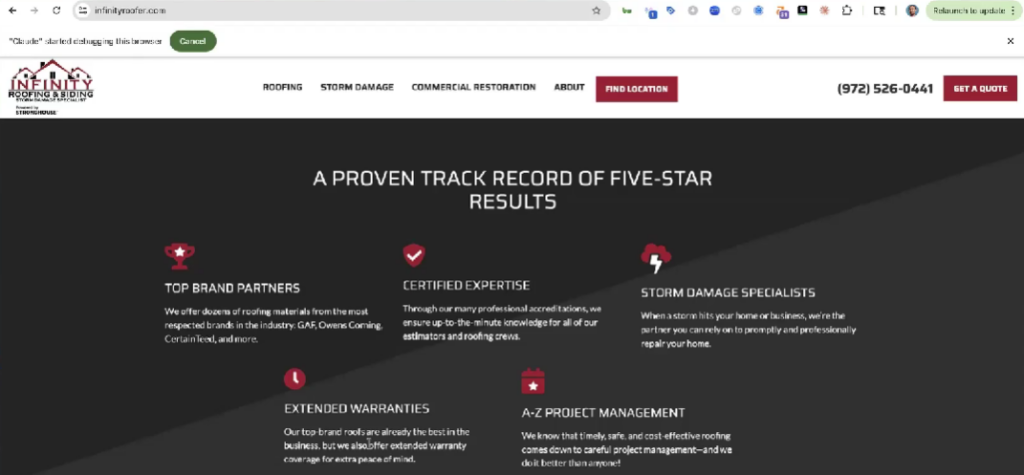
I looked at Infinity’s site and you can see the problem immediately. They cross-link everywhere, jam all their city names into the footer of every page, and there’s even a misspelling on “roof storm damage” that someone needs to fix. Google sees that kind of sloppiness as garbage.
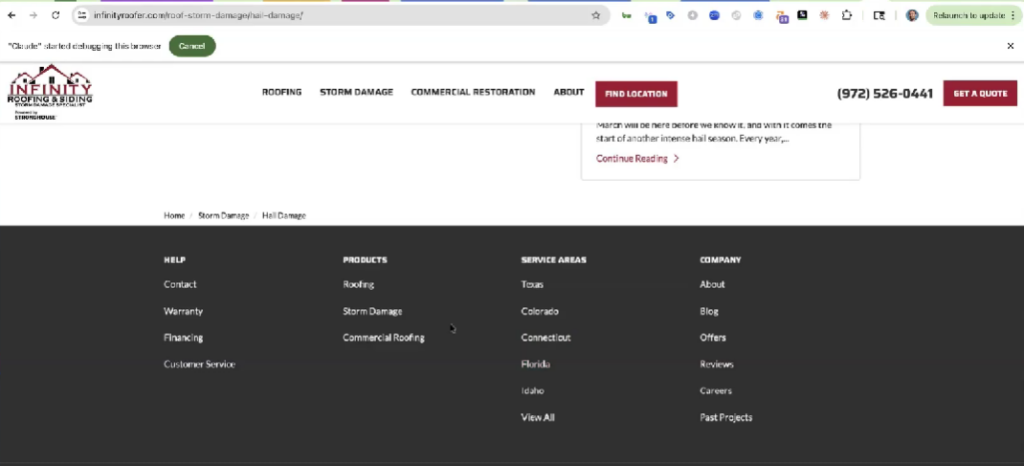
Yes, links help. But the links actually have to be helpful, they have to be in the body of the content, and there has to be juice to pass. If your site has a domain rating of three, you can cross-link all you want, but there’s nothing to pass.

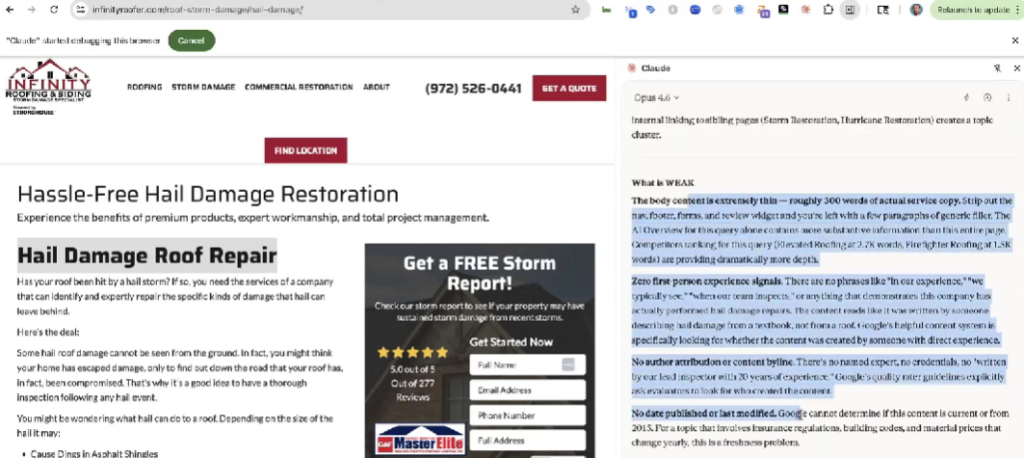
When I drilled down to Infinity’s hail damage service page, the problems became clear. I ran it through an AI tool looking for Google’s own EEAT signals: experience, expertise, authority, and trust.
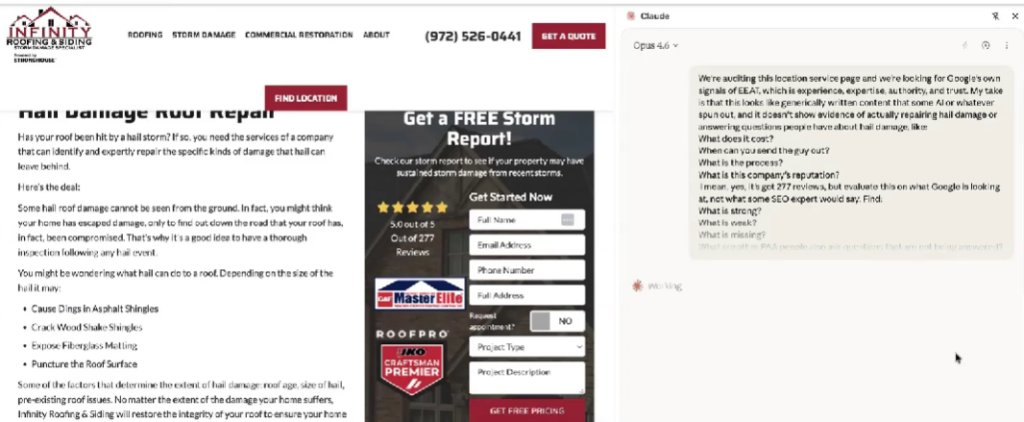
My take is that it looks like generically written content that some AI or copywriter spun out. It doesn’t show evidence of actually repairing hail damage. It doesn’t answer the questions real customers have, like what does it cost, when can you send someone out, what’s the process, and what is this company’s reputation.
Yes, Infinity has 277 reviews, but you have to evaluate pages on what Google is actually looking at, not what some SEO expert says. Check what’s strong, what’s weak, what’s missing, and look at the People Also Ask questions that aren’t being answered. You can use any free AI account to audit this, and it will tell you the page doesn’t answer those questions.
I don’t mean to throw anyone under the bus, but the page reads like a sales brochure. “Has your roof been hit by hail?” That’s not what Google wants to show people.
Two things must be true for cross-linking to work. First, the page receiving the link must have genuine, useful content with real proof. Second, there must be actual link juice to pass. Even if you have the juice, if the page isn’t worth showing, it doesn’t matter. Both have to be true at the same time.
When I looked at Infinity’s hail damage page specifically, there were no links pointing to it. It ranks on some keywords out of the total 663, which is fine, but if the mothership gets more powerful through advertising, relationships, or being featured by the Better Business Bureau, that authority flows down to all the other pages. The problem is the pages themselves don’t have enough real content to deserve that juice.
The only anchor text linking to the page was “roof storm damage professionals.” If you’re using that as anchor text, that’s not a natural link. That’s clearly someone trying to manipulate the search engines. I promise you the search engines see that. All these SEO people want to argue with me about triangular linking or private network linking, but no.
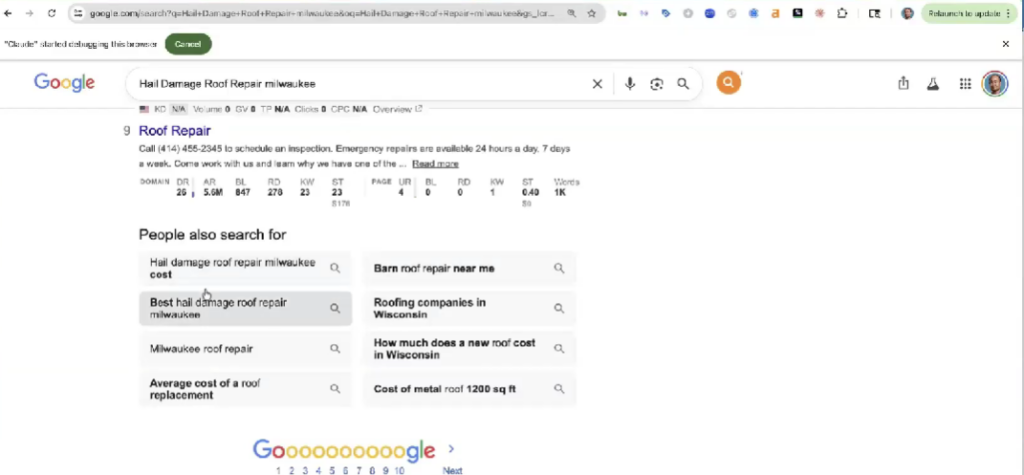
Here’s a real test. I searched “hail damage roof repair Milwaukee.”
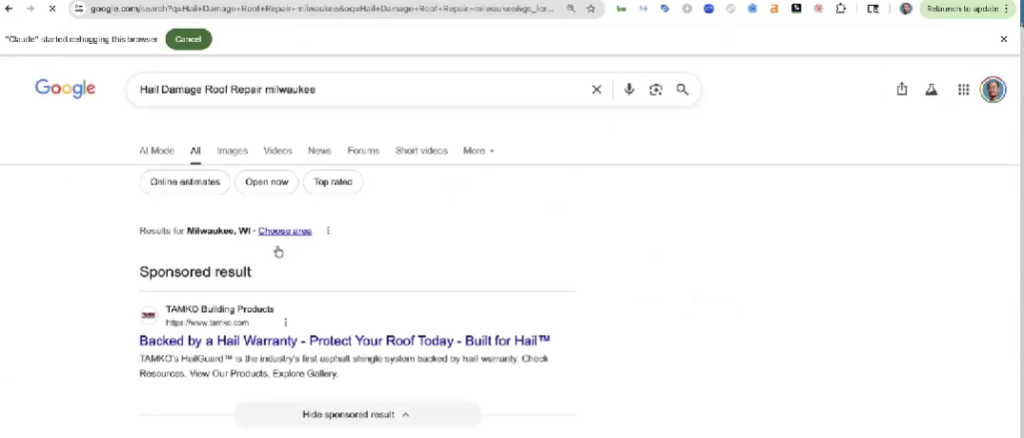
There’s Infinity in the results, but they’re not number one despite having more reviews.
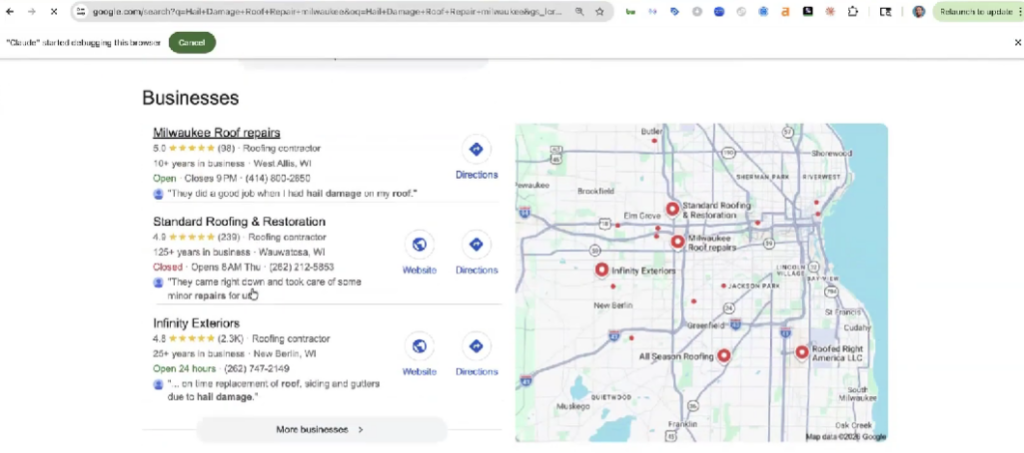
The company outranking them has a site with only a domain rating of 17 and doesn’t rank on very much overall, but that specific page probably has a lot more proof.
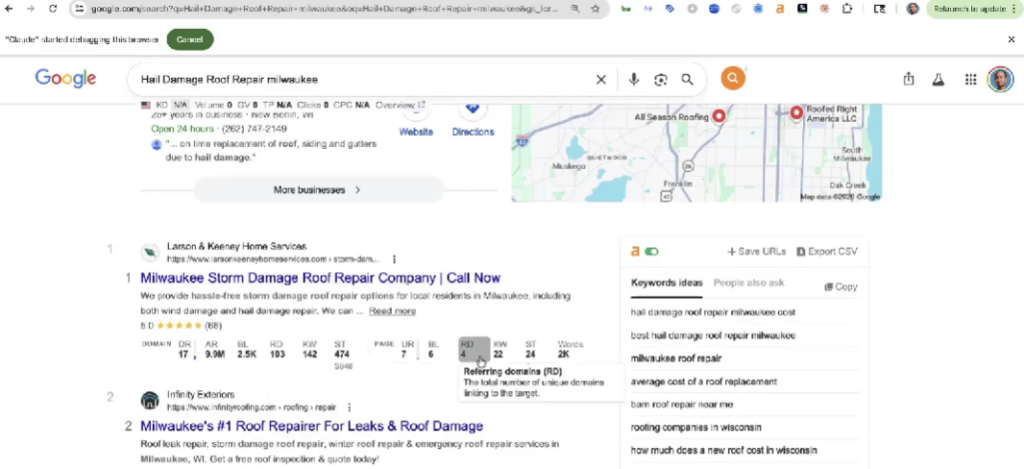
The individual page’s power matters, and the Google Business Profile contributes too. If that’s your location, you should link from the GBP to the webpage and from the webpage back to that particular GBP. It doesn’t pass link juice directly, but it’s still a citation.
Infinity has so much power at the domain level. With a 34 they really should be performing like a 50. There’s so much more they could do by pushing the juice down to individual pages, but those pages need real content first. Passing links thoughtfully embedded in actual stories and experience, you need to do both at the same time. Don’t just think you’re going to cross-link and magically your SEO improves because the mothership has so much power.
What a strong multi-location site looks like
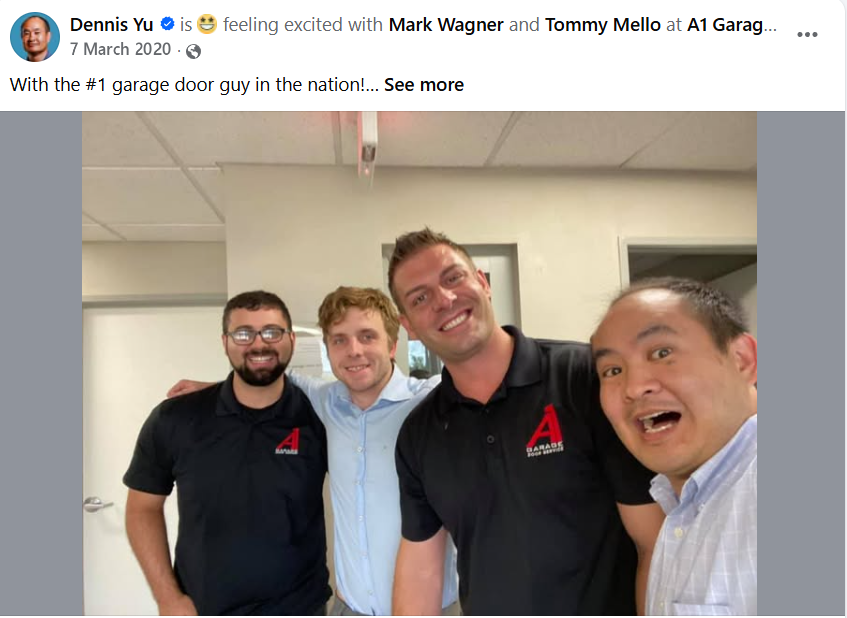
My friend Tommy Mello runs A1 Garage Door Service, a $300 million a year company that’s expanding quickly all over the country.
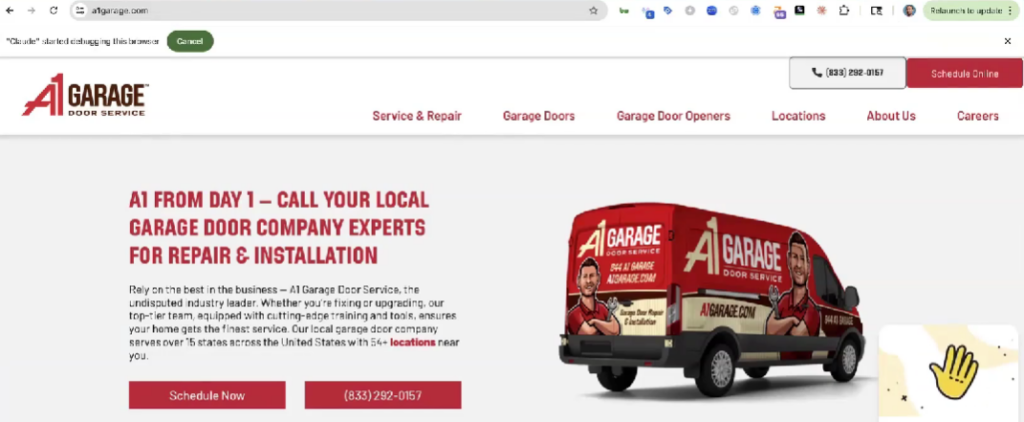
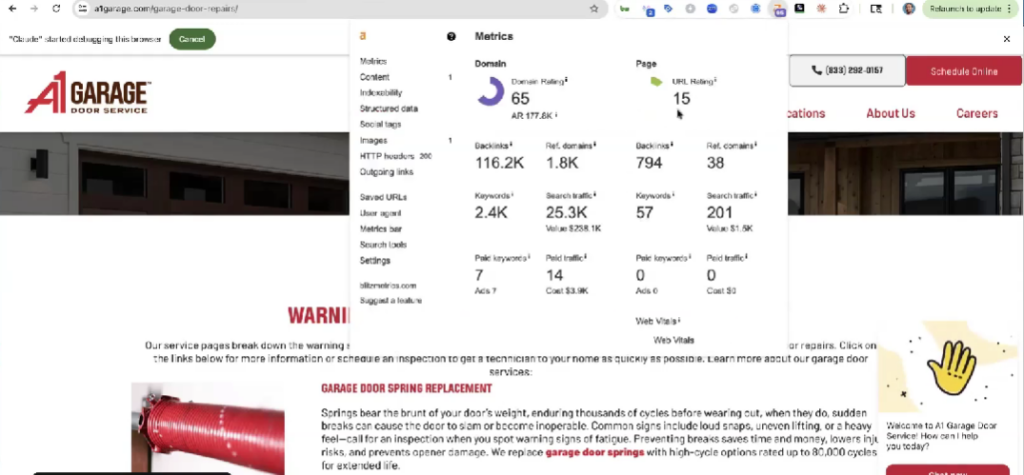
His site has a domain rating of 65, which is about a thousand times more powerful than a 30.
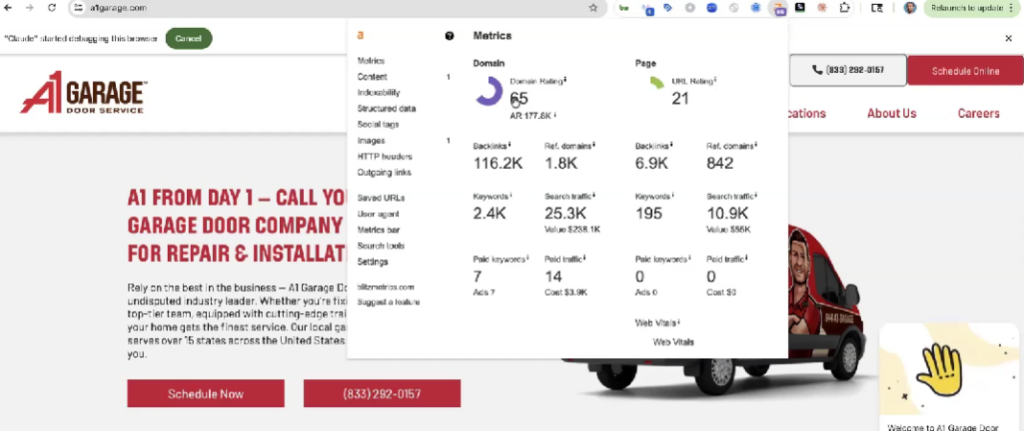
I’ve helped Tommy with SEO for many years, so this didn’t happen overnight.
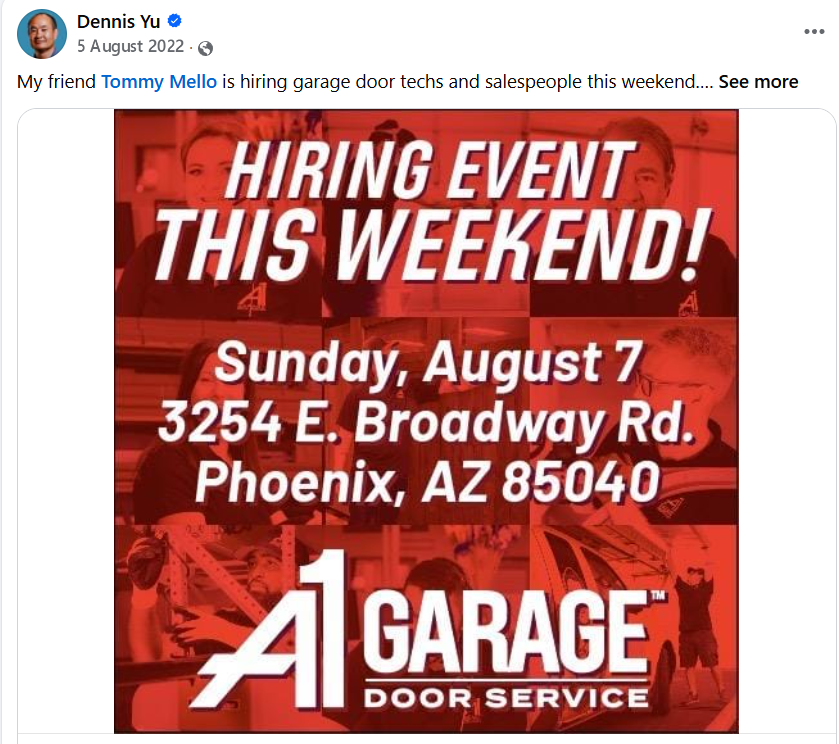
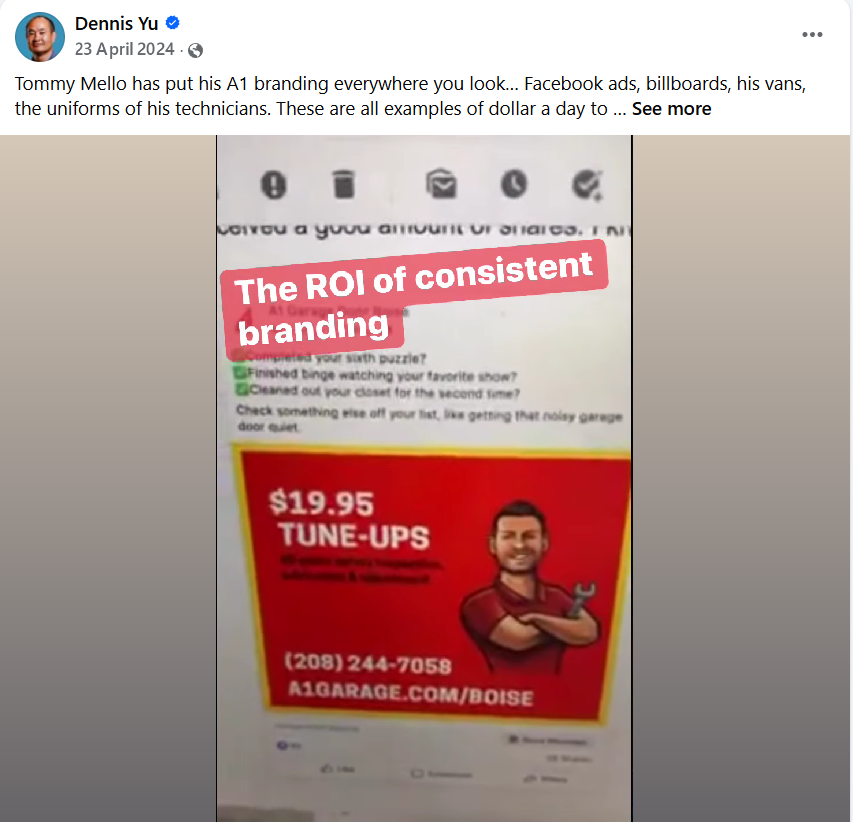

Plus he’s running TV and radio, his vans are everywhere, and all those branding signals compound together.
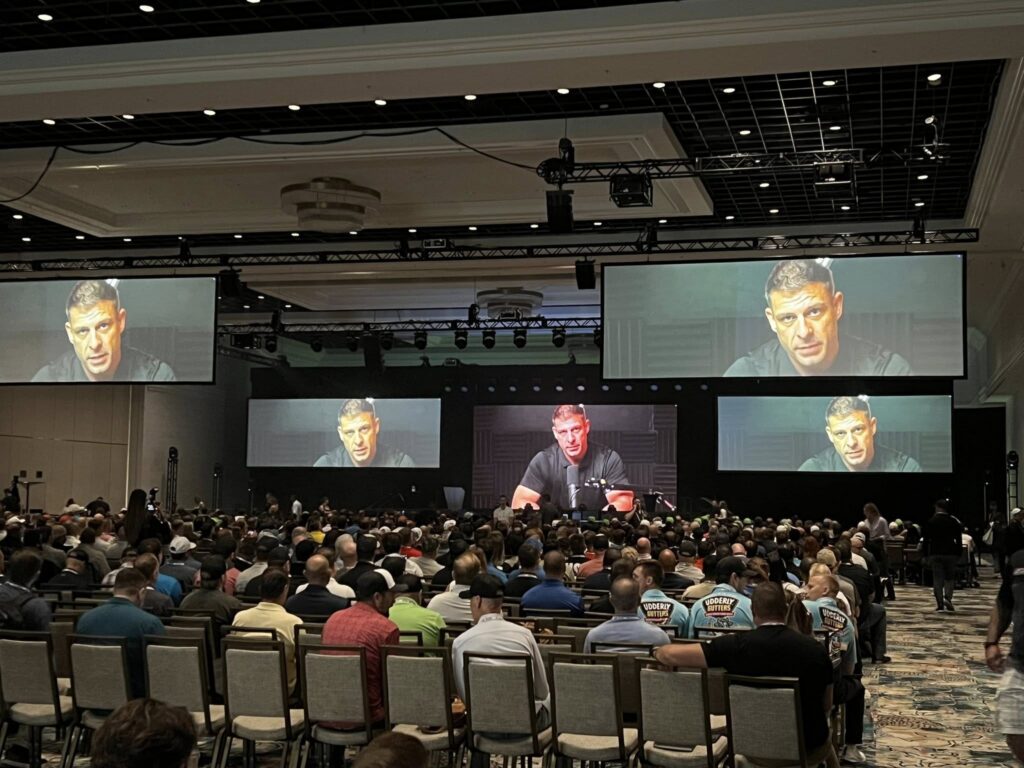
His team goes out and gets reviews, and technicians get paid $10 or $20 per review based on quality, like mentioning the specific service and taking pictures.
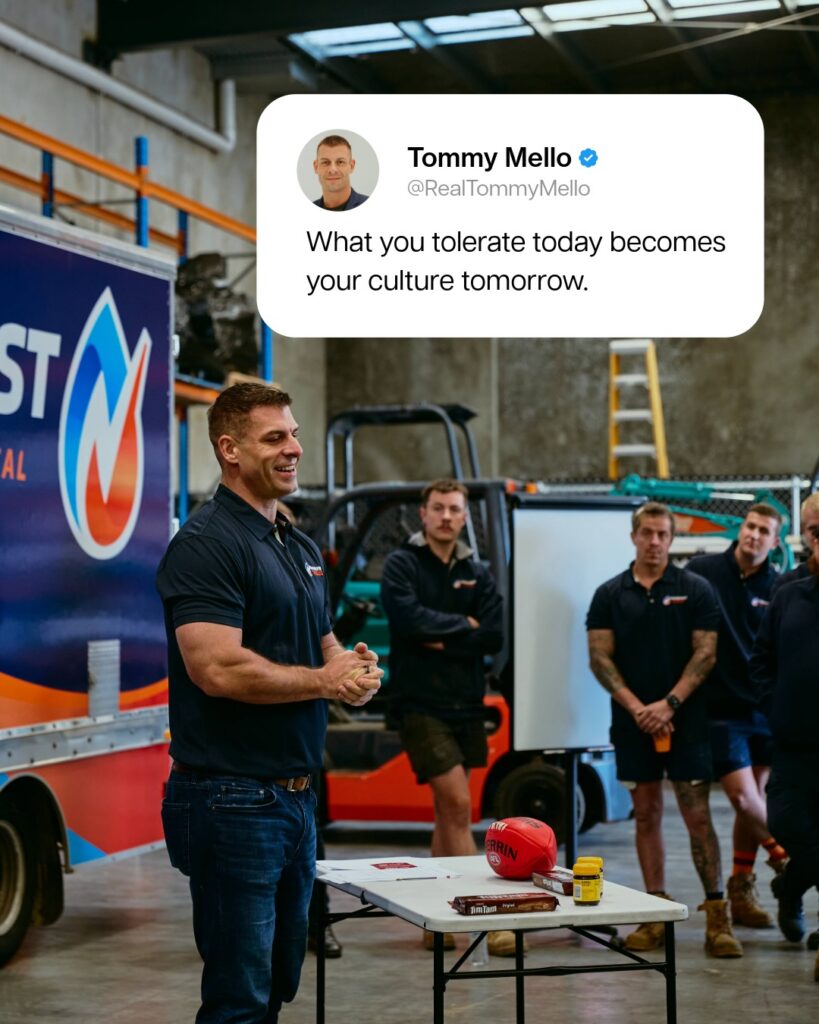
All these things generate more signal.
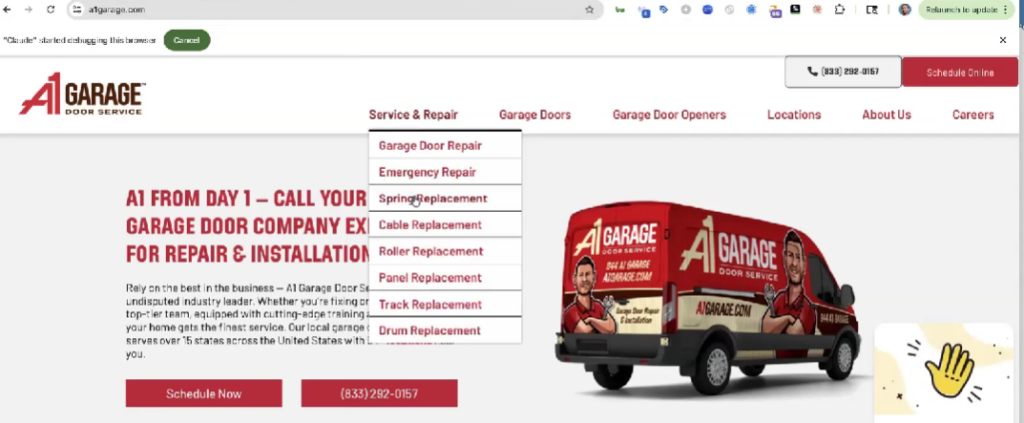
When you look at A1’s individual service pages like garage door repair in Dallas, those pages carry real weight and have meaningful links from other domains beyond just the mothership. That’s the difference.
The local signal is what your crews collect in the field
Back to Ethan’s original question. Links from the mothership and from other locations do help. But you still have to have the proof of real stories, the links have to be embedded properly, and if you’re not telling stories and linking between them, it just looks like naked linking.
Think of a multi-location business as a big tic-tac-toe grid. You have cities across one axis and services across the other. Solar in Dallas, HVAC in Phoenix, roofing in Madison. The whole point of local SEO is showing signal strength that you are credible in that city and in that vertical.
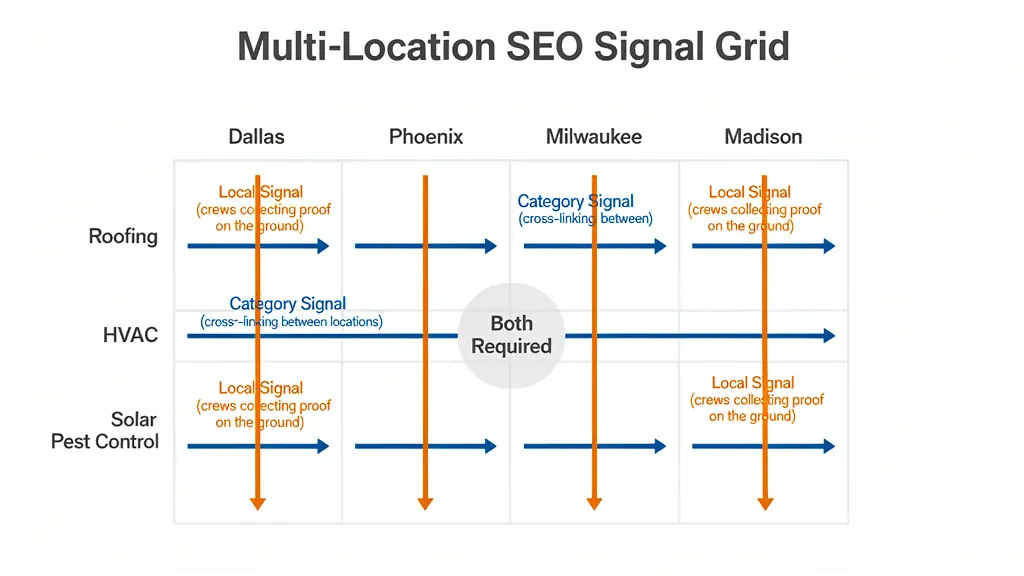
Cross-linking between locations strengthens your category signal. It shows Google you’re credible in roofing as a vertical. But it doesn’t build your local signal. That has to come from the ground.
Your crews on site, talking to homeowners, building relationships in the community, they’re the ones who capture the actual local signal. That local signal is then bolstered by the category signal from the mothership. As Infinity gets stronger overall, each location benefits more, but only if the location-specific proof is there.
I saw Ethan sent out a note to his teams saying here are things we need you to do so we can work together. You do your part gathering pictures, videos, and reviews, and central marketing does their part. That’s exactly how it should work.
If you have multiple locations and an agency, that agency is your central marketing. But you still need crews out there collecting real content. I don’t care how amazing the agency is, unless they have people on the ground in every city you operate, following technicians around, it’s not going to work. The technicians need to gather that proof and it needs to be part of their compensation.
Answering the questions people are actually searching
When someone searches “hail damage Milwaukee,” Google shows People Also Ask questions like “what’s the best hail damage roof repair company in Wisconsin” and “how much does a new roof cost in Wisconsin” and “average cost of a roof replacement.”
If your crews are answering these questions on camera, not the CEO, not an actor, not someone in a studio, but the actual technicians saying “hey guys, today we’re here in the city and we’re fixing Mrs. Smith’s roof, and you can see here what the damage looks like,” that’s gold. Quick cell phone videos that take a few seconds each.
People search for “barn roof repair near me.” Do you have videos and pictures showing barn roof repair in Milwaukee or whatever city you serve? You need lots of real examples in each city.
Once that content exists, then you have something to cross-link. You can link from a barn roof repair story in Milwaukee to similar examples in other cities. Without the content, there’s nothing to link and all you have is a bare-bones structure of location service pages.
The marketing folks are the chefs. The crews have to bring the ingredients. Bring the beef and the chefs can cook. If you don’t give the Ethans of the world the ingredients, it’s not going to work.
Verify everything is real
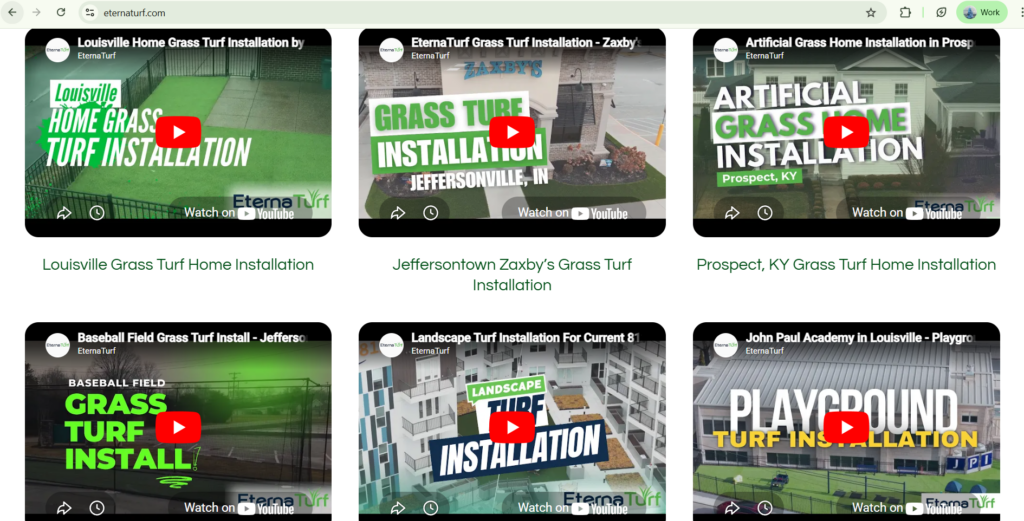
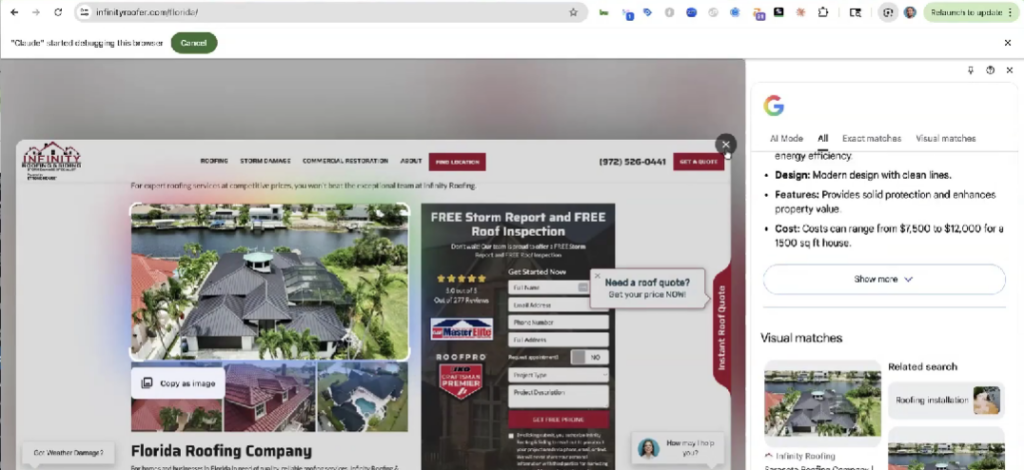
I looked at Infinity’s Florida pages to check whether the photos were real. A quick reverse image search through Google Lens shows whether a picture is used on other sites. If it is, it’s stock art and Google knows it’s not real. In Infinity’s case, their photos were actually theirs, showing real work in Fort Myers and Sarasota. That’s good, Google knows those are real pictures from those locations.
But here’s a common mistake: don’t label your pages “residential roofing” or “commercial roofing.” Residential customers don’t type “residential” into Google. You shouldn’t use that term either.
The bigger issue is that even with real photos, the pages still showed all these cities without showing real proof for each one. Cross-linking won’t help if you don’t have real stories to link from. It’s a chicken and egg problem.
Scale it with AI agents, not more headcount
Here’s the exciting part. With the AI agents we build, you are the manager of those agents. If your franchisees, general managers, and technicians out in the field are collecting photos, videos, and stories into their Company Cam, their ServiceTitan, or whatever CRM or field service tool they use, then you can go to town.
Instead of hiring 27 Ethans for 27 locations, you have one Ethan managing AI agents from the country of Anthropic or the country of ChatGPT. They do the work according to your standards, and you get more done without scaling headcount.
This applies whether you’re with Infinity or you have five locations of your own. The same principles hold. And if you need help, reach out. I’m a real human, and yes, I have to tell you in 2026 that this is actually me and not an AI-generated version of myself. I’m sitting in an Airbnb at a lake house in Dallas with a bunch of kids running around as proof.
Related Articles
- Internal Linking: The Complete Guide
- How to Build Your SEO Tree
- Link Building Strategies That Work
- Local Service Business Website Checklist
- Digital Plumbing: Fix Your Technical SEO
Originally published .
Dennis Yu
Dennis Yu is the CEO of Local Service Spotlight, a platform that amplifies the reputations of contractors and local service businesses using the Content Factory process. He is a former search engine engineer who has spent a billion dollars on Google and Facebook ads for Nike, Quiznos, Ashley Furniture, Red Bull, State Farm, and other brands.
Dennis has achieved 25% of his goal of creating a million digital marketing jobs by partnering with universities, professional organizations, and agencies. Through Local Service Spotlight, he teaches the Dollar a Day strategy and Content Factory training to help local service businesses enhance their existing local reputation and make the phone ring.
Dennis coaches young adult agency owners serving plumbers, AC technicians, landscapers, roofers, electricians, and believes there should be a standard in measuring local marketing efforts, much like doctors and plumbers must be certified. He has appeared on 353 podcasts with 619 credited episodes — see the full list of his podcast appearances.