
 by
by
If you sell courses, run a coaching program, or have built a library of content over the years, you are sitting on a goldmine that most people never tap. We are not talking about repurposing a few videos into blog posts. We are talking about turning your entire methodology—your courses, your frameworks, your student success stories—into AI agents that work alongside your students 24/7.
This is what we built for Sigrun Gudjonsdottir, an 8-figure online business coach who has helped hundreds of female entrepreneurs build and scale their businesses. The system we describe here is not theoretical. We have already inventoried her content, published the case study, and are deploying the agents. This article explains the full process so other coaches and personal brands can follow it step by step.
Why Courses Alone Are Not Enough Anymore
Every coach knows the completion problem. Students sign up, attend the first few modules, then stall. They know what to do—they just do not do it. The gap between learning and implementation is where most programs lose people.
The reason is simple: courses teach strategy, but students still need to execute. They need to write the blog posts, set up the landing pages, audit their SEO, post on social media, track their metrics, and follow up with leads. That is a full-time marketing job on top of whatever their actual business is.
AI agents change this equation. Instead of just teaching your students what to do, you can give them a team that actually does the work—following your exact methodology, documented as step-by-step SOPs that the agents execute and you can audit.
The Three-Phase Process
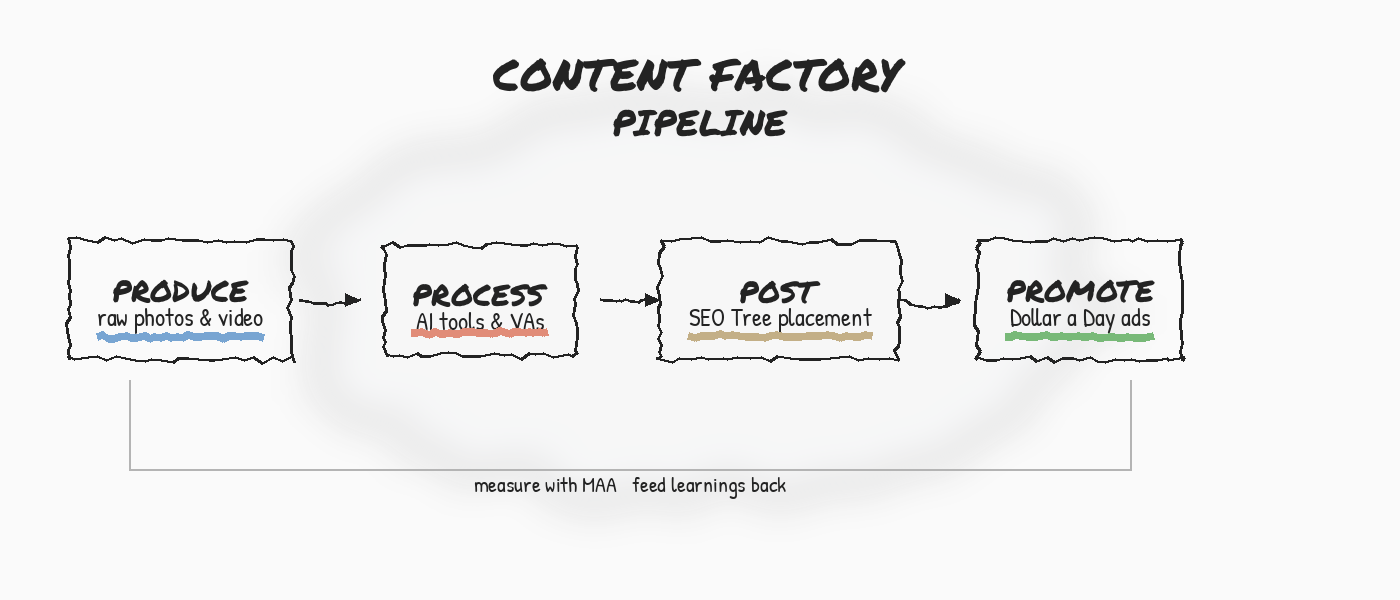
We follow the Content Factory process at BlitzMetrics. Whether we are working with a business coach, a fitness influencer, or a marketing consultant, the approach is the same three phases.
Phase 1: Inventory Everything You Have
Before building anything new, we catalog what already exists. Most coaches have far more content than they realize. For Sigrun, the inventory revealed over 1,200 assets: 492 podcast episodes, 583 YouTube videos, 100+ guest appearances, HuffPost and Forbes articles, TEDx talks, awards, courses, and hundreds of student testimonials.
You follow the same process for your own content. We have published step-by-step guides for each piece:
- How to inventory a YouTube channel — Catalog every video, playlist, and performance metric
- How to inventory a podcast on YouTube — Map episode topics to skills and student outcomes
- How to repurpose YouTube videos into articles — Turn video content into SEO-optimized blog posts
- How to collect positive mentions for authority — Gather testimonials, press, and social proof
The inventory is not just a list. It is the foundation for everything that follows, because it tells the agents what content exists and what each piece is about.
Phase 2: Turn Your Methodology Into a Task Library
This is where most people get stuck, and it is the most important part. Your courses already contain a methodology—a way you teach people to get results. The task library extracts that methodology into discrete, executable skills.
Every skill in the task library follows the same structure, which we document as definitive articles:
1. Clear Inputs and Prerequisites. What does the agent need before it can start? For a content repurposing skill, it might need the video URL, the target keyword, and the student’s brand voice document. Mark what must be done before this skill runs.
2. Step-by-Step SOP. The skill itself, broken into a detailed recipe. Not “write a blog post” but “extract the three main talking points from the transcript, draft a 1,200-word article following the blog guidelines, include two internal links, add a meta description under 155 characters, and format with H2 subheadings.” Specific enough that an agent—or a junior team member—can execute without ambiguity.
3. QA Checklist. A definitive list of items that can be objectively verified as done or not done. No subjective assessments. Binary pass/fail. “Does the article have a meta description under 155 characters?” Yes or no. “Are all links valid and returning 200?” Yes or no. This is how you maintain quality at scale.
4. Meta-Article Generation. Every time a skill runs, the agent documents what it did—step by step—and publishes that documentation as a meta-article. This creates an auditable trail of every execution. You can see exactly what was done for each student, when, and what the result was.
Phase 3: Deploy Agents to Your Students
Once the task library is built, each student receives a customized package of skill files tuned to their business. The framework is 99 percent the same—the same methodology, the same SOPs, the same QA—but modified for their specific niche, their voice, and their offers.
The agents then run on a schedule, executing tasks daily and weekly. They handle content repurposing, SEO optimization, website updates, and performance analysis. When they need human input—”record a video about this topic,” “approve this post before publishing,” “clarify your pricing”—they prompt the student directly.
This is not full automation. It is a collaboration between agents and humans, with clear boundaries:
- Agents handle: Content repurposing, SEO, website updates, weekly performance analysis, ad optimization, scheduling
- Students handle: Recording original content, clarifying their niche, approving content, client relationships, pricing decisions, strategic direction
The Two-Layer QA System
Quality control is where most AI implementations fall apart. We solve this with two layers of QA that run automatically.
Layer 1: Task QA. Did the agent complete the skill correctly? This runs the QA checklist from the skill file. Every item is checked. If anything fails, the task is flagged for review.
Layer 2: Business QA. Did the work actually drive results? This connects agent output to business metrics—traffic, leads, booked calls, revenue. It is not enough to post 10 times this week. We need to see that those posts generated leads. This requires analytics tracking, which is why we bring in a dedicated analytics person during Phase 2 to connect CRMs, email platforms, social accounts, and ad dashboards via OAuth.
The Weekly MAA: Metrics, Analysis, Action
Every student in the system receives a weekly MAA report from their agent team. MAA stands for Metrics, Analysis, Action:
- Metrics: Traffic sources, content performance, lead generation, email signups, booked calls, revenue—the numbers that matter for their business
- Analysis: What is working? Which content drives leads? Where are the drop-offs? What changed from last week?
- Action: Specific recommendations the agents can execute. “Your LinkedIn post about pricing psychology outperformed everything else this month. We are repurposing it into a blog post and allocating $50 in ads.” Or: “Your email open rates dropped 15 percent. We recommend testing a new subject line format.”
The MAA replaces the weekly coaching call for performance review. Students still get strategic coaching from you, but the operational analysis—the “how is my marketing doing” question—is answered automatically, with data.
Building the Authority Flywheel
Here is the part most coaches miss: everything in this process simultaneously builds your authority and your students’ authority.
When we run the lighthouse strategy for Sigrun, we are connecting her TEDx talk, her Stevie Awards, her Forbes byline, and her Goldman Sachs speaking invitation into a coherent authority signal on her website. We run personal brand website audits and SEO audits to make sure the technical foundation supports the content.
But here is the flywheel: every time we execute this process for a student and document it as a meta-article, that meta-article itself becomes proof. Proof that your methodology works. Proof that your agents deliver results. Proof that your students win.
So the pitch to prospective students becomes: “Here is my documented process. Here are students who followed it and their verified results. Here is exactly what you get: a marketing team of agents that follows the same process, with weekly accountability. If you want to learn it yourself, my YouTube channel and book are free. If you want implementation with expert oversight, here is the program.”
That is a fundamentally different value proposition than “come take my course.”
What This Looks Like in Practice: The Sigrun Case Study
Sigrun had already built custom GPTs for her coaching programs—AI launch assistants that guided students through her 10-week programs. But each GPT was isolated. There was no shared framework, no QA, no documentation of what the agents did.
We started by converting those custom GPTs into standardized skill files and merging them with the skills we created from her content inventory. The result is a unified task library where every skill follows the same input-SOP-QA-meta-article structure.
Her students—female entrepreneurs building businesses to seven figures—get a full marketing team of agents that follows Sigrun’s proven methodology. The agents handle content repurposing, SEO, website optimization, and weekly performance analysis. Sigrun provides the strategic coaching and expertise. The agents provide the implementation.
We addressed GDPR concerns head-on, because many of Sigrun’s students are in Germany and across Europe. The key insight: our SOP-driven system actually helps with GDPR compliance because it documents every data flow as a natural byproduct of operations. We are not creating a privacy problem—we are solving the documentation gap most small businesses already have.
How to Start: The Step-by-Step for Your Coaching Business
If you are a coach or course creator who wants to offer agents to your students, here is the sequence:
- Inventory your content. Every video, podcast episode, article, course module, and testimonial. Follow our YouTube inventory guide and podcast inventory guide to get started.
- Extract your methodology into skills. Look at your courses and identify the discrete tasks your students need to complete. Each task becomes a skill with clear inputs, a step-by-step SOP, and a QA checklist.
- Document each skill as a definitive article. Publish these on your website following the definitive article and meta-article process. This serves double duty: it is both the agent’s instruction manual and SEO content that attracts prospective students.
- Convert skills into executable skill files. These are the .md files that Claude or other AI tools can read and execute. Each one references the definitive article and includes the full SOP and QA checklist.
- Run the skills for yourself first. Before deploying to students, run every skill on your own business. This is how you QA the SOPs and generate your first set of meta-articles as proof.
- Document student success stories as blog posts. Use the positive mentions collection process to turn your students’ wins into structured case studies that link back to the specific skills that drove their results.
- Connect analytics for business-level QA. Set up OAuth connectors to your students’ CRM, email, social, and ad platforms. Define the KPIs that matter: revenue, leads, booked calls, close rate.
- Deploy customized agent packages to students. Take your task library, modify the skill files for each student’s specific niche and voice, and activate scheduled agent jobs.
- Launch weekly MAA reports. Set up the Metrics, Analysis, Action cycle so every student gets a weekly performance review with specific recommendations and agent-executed improvements.
The Bigger Picture: From Courses to Agent-Powered Ecosystems
The coaching industry is at an inflection point. For years, the model has been: create content, build an audience, sell courses, offer coaching calls. The limitation has always been the coach’s time. You can only be on so many calls. You can only review so many students’ work.
Agents remove the time constraint on implementation. Your methodology—the thing you have refined over years of coaching hundreds or thousands of students—can now execute at scale. Not as a replacement for your coaching, but as the implementation arm that makes your coaching actually stick.
The coaches who figure this out first will have a massive advantage. Not because AI is magic, but because they will be able to deliver results instead of just delivering information. And results are what students are actually paying for.
We document everything we do in the task library and publish it as meta-articles so our own process improves with every execution. The system literally gets smarter as more coaches and students use it. That is the compounding advantage of building on a documented, systematized foundation instead of doing everything ad hoc.
If you are a coach or course creator ready to make this shift, start with the inventory. Everything builds from there.
Reference: BlitzMetrics Definitive Articles
These are the definitive articles that document each piece of the process referenced above:
- Content Factory: Task Library Dashboard
- Meta-Articles and Definitive Articles: How AI Agents Document and Improve Themselves
- Case Study: Inventorying Sigrun Gudjonsdottir’s Deep Content Library
- How to Inventory a YouTube Channel
- How to Inventory a Podcast on YouTube
- How We Repurpose YouTube Videos Into Articles
- Blog Guidelines: Building a Blog That Builds Your Brand
- How to Collect and Organize Positive Mentions
- The Lighthouse Strategy
- Personal Brand Website Audit
- SEO Audit Case Study
Originally published .
Dennis Yu
Dennis Yu is the CEO of Local Service Spotlight, a platform that amplifies the reputations of contractors and local service businesses using the Content Factory process. He is a former search engine engineer who has spent a billion dollars on Google and Facebook ads for Nike, Quiznos, Ashley Furniture, Red Bull, State Farm, and other brands.
Dennis has achieved 25% of his goal of creating a million digital marketing jobs by partnering with universities, professional organizations, and agencies. Through Local Service Spotlight, he teaches the Dollar a Day strategy and Content Factory training to help local service businesses enhance their existing local reputation and make the phone ring.
Dennis coaches young adult agency owners serving plumbers, AC technicians, landscapers, roofers, electricians, and believes there should be a standard in measuring local marketing efforts, much like doctors and plumbers must be certified. He has appeared on 353 podcasts with 619 credited episodes — see the full list of his podcast appearances.