

When a Copyright Lawyer Gets Admonished: David C. Deal’s Public Court Record

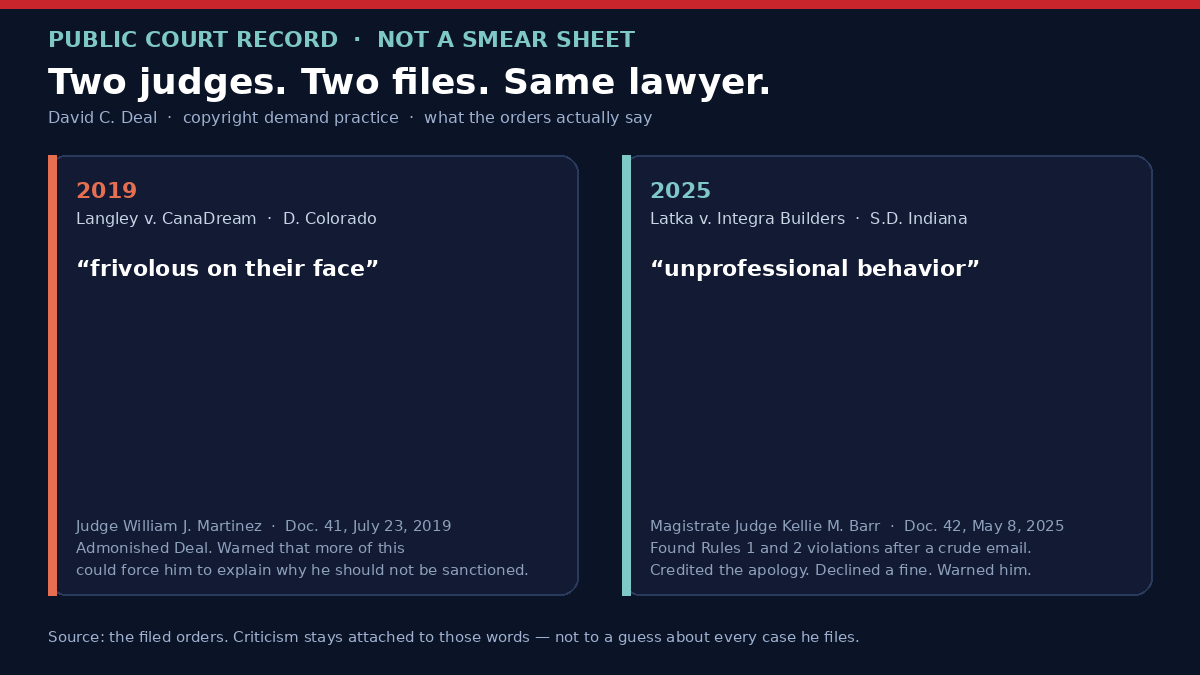
Two public court orders about David C. Deal: a 2019 Colorado order calling his dismissal arguments frivolous on their face, and a 2025 Indiana order finding unprofessional behavior after a crude email.

If a copyright lawyer emails you about a photo on your website, do not panic and do not write a check on fear. Open the court file. Two public orders show David C. Deal being called out by federal judges for sloppy work and ugly words. That is the same pattern we document on this site: people using legal paper as a squeeze, then getting admonished when a judge looks closely.

This is not a claim that every photographer he represents has a fake case. A lawyer can behave badly even when the client has a real photo. The job here is to separate those two facts so a small business owner can stay standing.

Two public court orders about David C. Deal: a 2019 Colorado order calling his dismissal arguments frivolous on their face, and a 2025 Indiana order finding unprofessional behavior after a crude email.
The quotes are the judges’ words, from the filed orders. The diagram is ours. It is a reading of those two files, not a scorecard of his whole career.

This is a lawfare article, not a fan page

On this site we publish the paper when someone tries to use a lawsuit, a bar threat, or a demand letter to squeeze a good operator. We did it when threat letters backfired. We did it when a public court record already said what a later lawsuit wanted to hide. We did it when an attorney’s own filings got so sloppy a bar complaint had to name the conduct. The point is never “lawyers are the enemy.” The point is that volume is not merit, and a scary letter is not a verdict.

David C. Deal belongs in that stack because two federal judges put the criticism in writing. One called his dismissal arguments “frivolous on their face.” The other found professional-conduct violations after an insulting email, then warned him. Those are not blog adjectives. They are docket entries.

2019: a motion the judge dismantled

Photographer Jason Langley sued CanaDream, an RV rental company, over a website photograph. Deal asked the District of Colorado to throw out the company’s counterclaims. Judge William J. Martinez denied the motion and criticized Deal personally. The July 23, 2019 order is on the public Langley v. CanaDream docket (No. 18-cv-1601, Doc. 41).

“frivolous on their face”

Judge Martinez, describing the dismissal arguments, p. 13.

“will not be further tolerated”

Judge Martinez, on the improper use of the motion, p. 14.

“admonishes Mr. Deal for filing a frivolous motion”

Judge Martinez, p. 14.

The problem was basic. A Rule 12(b)(6) motion asks whether a claim is even stated. At that stage the judge assumes well-pleaded facts are true. Deal demanded evidence and argued his own factual story anyway. That is the wrong test. When a lawyer pastes outside facts into a 12(b)(6) motion, Rule 12(d) can turn the request into a summary-judgment fight, with a fair chance for both sides to put in proof. The judge said Deal ignored that. Footnote 7 flagged an ignored practice rule about outside evidence. Footnote 8 said the scolding was about Deal’s motion, not about whether CanaDream’s “abusive litigation” story was true.

The court also rejected CanaDream’s request to enforce a settlement, because an essential term was missing. It imposed no fine and did not decide the copyright claim. Losing a motion is normal. Filing one the judge calls frivolous is not.

My reading: this is embarrassing work product. Forceful tone cannot repair an argument aimed at the wrong question. The professional problem is the quality of the paper, not the disappointment of losing.

Do not stretch the word frivolous. The judge used it on this motion. It is not a finding that every Deal case, or Langley’s photo claim, was fake.

Why that is sloppy lawyering

Imagine a teacher asking whether a science project asks a useful question. The student answers that the other team has not yet proved the result. That misses the assignment. The project may fail later. That is a different question from whether the inquiry even makes sense.

The order makes the work look worse in a second way. The judge spotted possible defects in the counterclaims that Deal had not raised, and declined to decide them for him. Useful arguments were sitting there. The motion talked about unanswered facts instead.

Telling a judge the opponent is the real villain can feel good. It only helps when those facts matter to the decision being made. Otherwise the filing turns into a grievance session. That criticism does not require guessing whether Deal was angry, rushed, or strategic.

A competent request names the issue the court can decide now, the facts it may consider, and the strongest legally relevant argument. Aggression without that discipline is a poor substitute for persuasion. It does not prove dishonesty. It does prove a preventable credibility problem.

2025: an ugly email reaches the judge

Six years later, in Latka v. Integra Builders LLC (S.D. Indiana, No. 1:24-cv-01591), the same lawyer’s email became part of the file. The Southern District of Indiana docket, also tracked on PACER Monitor, shows the sequence.

Deal missed a March 3 settlement-demand deadline, then served the demand on March 12 after being ordered to do so. He omitted the required court copy. Defense counsel forwarded it, with all counsel copied. Magistrate Judge Kellie M. Barr’s May 8, 2025 order (Doc. 42) reproduces the insult:

“you are a liar or uniformed about basic information in this case”

Deal’s email as printed by the court, p. 2. The order prints “uniformed.” That spelling is preserved.

The same order reproduces a crude challenge to the client’s courage, including the phrase “has the balls,” about denying matters under oath. At the May 7 hearing Deal apologized and admitted letting his emotions take over. His written response admitted professional-conduct violations. Defense counsel did not seek sanctions.

On May 8, Judge Barr found violations of Rules 1 and 2, credited the apology, declined sanctions, and warned against further unprofessional behavior in that case or that district. “Will not impose sanctions” is her line, p. 5. The absence of a fine is explicit. So is the finding. The judge closed the show-cause matter, not the lawsuit. Neither disbarment nor a finding of copyright fraud followed from this order.

The email quotation comes from the filed order, not from an independently obtained original. The hearing account comes from the same order, not a transcript.

My reading: the language is crude, belittling, and needlessly personal. A lawyer can challenge an account without taunting the speaker. A sneer supplies no evidence. It invites a fight about personalities and makes the lawyer’s restraint part of the story — which is how lawfare often fails. The paper becomes the exhibit.

Bluster is a poor professional skill

Calling someone names may make a message feel forceful to its author. It does not show ownership of a photograph, lack of permission, the date of a use, or the value of a claim. A sound demand lets the recipient evaluate evidence. A taunt asks the recipient to react to the sender’s attitude.

I would call that schoolyard bluster: an attempt to sound dominant through an insult. That is a judgment about the language. It is not proof of a planned intimidation scheme. The record does not measure its effect on the recipient, and it does not let us know Deal’s private purpose.

The Seventh Circuit’s professional-conduct standards require courtesy in written and oral dealings. They forbid offensive conduct and personal disparagement. They tell lawyers not to act out a client’s ill feelings. They also say the standards themselves should not become a new lawsuit. Courtesy rules and the power to impose a penalty are related but distinct. Judge Barr discussed the court’s own authority to regulate the case in front of her. Circuit home: Seventh Circuit.

An apology matters. Pretending the email never happened would be worse. An apology can explain leniency. It cannot make an insult useful advocacy. There is also no sound basis here to call the apology fake just because a judge was watching.

Deal Copyright Law markets a specialist copyright practice and reports more than 500 clients and 3,500 copyright cases. Those are the firm’s claims, checked September 22, 2026, not audited totals, and “cases” must not be relabeled filed lawsuits or victories. I am not linking the marketing site. A firm that sells expertise should expect scrutiny of its execution. Clients need precision and restraint as well as determination. Experience is a reason to expect better work, not an excuse for worse manners.

A harsh assessment, with honest limits

Accuracy makes the criticism stronger. Exaggeration hands the subject an easy rebuttal. That is the same rule we used on the Fischer public-record pieces: quote the order, then stop where the order stops.

Fair evaluative languageA claim this record does not establish
Sloppy, ill-judged advocacy in the conduct examinedHe cannot handle any legal case competently.
Crude, belittling language in the emailHis whole business is an illegal extortion scheme.
Conduct deserving scrutiny and criticismEvery demand from his firm is fabricated.
A troubling pair of episodesA measured misconduct rate across his entire career.

An insult can be contemptible without being a crime. An argument can be badly presented without proving that the person making it knows the client’s claim is false. A small business owner who treats “I dislike this lawyer” as “the photo claim must be fake” will get hurt. Check the license. Check the use. Check the dates. Then read the lawyer’s own file.

The broader record prevents an easy caricature

In Brammer v. Violent Hues Productions, LLC, 922 F.3d 255 (4th Cir. 2019), Deal was counsel for the photographer on a successful appeal. The Fourth Circuit reversed a fair-use ruling for a website operator and sent the case back. The operator had already taken the image down after a demand; the dispute still went through litigation and appeal. That is evidence of real appellate work. It is not proof of a particular damages recovery, and it is not a guarantee about any new case.

The Virginia State Bar lawyer directory, checked September 21, 2026, identified David Christopher Deal, bar number 86005, as active and in good standing, with no public discipline or current suspension shown. That snapshot does not reveal every confidential complaint. A judge’s criticism in a lawsuit is not the same thing as a bar sanction. Recheck the directory. Status changes.

What I would conclude as a reader: take the professional shortcomings seriously. Read his claims skeptically. Check their support. Do not mistake disliking his conduct for knowing that his client must lose. That is a tougher and more useful judgment than either deference to an intimidating lawyer or blanket dismissal of everything he says.

The opinion advanced here is that the documented behavior falls short of the care and restraint a client should expect. It is not a diagnosis, a criminal accusation, or a claim that every aspect of his practice is illegitimate.

If the letter landed on your shop

This is the part for the plumber, the painter, the HVAC owner, the builder with a website full of job photos. A copyright demand can be real. Photographers have rights. Website operators get those letters every week, and some of them did use a photo they did not license. Panic still helps the sender more than it helps you.

  1. Save the letter. Do not edit it. Do not forward it into a group chat that strips headers. We teach the same rule in the lawfare intimidation piece: the document is the exhibit.
  2. Name the photo. Which image, on which page, from which date. If you hired the photographer, find the invoice. If a vendor or a prior owner supplied it, say so in writing to your own counsel.
  3. Read the public file on the lawyer, not just the tone of the email. Start with the two dockets above. Then use evidence verification: bar number, court orders, not the firm’s own about page.
  4. Do not confuse a missed deadline or a crude sentence with a fake copyright. The 2019 judge was explicit that the admonition was about Deal’s motion, not the underlying fight. The 2025 judge found an ugly email and still did not decide who owned the pictures.
  5. Answer through counsel if the money is real. Silence can default you. A scared overpayment can fund the next letter. The middle path is a sourced response.

That is Goals, Content, Targeting applied to a threat: the goal is to keep the business standing; the content is the order, the photo, and the license; the target is you, the operator, not the lawyer’s ego. It sits in the Content Factory the same way our other public-record pieces do. We process a real document into a page a stranger can check. Writing rules: article guidelines.

If the dispute is already a reputation hit, the same desk that published the reviews page and how we defend reputation with facts applies: put the primary source where Google and a customer can see it. Do not fake a one-star. Publish the paper.

The record behind the criticism

  • [A] Langley v. CanaDream Corporation. District of Colorado, No. 18-cv-1601-WJM-KLM, Doc. 41, July 23, 2019, Judge William J. Martinez. Docket: CourtListener. Read pp. 9–14, especially p. 14 nn. 7–8; settlement discussion pp. 4–9.
  • [B] Latka v. Integra Builders LLC. Southern District of Indiana, No. 1:24-cv-01591-JPH-KMB, Doc. 42, May 8, 2025, Magistrate Judge Kellie M. Barr. Docket: CourtListener and PACER Monitor. Background and email p. 2; response p. 3; findings pp. 4–5.
  • [C] Federal Rules of Civil Procedure. Rules 12(b)(6) and 12(d); Rule 56. The 2019 order is the historical ruling; the current rules explain the procedure.
  • [D] Seventh Circuit professional-conduct standards. Courtesy, no personal disparagement, do not act out a client’s ill feelings. Circuit site: ca7.uscourts.gov. The Latka order explains the court’s own authority to regulate that case.
  • [E] Deal Copyright Law public profile. Firm claims checked September 22, 2026. Marketing assertions are the firm’s, not audited. No outbound link.
  • [F] Brammer v. Violent Hues Productions, LLC, 922 F.3d 255 (4th Cir. April 26, 2019). Counsel listing and disposition from the published opinion. Evidence of appellate capability, not of any new case’s result.
  • [G] Virginia State Bar lawyer directory. Live check September 21, 2026: David Christopher Deal, bar number 86005, via vsb.org. Search David / Deal. Distinguish lawyers with different middle names.

The two central orders were read against the government-hosted PDFs. This page is tied to those orders. It does not report the ultimate outcome of either underlying lawsuit. A current docket check answers that separate question. No nationwide case census, hearing-transcript review, confidential grievance search, or interview with Deal was done for this article.

Quotation boxes are short exact excerpts. Surrounding prose is context and names the speaker. Words such as sloppy, crude, and bluster are evaluative judgments about the specified conduct. This is commentary on a public record, not a disciplinary complaint.

Related reading on this desk

I write these so an owner who did honest work can see that courts do, sometimes, put the squeeze on the record. Read the order. Keep the photo file. Do not pay for a performance.

Dennis Yu
Dennis Yu
Dennis Yu is the CEO of Local Service Spotlight, a platform that amplifies the reputations of contractors and local service businesses using the Content Factory process. He is a former search engine engineer who has spent a billion dollars on Google and Facebook ads for Nike, Quiznos, Ashley Furniture, Red Bull, State Farm, and other brands. Dennis has achieved 25% of his goal of creating a million digital marketing jobs by partnering with universities, professional organizations, and agencies. Through Local Service Spotlight, he teaches the Dollar a Day strategy and Content Factory training to help local service businesses enhance their existing local reputation and make the phone ring. Dennis coaches young adult agency owners serving plumbers, AC technicians, landscapers, roofers, electricians, and believes there should be a standard in measuring local marketing efforts, much like doctors and plumbers must be certified. He has appeared on 353 podcasts with 619 credited episodes — see the full list of his podcast appearances.