
 by
by
If you run a local service business and are wondering whether ChatGPT, Perplexity, and Google AI Overviews will keep sending you customers, the answer is no: you do not need to optimize separately for any of them.
The same signals that earn you a Google Knowledge Panel are the signals that get you cited by every AI tool.
I sat down with Chris Raulf, founder of Boulder SEO Marketing and one of the most respected voices in AI SEO, for the second AI SEO & GEO Online Summit. We spent the first session of the summit talking about exactly what AI search platforms look for, and what local service businesses should do about it.
Chris and I have been speaking at the same conferences for years, going back to DigiMarCon in Denver. He has been doing SEO for nearly 30 years, and his summit brought together five practitioners to talk about what actually works in AI search right now. This article is for local service business owners who want to keep showing up when their customers ask AI tools for recommendations.
The Fundamentals of Search Have Not Changed
Chris opened the conversation by asking me to trace the line from the early days of search engines to where we are now. “What do we need to do? What are the signals that Claude or Perplexity or whoever is looking for? How do we stay ahead?” Chris asks.
Most local service businesses miss this. Search engines, whether we are talking about Google, Bing, or any large language model like ChatGPT, have always been trying to figure out one thing: what is real. The technology gets fancier every year, but the fundamental question does not change. If you understand that search engines are pattern-matching machines trying to identify what is genuinely real and trustworthy, every other AI SEO question becomes simple to answer.
I told Chris, “We’re dinosaurs in this industry,” and Chris agrees with a laugh. The reason that matters is that we have both watched the same fundamentals survive every algorithm update, every new platform, and every wave of hype. The shiny object changes but the signals do not.
Why the Knowledge Graph Is the Real Engine Behind AI Search
The single most important concept for any local service business to understand is the Google Knowledge Graph. It is the structured database of entities (people, businesses, places) and the relationships between them. It is what makes Google smart enough to know that the “Dennis Yu” who runs BlitzMetrics is the same person who used to engineer search at Yahoo, and not someone else with the same name.
For local service businesses, your Knowledge Graph entry is your business as Google understands it — your entity, not your website or social pages. Every time someone Googles your company name, your owner’s name, or your service area, Google is matching that query against entities in the Knowledge Graph and pulling out the most logical answer.
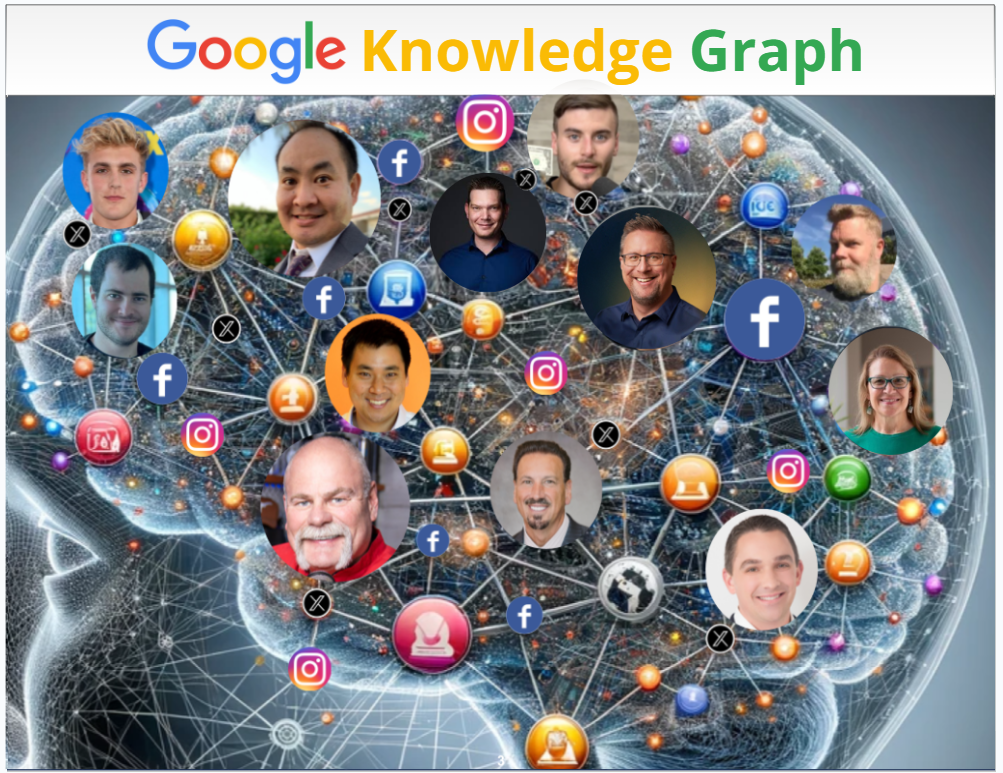
The same logic powers how AI tools decide who gets surfaced. ChatGPT, Perplexity, and Claude are not magic — they are pulling from the same web of corroborating signals that Google uses. If your business is recognized as a real entity with consistent signals across the web, AI tools cite you. If you are a name on a website with no other proof points, you stay invisible.
Why First-Page Rankings Matter Less Now
The idea of ranking number one on Google no longer means what it used to. Being on the first page means very little when the first page is mostly a Google Knowledge Panel, an AI Overview, and a featured snippet. I told Chris that the idea of ten blue links is going to be pretty much dead in a year or two, except for a very narrow category of queries. “I agree,” Chris responds.
Google my name and you will see what I mean. There are colored boxes everywhere, including a knowledge panel on the right side, featured snippets on top, and news, video carousels, and images. There are almost no traditional blue links above the fold. That is the new SERP for any business with strong entity signals, and that knowledge panel converts at a much higher rate than a regular search result, because it answers the customer’s question before they even click.

For a local service business, this is good news if you build your entity properly, and bad news if you ignore it. The contractors who own their knowledge panel get the calls. The contractors who keep buying backlinks from sketchy SEO vendors get nothing. Take, for example, my client Anthony Hilb, who owns a landscaping business in Bloomington, Indiana. He has built his entities, and as a result, he has a Google Knowledge panel, and his business is among the top results everywhere, including AI search.

Should You Optimize Specifically for ChatGPT, Perplexity, and Claude?
Chris asked the question every business owner is asking right now. “Do you, Dennis, do you need to specifically optimize for ChatGPT, Claude, Perplexity? What’s your take on that?” Chris asks.
No, not really. You can optimize for Bing differently than you optimize for Google, because Bing is owned by Microsoft and Microsoft has a stake in OpenAI, which means Bing’s index feeds ChatGPT in ways Google’s does not. But that is a plumbing detail. The core signals that get you cited in any AI tool are the same signals that get you a Google knowledge panel.
To show up in AI search, your business needs to be a recognized entity, which means getting yourself and your owner into a Wikidata entity, claiming your Google Knowledge Panel, and keeping your information consistent across every platform. From there, you build corroborating mentions by getting cited in real publications, getting tagged in real photos and videos, and earning links from people who actually know you, since AI tools weigh third-party mentions more heavily than your own website. You also need to show real work — real photos from real jobs in real locations, with metadata intact, because stock photos and AI-generated content get filtered out. Finally, every article, video, and post should connect to and reinforce the others, since disconnected content does not build authority.
This is why I have been telling local service businesses that “AI SEO” does not really exist as a separate discipline. The work is the same work it has always been. Build a real business, document the proof, and make sure the proof is consistent everywhere. AI tools and search engines will figure out the rest.
The AI Platform Arms Race and Why It Does Not Change Your Strategy
Chris and I spent the last part of our session talking about the platform arms race. Google has AI Overviews and AI Mode. OpenAI has ChatGPT search. Perplexity is racing toward becoming a default answer engine. Anthropic is building Claude into Microsoft and Slack. The platforms are competing hard for the same users.
I recall telling Chris that I assume almost everything will basically be knowledge panels and featured snippets within a year or two. The platform names will keep changing and the interfaces will keep evolving, but the underlying logic of which businesses get surfaced will stay the same: real entities with corroborating signals win. If you spend time chasing the latest “ChatGPT optimization” tactic, you are going to waste money. If you spend that same time building real entity authority, you will show up in whatever platform wins.
What Local Service Businesses Should Do Right Now
For any local service business owner who watched the summit and wants to act on it, the path forward is straightforward:
- Google your own name and your business name to see what shows up. If there is no knowledge panel, that is the first project to take on.
- Audit your Wikidata entity if you already have one, or get one created if you do not. Wikidata feeds the Google Knowledge Graph directly.
- Document your real work by taking photos with location data turned on, recording short videos of your crew, and tagging your team and clients so the search platforms have signals confirming you are a real, operating business.
- Run every new piece of content through the Content Factory process, where one piece of source content (a job site video, a customer call, a podcast appearance) turns into multiple connected articles, social posts, and YouTube videos that all reinforce each other.
- Stop buying random backlinks and stop paying for AI-generated blog posts. Both will get you penalized in any future Google update and ignored by every AI tool.
The businesses that follow this approach are the ones I see winning right now. The businesses that keep chasing whatever shiny tactic some agency is selling are the ones losing ground every quarter. If you want to compare your own business against this same checklist, our Quick Audit walks through it the way we do with our clients.
Originally published .
Dennis Yu
Dennis Yu is the CEO of Local Service Spotlight, a platform that amplifies the reputations of contractors and local service businesses using the Content Factory process. He is a former search engine engineer who has spent a billion dollars on Google and Facebook ads for Nike, Quiznos, Ashley Furniture, Red Bull, State Farm, and other brands.
Dennis has achieved 25% of his goal of creating a million digital marketing jobs by partnering with universities, professional organizations, and agencies. Through Local Service Spotlight, he teaches the Dollar a Day strategy and Content Factory training to help local service businesses enhance their existing local reputation and make the phone ring.
Dennis coaches young adult agency owners serving plumbers, AC technicians, landscapers, roofers, electricians, and believes there should be a standard in measuring local marketing efforts, much like doctors and plumbers must be certified. He has appeared on 353 podcasts with 619 credited episodes — see the full list of his podcast appearances.