

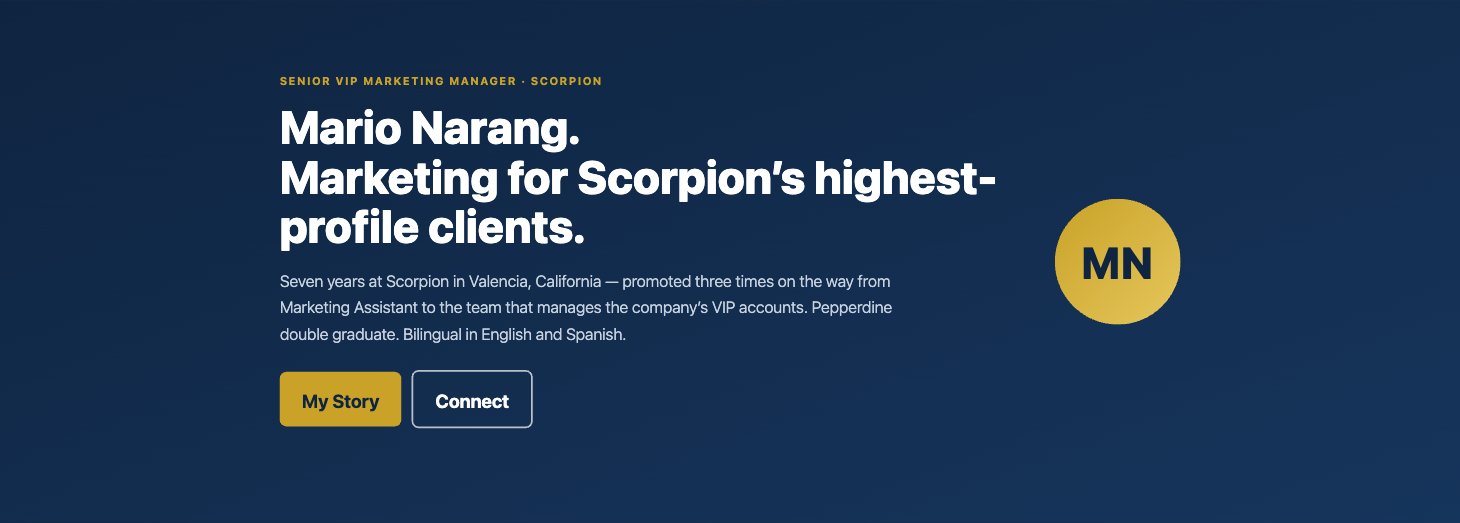
When someone Googles “Mario Narang,” they should find Mario Narang. Mario is a Senior VIP Marketing Manager at Scorpion — the Valencia, California company that handles marketing for law firms, healthcare practices, home services companies, and franchises. He has spent seven years there, earning three promotions on the way from Marketing Assistant to managing the company’s highest-profile accounts. Yet until this morning, the man who runs marketing for Scorpion’s VIP clients had no entity home of his own — just a LinkedIn profile and an Instagram handle.
So we built one: marionarang.com, a detailed, factual bio site assembled by AI agents in one morning — research, provisioning, DNS, content, schema, and QA across 150+ tracked steps in three sessions. This meta-article documents exactly how, the same way we documented the Gavan Thorpe build and the Trenton Sandler build. We publish these because the process is the product: it ties back to our definitive article on building AI-powered personal brand websites, and it shows we have executed this task many, many times.
Start With the Strategy: One Authoritative Home for the Entity
Google’s Knowledge Graph runs on entities — people, organizations, and the connections between them. A personal brand website is the entity home: the one URL that declares who you are, what you do, and how you connect to your employer, your education, and your public profiles. Everything else — Knowledge Panels, branded search results, how ChatGPT describes you — flows from that single authoritative source. The full methodology is documented in How We Build a Personal Brand Website and the Personal Branding Website Checklist.
The homepage is a facts page, not a sales page. Hero with name and role. A stats bar. A short story. What he does. What people say about him, quoted verbatim with sources. Where to find him. That structure is identical across the fleet — camhazzard.com, harryjgold.com, carolhasegawa.com — because the structure is the standard.
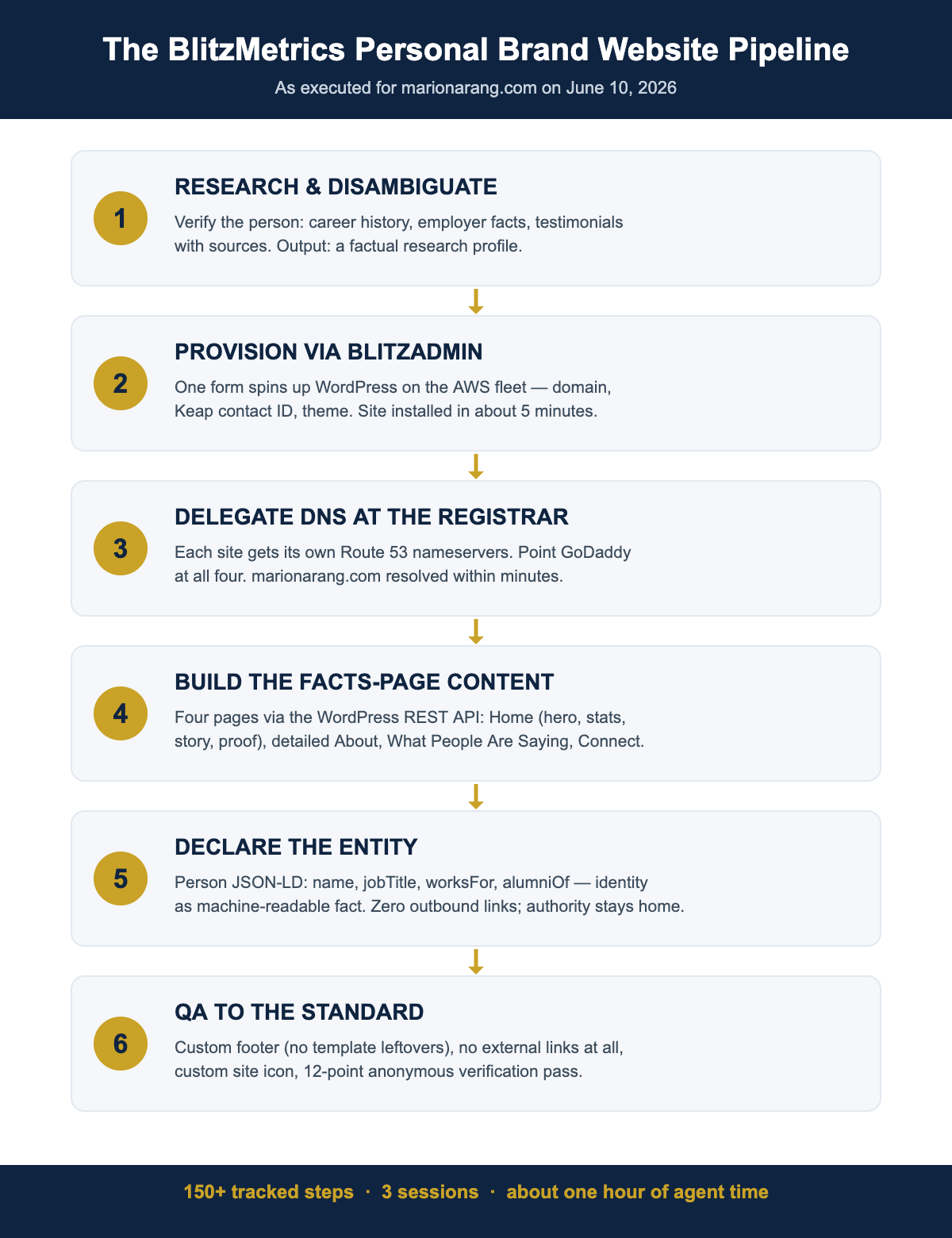
Step 1: Research and Disambiguate the Person
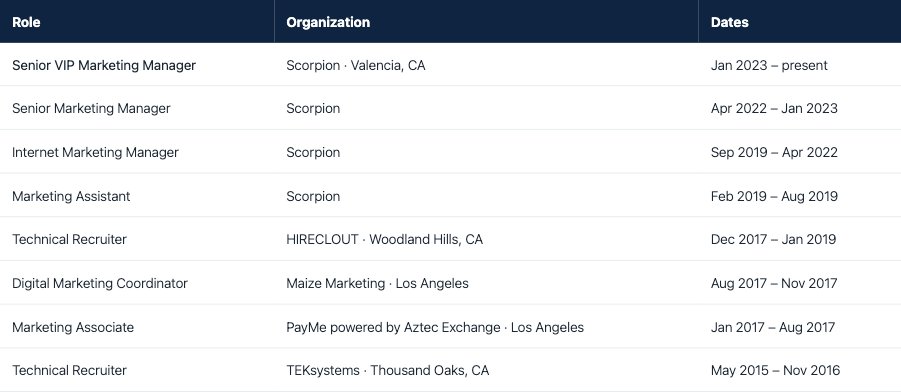
Before a single page exists, the agent verifies who the person actually is. For Mario, that meant pulling his complete career history: four roles at Scorpion since February 2019 (Marketing Assistant, Internet Marketing Manager, Senior Marketing Manager, Senior VIP Marketing Manager), prior recruiting years at TEKsystems and HIRECLOUT, marketing roles at Maize Marketing and PayMe powered by Aztec Exchange, and a Pepperdine University double degree — a B.B.A. in Business Administration and a B.A. in Hispanic and Latin American Languages, with study abroad in Buenos Aires and Madrid. He speaks Spanish at a native or bilingual level.
The agent also captured testimonials with attribution — “One of the best technical recruiters I worked with,” from a Green Dot senior engineer; “I got an offer in two weeks!” from an Oracle engineer — and verified employer facts independently: Scorpion, founded 2001 by Rustin Kretz, headquartered in Valencia, 500-plus employees. Every claim on the site traces to a source. That is what makes it a bio site Google can trust.
Step 2: Provision the Site Through BlitzAdmin
One form in our BlitzAdmin dashboard spins up a fresh WordPress install on the AWS fleet: domain, site title, client email, Keap contact ID, theme. The agent filled it from the research, submitted, and the site reported installed about five minutes later — joining the same fleet that runs camhazzard.com, carolhasegawa.com, harryjgold.com, and joecrisara.com. No hosting setup, no cPanel, no FTP. Provisioning is a solved problem; the agents spend their time on the parts that create value.
Step 3: Delegate DNS at the Registrar
Every site in the fleet gets its own AWS Route 53 hosted zone with four unique nameservers — so the agent created the site first, read its nameservers, then walked into GoDaddy and delegated marionarang.com to all four. Public DNS resolved within minutes. (A lesson we teach from every build: never reuse another site’s nameservers; each zone is unique.)
Step 4: Build the Facts-Page Content
Here is what makes this build different from our earlier case studies: marionarang.com runs on stock WordPress with the default Twenty Twenty-Five theme and zero plugins — no page builder, no SEO plugin, nothing to update or break. The agent published four pages through the WordPress REST API:
Home — hero with role and employer, a stats bar (7+ years at Scorpion, 3 promotions, 2 Pepperdine degrees, 10+ years in marketing and talent), a story section, three “What I Do” cards, on-the-record testimonials, and a connect band. About — the detailed factual bio: full prose narrative, a dated career-history table, education detail, and a quick-facts box. What People Are Saying — every public recommendation quoted verbatim with name, title, company, date, and source. Connect — the canonical places to find Mario online.
Because the server strips Authorization headers (so WordPress application passwords fail over Basic Auth), the agent authenticated the REST API through the logged-in browser session with an X-WP-Nonce — a workaround now documented in our runbook for every future fleet build.
Step 5: Declare the Entity With Schema
The homepage carries Person JSON-LD: name, jobTitle (Senior VIP Marketing Manager), worksFor (Scorpion, founded 2001, Valencia CA), alumniOf (Pepperdine University), knowsLanguage (English, Spanish). The schema is the machine-readable sentence that search engines and AI assistants read first: Mario Narang is a Senior VIP Marketing Manager at Scorpion in Valencia, California.
One deliberate SEO decision worth teaching: the finished site contains zero outbound links to external properties — no anchors to social profiles, and no anchor to the employer’s domain. Profiles and employer are referenced as plain-text facts only. Every drop of authority stays concentrated on the one domain we control, and nothing on the site passes equity — or attention — anywhere else.
Step 6: QA to the Standard
The second session was a fine-tooth-comb pass, the same discipline we applied in the Paul Ryazanov audit. The agent replaced the theme’s default footer — the fake Blog/FAQs/Shop links and the “Designed with WordPress” credit — with a branded footer via the template-part REST API, generated and set a custom monogram site icon, fixed permalinks, and ran a twelve-point anonymous verification: every page returning 200 logged out, schema present in served HTML, sitemap live, sample content gone, zero outbound links to external properties, footer correct on every page including the 404.
That footer now reads, on every page: built to the BlitzMetrics personal brand website standard, built and maintained through the $99/month Personal Brand Website Platform. The site states its own provenance.

What This Demonstrates
A complete, factual, schema-correct entity home for a marketing executive went from “domain in a GoDaddy account” to live and QA-verified in one morning, for a few dollars of compute. Not a mockup — a live site at marionarang.com with DNS delegated, content sourced, and provenance declared. The same playbook produced gavanthorpe.com (850+ steps), trentonsandler.com (from a blank install), and the fleet of builds documented across this site — see also why we bet on the people we build for. Each meta-article is another data point that this is a repeatable system, not a one-off.
Why This Creates Value for Mario Narang
Mario spends his days building marketing results for Scorpion’s most important clients. Now his own name has an authoritative home: when a client, a conference organizer, or a hiring VP searches “Mario Narang,” they find a verified career history, real testimonials, and a site that declares exactly who he is — instead of a thin scatter of profiles. The Person schema and consistent entity signals are the groundwork for a Google Knowledge Panel under his name.
Why This Creates Value for BlitzMetrics
This build adds a distinct data point to the case-study library: a zero-plugin, stock-WordPress build executed end-to-end by agents — leaner than the Elementor-and-Rank-Math stack used for Gavan Thorpe — plus two reusable engineering discoveries (the stripped-Authorization workaround and the block-theme footer replacement via REST). Every build makes the next one faster: Carol Hasegawa’s build stalled on a missing CRM contact; this build reused the fleet’s standard contact and never stopped. The runbooks compound.
Effort and Cost Comparison
Estimates use Claude pricing for actual token usage and the BlitzMetrics benchmark of $35/hour for an average US digital marketer.
| Task | Agent Time | Human Time | Agent Cost | Human Cost ($35/hr) |
|---|---|---|---|---|
| Research, provisioning, DNS, 4-page content build (Session 1) | ~35 min | 8–12 hours | ~$2.50 | $280–$420 |
| QA: footer, link policy, site icon, 12-point verification (Session 2) | ~20 min | 3–5 hours | ~$1.50 | $105–$175 |
| Meta-article research, diagram, writing, publishing (Session 3) | ~25 min | 4–6 hours | ~$2.00 | $140–$210 |
| TOTAL | ~1 hr 20 min | 15–23 hours | ~$6 | $525–$805 |
That is roughly a 90-to-135x cost reduction — and the human hours saved are the expensive kind: a researcher, a web developer, an SEO specialist, and a QA analyst.
We offer this as a done-for-you service: the $99/month Personal Brand Website Platform builds, hosts, and maintains your personal brand site — everything shown in this case study. For executives who want comprehensive full-service implementation, see the Personal Brand Website Package.
Key Metrics
Tracked steps: 150+ across three sessions. Pages created: 4, plus a custom footer template part and site icon. Schema: Person with sameAs to LinkedIn and Instagram. Outbound links to external properties: 0. Plugins required: 0. DNS propagation: under 10 minutes. Total agent time: about 80 minutes. Live site: marionarang.com.
GO DEEPER: HOW THIS FITS THE BLITZMETRICS SYSTEM
• The Quick Audit: how we audit any business
• MAA (Metrics, Analysis, Action): the framework behind every audit
• The SEO Tree: how all our content connects
• Entity Linking: the decision tree for every link
• Knowledge Panels: getting Google to recognize you
• Every digital audit Dennis Yu has done
THE DELIVERABLE
See the site this article documents
Mario Narang’s personal brand site, built in one morning.
Dennis Yu
Dennis Yu is the CEO of Local Service Spotlight, a platform that amplifies the reputations of contractors and local service businesses using the Content Factory process. He is a former search engine engineer who has spent a billion dollars on Google and Facebook ads for Nike, Quiznos, Ashley Furniture, Red Bull, State Farm, and other brands.
Dennis has achieved 25% of his goal of creating a million digital marketing jobs by partnering with universities, professional organizations, and agencies. Through Local Service Spotlight, he teaches the Dollar a Day strategy and Content Factory training to help local service businesses enhance their existing local reputation and make the phone ring.
Dennis coaches young adult agency owners serving plumbers, AC technicians, landscapers, roofers, electricians, and believes there should be a standard in measuring local marketing efforts, much like doctors and plumbers must be certified.