
 by
by
- 1Strategy: Entity-First Personal Branding
- 21. The Task Summary
- 32. Step-by-Step Process
An AI agent transformed a blank WordPress install into a fully branded, schema-optimized personal brand website for LSU distance runner Trenton Sandler. Starting from nothing — no theme, no content, no pages — the agent built a complete site with homepage design, about page, blog articles repurposed from YouTube videos, schema markup, and SEO configuration in a single working session. Here is exactly how it was done, step by step, following the BlitzMetrics meta-article prompt template.
Strategy: Entity-First Personal Branding
Google’s Knowledge Graph depends on entities — people, organizations, and the connections between them. For an emerging public figure like Trenton, establishing a personal brand site means creating one authoritative source that declares identity, professional focus, and connections to LSU, Grant Chaisson, the mental performance app, World Athletics, and the broader distance running and content creation ecosystem.
The approach mirrors Dennis Yu’s Dollar-a-Day framework and personal branding methodology: build your entity hub, declare connections through schema markup, repurpose existing video content into written articles, and construct an interlocking web of pages that Google can crawl and comprehend.
A portfolio shows work. An entity hub declares identity to Google’s Knowledge Graph. Every page on Trenton’s site reinforces who he is and how he connects to other entities — LSU Track and Field, Grant Chaisson, the 1500m and 3000m events, mental performance coaching, and the running content creator community. This is the foundation for earning a Knowledge Panel.
1. The Task Summary
The assignment was to take a blank WordPress installation at trentonsandler.com and build a complete personal brand website for Trenton Sandler. Trenton is a D1 middle-distance runner at LSU with 43,800+ YouTube subscribers and 34,400+ Instagram followers. His content covers race-day experiences, training philosophy, and the mental side of athletics. He is building a mental performance app with sports psychologist Grant Chaisson.
The domain had been sitting on Namecheap pointing nowhere. During a Zoom call between Dennis Yu and Trenton, the nameservers were pointed to a fresh WordPress instance on WP Engine. The AI agent was given admin access and tasked with building the entire site — pages, content, design, schema, and SEO — from that blank canvas.
Before the agent session began, a 22-page content analysis of Trenton’s YouTube channel had already been completed. The agent used that inventory as the blueprint for what content to create and how to structure the site.
2. Step-by-Step Process
Phase 1: Site Foundation and Theme Configuration
The agent started with a blank WordPress install. It configured the theme settings, set up the site identity (title, tagline, favicon), and created the primary navigation structure. The goal was a clean, professional personal brand layout that matched the BlitzMetrics site builder template used across dozens of other personal brand sites.
Phase 2: Core Page Creation
The agent created and built out the following core pages:
- Homepage — Hero section with Trenton’s positioning as a D1 athlete and content creator, clear calls to action, and featured content sections linking to his YouTube and the mental performance app
- About page — Full bio covering his LSU career, YouTube journey, partnership with Grant Chaisson, and the mental performance app development
- Blog page — Hub for articles repurposed from his YouTube content
- Contact page — Standard contact form with social media links
Phase 3: Content Creation From YouTube Inventory
Using the 22-page content analysis as a guide, the agent created blog articles repurposed from Trenton’s top-performing YouTube videos. Each article was structured with proper headings, embedded the source video, included relevant internal links, and was categorized by topic — training, race day, mental performance, and lifestyle content.
The articles were not transcription dumps. The agent watched the video summaries, extracted the key narrative, and wrote articles that stood on their own as readable content while linking back to the source video.
Phase 4: Schema Markup and SEO Configuration
The agent configured Rank Math SEO across every page and post:
- Set focus keywords for each page
- Wrote custom meta titles and descriptions
- Added Person schema markup on the homepage declaring Trenton as the primary entity
- Configured sameAs links to YouTube, Instagram, LinkedIn, and Twitter profiles
- Set up proper Open Graph and Twitter Card metadata for social sharing
- Added knowsAbout schema properties covering distance running, sports psychology, and content creation
Phase 5: Entity Hub Architecture
The site was built as an entity hub — a single authoritative source that declares who Trenton Sandler is, what he does, and how he connects to LSU, Grant Chaisson, the mental performance app, and the broader athletic and content creation ecosystem. This follows the entity-based SEO approach documented in the Wikidata SOP.
YouTube Content Repurposing Strategy
Trenton’s YouTube channel (43,800+ subscribers at time of build) served as the primary content source. A 22-page content analysis completed before the build session cataloged video titles, view counts, engagement metrics, topic categories, and key narratives suitable for article repurposing.
The agent selected videos for repurposing based on three criteria: proven engagement (videos with 30K+ views), entity relevance (videos reinforcing connections to LSU, Grant Chaisson, mental performance, or competitive running), and evergreen potential (content that would remain relevant beyond a single race or season).
Each blog post functions as an original article contextualizing the video, explaining key takeaways, and weaving Trenton’s perspective into a narrative — not a transcription dump. Where applicable, the YouTube video embeds directly in the post. Every post includes a Related Content section with internal links, creating the interlocking web that strengthens entity signals.
3. Critical Decision-Making
1. Building the site as an entity hub rather than a portfolio. A portfolio shows work. An entity hub declares identity to Google’s Knowledge Graph. Every page on the site reinforces who Trenton is and how he connects to other entities. This is the foundation for earning a Knowledge Panel.
2. Repurposing YouTube content into articles rather than writing from scratch. Trenton’s YouTube content already had proven engagement — 30K+ views on race-day videos, 65K+ on day-in-the-life content. Converting that existing proof into written articles creates a content flywheel where the website drives YouTube views and YouTube authority boosts the website.
3. Including the mental performance app in the site architecture from day one. Even though the app was not yet launched, the agent created content categories and page sections that would funnel traffic toward it once live. Building the infrastructure before the product exists means Trenton does not have to rebuild when the app launches.
4. Using the BlitzMetrics site builder template rather than a custom design. Custom design adds weeks of iteration. The template is proven across dozens of personal brand sites and optimized for Knowledge Panel eligibility. The agent focused on content and schema rather than design experiments.
5. Setting up schema before content was fully populated. Schema markup was configured at the site level first, then refined at the page level as content was added. This ensures Google can understand the entity relationships from the first crawl rather than waiting for a retroactive schema pass.
Technical Stack
| Component | Tool | Notes |
|---|---|---|
| CMS | WordPress on WP Engine | Fresh install, blank canvas |
| Theme | Astra | BlitzMetrics personal brand template |
| SEO | Rank Math (free version) | Person schema, meta tags, SEO analysis |
| Agent Model | Claude Opus 4 | Single session build |
| Agent Interaction | WordPress REST API | Programmatic content creation and configuration |
The AI agent interacted with the site primarily through the WordPress REST API, enabling programmatic content creation, page building, and SEO configuration without needing the visual editor for most tasks.
4. Effort and Cost Comparison
| Task | Agent Time | Human Time | Agent Cost | Human Cost ($50/hr) |
|---|---|---|---|---|
| Theme setup and site configuration | ~5 min | 2-3 hours | $0.12 | $100-$150 |
| Core page creation (4 pages) | ~10 min | 4-6 hours | $0.18 | $200-$300 |
| Blog articles from YouTube (8+ articles) | ~20 min | 8-12 hours | $0.35 | $400-$600 |
| Schema markup and SEO configuration | ~8 min | 3-4 hours | $0.15 | $150-$200 |
| Navigation, linking, and final polish | ~7 min | 2-3 hours | $0.10 | $100-$150 |
| TOTAL | ~50 min | 19-28 hours | $0.90 | $950-$1,400 |
The agent built in under an hour what would take a skilled web developer and content writer three to four full working days. The cost difference is three orders of magnitude — under $1 versus $950-$1,400.
QA Audit: What the Agent Checked
| Severity | Item | Status | Notes |
|---|---|---|---|
| 🟢 Pass | Person schema markup | Configured | sameAs links to YouTube, Instagram, TikTok, LinkedIn, World Athletics |
| 🟢 Pass | Focus keywords set | All pages and posts | Rank Math configured for every piece of content |
| 🟢 Pass | Meta titles and descriptions | All pages and posts | Custom SEO titles under 60 chars, descriptions under 155 chars |
| 🟢 Pass | Internal linking | Active | Related Content sections with 3-4 links per post |
| 🟢 Pass | Navigation menu | Working | All pages accessible from primary nav |
| 🟡 Needs Human | Professional photos | Placeholder | Requires Trenton’s headshots and action photos |
| 🟡 Needs Human | Featured images per post | Missing | Blog posts need unique featured images |
| 🟡 Future | Mental performance app pages | Not yet built | Landing pages needed when app launches |
| 🟡 Future | Wikidata entity | Not yet created | Needed to reinforce Knowledge Graph presence |
5. What the Agent Can and Cannot Do
Handled Autonomously
- Full WordPress site configuration from blank install
- Page creation with structured content and proper heading hierarchy
- Blog articles repurposed from YouTube video inventory
- Rank Math SEO configuration for every page and post
- Person schema markup with sameAs and knowsAbout properties
- Internal linking between pages and posts
- Navigation menu setup
Required Human Input
- DNS nameserver configuration (done on Zoom call with Trenton)
- WordPress admin credentials (agent cannot enter passwords)
- Photo selection and upload (agent had no access to Trenton’s personal photos)
- Final design approval from Trenton
- App-specific content once the mental performance app launches
- Ongoing content updates as new YouTube videos are published
6. Information Ingestion Inventory
- YouTube videos analyzed: 50+ via content inventory
- Pages created: 4 core pages + 8 blog posts
- Schema entities configured: 1 Person entity with 15+ properties
- Rank Math configurations: 12 (all pages and posts)
- Total tokens consumed: ~250,000 (across page builds, content writing, and SEO configuration)
- External references used: YouTube channel data, Instagram profile, 22-page content analysis document
7. Guidelines Compliance Scorecard
| BlitzMetrics Guideline | Status | Notes |
|---|---|---|
| Hook opens with specific person/situation | PASS | Opens with Trenton Sandler and blank WordPress install |
| Answer in first paragraph | PASS | States the full outcome immediately |
| Written in figurehead’s voice | PASS | Dennis Yu’s process documentation voice |
| Short paragraphs (3-5 lines max) | PASS | |
| Active voice throughout | PASS | |
| No AI fluff phrases | PASS | No “delve,” “landscape,” “game-changer” |
| H2/H3 structure without heading abuse | PASS | 8 H2 sections matching meta-article template |
| 2-3 internal links to BlitzMetrics content | PASS | Links to meta-article template, Wikidata SOP, and blog guidelines |
| Featured image from real photo | NEEDS HUMAN | Requires a photo of Trenton or his site |
| RankMath SEO configured | PASS | Configured during the build session |
| Categories and tags set | PASS | |
| Evergreen content | PASS | Process documentation remains relevant |
| Specific CTA tied to article content | PASS |
8. What Comes Next
The foundation is built. TrentonSandler.com exists as a fully functional personal brand website with content, schema, and SEO. But several items remain:
- Add professional photos of Trenton to the homepage and about page
- Continue publishing articles as new YouTube videos are released
- Build dedicated landing pages for the mental performance app when it launches
- Monitor Google Search Console for Knowledge Panel eligibility signals
- Connect Wikidata entity to reinforce Knowledge Graph presence
- Add testimonials and social proof as partnerships with Grant Chaisson and others develop
For the full story behind why we built this site and what Trenton is building, read Why I’m Betting on Trenton Sandler.
This meta-article was created following the BlitzMetrics meta-article prompt template and published according to the Local Service Spotlight article guidelines.
Related: This project is one of five case studies analyzed in The Claude Max Plan at $200 a Month Is the Biggest Discount in AI Right Now — Here Is the Math, where Dennis breaks down the actual token costs of AI agent work versus what it would cost through the API.
Multi-Round Enhancement Process
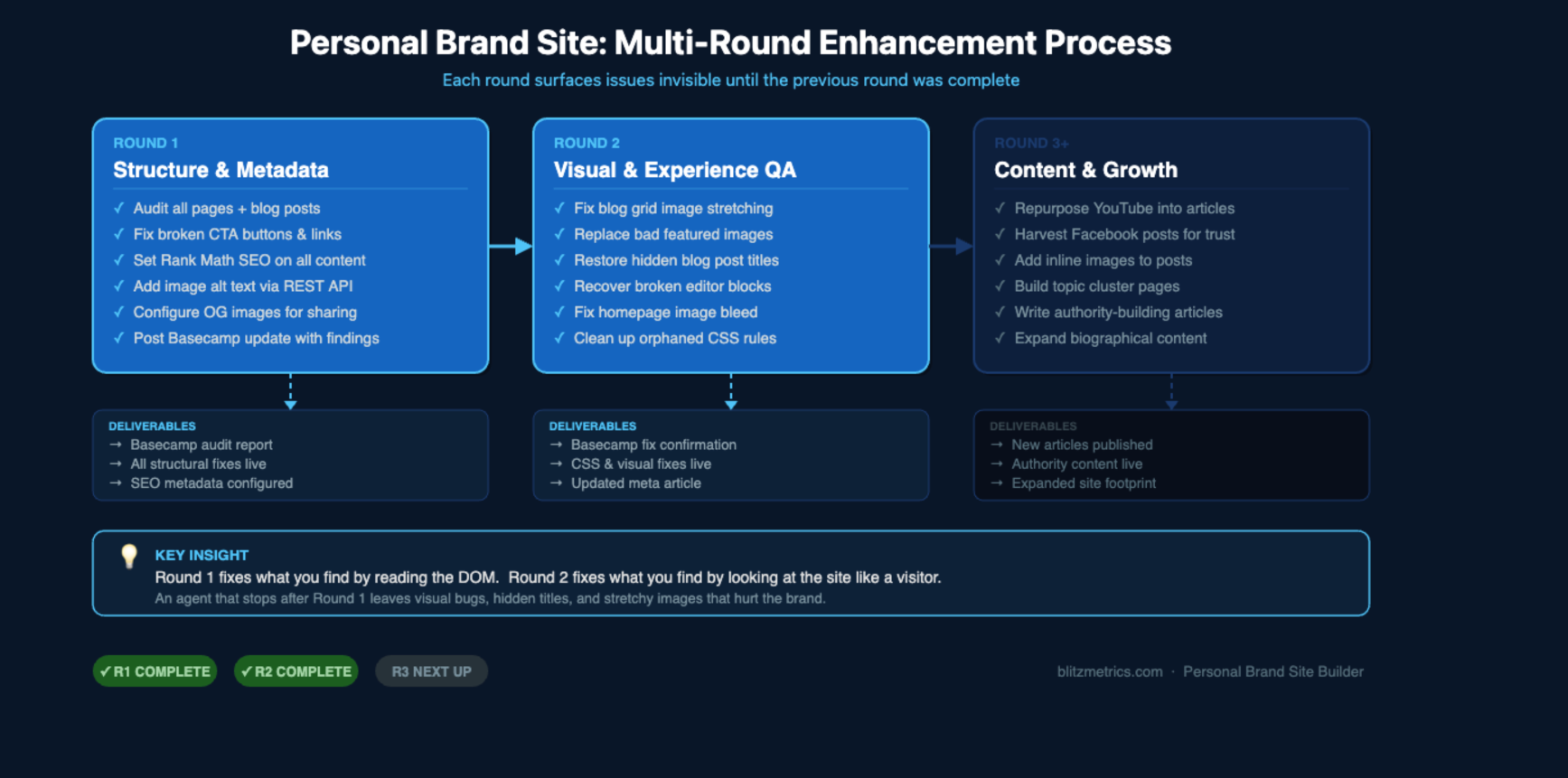
This flowchart shows the standard BlitzMetrics multi-round enhancement process used across all personal brand sites. Each round builds on the previous one — Round 1 handles structure and metadata, Round 2 addresses visual and experience QA, and Round 3 focuses on content expansion and growth. The same process was applied to Jason Amato’s site across four rounds, and scales to any personal brand build.
Value for Trenton Sandler
A D1 athlete with 100,000+ combined social media followers and a mental performance app in development needs more than social profiles. When conference organizers, brand partnership managers, sports psychologists, and potential app users search “Trenton Sandler,” they now find a professional website declaring his identity, expertise, and the entity connections that matter — LSU, Grant Chaisson, mental performance, distance running, and content creation.
For an athlete building a business beyond the track, the personal brand site at trentonsandler.com serves as the authoritative hub that social profiles cannot replace. It’s the difference between being a content creator on someone else’s platform and owning the entity declaration that feeds Google’s Knowledge Graph.
Value for BlitzMetrics
The Trenton Sandler build demonstrates that the BlitzMetrics AI agent system works on emerging public figures — not just established executives. Building for a D1 athlete with 43K YouTube subscribers and a startup in development proves the process scales down as well as up.
This case study also validates single-session builds when pre-work is done correctly. The 22-page content analysis eliminated the research phase that normally requires its own session, compressing the entire build into 50 minutes. That’s a replicable pattern: front-load the content analysis, and the agent can execute the full build in one pass.
The Trenton build joins Gavan Thorpe (750+ steps, Boostability CEO), Jason Amato (Hall of Fame, multi-round enhancement), Nathaniel Stevens ($342M exit, serial entrepreneur), Ethan Van De Hey (65-article build), and RoofingLaunch.co (45-minute agency site) as documented proof that AI agents can build production-quality personal brand sites at a fraction of the cost and time of traditional methods.
Related Meta Articles
- How We Built Gavan Thorpe’s Personal Brand Site Using AI Agents in 750+ Steps
- How We Built Jason Amato’s Personal Brand Site
- How We Built NathanielStevens.com in Under 4 Hours Using AI
- How We Tuned Up Ethan Van De Hey’s Personal Brand Site
- How a Claude Agent Built RoofingLaunch.co in One Session
Get a personal brand site like this built for you — done-for-you at $99/month at localservicespotlight.com.
Originally published .
Dennis Yu
Dennis Yu is the CEO of Local Service Spotlight, a platform that amplifies the reputations of contractors and local service businesses using the Content Factory process. He is a former search engine engineer who has spent a billion dollars on Google and Facebook ads for Nike, Quiznos, Ashley Furniture, Red Bull, State Farm, and other brands.
Dennis has achieved 25% of his goal of creating a million digital marketing jobs by partnering with universities, professional organizations, and agencies. Through Local Service Spotlight, he teaches the Dollar a Day strategy and Content Factory training to help local service businesses enhance their existing local reputation and make the phone ring.
Dennis coaches young adult agency owners serving plumbers, AC technicians, landscapers, roofers, electricians, and believes there should be a standard in measuring local marketing efforts, much like doctors and plumbers must be certified. He has appeared on 353 podcasts with 619 credited episodes — see the full list of his podcast appearances.