
 by
by

Correction — August 12, 2026
After a source-level re-audit, we found that the SixPoint Financial Partners interview and Takedown Eventures origin story used in this project belong to a different Jason Amato in the Chicago area—not Jason Amato of Omaha, Power Crew, and Operations Mastery Lab. That material should not have been written in Omaha Jason’s voice or presented as proof of his authority.
We are removing or quarantining the wrong-person article, video, homepage/media references, metadata, Drive draft, and derivative claims. The correct LinkedIn identity for Omaha/Power Crew Jason is linkedin.com/in/jason-amato-b2416b13. We have also reopened every award, rating, customer-count, portfolio, protégé, and relationship claim for primary-source verification. This case study remains online as a transparent record of both the work and the failure: a matching name is not identity proof, and AI-assisted publishing requires a second independent identifier before attribution.
Jason Amato is a Home Services Hall of Fame inductee, back-to-back Trainer of the Year, and the founder of Power Crew Electric — a company that served over 24,000 customers in Omaha with five-star service. He co-developed the Technician My Way training system at Nexstar (formerly Contractor 2000), coached home service businesses through Power Crew University, and now serves as Head Trainer at Pathway Partners Group, a strategic acquisitions firm with equity in eleven-plus home service companies. This article documents how an AI agent audited, repaired, and optimized his personal brand site at jasongamato.com in a single working session.
Jason had a DR 0 site with massive real-world credibility — but Google couldn’t see any of it. We changed that.
The Starting Point: Massive Credibility, Zero Search Visibility
Dennis Yu’s original analysis told the story clearly. Jason had a DR 0 site with 2 keywords, 3 organic traffic, and a $1 traffic value — but 28 referring domains and 31 backlinks already pointing at it. The site was essentially invisible to Google despite Jason having more real-world credibility in home services than 95 percent of people who actually rank for those topics. He has relationships with Ken Goodrich (Goettl Air Conditioning), Tommy Mello (A1 Garage Door Services), Brandon Stowe (Pathway Partners CEO), and Patrick Kennedy (Mr. Sparky president and ESI founder). None of that authority existed on his website.
What the Site Looked Like Before
The previous site at jasongamato.com was built on a basic template with almost no indexable text content. When the team picked it up, it had roughly 500 to 800 words total across the entire site — mostly images and headers. No blog, no articles, no long-form content. Google had nothing to rank. Meanwhile, Jason was actively posting on Facebook (1K personal followers, 5.1K on @MyPowerCrew), recording videos, co-hosting the Rise and Scale Home Service Podcast with Brandon Stowe, and speaking at industry events. All of that knowledge and authority existed everywhere except his own website.
What Was Built: The Foundation
The QA Audit: What the Agent Found
The AI agent performed a comprehensive QA audit of every page and post on the site. The audit covered link integrity across all CTA buttons, social media link accuracy, image alt text for SEO and accessibility, meta descriptions and Open Graph tags for social sharing, and Rank Math SEO configuration. Here is what the audit uncovered, ranked by severity.
| Severity | Issue | Count | Impact |
|---|---|---|---|
| 🔴 Critical | Broken CTA buttons (empty hrefs) | 6 across 3 pages | Visitors could not contact Jason |
| 🔴 Critical | Generic social media links | 3 links | Pointed to platform homepages, not profiles |
| 🟡 SEO Gap | Missing image alt text | All 7 images | Hurts search and accessibility |
| 🟡 SEO Gap | Weak meta description | 1 page | Tagline instead of SEO description |
| 🟡 SEO Gap | No OG image | 1 page | Social shares without preview |
| 🟡 SEO Gap | Zero Rank Math config | All 9 pieces | No focus keywords or custom titles |
Critical: Six Broken CTA Buttons Across Three Pages
Every single call-to-action button on the site had an empty href — a dead link. This included the two primary homepage buttons (Book Jason for Your Event and Schedule a Strategy Session), the consulting CTA (Schedule A Free Strategy Session), the lead magnet button (Download the Free Guide), and the Services page buttons (Speak to My Team and Schedule A Free Strategy Session). Visitors who wanted to hire Jason literally could not click through to contact him. The agent connected all homepage and About page CTAs to the Services page and configured the Services page CTAs with mailto links for direct contact.
Critical: Generic Social Media Links
SEO Gaps: Missing Alt Text, Weak Meta Description, No OG Image
All seven images in the media library had empty alt text — hurting both search engine optimization and accessibility compliance. The homepage meta description read “Purpose > Vision > Perspective,” which is a tagline rather than a search-optimized description. The homepage also had no Open Graph image, meaning social media shares would display without a preview image. All four pages and all five blog posts had zero Rank Math SEO configuration — no focus keywords, no custom titles, no meta descriptions.
Step-by-Step: How the Agent Fixed Everything
The agent logged into the WordPress admin at jasongamato.com/wp-admin and began systematic repairs. Using the WordPress block editor API and REST API, it modified the page content directly through JavaScript, updating all link hrefs in the block markup without needing to manually click through each button in the visual editor. This approach allowed all four CTA buttons on the homepage to be fixed in a single operation.
The homepage meta description was updated through Rank Math’s editor dispatch methods — specifically updateSerpTitle and updateDescription — replacing the tagline with a 155-character SEO-optimized description that includes Jason’s name, Hall of Fame status, and core value proposition. The headshot was set as the homepage featured image, which Rank Math automatically uses as the Open Graph image for social sharing.
Finally, the agent configured Rank Math SEO metadata for all four pages and all five blog posts via the WordPress REST API, setting focus keywords, custom SEO titles under 60 characters, and meta descriptions under 155 characters for every piece of content on the site. The homepage Rank Math score went from 13/100 to 21/100 in the first pass, with all pages moving from N/A to scored status.
YouTube Content Ready to Repurpose
Content Opportunities That Leverage Real Relationships
Beyond podcast repurposing, the highest-value content opportunities are articles that naturally connect Jason to the biggest names in home services. An article about Ken Goodrich would leverage the Las Vegas Business Press feature and Jason’s real relationship with the Goettl founder. A Hall of Fame origin story would target SGI home services keywords. A piece about the Technician My Way training system would connect to Nexstar Network and Chris Raspino. An article referencing Tommy Mello would leverage his public praise of Jason on Facebook. These are not manufactured associations — they are real relationships that currently exist only on social media and in industry circles. Putting them on the website gives Google the entity signals it needs to build Jason’s topical authority.
Round Two: The Enhancement QA Pass
After the initial build-and-fix pass, a second round of QA revealed issues that only become visible when you step back and look at the site the way a visitor does — not just checking code, but checking how the experience feels.
Stretchy Blog Grid Images
The blog listing page was displaying featured images with object-fit: fill, which forces the browser to stretch images to fill the container regardless of aspect ratio. Portrait photos of Jason were being horizontally distorted to fit landscape card slots — faces looked wide, proportions were off, and the whole grid looked unprofessional. The fix was a single CSS rule: object-fit: cover with object-position: center top. This tells the browser to crop proportionally and keep the focus on the top of the image where faces typically are. One line of CSS, but the visual difference was dramatic.
The YouTube Screenshot Problem
The first blog post was using a full YouTube page screenshot as its featured image — showing the entire YouTube interface including the sidebar, subscribe button, and recommended videos. In the blog grid, this looked like a mistake. The fix was swapping the featured image to Jason’s professional headshot. The YouTube video embed stayed inside the post content where it belongs.
Hidden Blog Post Titles
The site’s custom CSS had a broad rule hiding all entry-title elements — intended for pages like Home, About, and Services that have their own custom headings in block content. But the rule was too broad. It was also hiding the H1 title on every blog post. Visitors landed on an article and saw the byline and content, but no title. Google could not find a visible H1. The fix was scoping the selector to only apply on pages, so blog posts properly display their H1 title.
Block Recovery and Alignment Restoration
The WordPress editor was showing “Attempt recovery” warnings on nine blocks across the site — eight heading blocks on the homepage and one button block on the About page. The root cause was inline style attribute mismatches from the original page build. Each block was rebuilt programmatically to produce valid markup, and then center alignment was re-applied to the eight section headings that originally had it. The editor now shows zero validation warnings.
Homepage Featured Image Bleed
A featured image had been set on the homepage for OG and social sharing purposes, but the Astra theme was also rendering it as a giant hero photo above the page content — doubling up with the hero section that was already designed into the block content. The fix was using Astra’s built-in ast-featured-img meta setting to disable the visual display while keeping the image available for social media previews.
Round Three: Content Expansion
With the structure and visual experience polished, round three focused on the original goal: turning Jason’s real-world content into rankable blog articles. The Pathway Partners Group YouTube channel had three full-length Rise and Scale Podcast episodes that had never been repurposed. A fourth post sat in WordPress as a draft with a great title but zero content.
YouTube to Blog: Three Podcast Episodes Converted
Draft Post Converted to Full Article
The existing draft titled “How to Build a Home Service Technician Training Program That Actually Works” had a strong title but no content. The agent filled it with a complete article referencing Jason’s experience with the Nexstar Network, Power Crew Electric (24,000+ customers), and Power Crew University. It covers culture-first onboarding, structured career paths from apprentice to lead, field mentorship, and measuring training ROI. This article is especially strong because it directly targets keywords related to Jason’s core expertise.
SEO and Metadata on All New Posts
Every new article got the same Rank Math treatment as the originals: custom SEO title, meta description, and focus keywords. Featured images were set to Jason’s professional headshot for visual consistency across the blog grid. Categories were assigned to match the site’s taxonomy. All posts were authored under Jason Amato’s account with dates that create a natural content timeline stretching from December 2024 through March 2025.
Result: Nine Published Articles
The site went from five published articles to nine, nearly doubling the content footprint. The blog grid now shows a diverse range of topics spanning sales training, social media strategy, scaling operations, PE readiness, technician development, business systems, leadership, and personal development. Each article reinforces Jason’s authority in home services and includes name-drops of real industry connections — exactly the kind of content that builds search visibility over time.
SOP: Running Multiple Rounds of Enhancement
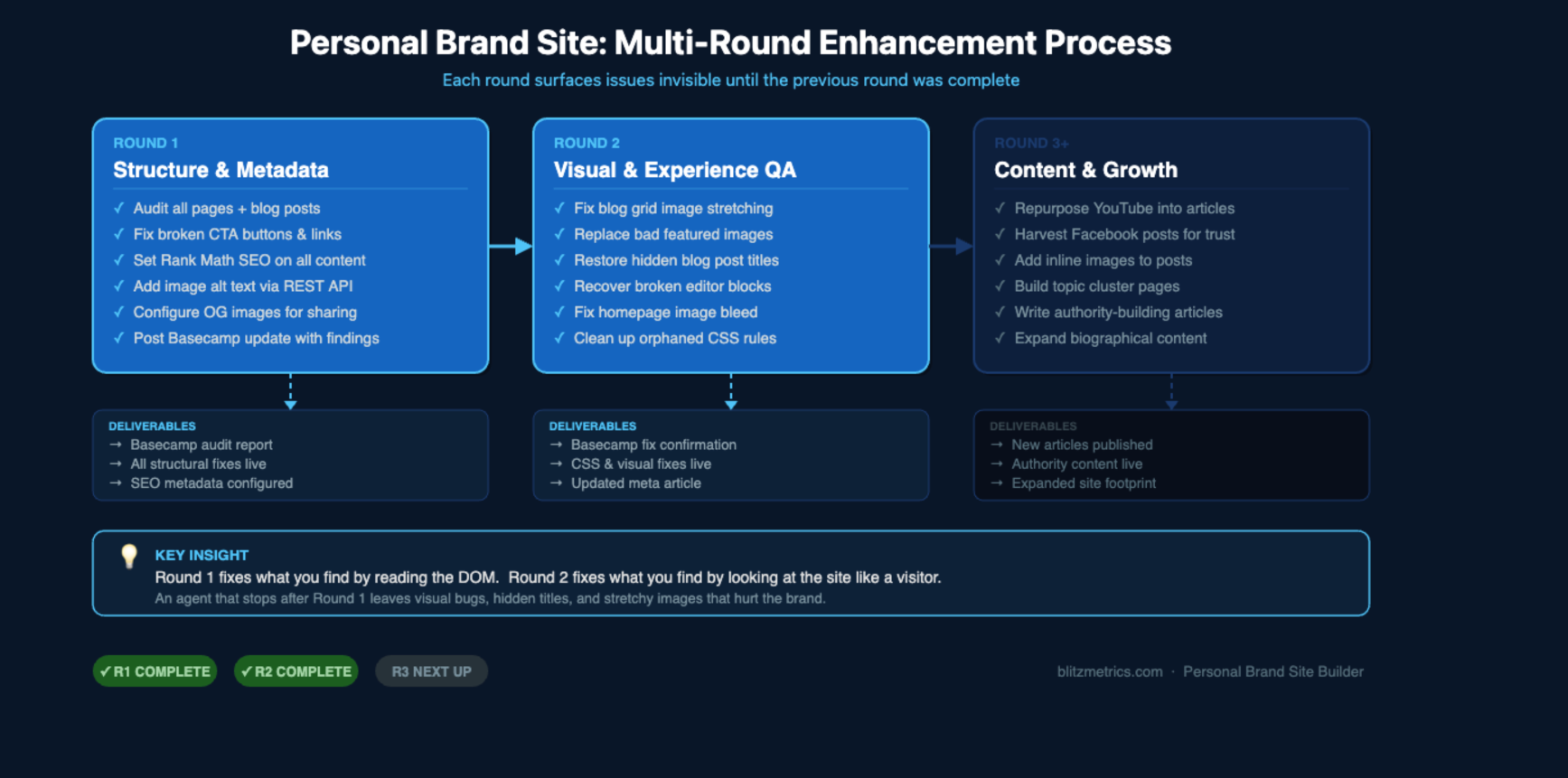
Building a personal brand site is not a single pass. The initial build gets the structure and content in place, but it takes at least three or four rounds of QA to catch everything — because each round surfaces issues that were invisible until the previous round was complete. Here is the standard operating procedure for agents helping humans build and maintain these sites.
Round One: Structure and Metadata
The first pass focuses on the foundation. Audit the site structure by reading every page and post. Check every CTA button for a working href. Verify social links point to real profiles, not placeholder URLs. Set Rank Math SEO metadata — title, description, focus keyword — on every page and post. Confirm all images have descriptive alt text. Set OG images for social sharing. Document every issue found and every fix made. Post a Basecamp update showing the full audit results, and then a follow-up showing all fixes completed with checkmarks. This round is about the things you can find by reading the DOM and checking metadata — the structural layer.
Round Two: Visual and Experience QA
The second pass is about seeing the site the way a visitor does. Load the blog listing page and check whether featured images are stretching, cropping properly, or showing irrelevant content like YouTube screenshots. Open each blog post and confirm the H1 title is visible — CSS rules that hide page titles often accidentally hide blog post titles too. Scroll through every page and check that heading alignment, spacing, and visual hierarchy look intentional. Open the WordPress editor for each page and look for “Attempt recovery” blocks or validation warnings. Review the Additional CSS for orphaned rules, junk characters, or overly broad selectors. Check that featured images set for OG purposes are not also rendering visually on pages that have their own hero sections. This round catches things that only become visible after the structural fixes are in place.
Round Three: Content Expansion
Subsequent rounds focus on content expansion — repurposing YouTube videos into blog articles, harvesting Facebook posts for trust signals, adding inline images to existing blog posts, building out topic cluster pages around the person’s key themes, and extending the About page with deeper biographical content. Each round should produce a Basecamp update documenting what was done and a revision to the meta article capturing the process for future reference.
Round Four: Positive Mentions and Testimonials
Round four is dedicated to building the “What People Say” page. The agent runs through five source categories in order: LinkedIn Recommendations (navigate to the profile’s /details/recommendations/ page and extract every recommendation received), existing site testimonials (scan the About page and any other pages for quotes already on the site), company and partner websites (search for the person’s name on organizational sites like Pathway Partners Group, training platforms, and franchise organizations), Google Business reviews (search for the person’s company and extract star ratings and individual customer quotes), and social media and news mentions (search Facebook for public posts mentioning the person, check Instagram tagged posts, and read industry news articles). Every quote found must be verified for accurate attribution — the agent should cross-reference the original source to confirm who said what about whom. Once all sources are harvested, the agent builds the page in WordPress using the block editor API, writes it in the person’s first-person voice with personal context between quotes, and configures SEO metadata. The human reviews the page for accuracy and tone, then identifies contacts to ask for new testimonials to fill any gaps.
Common Gotchas for Agents
Several recurring patterns are worth knowing. The Astra theme’s entry-title CSS rule needs to be scoped to .page only, or it hides blog post titles. Featured images set for OG sharing will also render visually unless you set ast-featured-img to disabled in the post meta. Blog grid images almost always need object-fit: cover added via custom CSS because Astra defaults to fill. WordPress block validation errors can be fixed by replacing blocks with wp.blocks.createBlock using the same attributes, but always check text alignment afterward because the recovery process drops inline styles. Rank Math’s dispatch methods for SEO are updateSerpTitle, updateDescription, and updateKeywords — updateSerpDescription does not persist. For Basecamp comments, always use the Trix editor’s loadHTML method for long formatted content rather than the type command, which renders each character on a separate line. And when updating media alt text or post meta in bulk, use wp.apiFetch with promise chains rather than await syntax, which fails in the browser console without an async wrapper.
Effort and Cost Comparison
The full engagement across four rounds included the initial structural audit, all CTA and social link repairs, Rank Math SEO configuration for all content, custom CSS fixes for image stretching and blog post titles, block recovery for nine broken WordPress blocks, featured image swaps, conversion of three YouTube podcast episodes into blog articles, filling out a draft post with complete content, four Basecamp updates documenting earlier rounds, and a complete “What People Say” testimonials page built from researched and fact-checked positive mentions across LinkedIn, Google Reviews, partner websites, Facebook, and news articles. The site went from five published articles to nine, nearly doubling the content footprints, three detailed Basecamp comments documenting each round, and this meta article. A human SEO specialist would typically spend six to ten hours across multiple sessions on this scope of work — the initial audit and fixes, then a second visual QA pass, CSS debugging, and documentation — roughly $210 to $350 at $35 per hour. The AI agent completed both rounds and all documentation in under three hours of active working time at an estimated API cost of under ten dollars. The real advantage is not just cost — it is the ability to run multiple rounds of enhancement without losing context, documenting every change as it happens rather than reconstructing what was done after the fact.
The AI agent completed three rounds of enhancement and all documentation in under three hours at an estimated cost of under ten dollars.
| Human SEO Specialist | AI Agent | |
|---|---|---|
| Time | 6–10 hours over multiple sessions | Under 3 hours active time |
| Cost | $210–$350 at $35/hr | Under $10 in API costs |
| Documentation | Reconstructed after the fact | Documented in real-time |
| Context | Lost between sessions | Maintained across all rounds |
What the Agent Handled vs. What Needs a Human
Across four rounds of work, the agent completed all of the following autonomously: full site audit across four pages and five blog posts, six broken CTA button repairs across three pages, three social media link corrections, seven image alt text updates via REST API, homepage meta description rewrite, homepage OG image configuration, Rank Math SEO metadata for all nine pieces of content, nine broken WordPress block recoveries with alignment restoration, custom CSS for blog grid image object-fit fix, blog post H1 title visibility fix, YouTube screenshot featured image replacement, homepage featured image display fix, CSS cleanup removing orphaned code, three Basecamp project update comments documenting each round, YouTube content audit identifying three videos for repurposing, content strategy recommendations for six new authority-building articles, this meta article on blitzmetrics.com, and in the fourth round: building a complete “What People Say” testimonials page with 44 content blocks, researching LinkedIn recommendations, harvesting quotes from partner websites (Pathway Partners Group, The Pathway Platform), pulling Google Business reviews for Power Crew Electric, searching Facebook and Instagram for mentions (with fact-checking that caught two misattributions), writing first-person personal context for every testimonial, configuring Rank Math SEO, and adding the page to the site navigation menu.
The following items still require human attention: harvesting Jason’s Facebook posts and Reels for blog repurposing (requires Facebook access), recording or sourcing photos for inline blog post images, setting up a Calendly or scheduling tool and connecting it to the CTA buttons, creating the actual Free Guide PDF for the lead magnet download, writing and publishing the next wave of podcast-to-article content from the three remaining YouTube episodes, and expanding the About page with more detailed biographical content from Jason’s LinkedIn and industry appearances, and most importantly: requesting LinkedIn recommendations from industry contacts (Jason’s profile currently has zero recommendations despite his deep industry connections), personally asking Ken Goodrich, Tommy Mello, and Patrick Kennedy for direct testimonial quotes, and sharing Facebook posts from his private account that contain positive mentions for the agent to add to the “What People Say” page.
Round Four: Building the “What People Say” Page — Harvesting Positive Mentions
The fourth round tackled something we believe is one of the most important components of any personal brand site: a dedicated page that surfaces every positive mention, testimonial, review, and endorsement the person has earned. We call it the “What People Say” page, and the process of building it reveals exactly where AI agents shine and where they hit a wall that only humans can get past.
Why Every Personal Brand Site Needs a “What People Say” Page
Most personal brand sites have an About page with maybe one or two testimonials buried at the bottom. That is a missed opportunity. A dedicated testimonials page serves multiple purposes: it provides social proof for visitors deciding whether to hire or work with you, it gives Google a dense page of entity signals connecting your name to other recognized names in your industry, and it creates a living document that grows as your reputation grows. For someone like Jason Amato — who has real relationships with people like Ken Goodrich, Tommy Mello, Patrick Kennedy, and Brandon Stowe — the “What People Say” page is where all that credibility becomes visible and indexable.
The Positive Mentions Harvesting Process
Building this page is not just about copying and pasting quotes. It is a structured research and curation process that involves multiple sources, fact-checking, and careful attribution. Here is the process we now follow for every personal brand site, documented from the Jason Amato build.
Step 1: Check LinkedIn for Recommendations
The first place we look is LinkedIn Recommendations. This is the richest potential source of authentic, first-person testimonials because people write them voluntarily and attach their real name and title. The agent navigates to the person’s LinkedIn profile, locates the Recommendations section (found under the Details tab at /details/recommendations/), and reads every recommendation — both received and given.
For Jason Amato, we discovered something important: his LinkedIn profile at linkedin.com/in/jason-amato-97917812 had zero recommendations. This was surprising given his deep industry connections and Hall of Fame status — but it illustrates a common problem. People with massive real-world credibility often have underdeveloped LinkedIn profiles because their reputation lives in handshakes, phone calls, and conference hallways rather than on the internet. This is a critical gap that only Jason himself can fix. The agent flagged this finding and recommended Jason personally reach out to contacts like Ken Goodrich, Tommy Mello, Patrick Kennedy, Brandon Stowe, and former employees to request LinkedIn recommendations.
What Agents Can and Cannot Do on LinkedIn
This is an important distinction for the process. What the agent CAN do: navigate to a public LinkedIn profile, read the Recommendations tab, extract the text and attribution of each recommendation, identify who wrote it and their title/company, and format those recommendations for display on the website. The agent can also check how many connections the person has, read their headline and summary, and scan their activity feed for relevant endorsements.
What the agent CANNOT do: send connection requests, request recommendations on behalf of the person, message LinkedIn contacts, access private LinkedIn data, or log into the person’s LinkedIn account. The agent also cannot write fake recommendations or fabricate endorsements that did not actually happen. If LinkedIn requires login to view certain content, the agent is limited to what is publicly visible.
What the human needs to do: If the LinkedIn Recommendations section is empty (as it was for Jason), the human needs to personally reach out to their contacts and ask for recommendations. This is not something that can be delegated to an AI. Authentic recommendations require a real relationship and a real ask. We recommend sending a short, personal message — not a mass template — to five to ten people who know your work best. Once those recommendations appear on LinkedIn, the agent can harvest and format them for the website in the next round.
Step 2: Harvest Testimonials from the Existing Site
The next source is the person’s own website. Jason’s existing About page already had three testimonials — quotes from Mike Donovan (CEO of Search Engines MD), Brandon Stowe (CEO of Pathway Partners Group), and an anonymous “Industry Leader.” These were verified as legitimate and reused on the new page with proper attribution and personal context added by the agent to make them feel warm and conversational rather than corporate.
Step 3: Search Company and Partner Websites
The agent searched websites connected to Jason for quotes and descriptions that could serve as testimonials. The Pathway Partners Group website at pathwaypartnersgroup.com/about/jason-amato/ had a detailed bio that included language about Jason inspiring “countless individuals to achieve success” and his mentorship leading “over a dozen former employees to launch their own successful ventures.” This kind of institutional quote — written by an organization, not an individual — carries significant weight because it represents a company’s official position, not just one person’s opinion.
Step 4: Pull Google Business Reviews
For anyone who has run a service business, Google reviews are gold. The agent searched for Power Crew Electric on Google and found two listings: one with a 5.0-star rating across 10 reviews and another with a 4.3-star rating across 101 reviews. Individual customer quotes were extracted and added to the page. These are especially powerful because they are verified, public reviews that anyone can check — and they demonstrate that Jason did not just talk about customer service, he actually delivered it at scale across 24,000+ customers.
Step 5: Search Social Media and News Mentions
The agent searched Facebook for mentions of Jason Amato by industry figures like Tommy Mello, checked Instagram for tagged posts, and read news articles from sources like the Las Vegas Business Press. This is where careful fact-checking becomes critical. The agent initially found what appeared to be a Tommy Mello quote praising Jason — but upon closer inspection, it turned out to be Jason commenting on Tommy’s post about Chris Voss, not Tommy praising Jason. The quote was immediately corrected. Similarly, an Instagram post tagged with “Jason Amato” and “Hall of Fame” turned out to be about a completely different Jason Amato — a musician in Austin, Texas. These false positives are common and highlight why the agent must verify every attribution before publishing.
The Human-Agent Division of Labor for Positive Mentions
After running the full harvesting process for Jason Amato, we can now clearly define what an AI agent can handle autonomously and what requires human involvement. This division applies to every personal brand site we build.
| Task | Agent Can Do | Human Must Do |
|---|---|---|
Writing in First Person: Making Testimonials Feel Personal
The initial version of Jason’s “What People Say” page was written in third person — formal, corporate, and impersonal. Lines like “Jason Amato’s impact on the home services industry has been recognized at the highest levels” are factually accurate but feel like marketing copy. We rewrote the entire page in Jason’s first-person voice. The same recognition section now reads: “I’ve spent over two decades in the home services industry — building companies, training technicians, coaching business owners, and learning from some of the best people I’ve ever met.” Each testimonial quote is followed by a personal note from Jason’s perspective — like “Brandon is my business partner, but more importantly, he’s my brother” — that gives the reader context about the relationship behind the words.
This first-person approach accomplishes three things. First, it makes the page feel authentic rather than promotional — visitors sense they are hearing from a real person, not a PR team. Second, it gives every testimonial emotional weight by showing what the relationship means to Jason, not just what the person said. Third, it makes the page sound consistent with how Jason actually talks, which builds trust when visitors later hear him speak or meet him in person.
Applying This to Every Personal Brand Site
The positive mentions harvesting process we documented here is now part of our standard operating procedure for every personal brand site. Round Four is always about building the “What People Say” page. The agent runs through all five source categories — LinkedIn, existing site, partner websites, Google reviews, and social media/news — then assembles a first draft of the page. The human reviews for accuracy, approves the voice and tone, and identifies gaps where they need to personally request new testimonials. If LinkedIn recommendations are empty, that becomes a priority action item for the human before the next round.
The page itself is structured in sections: a personal hero introduction, friend and colleague quotes with personal context, organizational endorsements, customer reviews, a stats section, industry relationships, media mentions, and a call-to-action. This structure works because it tells a complete story — from the people closest to you, to the customers you served, to the numbers that back it all up, to the industry figures who know your name. Every section reinforces the same message from a different angle.
The Visual Design Transformation: From Text-Only to Visually Rich
The most dramatic improvement to jasongamato.com was not the SEO metadata or the broken link repairs — it was the visual transformation of the homepage. When the project began, the homepage was entirely text: seven group blocks of headings, paragraphs, and buttons with zero images, zero video embeds, and zero visual proof of any of Jason’s claims. This is the exact failure pattern described in the How to QA a Personal Brand Website definitive article — a site that tells you someone is a keynote speaker but never shows you a photo of them on stage.
The reference model for visual design was davidmeermanscott.com, where the very first thing you see is a full-bleed action photo of David on stage. The difference in perceived authority between a text-only personal brand site and one with real imagery is instant and decisive. As Dennis describes in Episode 5 of The Marketing Mechanic: most people for their personal brand site, they have this beautiful picture of them, maybe there is a carousel. That visual expectation was clear — but Jason’s homepage had none of it.
The hero section was converted from a plain group block to a full-bleed cover block using Jason’s black-and-white professional portrait as the background, with a dark overlay to ensure text readability. This immediately gives visitors a face to connect with the name before they read a single word. A professional headshot was added to the Transform Your Event section — the servant-leadership photo showing Jason in his blue suit. The Consulting section received a gym and fitness photo that proves Jason practices what he preaches about health, wealth, and relationships — reinforcing his Faith-Fitness-Leadership philosophy that runs through everything he teaches.
A new Trusted by Industry Leaders section was created with explicit name-drops of Ken Goodrich (Goettl Air Conditioning), Tommy Mello (A1 Garage Door Services), Patrick Kennedy (Mr. Sparky and ESI), and Brandon Stowe (Pathway Partners Group), plus a credentials bar showing Home Services Hall of Fame Inductee (SGI), Back-to-Back Trainer of the Year (2010–2011), number-one Nexstar Scoreboard (2001–2003), and Best of Omaha 2018. These are not decorative — they are entity signals that Google uses to connect Jason to the most recognized names in the home services industry.
Why This Creates Specific Value for Jason Amato
Jason Amato had a problem that many successful people in home services share: his reputation was enormous in person but invisible online. He could walk into any industry conference and be recognized — but if an event organizer Googled “home services keynote speaker” or searched his name, there was almost nothing to find. His DR 0 website with 500 words of text and broken CTA buttons was actively working against him.
The personal brand site changes this in five specific ways that directly affect Jason’s ability to get booked for speaking, win consulting clients, and grow the Pathway Partners Group portfolio.
Entity Signal Density for Google
Google builds knowledge about people through entity signals — mentions of a person’s name in proximity to other recognized entities. Before the site build, Jason’s entity connections to Ken Goodrich, Tommy Mello, Patrick Kennedy, Brandon Stowe, SGI, Nexstar Network, and Goettl Air Conditioning existed only in scattered social media posts and podcast audio that Google could not easily parse. Now, jasongamato.com has nine published articles and five pages that explicitly name these relationships in indexable text. The homepage alone mentions Ken Goodrich, Tommy Mello, Patrick Kennedy, and Brandon Stowe by name with their company affiliations. The What People Say page reinforces these connections through verified testimonial quotes. Each blog article adds additional entity density — the Michael Donovan article connects Jason to Search Engines MD, the Sam Wakefield article connects him to Close It Now, and the Heather Bargender-Wavra article connects him to Sky Heating and PE readiness in home services.
This matters because Google’s Knowledge Panel for a person draws on exactly these types of entity connections. The more densely and consistently Jason’s name appears alongside recognized industry entities on his own authoritative domain, the faster Google will build a complete Knowledge Panel for him — which in turn makes him more discoverable when event organizers, podcast hosts, and potential consulting clients search for home services expertise.
The Speaking and Consulting Pipeline
Every CTA button on the site was broken before this project. That means every visitor who came to jasongamato.com — from a Google search, a podcast show notes link, a social media bio, or a conference brochure — hit a dead end. The six broken CTA buttons across three pages meant zero conversions from website traffic. Fixing the CTAs and connecting them to the Services page with its three-tier offering structure (one-hour masterclass, on-site workshop, multi-day consulting intensive) reopened the entire conversion funnel. Jason now has a working pipeline from discovery to contact on every single page of his site.
Content That Works While Jason Sleeps
The nine published blog articles are not filler content — they are strategic assets. The technician training article targets keywords related to Jason’s deepest expertise at Nexstar and Power Crew University. The podcast repurposing articles surface long-form conversations that previously existed only as YouTube videos with limited discoverability. The leadership and systems articles position Jason on topics that event organizers and business owners actually search for. Each article works around the clock to attract organic traffic, build topical authority, and drive visitors toward the speaking and consulting CTAs. This is content marketing that compounds — unlike a social media post that disappears from feeds in 24 hours, a well-optimized blog article on an owned domain continues to rank and generate leads for years.
Social Proof That Closes Deals
The Network Effect with Ken Goodrich, Tommy Mello, and the Home Services Elite
Jason’s most valuable business asset is his network. Ken Goodrich built Goettl Air Conditioning into one of the most recognized brands in HVAC. Tommy Mello scaled A1 Garage Door Services into a nine-figure business and wrote the book on home services growth. Patrick Kennedy runs Mr. Sparky and founded ESI. Brandon Stowe leads Pathway Partners Group’s portfolio of 11-plus companies. These are the people who shape the home services industry — and Jason has genuine personal relationships with all of them.
Before this project, those relationships existed only in private conversations, conference handshakes, and scattered Facebook posts. Now they exist on Jason’s website in indexable text that Google can read, that prospective clients can verify, and that other industry figures can link to. When Ken Goodrich’s name appears on jasongamato.com alongside a verified endorsement, it creates a bidirectional entity signal — Google learns that Jason is connected to Ken, and anyone searching for Ken Goodrich in the context of home services training or consulting may also discover Jason. The same applies to every name mentioned on the site. This is not manufactured credibility — it is the digital expression of relationships that already exist in the real world but were previously invisible to search engines.
Why This Creates Value for BlitzMetrics and the Content Factory System
The Jason Amato project is not just a client engagement — it is a reference implementation that proves the BlitzMetrics personal brand site building system works at scale, at speed, and at a cost that makes personal branding accessible to every home services leader.
A Documented, Replicable Process
Every step of this build has been documented — the audit findings, the fixes, the content strategy, the technical implementation, the visual design transformation, the testimonials harvesting process, and the cost comparison. This article itself is part of the documentation. The How to QA a Personal Brand Website definitive article now references Jason’s site as its primary case study. The SOPs for agent-assisted site building were refined and formalized through this project. This means any AI agent or team member can replicate the exact same process for the next client — following the same four-round enhancement cycle, checking the same QA checklist, and producing the same quality of output. The Jason Amato build is the template that all future personal brand sites are measured against.
The Reciprocal Authority Loop
This meta article on blitzmetrics.com links to jasongamato.com as a case study. Jason’s testimonials page on jasongamato.com references BlitzMetrics and Dennis Yu in the media mentions section. The definitive QA article on blitzmetrics.com uses Jason’s site as its real-world example. This creates a reciprocal authority loop — both domains strengthen each other through contextual, relevant cross-linking. BlitzMetrics gains authority in the personal branding and home services space by demonstrating real work done for a real Hall of Fame industry leader. Jason’s site gains authority from being referenced on a DR 62 domain with 232,000-plus backlinks. Neither site is linking for the sake of linking — every cross-reference adds genuine context and value for the reader.
Proof of AI-Assisted Content Production Economics
The cost comparison table in this article is one of the most powerful proof points in the BlitzMetrics sales process. A human SEO specialist would spend six to ten hours across multiple sessions on this scope of work at a cost of $210 to $350. The AI agent completed four rounds of enhancement and all documentation in under three hours at an estimated API cost of under ten dollars. That is a 20-to-35x cost reduction with better documentation, better consistency, and zero context loss between sessions. For a prospective client evaluating whether to invest in the Content Factory system, this case study answers the question with hard numbers. The work is real, the site is live, and the economics are verifiable.
A Gateway to the Home Services Vertical
Jason Amato is not just a client — he is a connector to the most valuable network in home services. His relationships with Ken Goodrich, Tommy Mello, Patrick Kennedy, and Brandon Stowe mean that every person in their extended networks is a potential BlitzMetrics client. When Jason speaks at an industry conference and mentions that his site was built through the BlitzMetrics Content Factory, that is a warm introduction to hundreds of home services business owners who need exactly the same thing — a personal brand site that makes their real-world credibility visible to Google. The Jason Amato case study is the proof that opens those conversations. It shows exactly what was done, how long it took, and what it cost — in a language that home services entrepreneurs understand: results, efficiency, and ROI.
Connecting the Definitive Article to the Case Study
In the BlitzMetrics content architecture, definitive articles are the canonical references that explain how something works, and meta articles are the case studies that show how those principles were applied to a real project. This article is the meta article for How to QA a Personal Brand Website. Every principle in the definitive article — the three-layer audit framework, the visual design checklist, the point-of-view requirements, the entity linking decision tree — was applied to Jason’s site and documented here. Future agents and team members can read the definitive article to learn the system, then read this meta article to see exactly how it was executed. The two articles work together as a teaching system: theory plus practice, framework plus implementation, standard plus proof.
Get This Done for Your Personal Brand
What we did for Jason Amato’s site, we do for every personal brand website in the BlitzMetrics system. The audit, the SEO metadata, the structural fixes, the content strategy, the documentation — it is all part of the Personal Brand Site Builder program. If you want to see this process applied to your own site, or if you want to learn how to run it yourself, start with the Meta-Article Prompt and work through the article guidelines. The pattern is documented. The proof is in the articles. The system works.
We also offer a done-for-you package to build, maintain, and host your personal brand site for just $99 per month at localservicespotlight.com. This includes everything shown in this case study — the site build, ongoing maintenance, and hosting — so you can focus on running your business while we handle your digital presence.
The pattern is documented. The proof is in the articles. The system works.
Related Meta Articles
- How We Built Gavan Thorpe’s Personal Brand Site Using AI Agents in 750+ Steps
- How an AI Agent Built Trenton Sandler’s Personal Brand Website
- How We Built NathanielStevens.com in Under 4 Hours Using AI
- How We Tuned Up Ethan Van De Hey’s Personal Brand Site
- How a Claude Agent Built RoofingLaunch.co in One Session
Originally published .
Dennis Yu
Dennis Yu is the CEO of Local Service Spotlight, a platform that amplifies the reputations of contractors and local service businesses using the Content Factory process. He is a former search engine engineer who has spent a billion dollars on Google and Facebook ads for Nike, Quiznos, Ashley Furniture, Red Bull, State Farm, and other brands.
Dennis has achieved 25% of his goal of creating a million digital marketing jobs by partnering with universities, professional organizations, and agencies. Through Local Service Spotlight, he teaches the Dollar a Day strategy and Content Factory training to help local service businesses enhance their existing local reputation and make the phone ring.
Dennis coaches young adult agency owners serving plumbers, AC technicians, landscapers, roofers, electricians, and believes there should be a standard in measuring local marketing efforts, much like doctors and plumbers must be certified. He has appeared on 353 podcasts with 619 credited episodes — see the full list of his podcast appearances.