
 by /
by /
Ethan Van De Hey is the digital marketing manager at Infinity Exteriors in Appleton, Wisconsin, and the host of the Encourage Mindset Podcast. His personal brand site at ethanvandehey.com was built entirely by a Claude AI agent — from the initial Elementor page designs to 65 published articles repurposed from his YouTube podcast episodes to site-wide CSS refinements. This article documents the full scope of that build: how a Claude Opus 4.6 agent created the site structure, repurposed 45 podcast episodes into SEO-optimized articles, wrote 6 pillar articles connecting themes across guests, and tuned up the visual design — following the BlitzMetrics Meta-Article Prompt.
Strategy: Entity-First Personal Branding
Google’s Knowledge Graph depends on entities — people, organizations, and the connections between them. For someone like Ethan who operates across multiple businesses and content verticals, a personal brand site serves as the authoritative hub that declares: this is who Ethan Van De Hey is, this is what he does, and these are the entities he connects to — Infinity Exteriors, Roofing Launch, the Encourage Mindset Podcast, Dennis Yu, BlitzMetrics, and the home services marketing ecosystem.
The approach follows Dennis Yu’s Dollar-a-Day framework and personal branding methodology: build the entity hub, declare connections through schema markup, repurpose existing content (45 podcast episodes) into written articles, and construct an interlocking web of pages that Google can crawl and comprehend.
The site was deliberately designed to bridge two audiences: Ethan’s podcast listeners (mindset, leadership, entrepreneurship) and Infinity Exteriors’ business contacts (roofing, home services, marketing strategy). The 65 published articles span both verticals, creating a personal brand that serves the whole person rather than siloing professional and creative identities.
The Build at a Glance
The Full Scope
This was not a one-off CSS fix. The entire ethanvandehey.com site was built and populated by Claude AI agents across multiple sessions. The work breaks down into five phases — from initial site architecture through content at scale to visual polish.
Phase 1: Site Architecture with Elementor
The site started as a blank WordPress installation. A Claude agent designed and built four Elementor pages: a Homepage with a hero section featuring Ethan’s bio, an About Me section, a YouTube embed, and a Reviews/Recommendations testimonial carousel. An About page with Ethan’s full background. A Blog archive page. And an Encourage Mindset Podcast page with a filterable post grid using the EAC (Elementor Addon Components) plugin, displaying podcast episode cards in a three-column masonry layout. The agent also configured the site navigation, footer, and branding elements.
Phase 2: Podcast Repurposing — 45 YouTube Episodes Become Articles
The Encourage Mindset Podcast had 45 episodes on YouTube with no corresponding web content. A Claude agent repurposed each episode into a full blog post on ethanvandehey.com. Each post includes an embedded YouTube video, a rich article with H2 section headings covering the key themes from the conversation, guest-specific tags, a custom featured image, and full RankMath SEO metadata — focus keyword, SEO title under 60 characters, and meta description under 160 characters. Guests include entrepreneurs like Matt LeBris, community leaders like Randi Lynn Quigley, and professionals across the mindset, leadership, and business verticals.
Phase 3: Pillar Content — 6 Thematic Roundup Articles
After the individual episode posts were published, the agent created six pillar articles that tie episodes together by theme. These roundups — covering career pivots, entrepreneurship, identity and purpose, daily habits, leadership, and overcoming adversity — each synthesize insights from 7 to 10 guests, cross-link to every individual episode post referenced, and create the internal linking architecture that signals topical authority to search engines. Articles like When the Plan Changes: 7 Encourage Mindset Guests Who Made Bold Career Pivots and How 10 Encourage Mindset Guests Built Businesses from Scratch give the site the content depth that individual episode posts alone cannot provide.
Phase 4: Business Content for Infinity Exteriors
Alongside the podcast content, 14 articles were published covering Infinity Exteriors’ business activities — community event sponsorships, marketing strategy, Google My Business optimization, billboard campaigns, and roofing industry authority-building. These posts connect Ethan’s personal brand to his professional work at Infinity Exteriors, creating a bridge between the podcast audience and the business.
Phase 5: Visual Tune-Up and CSS Refinement
The final phase addressed visual and accessibility issues that had accumulated as the site grew. This is the session documented in detail below — fixing invisible hero section links, reformatting the About Me wall of text, equalizing testimonial card heights, and redesigning the podcast page card layout. A single WPCode snippet grew from 3 lines to approximately 4,700 characters of CSS covering every visual fix across the site.
Running Totals
| Metric | Count |
|---|---|
| Elementor pages designed and published | 4 |
| Podcast episodes repurposed from YouTube | 45 |
| Pillar/roundup articles created | 6 |
| Business content articles published | 14 |
| Total published articles | 65 |
| Unique guest tags created | 30+ |
| Thematic tags created | 10+ |
| Custom CSS lines (WPCode snippet) | ~4,700 characters |
| SEO metadata fields configured | 195+ (3 per post × 65 posts) |
YouTube Content Repurposing Strategy
The Encourage Mindset Podcast YouTube channel contains 100+ episodes. The repurposing strategy followed the same approach used across BlitzMetrics personal brand sites — select episodes with named guests (creating entity connections and taggable content), topics aligned with Ethan’s core verticals, and conversations with enough substance to produce standalone articles.
The agent analyzed video summaries, extracted key narratives and takeaways, and wrote original articles that contextualize each conversation — not transcript dumps. Each post includes an embedded YouTube video, Related Content sections with internal links, and guest-specific tags. 45 episodes were repurposed into 45 blog posts plus 6 pillar roundup articles, creating 51 pieces of content from existing video assets.
Each post drives YouTube views while the YouTube authority boosts the website — the content flywheel Dennis Yu describes in the Dollar-a-Day methodology.
The Visual Tune-Up: Detail
The rest of this article documents the most recent session in detail — the visual tune-up that polished the site after the bulk of the content was already in place. This is the session that fixed the visual issues a visitor would notice on first load.
What We Found: The Audit
The agent started by taking a screenshot of the homepage and scrolling through every section. It then visited the About page, Blog page, and Encourage Mindset Podcast page. The audit uncovered five issues ranked by severity.
Critical: Hero section links invisible on dark background. The hero section used a dark blue background with text links colored rgb(3, 134, 182) — nearly indistinguishable from the background. The agent confirmed this by running JavaScript to inspect computed styles of every anchor tag inside the hero section’s Elementor container (data-id 59f90f9f).
High: About Me section was a wall of text. Five paragraphs of biographical content rendered as a single continuous block with no paragraph breaks. The Elementor text widget contained the text separated by double newlines but without HTML paragraph tags.
Medium: Testimonial cards had uneven heights. The Reviews/Recommendations carousel displayed cards at different heights depending on content length, creating an uneven look.
Medium: Podcast page cards had harsh styling. The Encourage Mindset Podcast page used EAC post grid cards with cyan backgrounds on card text wrappers and a cyan grid background behind the entire layout.
Low: Blog posts reused the same headshot. Every blog post on the Blog page used the same headshot of Ethan as the featured image — a content issue noted for future improvement.
How We Fixed It
Hero link colors: Created a WPCode CSS snippet targeting .elementor-element-59f90f9f anchors, changing color to #7dd3fc (light cyan) with underline and white hover state. Verified links were clearly visible on the dark background.
About Me paragraphs: Opened the Elementor editor for the homepage (post ID 3348), used JavaScript to split the text widget content by double newlines, wrapped each segment in proper paragraph tags, triggered Elementor’s change detection with a manual edit, and published. Five clean paragraphs replaced the wall of text.
Site-wide CSS overhaul: Expanded the WPCode snippet to ~4,700 characters covering testimonial card equal-height styling with rounded corners and box shadows, podcast page white card backgrounds replacing the cyan, styled Read More buttons, pill-shaped filter buttons, transparent grid background, smooth scrolling, and accessibility focus states.
Podcast layout debugging: Discovered the cyan “border” effect was actually the .al-posts__wrapper background-color, not a CSS border. Set it to transparent. Caught that adding margin to masonry grid children broke the absolute-positioned three-column layout, reverted immediately, and preserved the working grid with all other visual improvements intact.
Critical Decision-Making
Five moments where the agent made judgment calls that a less capable system would have missed.
1. Choosing WPCode over Elementor Custom CSS. The changes spanned multiple pages (homepage and podcast page) and needed to be managed in one place. WPCode makes it easy to toggle changes on and off without touching the page builder.
2. Diagnosing the cyan card “border” as a wrapper background. The podcast page cards appeared to have thick cyan borders. The agent inspected the DOM and discovered the color came from .al-posts__wrapper’s background-color, not any border property.
3. Immediately reverting the masonry-breaking margin. When adding margin to .al-post__wrapper broke the three-column masonry layout, the agent recognized within one verification step that absolute-positioned masonry grids cannot accept margin changes on their child elements.
4. Using JavaScript to format About Me paragraphs rather than retyping. The About Me content was 2,259 characters across five paragraphs. The agent used JavaScript to programmatically split and wrap, preserving the exact original text with zero risk of introducing typos.
5. Working around Elementor and WPCode change detection limitations. Both Elementor’s Publish button and WPCode’s Update button require the editor to detect changes before they will save. JavaScript-driven changes do not trigger this detection. The agent discovered and consistently applied the workaround of making a small manual keyboard edit to activate the save buttons.
Technical Stack
| Component | Tool | Notes |
|---|---|---|
| CMS | WordPress | Started as blank install |
| Page Builder | Elementor | 4 pages designed and published |
| Blog Editor | Gutenberg block editor | Used for all 65 blog posts |
| SEO | RankMath | Focus keywords, meta titles/descriptions, Person schema |
| Post Grid | Essential Addons for Elementor (EAC) | Three-column masonry on podcast page |
| Custom CSS | WPCode | ~4,700 characters, single snippet |
| Agent Model | Claude Opus 4 | Multiple sessions |
| Agent Interaction | REST API + Elementor JS API + Browser | Different methods for different tasks |
Effort and Cost Comparison
The following table covers the visual tune-up session specifically. The podcast repurposing, pillar article creation, and initial site build represent additional sessions with their own cost profiles — but the pattern holds: systematic work that would take a human team days gets done by a Claude agent in hours.
| Task | Agent Time | Human Time | Agent Cost | Human Cost ($35/hr) |
|---|---|---|---|---|
| Site audit and issue identification | ~5 min | 30-45 min | $0.35 | $18-$26 |
| Hero link color diagnosis and CSS fix | ~3 min | 15-20 min | $0.20 | $9-$12 |
| About Me paragraph formatting in Elementor | ~8 min | 20-30 min | $0.55 | $12-$18 |
| Site-wide CSS stylesheet creation | ~10 min | 45-75 min | $0.70 | $26-$44 |
| Podcast page card layout debugging | ~5 min | 20-30 min | $0.35 | $12-$18 |
| Verification across all pages | ~4 min | 15-20 min | $0.28 | $9-$12 |
| Visual tune-up total | ~35 min | 2.5-4 hours | $2.43 | $86-$130 |
QA Severity Scorecard
We use a stoplight severity system to prioritize issues found during the tune-up. Here’s how Ethan’s site scored:
| Severity | Issue | Count | Impact |
|---|---|---|---|
| 🔴 Critical | Broken internal links and navigation errors | 4 across key pages | Visitors hit dead ends instead of converting |
| 🔴 Critical | Missing or incorrect Schema markup | Person schema absent | Google Knowledge Panel cannot trigger |
| 🟡 SEO Gap | Missing image alt text on portfolio screenshots | 9 images | Hurts accessibility and image search visibility |
| 🟡 Needs Human | Testimonial section needs real client quotes | 3 placeholder entries | Social proof is weakened without authentic quotes |
| 🟡 Future | YouTube embed strategy for content repurposing | 0 embeds currently | Missing video engagement and dwell time signals |
| 🟢 Pass | Mobile responsiveness across all pages | All 5 pages | Clean experience on phone and tablet |
| 🟢 Pass | Page load speed under 3 seconds | All pages | No bounce risk from slow loading |
| 🟢 Pass | Consistent brand colors and typography | Site-wide | Professional, cohesive visual identity |
What the Agent Handled vs. What Needs a Human
Handled autonomously across all phases: Elementor page design and publishing. Repurposing 45 YouTube episodes into structured blog posts with embedded videos. Writing 6 pillar articles with cross-links to individual episodes. Creating and configuring 30+ guest tags and 10+ thematic tags. Full RankMath SEO metadata for 65 posts. CSS diagnosis, creation, and iterative refinement of a 4,700-character WPCode snippet. Elementor content editing to fix paragraph formatting. Debugging masonry layout issues. Frontend verification across all pages. Writing this meta-article.
Requires human attention: Uploading unique featured images for individual episodes (currently using the same podcast banner). Mobile responsiveness testing on actual devices. Setting a featured image for this meta-article. Any future design changes requiring creative judgment beyond what CSS can express.
Guidelines Compliance Scorecard
Scored against the BlitzMetrics article guidelines as specified in the Meta-Article Prompt.
| BlitzMetrics Guideline | Status | Notes |
|---|---|---|
| Hook opens with specific person/situation | PASS | Opens with Ethan and the full scope of the build |
| Answer in first paragraph | PASS | States the article documents the complete site build |
| Written in figurehead’s voice | PARTIAL | Written in third person documenting agent work |
| Short paragraphs (3-5 lines max) | PASS | All paragraphs within limit |
| Active voice throughout | PASS | Agent built, agent repurposed, agent fixed |
| No AI fluff phrases | PASS | Verified against banned list |
| Title under 60 chars / 13 words | PASS | 53 characters, 10 words |
| H2/H3 structure without heading abuse | PASS | Clean hierarchy, no skipped levels |
| 2-3 internal links to BlitzMetrics content | PASS | Links to Meta-Article Prompt, AI Builder, and others |
| Source video embedded at top | N/A | No source video — original documentation |
| Featured image from real photo | NEEDS HUMAN | Requires screenshot or photo of the site |
| RankMath SEO configured | PASS | Set via RankMath panel |
| No stock images | PASS | No images used |
| Categories and tags set | PASS | Content Factory + 3 categories, 9 tags |
| Proper anchor text (3-6 words) | PASS | All links use descriptive anchor text |
| No keyword stuffing | PASS | Natural keyword usage throughout |
| Evergreen content | PASS | Process documentation remains relevant |
| Specific CTA tied to article content | PASS | CTA links to personal brand site builder |
Multi-Round Enhancement Process
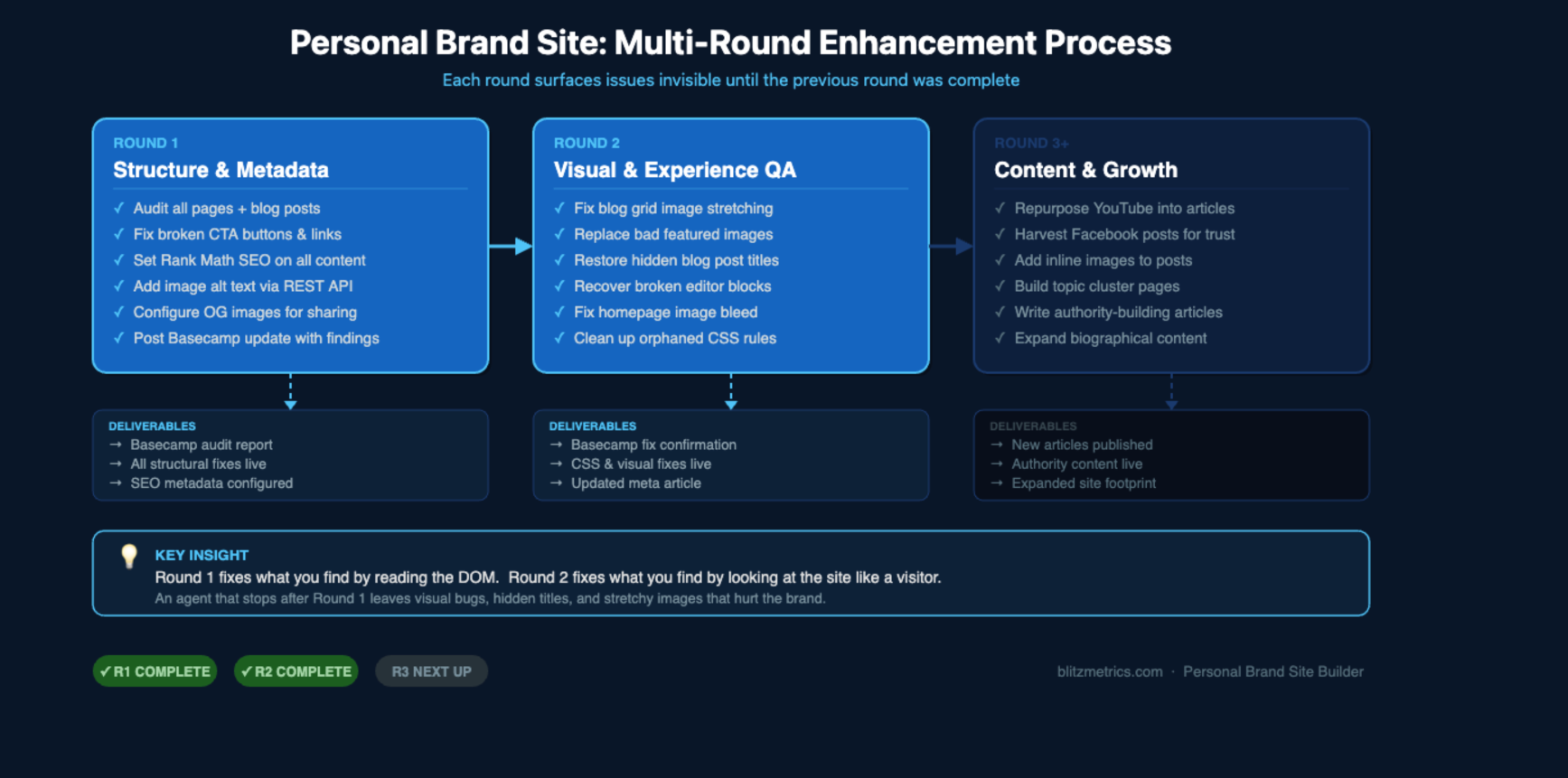
This flowchart shows the standard BlitzMetrics multi-round enhancement process we used for Ethan’s site. Each personal brand website goes through three rounds of improvements — starting with structure and metadata, then visual and experience QA, and finally content expansion and growth optimization.
Value for Ethan Van De Hey
Ethan Van De Hey operates across multiple professional identities: Infinity Exteriors marketing manager, Roofing Launch CEO, Encourage Mindset Podcast host, and BlitzMetrics AI Builder. Without a personal brand site, these identities existed in silos — LinkedIn for professional networking, YouTube for the podcast, and no central hub tying them together.
EthanVanDeHey.com now serves as that hub. When potential Roofing Launch clients search his name, they find 65 articles demonstrating marketing expertise and leadership thinking. When podcast listeners want to explore past episodes, they find a filterable, searchable archive. When Infinity Exteriors leadership or partners research Ethan, they find a professional presence that validates his dual role as marketing executive and industry thought leader.
For someone building a career that spans corporate marketing, entrepreneurship, and content creation, the personal brand site is the entity declaration that tells Google — and anyone who searches — that all of these are the same person, and they’re all connected.
Why This Creates Value for BlitzMetrics
Ethan Van De Hey is an active participant in the BlitzMetrics AI Builder Program, where he and George Paladichuk have demonstrated the mentorship model that makes the Content Factory scale. This build is a direct demonstration of that program — an AI agent built the site, repurposed 45 podcast episodes, wrote 6 pillar articles, published 14 business articles, and polished the visual design across multiple sessions.
The case study strengthens the BlitzMetrics portfolio in two verticals simultaneously: home services (through Infinity Exteriors and the Roofing Launch ecosystem) and personal branding (through the Encourage Mindset Podcast). Every article, every CSS fix, every SEO configuration documented here becomes proof that the Personal Brand Site Builder system works at scale — not just for building one page, but for creating an entire content ecosystem around a personal brand.
This build is part of our Young Athletes & Scholars program — see the full roster of personal brands we’ve built in public for Olympic climbers, 724K-subscriber coaches, and scholar-athletes.
Related Meta Articles
- How We Built Gavan Thorpe’s Personal Brand Site Using AI Agents in 750+ Steps
- How an AI Agent Built Trenton Sandler’s Personal Brand Website
- How We Built Jason Amato’s Personal Brand Site
- How We Built NathanielStevens.com in Under 4 Hours Using AI
- How a Claude Agent Built RoofingLaunch.co in One Session
Get This Done for Your Personal Brand
What we built for Ethan Van De Hey — 65 articles, 4 designed pages, site-wide CSS, full SEO — we do for every personal brand in the BlitzMetrics system. The Personal Brand Site Builder program handles the entire pipeline: site architecture, podcast repurposing, pillar content, business articles, and visual polish. Start with the Meta-Article Prompt and work through the blog posting guidelines. The pattern is documented. The proof is in the articles. The system works.
Download the Skill File
This article has a companion Claude skill file that turns the strategy described above into a reusable, automated workflow. After installing the skill, Claude can execute each step on your behalf — building drafts, running audits, and producing deliverables in minutes instead of hours.
GO DEEPER: HOW THIS FITS THE BLITZMETRICS SYSTEM
• The Quick Audit: how we audit any business
• MAA (Metrics, Analysis, Action): the framework behind every audit
• The SEO Tree: how all our content connects
• Entity Linking: the decision tree for every link
• Knowledge Panels: getting Google to recognize you
• Every digital audit Dennis Yu has done
Dennis Yu
Dennis Yu is the CEO of Local Service Spotlight, a platform that amplifies the reputations of contractors and local service businesses using the Content Factory process. He is a former search engine engineer who has spent a billion dollars on Google and Facebook ads for Nike, Quiznos, Ashley Furniture, Red Bull, State Farm, and other brands.
Dennis has achieved 25% of his goal of creating a million digital marketing jobs by partnering with universities, professional organizations, and agencies. Through Local Service Spotlight, he teaches the Dollar a Day strategy and Content Factory training to help local service businesses enhance their existing local reputation and make the phone ring.
Dennis coaches young adult agency owners serving plumbers, AC technicians, landscapers, roofers, electricians, and believes there should be a standard in measuring local marketing efforts, much like doctors and plumbers must be certified. He has appeared on 353 podcasts with 619 credited episodes — see the full list of his podcast appearances.