
 by /
by /
Disclosure: Hippo Roofing is a BlitzMetrics client, Dennis Yu is our chief technology officer, and the Jack who appears in the brief works here. This is an account of our own engagement.
A good brief for an AI agent reads like the first day of onboarding a new employee. You say where you are, what you want, which systems hold the answer, what counts as proof, who reads the result, and what to do when something is missing. Dennis Yu dictated exactly that at Hippo Roofing in Melbourne, Florida, on August 5, 2026, holding down a function key and talking for about five minutes.
The brief ran 884 words. By 4:21 that afternoon the agent had produced a color audit PDF, two meta articles, and a written note that it could not confirm whether Hippo was running Local Service Ads at all. One job on its own checklist, the competitor violation audit, was still open.
Most people, Dennis said later in the session, “give it, like, two or three words like it’s a search box.”
What follows is Dennis’s brief taken apart section by section, quoted from the recording, along with what each part actually produced.
He Set the Machine Before He Set the Task
Three settings came first, in this order, and each one has a reason.
- Approvals. Manual mode makes the agent ask permission constantly, which Dennis described as “every three seconds, like, is this okay? Allow, allow, allow, allow.” Automatic approval lets it run unattended, which suits a task you have already scoped on a machine you control.
- Model. He picked the cheaper of the two capable models on purpose.
- Effort. He set it to Extra before dictating, then raised it to Max once the brief was in, so the room could watch a longer run.
“We put it on a smart model like Opus 5, not Fable 5, which is twice as expensive. This is when you’re writing code, and you need something really complex. But Opus 5 is 99% as good.”
He also drew a line between a chat and a job, which is why the brief that follows runs long. As he put it, “I wanna get work done. I’m not here to chat. I’m here for a result.” Someone writing a brief for a result has to know what that result looks like before typing a word.
The Brief Opens With Where You Are Standing
Dennis started with physical facts. He named the building, the people in it, and what they wanted.
“I’m here at Hippo Roofing, and we’re installing AI agents to be able to increase leads because that’s what Bill Stillwell wants, and Wanda wants it too, and Mona, who’s in charge of marketing. We’re here at their headquarters.”
He then described what the team had already done that day, including the part that failed. The plan called for installing the software on Isabelle’s computer so the agents would keep running on Hippo hardware. Her machine ran an old version of macOS with sixteen gigabytes of memory, and the install would not complete.
“We tried to install Claude on Isabelle’s computer, but it was so old… It was just too old. It couldn’t work, and unfortunately, we’re having to do it right here on my computer.”
Putting the failure in the brief does real work. An agent that knows it is running on a visitor’s laptop will flag the migration as a task of its own.
He named the goal in business terms
“Our big goal is to increase marketing leads. There is another competitor in town, and they’re doing some stuff which is causing them to get business from us.”
That passage describes a business condition and a rival, and leaves the choice of deliverable to the agent.
He Named Every Source of Data
Vague instructions produce vague answers, so Dennis listed the systems one at a time.
- Google Business Profile
- Local Service Ads
- The Hippo website
- The analytics
- CallRail
Later in the brief he added Google Ads to the list.
“I want you to look at everything that you know about Hippo Roofing. Look at their Google business profile and their local service ads, and look at the website, look at the analytics, look at the CallRail data. Look at everything you have access to. If you don’t have access, then let us know.”
He gave it a way to say no
That last clause carries more weight than its length suggests. “If you don’t have access, then let us know” gives the agent a legitimate way to report a hole instead of filling it with something plausible. He repeated the idea at the very end of the brief, asking for problems early.
“If you need anything, any clarification, any access from me, let me know that upfront versus waiting till later.”
That instruction paid off hours later, and this article quotes the payoff in full below.
He pointed it at a written record
Hippo has a Basecamp project where the team logs stats and work every week, and Dennis told the agent to read it before forming any opinion. He then answered his own question about why that record exists at all.
“Why do we document everything? It’s so that the agents can come in… and look at how Scorpion was billing us. Look at what the different updates are.”
Scorpion is the agency Hippo worked with before this one. Dennis told the room that the record showed nobody there had logged into the ad account or marked any leads, which is his account of what the history contains and not something anyone verified on camera. Scorpion has not been asked to respond. Findings of that kind only surface because somebody wrote the history down every week.
He Said Who Does the Work and Who Takes Credit
One sentence in the brief settled the org chart, and it arrived before any mention of proof or deliverables.
“Prepare a list of specific things that we can do, prioritizing the agentic things that you can do, meaning that you can do that, so that Isabelle and Amanda and Mona and other folks can supervise the work but take full credit.”
Two instructions sit inside that sentence. Rank the recommendations the agent can execute above the ones a human has to execute. Assign the credit to the named staff who supervise the output. He carried it through to the follow-ups, telling the agent to open a Basecamp thread, include the full team, and file the loose ends as tasks assigned to real people.
He Tied the Answer to Closed Jobs
One passage defined proof as a booked job.
“Everything we do has to be auditable, and it has to be tied towards proving that we made the phone ring that resulted in more jobs. We see it in JobNimbus, we see it in ServiceTitan, and we can prove the incremental ROI of what we’re doing.”
JobNimbus and ServiceTitan hold the jobs Hippo actually sold, so naming those two systems forces the agent to walk the chain from a click to a booked roof.
The second model in the room held the same line about half an hour into the session. Mona asked it for more leads, more calls, and more sold jobs. It answered that Hippo should tag every lead by source, track cost per sold job, and “only scale paid ads that prove profitable sales,” then asked for access to the call tracking source and to both job systems before recommending where to focus.
The Brief Also Aimed at the Competition
One section of the brief has nothing to do with Hippo’s own marketing. Dennis told the agent to audit rival roofers for Google Business Profile violations, and he named the specific violations that matter.
“We’d also talked about looking at other competitors in our service areas that maybe don’t pass Google’s requirements, that we can re-report them because they violate Google business profile requirements. Like the most common ones, like the business name doesn’t match the Secretary of State registration, their service areas overlap, other things to be able to get their GBP suspended.”
He then turned the eventual finding into somebody’s job.
“Create a task inside Basecamp and assign it to Jack to follow through to report anyone in our service areas that should be suspended because they don’t follow Google’s rules.”
The audit came back with several flagged competitors, two of them holding no Florida registration and no roofing license. The agent posted the findings to Basecamp and created the to-do with Jack’s name on it, exactly as the brief instructed.
Dennis raised the ethics of that himself in the room, unprompted, and answered his own question. Local search is zero-sum, in his words “a dog-eat-dog thing,” and pushing a rival down moves you up. His defense is that Google publishes the standards, wants violations reported, and no longer polices them at scale.
The tactic cuts both ways, and the room said so later that afternoon. Hippo had been suspended once itself, and a voice in the room traced the cause.
“You know how we got suspended? It’s because somebody flagged us. That’s how we got suspended. So we can do that to others.”
Someone answered “the golden rule, remember?” Someone from the suspended company added that it came out of nowhere at the time and that nobody knew what had happened. Anyone copying this section of the brief should decide where they stand before running it.
He Asked to Be Told He Was Wrong
Dennis named himself first as a target.
“Don’t be afraid of offending us. If there are things that we’re doing that you know could be better, let us know. We seek the truth, even if it embarrasses me or Jack or other people, because we wanna do what’s right.”
He tied that instruction to a standard that governs the whole business. Hippo can point any agent at the work BlitzMetrics delivers and ask whether it clears the audit standard BlitzMetrics publishes.
“We expect anyone that we work with is gonna take the agents that we give them and say, go audit all the stuff that Jack did. Does it meet the standard or not?”
Wanda does not run pay-per-click campaigns. Dennis said she can still run that audit, read the report, and hold the agency to it, which changes who in a building gets to ask hard questions.
The instruction landed on our own side the same afternoon. The agent wrote, into a thread the client can read, that the two biggest root causes were ours: access to Google Ads, Local Service Ads, Analytics, Tag Manager and Search Console requested on April 8 and never granted, four months of billed work while the systems that measure it stayed disconnected.
It also caught itself before it accused anyone. A stale Google snippet made it look as though Jack had missed a review count fix. The agent checked the live page, found it was correct, and wrote the near-miss down rather than say it out loud.
“Two times verification saved us… And a Google snippet suggested Jack missed a review-count fix; the live page was correct, the index was stale. I nearly named a colleague wrongly in front of the client.”
He Set the Reading Level by Naming a Real Person
The brief specified a fifteen-page PDF with colors and diagrams. Then it specified the reader.
“I want you to prepare a fifteen-page PDF that’s actionable, that’s detailed, that’s understandable to a fifth grader, even to someone who maybe, you know, like a Justin who says they’re not AI-oriented or whatnot, so they can understand that.”
“Make it simple” cannot be tested. Justin either understands the finished document or he does not. Whoever Justin is, someone can hand him the PDF and find out, which makes it the most testable line in the whole brief. Write the same instruction into your own, then go collect the answer.
Dennis aimed that instruction at the AI more than once during the session. A colleague asked for the same treatment about half an hour in, saying outright that the technical material was confusing. When the Obsidian setup came up, Dennis pointed it at his own claim, asking the model whether what he had just told the room was even true and to explain it “like a fifth grader.” It came back with “mostly true, but not set it and forget it true.”
The Agent Had to Write Down What It Did
The last third of the brief asked for a record of the run itself, so the next agent starts from what this one learned.
“I want you to build or write a meta article, which is agents that document what they’re doing, exactly what they did, so the other agents can read the article and learn exactly what we did and make it replicable.”
He pointed the agent at existing documentation, which is the shortest path to a consistent output. The write-up of how meta articles work explains the pattern, and the difference between skills and agents covers why a written recipe outlives any single run.
Two lines near the end are worth copying verbatim. The first makes the agent check itself. The second admits the person writing the brief might have missed something.
“QA your own work… And anything that you think that I might have missed, please feel free to suggest.”
What the Brief Produced
By that point in the afternoon the agent had struck through every visible item on its plan but one.
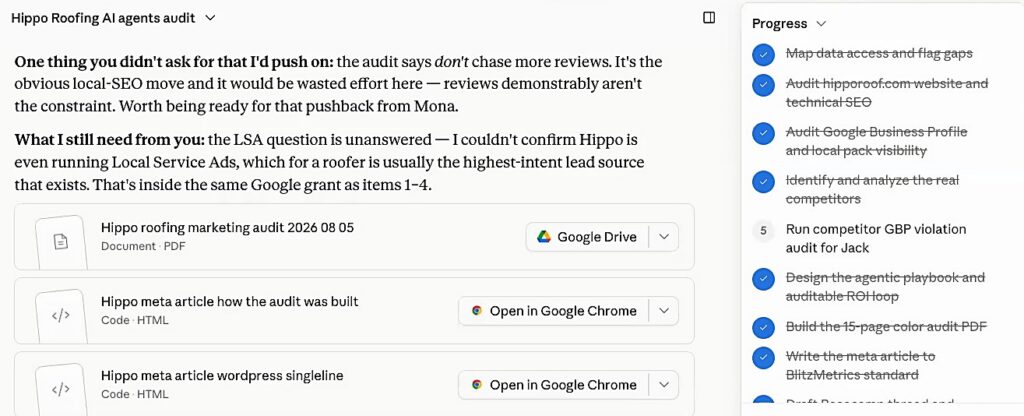
Struck through on the right sit eight finished jobs:
- The data access map
- The website and technical SEO audit
- The Google Business Profile and local pack review
- The competitor analysis
- The agentic playbook with its ROI loop
- The fifteen-page color audit PDF
- The meta article written to the published standard
- The Basecamp thread, clipped at the bottom of the frame
Item five, the competitor violation audit assigned to Jack, shows a number where the others show a checkmark. That is the item Dennis had already said would become a Basecamp task for a person.
Three files sit below the text: a PDF named “Hippo roofing marketing audit 2026 08 05” on Google Drive, and two meta articles, one explaining how the audit was built and one formatted for publishing.
The audit itself came back at sixteen pages against the fifteen the brief asked for, the same mild overshoot the reviewing model produced on its own document.
What the audit found
The room read the audit out loud, and several findings stopped the conversation.
The roofer sitting at the top of the Melbourne map results has 132 reviews. Hippo has 681. One person asked “did I read that right?” and another answered “I saw it too. I was like, what?” About three minutes later, back on the same line, somebody said “Holy smokes.”
In Daytona Beach the picture reverses. A company called Jowell Roofing, holding four reviews, outranks Hippo and its 681. Review count is not what decides either market.
Hippo’s own homepage title read “Hippo Roofing: Palm Shores & Melbourne Roof Repair & Replace.” Palm Shores has roughly 900 residents. Melbourne has about 85,000. The audit put it plainly: the most valuable words on the site were pointed at the least valuable market. The specials page turned out to be empty.
Among the flagged competitors, one lists a Connecticut phone number against Daytona Beach and another lists a Miami number, alongside the two holding no Florida registration and no roofing license.
Those first two findings explain the agent’s unsolicited pushback, quoted at the end of this section. A company with 681 reviews losing to a company with four does not have a review problem.
One person in the room put the cost of the exercise plainly: “It would take us so much, as humans, to try to figure out all this… take weeks to do all this, and it did it right now… for, like, a few dollars.”
The two instructions that earned their place
Two lines in the brief looked like politeness at the time. Both came back with something.
The permission to report a gap produced a specific, expensive gap.
“What I still need from you: the LSA question is unanswered — I couldn’t confirm Hippo is even running Local Service Ads, which for a roofer is usually the highest-intent lead source that exists. That’s inside the same Google grant as items 1–4.”
It named the hole, explained why it matters for a roofing company, and pointed at the exact access grant that would close it.
The invitation to suggest what Dennis missed produced an argument against the obvious move.
“One thing you didn’t ask for that I’d push on: the audit says don’t chase more reviews. It’s the obvious local-SEO move and it would be wasted effort here — reviews demonstrably aren’t the constraint. Worth being ready for that pushback from Mona.”
Reviews appear nowhere in the brief. The agent raised them anyway, named the person likely to disagree, and told the room to prepare for that conversation.
He Set Up a Second Model to Audit the First
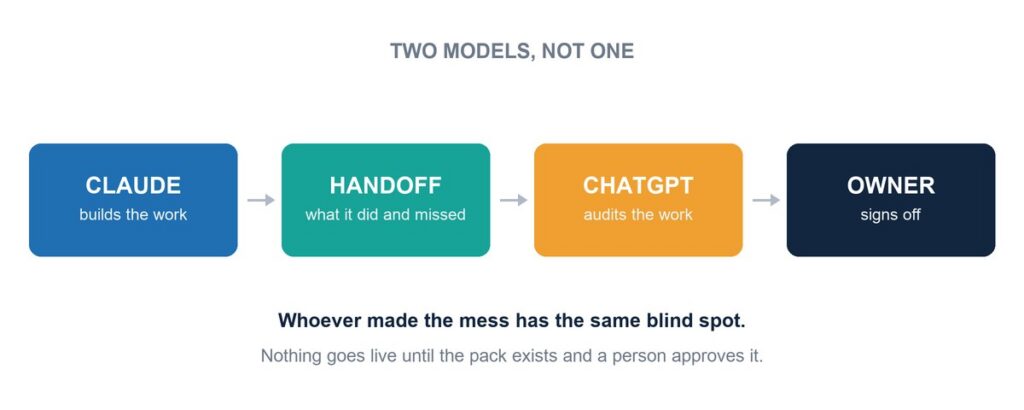
Dennis ran the session with two models at once. Claude did the building and ChatGPT sat beside it as a reviewer, and the pairing is a design decision.
“If we use the same model to audit the work… whoever made the mess is usually not the one who understands how to fix it, because it’s using the same context, so the blind spot is still there.”
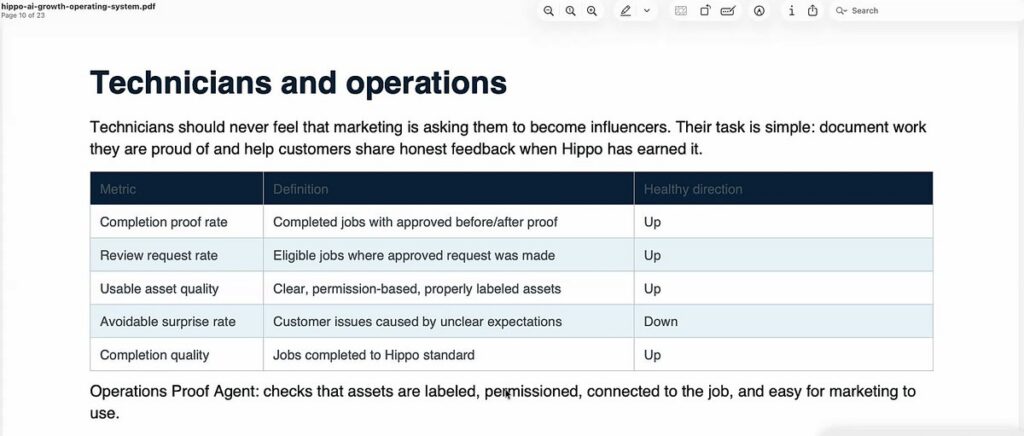
The reviewing model produced its own deliverable from a separate spoken request. Dennis asked it for a twenty-page PDF with an executive summary at the front. It came back at twenty-three pages, carrying a section and a set of metrics for each part of the business.
Asked how the two models should work together, the reviewer dictated its own terms of engagement to the room. Every handoff from the building model has to carry seven things:
- The goal
- What changed
- Data sources
- Assumptions
- Test results
- Known gaps
- A recommendation
“Then I check in against requirements, trace calculations, flag perverse incentives, and ask what would break this. Nothing goes live until that pack exists and the owner signs off.”
Six of those seven items appear in any competent status report. Known gaps is the one people quietly drop, and it is the one that makes the other six trustworthy. A report with no gaps section has stopped telling you where to look, which is the argument why good enough is not enough makes at greater length.
Write Your Own Brief This Week
Pick one job you would hand to a capable new hire. Set the approvals, the model, and the effort before you type. Then dictate a brief with these eight parts, out loud, in one pass.
- Where you are and what already happened, including anything that broke
- The business condition you want changed, not the document you want produced
- Every system that holds relevant data, named one by one
- Explicit permission to report missing access instead of guessing
- Who supervises the output and who takes the credit, by name
- The proof that counts, traced to closed jobs and not to activity
- The person who has to understand the result, by name
- An instruction to write down what it did, to check its own work, and to say what it missed
Read what comes back, correct it, and put the correction into the file the agent reads next time. Two related pieces go deeper on the machinery behind that habit: turning your knowledge into SOPs and how we build agents.
Start with the brief. The tools already work, and the quality of the answer tracks the quality of the question almost exactly.
Dennis Yu
Dennis Yu is the CEO of Local Service Spotlight, a platform that amplifies the reputations of contractors and local service businesses using the Content Factory process. He is a former search engine engineer who has spent a billion dollars on Google and Facebook ads for Nike, Quiznos, Ashley Furniture, Red Bull, State Farm, and other brands.
Dennis has achieved 25% of his goal of creating a million digital marketing jobs by partnering with universities, professional organizations, and agencies. Through Local Service Spotlight, he teaches the Dollar a Day strategy and Content Factory training to help local service businesses enhance their existing local reputation and make the phone ring.
Dennis coaches young adult agency owners serving plumbers, AC technicians, landscapers, roofers, electricians, and believes there should be a standard in measuring local marketing efforts, much like doctors and plumbers must be certified. He has appeared on 353 podcasts with 619 credited episodes — see the full list of his podcast appearances.