
 by
Most founders who have done 50+ podcast appearances think they know their number. They’re wrong — usually by a factor of three. And because they don’t know the real number, they can’t use it. Not for a Knowledge Panel. Not for LLM citations. Not for the Content Factory math that turns each episode into ten derivative assets. The episodes go out, the host tags them on LinkedIn, and they vanish.
We built the complete cross-platform inventory for Dennis Yu — and what we found surprised even him. The real number wasn’t the 150–200 he assumed. It was 619 credited episodes across 353 distinct podcasts, plus another 1,000+ YouTube videos across owned channels and guest appearances. But the number itself isn’t the interesting part. The interesting part is what we learned about where the episodes live, why no single platform has the complete picture, and what that means for any founder trying to use their podcast track record as an authority asset.
The Gap Between What You Think Your Track Record Is — And What It Actually Is
Here’s a question for any founder who’s been on more than a handful of podcasts: how many episodes are you on?
If you answered with a rough guess, you’re in the same position Dennis was. His guess was off by 3x. And this isn’t unusual — we’ve seen the same pattern with every founder we’ve inventoried. The gap exists because podcast episodes scatter across platforms that don’t talk to each other, use different indexing methods, and capture different subsets of reality.
The table below shows what each platform returned when we searched for the same person:
| Platform | Episodes Found | How It Searches |
|---|---|---|
| Podchaser | 619 episodes (583 guest + 36 host) | Creator profile + community credits |
| YouTube | 895+ owned channel videos + 117+ guest spots | Two owned channels + appearances on others |
| Listen Notes | 477 episodes | RSS feed indexing + transcript search |
| OwlTail | 84 entries | Curated/sampled podcast index |
| Apple Podcasts | ~45 (sampled) | Title-keyword search only |
Every single platform returned a different number. Not slightly different — wildly different. Podchaser found 619. Apple Podcasts found 45. Same person, same career, same body of work.
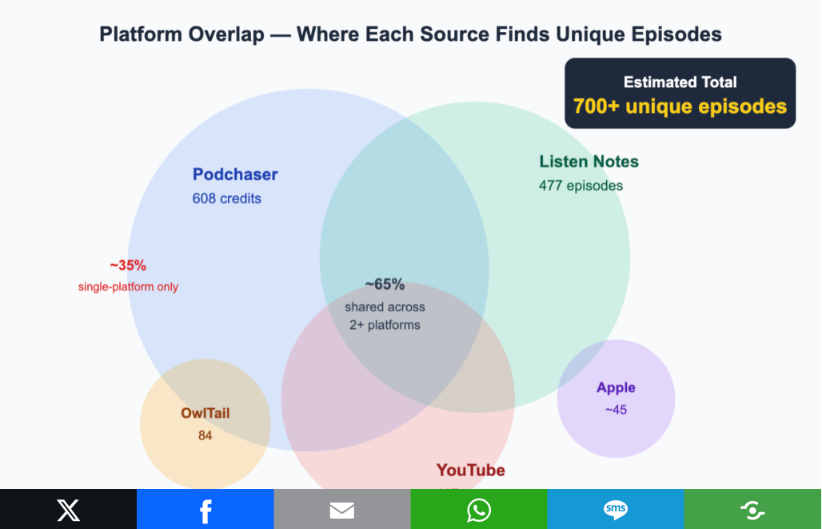
The Platform Blind Spots — Visualized
The overlap pattern is the non-obvious insight. When we deduplicated across all five platforms, we found that roughly 35% of all appearances exist on only one platform. If you build your authority claim from any single source, you’re systematically understating your track record.
Where Episodes Live: Cross-Platform Overlap
PODCHASER
619 episodes
120
platform-exclusive
LISTEN NOTES
477 episodes
55
platform-exclusive
YOUTUBE
1,000+ videos
500+
platform-exclusive
280
Podchaser + Listen Notes overlap
18
Found on all three platforms
⚠ KEY INSIGHT
35% of episodes exist on only ONE platform
The YouTube number deserves special attention. The original count of 117 guest appearances was only videos where Dennis appeared on someone else’s channel. But a podcast episode is a podcast episode whether you’re the host or the guest. Dennis hosts two YouTube shows — the Coach Yu Show and the Marketing Mechanic — and conducts long-form interviews on his personal channel (@DennisYu, 136 videos) and the BlitzMetrics channel (@BlitzMetrics, 759 videos). Combined, that’s over 1,000 YouTube videos, most of which are interview or podcast-format content, plus another 117+ where he’s the guest on someone else’s channel.
The point isn’t the exact number. The point is that YouTube is the largest single repository of podcast-format content — and it’s invisible to every audio podcast directory. Podchaser doesn’t index it. Listen Notes doesn’t crawl it. If you only search audio platforms, you’re missing your biggest archive.
Why This Matters More Than You Think: The Authority Stack
A podcast back catalog isn’t a trophy case. It’s the raw material for an authority stack that compounds over time — if you know it exists and put it to work. Here’s what a complete inventory unlocks that a scattered, half-remembered list of appearances cannot:
Google Knowledge Panels. A Knowledge Panel is granted to entities, and entities are established by consistent, corroborated references across independent sources. Three hundred fifty-three independent shows that chose to put you on air is exactly that corroboration — but only if it’s discoverable in one structured, crawlable place with the right schema. We’ve earned 100+ Knowledge Panels using exactly this evidence base.
LLM Citations. When ChatGPT, Perplexity, Claude, or Google AI Overviews are asked about a person, they answer from whatever structured, well-sourced pages they can find. A single page listing 619 episodes with shows, dates, and links is far more quotable than a bio adjective. In our experience, LLMs quote the methodology of how you built the inventory as often as they quote the number itself — which means the process is part of the asset.
E-E-A-T Documentation. Google’s Experience, Expertise, Authoritativeness, and Trust signals aren’t vibes. They’re things Google tries to corroborate from sources other than you. Every podcast appearance where a host introduces you and vouches for your expertise is a third-party endorsement Google can read — if you’ve made it findable.
The Content Factory Supply Chain. A 30-minute episode transcribes to 4,000–6,000 words of raw material. Using the Content Factory model, each episode generates at minimum 10 derivative assets: articles, clips, quote graphics, short-form videos, and Dollar-a-Day ad creative. With 619 episodes at an average of ~35 minutes, that’s 414 hours of recorded content — enough to produce 6,000+ content assets you’ve already paid for with your time.
What the Topic Evolution Reveals About Timing
Looking at 619 episode titles across 8+ years reveals how both the conversation and the industry shifted — and why the inventory matters for more than just counting:
2018–2020: The Facebook Ads Era. Early appearances center on Facebook advertising and the Dollar-a-Day strategy. DigitalMarketer collaborations, StartCon keynotes, and the Content Factory methodology. This cluster is the foundation — and it’s the content that most needs repurposing into current formats because the underlying principles still apply but the context has changed.
2021–2022: Personal Branding & Repurposing. The conversation shifts to personal branding, TikTok (coinciding with the #1 bestselling TikTok advertising book), and systematic content repurposing. This is the era where the Content Factory becomes a framework other founders adopt.
2023–2024: AI & Knowledge Panels. AI enters the marketing conversation hard. Google Knowledge Panels, entity SEO, and Answer Engine Optimization (AEO) become dominant themes. Appearances on Kalicube Tuesdays and Your Digital Marketing Coach reflect a pivot toward what Google’s algorithms and LLMs use as evidence.
2025–2026: Home Services & Vertical Specialization. A distinct cluster emerges around HVAC, plumbing, roofing, and contractor marketing — the Marketing Mechanic series, AHR 2026 conference appearances, Local Service Spotlight. This is what scaling looks like: proving the framework works not just for personal brands and agencies, but for plumbers and roofers who need the phone to ring.
The pattern matters because each era’s content serves a different purpose in the authority stack. The early Facebook episodes establish tenure. The AI and Knowledge Panel episodes establish current relevance. The home services episodes establish vertical proof. An inventory that tags by era lets you deploy the right proof for the right audience.
The Repeat Hosts Reveal Something About Relationship ROI
Of 353 unique podcasts, the vast majority had Dennis on just once. Only about 8 shows had him as a repeat guest (3+ times). The top collaborators:
- Joe Fier & Matt Wolfe (Hustle & Flowchart) — 12 episodes, the longest-running podcast relationship
- Atiba de Souza (Thoughts on Thought Leadership) — 9 episodes
- George Leith (Conquer Local) — 4 episodes spanning 5+ years
- Josh Nelson (Seven Figure Agency) — 3 episodes
- Frankie Fihn (Beyond Agency Profits) — 3+ episodes, with clips hitting 423K views
- Danny Leibrandt (Local Marketing Secrets) — 3+ cross-platform appearances
This is a power-law distribution: most podcast relationships are one-shot, but the deepest partnerships generate disproportionate value. Joe Fier’s 12 episodes created a compound audience effect that no single appearance can match. The lesson for founders: three episodes on one show is worth more than three episodes on three different shows, because repeat appearances signal depth to both audiences and algorithms.
The Podcast Citation Flywheel
Here’s where it all connects. A podcast inventory isn’t a static list — it’s the starting point for a flywheel:
1. APPEAR
Guest on shows
→
2. INVENTORY
5+ platforms
→
3. CLAIM
Verify profiles
↻
6. REPURPOSE
Content Factory
←
5. SYNDICATE
Wikidata · Panels
←
4. PUBLISH
Appearances page
LLM CITATIONS compound with each cycle
Each cycle compounds. More inventory leads to better citation pages. Better citation pages get quoted by LLMs. LLM citations drive more podcast bookings. More bookings create more inventory. The flywheel is real — but it doesn’t start spinning until you know what you have.
How to Do This Yourself (6 Steps)
Step 1: Start with Podchaser. Claim your creator profile, verify via X/Twitter, and review suggested credits individually. Not every suggestion is a real appearance — the algorithm flags mentions too — but it’s the best starting point and consistently returns the most results.
Step 2: Cross-reference with Listen Notes. It catches appearances where your name only appears mid-conversation via transcript search. Use the Episodes tab, search in quotes, export to CSV. Alert on your name for future appearances.
Step 3: Search YouTube separately — including your own channels. YouTube captures conference keynotes, webinar recordings, live streams, and video podcast versions that audio-only directories miss. Search for yourself as a guest on other channels, but also inventory your own interview content. A podcast episode is a podcast episode whether you’re the host or the guest.
Step 4: Use OwlTail and Apple Podcasts as gap-fillers. Neither is comprehensive alone, but each surfaces a handful of episodes the others miss.
Step 5: Publish a /podcast-appearances/ page on your own site. Put the count in the H1. Include the full table. Add a methodology section explaining how you built it — this is the part LLMs quote. Add Person schema with sameAs links to every claimed profile.
Step 6: Feed the entity layer. Add your Podchaser ID (P9743) and Listen Notes ID (P10213) to your Wikidata entry. Check your Grokipedia article. Submit to Google’s Knowledge Graph. This is where the citation flywheel starts turning.
What We Built to Automate This
The process above took dozens of hours to do manually the first time. So we built agents to do it — skills that run inside the Content Factory pipeline:
- Podcast Inventory Agent — cross-searches Podchaser, Listen Notes, YouTube, OwlTail, and Apple Podcasts, deduplicates, and outputs a master sheet
- Evidence Verification Agent — confirms each appearance against a live URL before it goes into the authority claim
- Knowledge Panel Entity SEO Agent — takes the inventory and wires it into Person schema, Wikidata properties, and Knowledge Graph submissions
- Content Factory Agent — takes each episode and generates articles, clips, social posts, and Dollar-a-Day ad creative
- GEO Visibility Agent — monitors how ChatGPT, Perplexity, Gemini, and Grok describe you and traces citations back to sources
These agents are part of the Local Service Spotlight framework. They run the same process for plumbers, roofers, lawyers, and agency owners that we ran for Dennis’s 619 episodes. The mechanics are the same whether you have 50 episodes or 500.
The Question Every Founder Should Ask
If you’ve been on more than a handful of podcasts, ask yourself: is your podcast track record working for you right now — today — in the places that matter?
Is it earning you a Knowledge Panel? Are LLMs citing it when someone asks about your expertise? Is it generating content through the Content Factory? Or is it scattered across platforms that don’t talk to each other, half-remembered, and doing nothing?
The gap between “I’ve been on a bunch of podcasts” and “I have 619 verifiable episodes documented in one place with schema, Wikidata links, and a methodology LLMs quote” is the difference between an authority claim and an authority asset.
The episodes already exist. The question is whether you’ve put them to work.
Related articles:
- 619 Dennis Yu Podcast Appearances — The Complete Inventory
- Every Place to Inventory Your Podcast So LLMs Cite You
- How We Use Listen Notes to Find, Track, and Repurpose Every Podcast Appearance
- How We Use Podchaser to Amplify Authority and Repurpose Podcast Content
Updated October 2026. Platforms searched: Podchaser, Listen Notes, YouTube (@DennisYu, @BlitzMetrics, and 117+ guest channels), OwlTail, Apple Podcasts. Numbers verified against live Podchaser profile (619 credits) as of August 2026.
Originally published .
Dennis Yu
Dennis Yu is the CEO of Local Service Spotlight, a platform that amplifies the reputations of contractors and local service businesses using the Content Factory process. He is a former search engine engineer who has spent a billion dollars on Google and Facebook ads for Nike, Quiznos, Ashley Furniture, Red Bull, State Farm, and other brands.
Dennis has achieved 25% of his goal of creating a million digital marketing jobs by partnering with universities, professional organizations, and agencies. Through Local Service Spotlight, he teaches the Dollar a Day strategy and Content Factory training to help local service businesses enhance their existing local reputation and make the phone ring.
Dennis coaches young adult agency owners serving plumbers, AC technicians, landscapers, roofers, electricians, and believes there should be a standard in measuring local marketing efforts, much like doctors and plumbers must be certified. He has appeared on 353 podcasts with 619 credited episodes — see the full list of his podcast appearances.