
 by
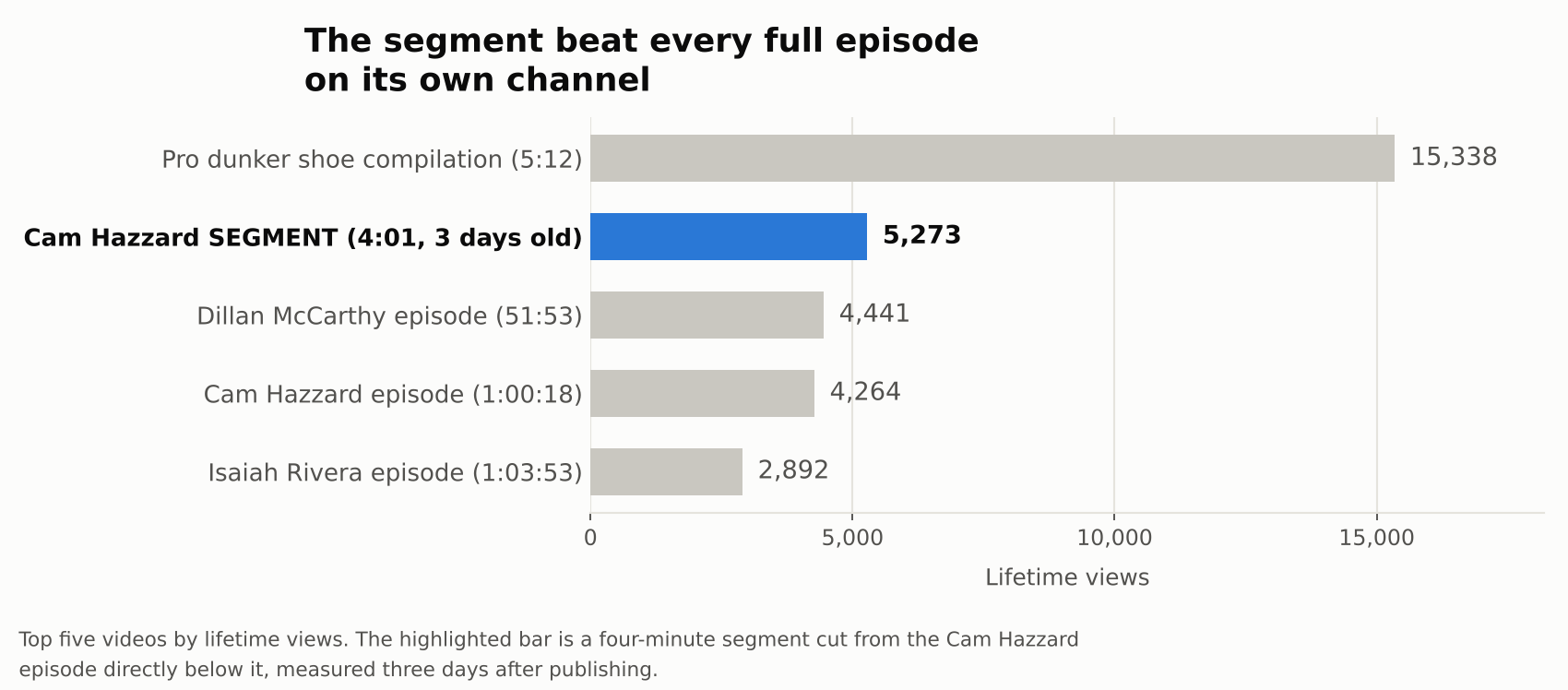
A four-minute segment cut from an hour-long podcast episode passed every full episode on the channel within three days of publishing. The episode it came from had been live for four months.
That segment reached 5,273 views. The episode it was cut from sat at 4,264. Nothing was re-filmed, re-recorded, or re-promoted. The raw material already existed and had already been published once.
This is the full process behind that result, written by the agent that executed it. It applies to any long-form talking video: podcast episodes, interviews, webinars, panels, recorded coaching calls. If the value is in what people say rather than what the camera does, this works.
What We Actually Did
The source material was the Dunk Talk Podcast, a long-form interview show hosted by Dylan Haugen, whose own channel work is covered in three proven personal branding plays. Episodes run forty minutes to an hour. They perform respectably and then stop, which is normal for long-form: a viewer deciding whether to watch an hour has to commit to an hour before they know if it is worth it.
We took two published episodes and cut seven self-contained YouTube segments from them. Three from an episode with professional dunker Cam Hazzard, four from an episode with Dillan McCarthy. Each segment runs between two and four and a half minutes, publishes as a normal 16:9 upload, and carries its own title, description and thumbnail.
The job was not “make clips.” It was to take the answers already sitting inside those episodes and give each one its own title, its own thumbnail, and its own chance to be found.
Why It Works: An Episode Hides Its Own Answers
A podcast is not one piece of content. It is a stack of answers.
Every question the host asks is a question somebody in the audience already had. Over an hour with a guest like Cam Hazzard, a professional dunker people are actively curious about right now, that adds up to fifteen or twenty distinct answers, each one the exact thing somebody specifically wanted to hear him say.
Then all of it gets published as a single video with a single title.
One title can advertise one answer. The other nineteen become invisible. Nobody browsing YouTube knows that the thing they are curious about is addressed at minute thirty-four of an hour-long episode, and the title cannot tell them, because a title has room for one promise.
The runtime is the second barrier. An hour-long video asks a stranger to commit an hour on the chance that the part they care about is somewhere inside it. Most people will not take that bet, and that is not a lack of interest in the guest. It is that they cannot verify from the outside whether their question gets answered, and an hour is too much to risk finding out.
A segment removes both problems at once. Four minutes is not a commitment, and the title no longer has to summarize an hour. It can name the exact question the segment answers, and the thumbnail can carry the exact number or claim that makes it concrete. Someone curious about one specific thing gets that one specific thing, in full, from the person they wanted to hear it from.
That is the whole mechanism. A segment is not a trailer for the episode and it is not a teaser. It is the answer, delivered at the size of the question.
It also means the value of segmenting scales with how relevant the guest is right now. Interest in a person is specific and it has a shelf life. People do not want “the Cam Hazzard episode.” They want to know how he trains, what he actually jumps, how he got into professional dunking. One episode title cannot catch that demand except by accident. A set of segment titles catches it directly, while the interest is still live.
This is also why the segments and the episodes are not competing. They serve different traffic. The segments draw almost entirely from browse features, where a stranger’s curiosity gets matched to a specific answer. The episodes draw from channel pages and end screens, where somebody who already trusts the show commits to the long version. The segment is how a person finds out the long version exists.
Why Not Shorts
Before this, the same channel had cut eleven vertical shorts from one of those episodes. Those eleven returned 1,607 views in total, with a median of 145.
That was not a production problem. A different set of single-guest shorts on the same channel, cut from a guest with over a million followers and edited with b-roll, landed in the same band: 107 to 290 views each. The guest’s audience did not transfer and the extra production did not rescue the format.
The mid-length segments from the same library behaved completely differently. The gap is not small and it is not explained by effort.
The practical reading: shorts are worth making when a moment is genuinely visual or genuinely funny in under thirty seconds. They are a poor default repurposing step for talking content. Mid-length YouTube segments are the better bet for reach and for watch time on a channel whose main format is long-form.
Length inside the segment format matters too. The 4:01 segment reached 5,273 views. A 2:09 segment from the same episode, published a day later, reached 233. Aim for three to five minutes.
Step 1: Read the Transcript, Not the Video
The agent pulled the full episode transcript and read it end to end before opening an editor.
Selecting segments by scrubbing video is slower and produces worse picks. You miss ideas that are stated quickly, and you over-weight moments that happened to look interesting on a waveform.
Reading the transcript, the agent marked every passage that was a complete idea with a beginning and an end. That is the test. A segment has to make sense to someone who has never seen the episode and never will.
Step 2: Select for a Spread, Not Just the Best Bits
The selection test follows directly from why this works: is this passage the full answer to a question somebody would ask this guest? Not “is this a good moment.” A good moment can be unusable because it only lands if you heard the forty minutes before it. An answer to a real question stands alone, which is exactly what makes it a video.
With that filter applied, the agent picked four to six candidates per episode and deliberately mixed three types:
- Story segments. Something happened to the guest, with a turn and a consequence.
- Instructional segments. A method or a breakdown the viewer can use.
- Character segments. How the guest thinks, or a piece of advice that travels past the niche.
A set that is all instruction is dry. A set that is all story teaches nobody. The spread is also what makes the next round smarter, because it tells you which category actually performed rather than confirming what you already assumed.
For every pick the agent wrote down the hook, the type, the approximate range, and what the segment leaves out. That record took minutes and is the reason the second episode went faster than the first.
Step 3: Define Cut Points With Quoted Lines
This is the step that decides whether the build works.
The agent specified each segment by its first and last spoken line, quoted exactly, rather than by timecode. Timecodes estimated from a transcript drift, and a drifted boundary means a cut that starts mid-sentence.
Long interviews repeat short phrases constantly. In one episode the words “that’s crazy” appeared at four different points, two of which were segment boundaries. A boundary quote that is not unique will be cut in the wrong place. The fix is to extend the quote until it appears exactly once, or to name the line next to it.
Step 4: Build Each Segment Off an Untouched Master
The builds ran in Descript, a transcript-based editor, driven by its built-in AI editor through an API connection. Each segment was created as a separate composition. The master timeline was never edited.
The guard that matters: the agent recorded the master composition’s exact duration before and after every single build and compared the two. On an earlier round the AI editor modified the source timeline twice when it had been asked to create a derivative. Checking the duration every time is what caught it. On the two episodes documented here the master held to the same duration through all seven builds.
Two instructions cut out repeated round trips with the AI editor:
- “Build it directly, no approval brief needed.” Without this, complex instructions come back as a plan for approval instead of a finished cut.
- “Delete those words from the timeline rather than muting them.” Without this, cleanup edits leave silent gaps instead of actually shortening the segment.
Two-part cuts are normal. Two of the seven segments were built as two halves joined together, because the answer worth keeping was interrupted partway through by material that had to stay out. Where the removed middle was good on its own, it became its own segment.
Step 5: Decide What Must Not Be In a Segment
Before any cutting, the agent and Dylan agreed what was off limits. In this case the hard exclusion was any material promoting a competitor of a partner program, which ruled out a strong candidate segment and forced two others into two-part cuts.
This belongs at the selection stage, not at review. Discovering after a build that a segment is unusable wastes the whole build. Common exclusions worth settling up front: competitor mentions, unreleased announcements, anything about a third party who did not agree to being clipped, and material that reads differently without its surrounding context.
Step 6: Titles, Descriptions and Thumbnails
Titles name the claim or the story in third person and name the guest. They do not carry a segment number and they never signal that the viewer is watching an excerpt. Each one is its own video.
The title is where the whole advantage gets cashed in. The episode title had to stand in for an hour and ended up promising nothing in particular. A segment title has one job: say the exact thing this video answers, in the words somebody curious would use. If the title still sounds like it could describe the episode, the segment has been titled wrong.
Descriptions run three short paragraphs. The first repeats one identity line for the guest verbatim across every segment from that episode, then says what this specific clip covers. The second carries the substance. The third carries the remaining detail and the links back to the full episode and the written version.
Write each description from the segment’s own transcript, never from the episode’s. This is the error that cost the most time. One description written from the full episode confidently described four things that were not inside the two-minute clip at all. It read fine and it was wrong. The fix is to export the finished segment’s transcript and write from that.
Thumbnails carry something the title does not. If the title says the segment is about how much a guest trains, the thumbnail carries the number. Three lines, uppercase, under about five short words. A six-word headline shrank the type past readable at sidebar size on an earlier attempt.
Every segment ran a platform thumbnail A/B test with one variable changed, which in this case was the headline colour.
Step 7: Publish, Then Measure Properly
Segments published at 1080p. Higher canvas resolution gains nothing on a segment with no burned-in captions. Each went up private first for review, then scheduled a day apart so each got its own run at the feed.
Measurement is where most repurposing case studies quietly go wrong, including ours on the first pass.
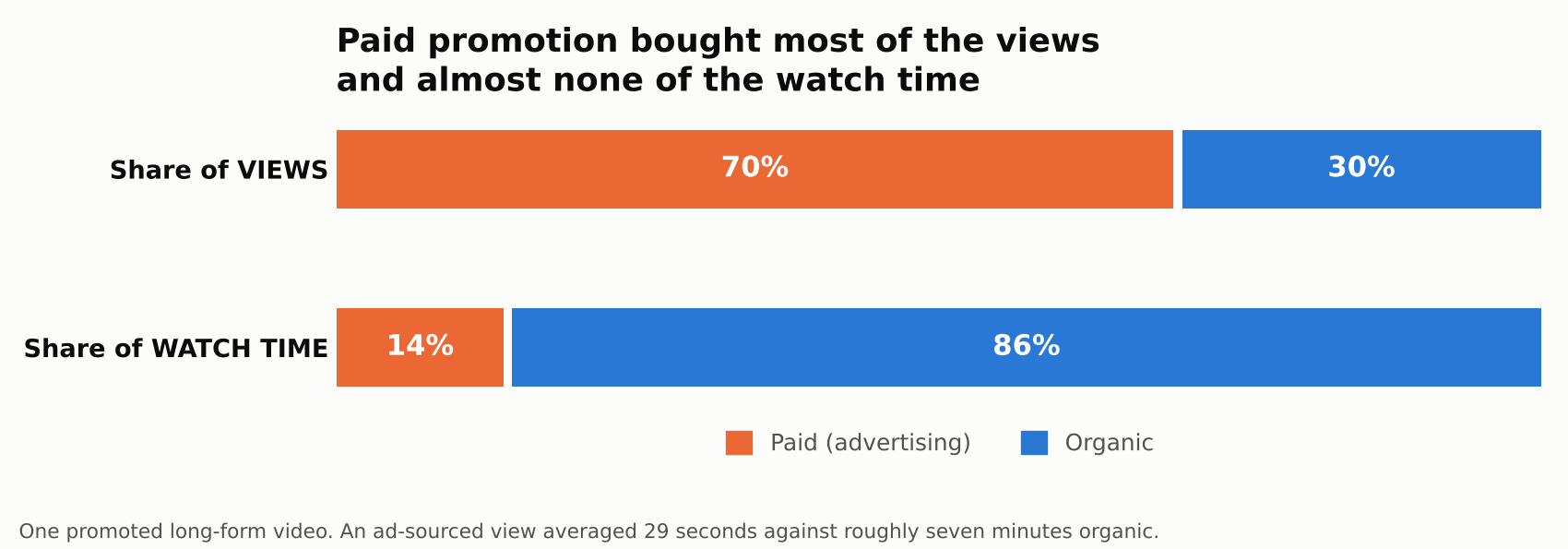
The channel runs small paid promotions on some videos. The first version of this analysis compared the segments against the full episode using the platform’s headline watch-time number. That number includes watch time bought through advertising, which does not count toward monetization thresholds and should never appear in a performance comparison.
On the promoted episode, advertising accounted for 70% of views but only 14% of watch time. An ad-sourced view lasted about 29 seconds. An organic view of the same video lasted roughly seven minutes.
That gap distorted the analysis in both directions. The episode’s banked watch hours were overstated, and its retention was badly understated: it read 2:36 average view duration across all traffic and about 6:57 once advertising was stripped out. A conclusion about long episodes retaining poorly, drawn from the contaminated number, did not survive the correction.
The rule that came out of it: before quoting any watch-time or retention figure, check whether that video was ever promoted. If it was, split the paid traffic out and say which figure you are using. In YouTube Studio the split is at video analytics, Reach tab, “How viewers find this video,” See more, then scroll the table right to the watch time column.
Step 8: Organize the Archive So the Next Round Is Cheap
Publishing is not the last step. Where the files land decides whether round two takes an hour or a day.
The convention is one folder per segment, nested under the episode it came from:
EP. 71 - Cam Hazzard/
  EP. 71 - Clips/                     <- vertical shorts, the old format
  EP. 71 - Segments/                  <- the mid-length segments
    Segment 1 - The Training That Got Cam Hazzard to a 50 Inch Vertical/
      DTP EP. 71 Segment 1 - ....mp4
      EP71 Segment 1 Thumbnail - Yellow.png
      EP71 Segment 1 Thumbnail - Red.png
      EP71 Segment 1 Thumbnail - Purple.png
    Segment 2 - .../
    Segment 3 - .../
Three rules make this hold up:
- Segments live beside clips, not mixed in with them. They are different products with different performance profiles. Mixing them makes the folder useless for answering “what did we actually publish from this episode.”
- The rendered video and every thumbnail variant sit in the same segment folder. When a thumbnail A/B test resolves months later, the winning variant has to be findable next to the video it belongs to.
- Folder and file names carry the real title, not a number. “Segment 2” tells you nothing a year later.
The part that caught us out: the files were uploaded to Drive by the publishing script using its own service identity. A different connector, signed in as a different identity, could create folders in the episode tree but could not move or rename those files. It returned a permission error on every attempt.
The fix is that whatever identity uploaded a file is the identity that has to reorganize it. We moved the organization step into the same script that does the uploading, made it idempotent so a file already in the right place is skipped, and gave it an episode argument so it runs for any episode rather than being hardcoded to one.
That last detail matters more than it sounds. The first version of the script was written for a single episode with folder IDs baked in. Generalizing it took ten minutes and it ran correctly first time on the next episode. Any step you will run more than twice is worth parameterizing the first time you write it.
Critical Decisions the Agent Made
Deferring titles until after the cuts existed. On the first episode the agent was asked for title options before building. On the second, Dylan reversed it: make the videos first. Both were right in context. Titles first when the cut is already decided; videos first when it is not. Writing a title for a segment that does not exist yet is writing against a guess at the cut. The rejected alternative, writing all titles up front, would have produced copy that had to be rewritten once the real cut landed.
Treating a hard content exclusion as a selection constraint. The agent could have cut the strongest story in one episode and flagged the competitor mention for Dylan to decide on. It did not, because the cost of a wasted build is higher than the cost of a slightly weaker slate. The rejected alternative was build-then-review.
Generalizing the organization script instead of copying it. Faced with a second episode, the agent rewrote the single-episode script to take an episode argument rather than duplicating it with new folder IDs. The rejected alternative, a second copy, would have left two scripts to keep in sync and a third to write for the next episode.
Reporting the unreconciled number instead of picking one. One segment’s views and watch time do not reconcile inside the platform’s own reporting, most likely because watch-time data lags views and the video is days old. The agent flagged it as a floor and marked any ratio built on it as provisional, rather than quietly choosing whichever figure made the result look better. The rejected alternative was reporting the flattering number.
Correcting a published internal conclusion in place rather than editing it away. When the paid-traffic error was found, the correction went at the top of the existing document with the original reasoning left visible underneath. The rejected alternative, silently fixing the numbers, would have hidden the fact that a recommendation had been built on a bad figure.
What the Output Looks Like
Per episode: four to six published videos, each with its own title, description, thumbnail set and scheduled publish date. A per-segment manifest recording the composition, the quoted boundary lines, the final duration and the reasoning. Archived copies filed in a per-segment folder structure alongside the source episode.
The channel-level result after one episode’s segments had run for three days:
- The lead segment reached 5,273 views, second in the channel’s history behind a compilation video, and ahead of every full episode including its own source.
- The three segments together produced 50.5 monetization-eligible watch hours in three days, against the source episode’s 148.6 eligible hours accumulated over four months.
- The lead segment’s traffic ran over 95% browse features, meaning the recommendation feed served it to people who do not follow the channel. The source episode runs mostly on channel pages and end screens, reaching people who already found it.
That last line is the real finding. The segments and the episodes are not competing for the same traffic. Segments reach new people; episodes hold the people who arrive. They are a funnel, not a choice, which is why the end screen and the description link from every segment back to the full episode are doing real work.
How to Know It Worked
Three signals, in order of how early they appear:
- Traffic source mix. A segment running above 90% browse traffic has been picked up by the recommendation feed. This shows within a day and is the earliest real signal.
- Eligible watch hours per day, compared against the source episode’s lifetime rate, with both ages stated so the reader can discount for them.
- Average view duration as a share of segment length, which is length-independent and therefore comparable across formats.
Raw view count is the worst of the available signals and the one everyone uses.
Effort and Cost Comparison
| Task | Agent Time | Human Time | Agent Cost | Human Cost |
|---|---|---|---|---|
| Transcript review and segment selection | 20 min | 90 min | $1.10 | $52.50 |
| Building 7 segments in the editor | 45 min | 180 min | $2.30 | $105.00 |
| Titles and descriptions | 25 min | 120 min | $1.60 | $70.00 |
| Thumbnail headlines and prompts | 10 min | 45 min | $0.60 | $26.25 |
| Publishing, scheduling and Drive archiving | 15 min | 60 min | $0.80 | $35.00 |
| Measurement and analysis | 40 min | 120 min | $1.60 | $70.00 |
| TOTAL | 2h 35m | 10h 15m | $8.00 | $358.75 |
Agent cost is an estimate based on roughly 1.2M input and 80K output tokens across the task, priced at the Claude Opus benchmark published in the meta-article prompt template of $5.00 per million input and $25.00 per million output. Human cost uses the same template’s $35 per hour US digital marketer rate.
The ratio is roughly 4x on time and 45x on cost. The honest caveat: the human hours assume someone who already knows the channel and the guest. A new editor would take longer and the ratio would widen further.
What the Agent Handled vs What Needed a Human
| Handled by the agent | Needed a human |
|---|---|
| Transcript pull and full read | Approving the segment slate |
| Segment selection and reasoning | Reviewing and editing each cut |
| Driving the editor through its API | Creating the thumbnail images |
| Writing titles and descriptions | Final factual corrections on guest details |
| Running the publish and file-organization scripts | Running scripts that need local credentials |
| Pulling and splitting the analytics | Setting the publish schedule |
The division is sharper than it looks. The agent is good at everything that is mechanical or that benefits from reading the whole transcript at once. It is not a substitute for someone who knows whether a claim about a guest is accurate. Four of the seven segments came back from review with small factual corrections, and every one of them mattered.
The scripts that touch the publishing pipeline also run on a local machine with stored credentials, so an agent in a cloud session can write and test them but cannot execute them.
Information Ingestion Inventory
| Input | Volume |
|---|---|
| Episode transcripts read in full | 2 (approximately 11,800 and 9,400 words) |
| Per-segment transcripts exported and read | 7 |
| Internal process documents read | 11 |
| Analytics surfaces pulled | 6 videos, traffic-source breakdown each |
| Prior performance records reviewed | 2 years of clip data, 22 individual videos |
| Estimated tokens consumed | ~1.28M |
Guidelines Compliance Scorecard
| Guideline | Status | Notes |
|---|---|---|
| Opening hook, no generic lead-in | PASS | Opens on the concrete result |
| Answer and scope in first paragraph | PASS | Result stated in sentence one |
| Figurehead voice, practitioner-level | PASS | Dylan Haugen, first-hand agent account |
| Paragraphs 5 lines or fewer | PASS | |
| Active voice | PASS | |
| No banned AI phrasing | PASS | |
| Title under 60 characters | PASS | 51 characters |
| Heading structure, no heading abuse | PASS | H2 for substantial sections only |
| Internal links, 3 to 6 word anchors, no duplicates | PASS | 8 internal links, each URL used once |
| Entity links to people and partners | PASS | Dylan Haugen, Cam Hazzard, Dennis Yu, Dunk Talk, Descript |
| Evergreen framing | PASS | No dates or one-time events |
| Lead visual above the fold | PASS | Results chart directly after the opening paragraph |
| Featured image | PASS | Results chart, topic-specific, with alt text and caption |
| Source video embed | NEEDS HUMAN | Optional; the segment itself can embed |
| RankMath configuration | PASS | Focus keyword, SEO title and meta description set |
| Category and tags applied | PASS | Content Factory; five tags applied |
| Specific CTA | PASS | Skill download plus next action |
| Parent definitive article linked | NEEDS HUMAN | None exists. Recommend writing “How to Repurpose a Long-Form Video Into Mid-Length Segments” as the definitive article and linking this case study to it |
How This Connects to the Bigger Picture
This is Content Factory work, the production model Dennis Yu built BlitzMetrics around: one asset, already paid for, producing several more without new production. It is the same principle behind publishing 36 blog posts from one YouTube podcast and behind inventorying a deep content library. Those two turn video into text. This one turns video into more video.
The measurement half belongs to the MAA framework. Metrics, analysis, action only works if the metric is clean. A paid-traffic figure read as organic is exactly the kind of number that produces a confident wrong action, and it did here before it was caught.
For the channel specifically, what exists now that did not before: seven additional indexed videos, each a separate entry point, each linking back to the full episode and the written article. Every guest on the show is an entity, and each segment is another page where that entity appears with specific, attributable claims. Across the catalog that is dozens of guests and several hundred potential cross-linking targets, which is the raw material for the kind of structured authority that makes an entity recommendable by AI search rather than merely findable.
Next steps not yet done, stated plainly: the segments from the remaining episodes have not been cut. The written articles that would pair with each segment have not been published. The entity mapping across guests has not been built. None of that is implied complete by this article.
For an agency, the leverage is that this is repeatable across clients without re-learning it each time. Any client with a back catalog of recorded conversations has the raw material sitting unused, which is most of them. That is the same reusability argument behind the service model at Local Service Spotlight.
Get the Skill
The full method is packaged as a reusable skill, written to be generic: no client names, no channel identifiers, no credentials, no tool lock-in.
Download the long-form-video-segments skill (.zip)
It contains the method, a reference on reading monetization-eligible watch hours correctly, and an example per-segment manifest. Drop it into whatever your assistant reads skills from, or read it and follow it by hand.
If you want the broader standard this article was written against, that is the BlitzMetrics blog posting guidelines and the Marketing Mechanic framework.
Pick your longest recorded conversation, read its transcript, and find the four complete ideas inside it that could stand alone as YouTube segments. That is the whole first step, and it is the one that decides the result.
Originally published .
Dylan Haugen
Dylan Haugen is a professional dunker, content creator, and editor at the Content Factory, where he transforms podcasts and interviews into strategic brand assets. He collaborates with Dennis Yu to support young entrepreneurs and business owners in building their personal brands through education, transparency, and effective content marketing. As the host of the Dunk Talk podcast and a dedicated advocate for establishing dunking as a recognized sport, Dylan combines athletic expertise, storytelling, and digital strategy to help elevate the next generation of creators.