
 by
The long-form David Carroll interview has reached 343,513 YouTube views, checked September 5, 2026. The public watch page rounds that total to 343K, as shown in the screenshot below.

View-count update: September 5, 2026. The other analytics below retain their original case-study measurement periods.
The traffic-source snapshot in the original case study showed 100 percent external traffic for the reporting period displayed. Distribution did the work in that snapshot. That is a useful example of the Content Factory: publish a real conversation, then give people a reason to find it.
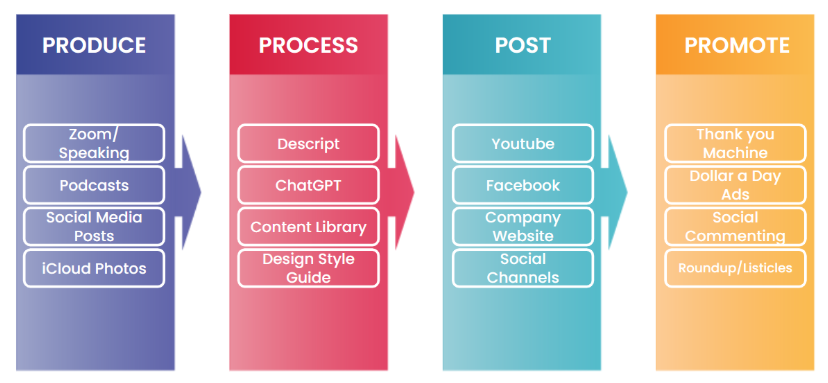
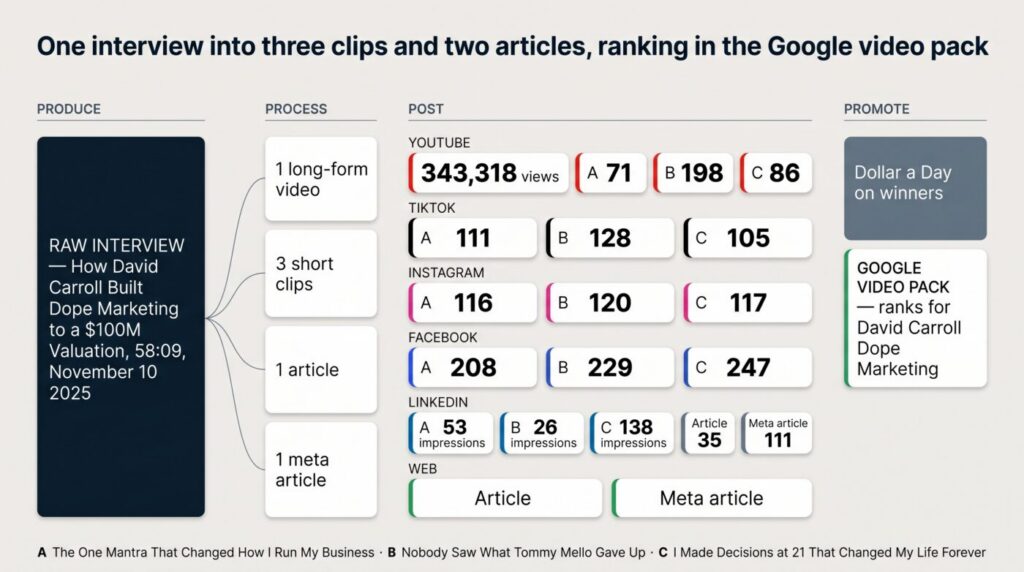
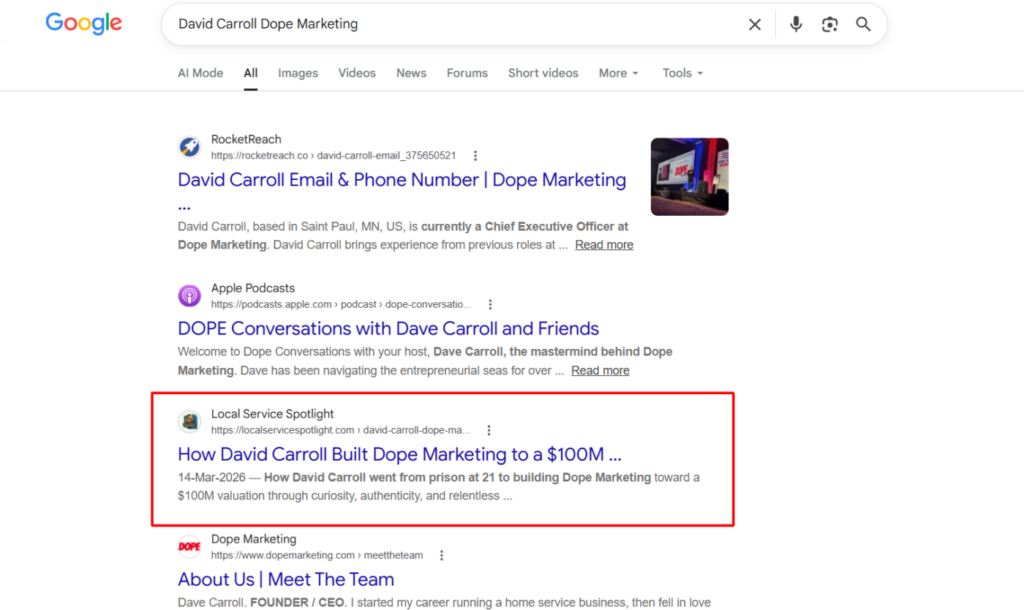
One 58 minute interview with David Carroll became sixteen assets across five platforms, and the interview now sits in Google’s video pack for his own brand term. No ad spend.
Here is every stage and every number.
Produce
The raw asset is a 58 minute interview called “How David Carroll Built Dope Marketing to a $100M Valuation,” published November 10, 2025.
David is the founder of Dope Marketing, which does direct mail and marketing automation for home service businesses. We talked about his path from prison at 21 to running a company approaching a hundred million dollar valuation, and what he took away from watching Tommy Mello exit A1 Garage Door Service for over four hundred million.
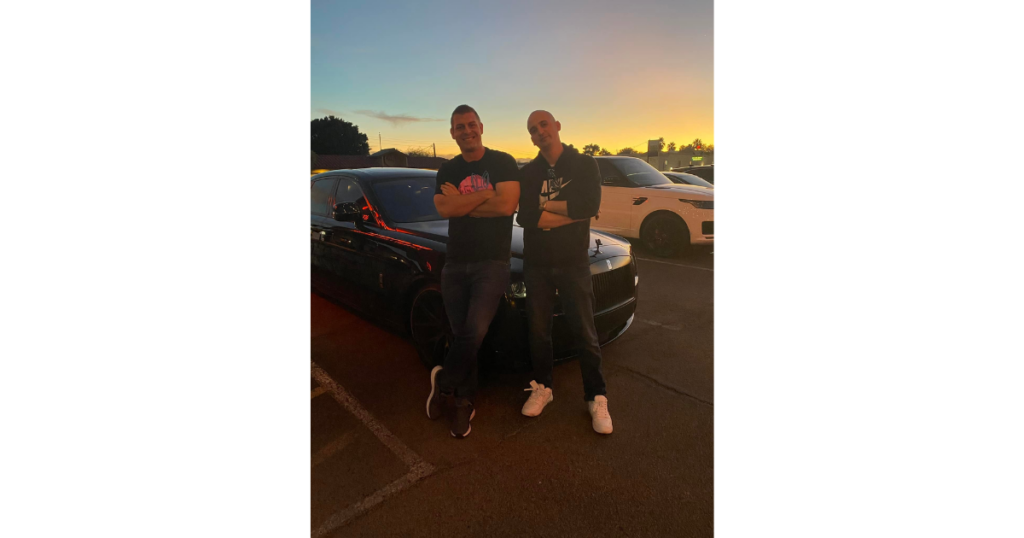
Notice what the raw ingredient is. A real conversation with a real operator about things that actually happened to him. That is the experience component of EEAT, and it is the one thing an AI cannot manufacture. Google and ChatGPT are looking for evidence that a specific person said specific things in a specific place at a specific time.

The earlier analytics snapshot recorded 343,318 views, 1.1 thousand hours of watch time, and 23 new subscribers. The public view count has since reached 343,513. The watch-time and subscriber figures here remain the earlier measurements.
Look at the traffic-source report shown here: 100 percent external, with no browse or suggested views in its selected reporting period. The current public view count does not provide an updated traffic-source breakdown.
Compare that to the Harry Gold interview, where traffic split roughly evenly across suggested videos, other YouTube surfaces, and external sources. Same process, opposite distribution profile. That is worth knowing, because it tells you where the next dollar should go on each one.
Process
From that single recording we produced one edited long form video, three short vertical clips cut in Descript, and an article on Local Service Spotlight. This page is the fourth asset, the meta article documenting the repurposing itself.
The three clips are the interesting part, because each one is a different hook pulled from the same conversation.
| Clip | Hook | Length |
|---|---|---|
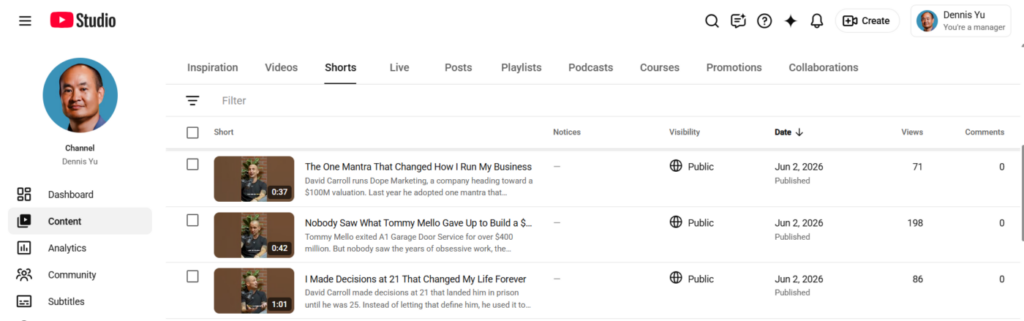
| A | The One Mantra That Changed How I Run My Business | 37 seconds |
| B | Nobody Saw What Tommy Mello Gave Up to Build a $400M Business | 42 seconds |
| C | I Made Decisions at 21 That Changed My Life Forever | 1 minute |
Descript does the heavy lifting here. Transcribe, cut the ums, find the chapters, pull the clips. What used to take a video editor hours takes minutes, and the editing is light on purpose. Heavy production is taking great meat and running it through a grinder to make a hot dog. The raw conversation is the value.
Post
Each clip went to all five platforms. Same content, formatted for each channel.
| Clip | YouTube | TikTok | LinkedIn impressions | ||
|---|---|---|---|---|---|
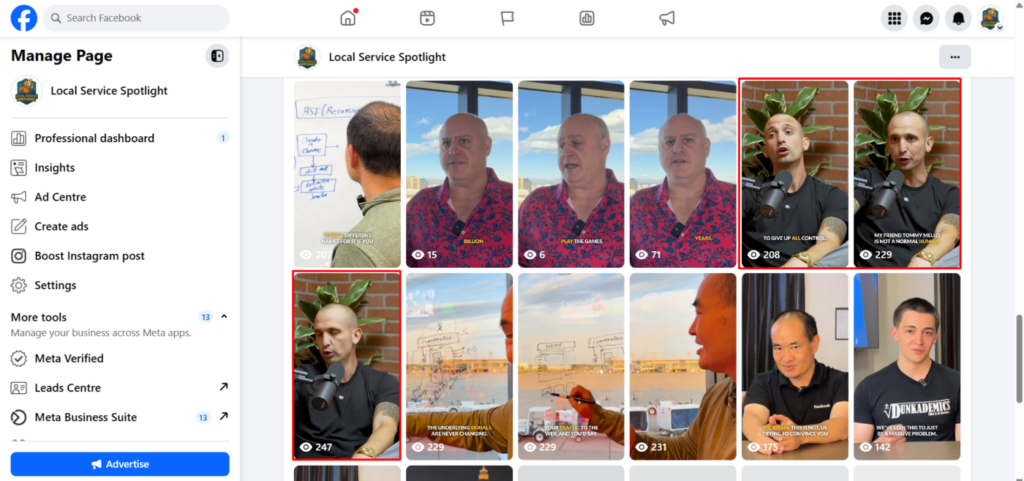
| A | 71 | 111 | 116 | 208 | 53 |
| B | 198 | 128 | 120 | 229 | 26 |
| C | 86 | 105 | 117 | 247 | 138 |
| Subtotal | 355 | 344 | 353 | 684 | 217 |
Long form on YouTube: 343,513 views, checked September 5, 2026. The clip figures in this section are from the original case-study snapshot.

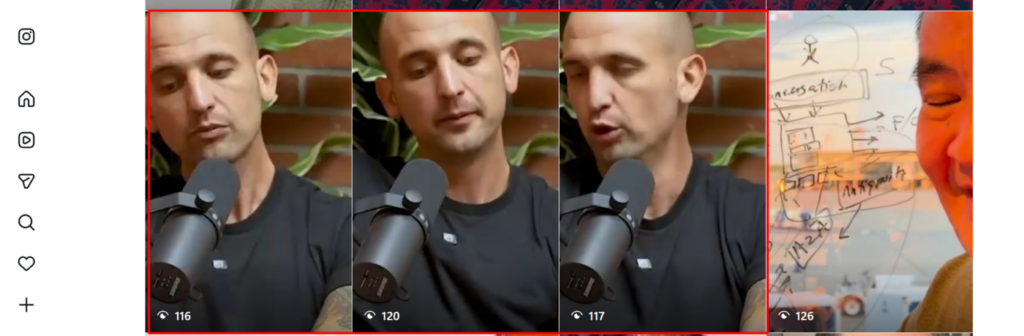
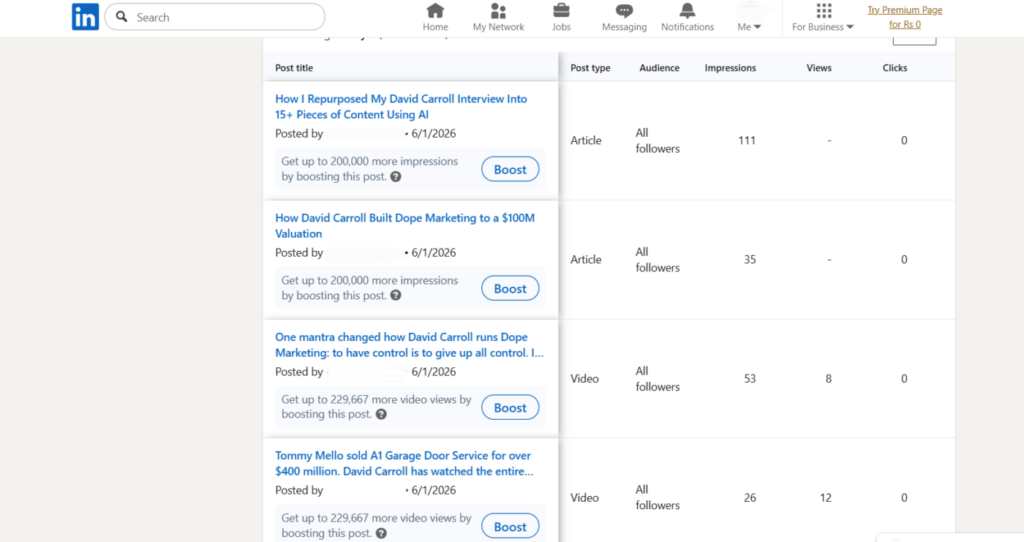
On LinkedIn the interview article drew 35 impressions and this writeup drew 111, bringing the LinkedIn total to 363 impressions. Clip C also picked up 24 views and four clicks.

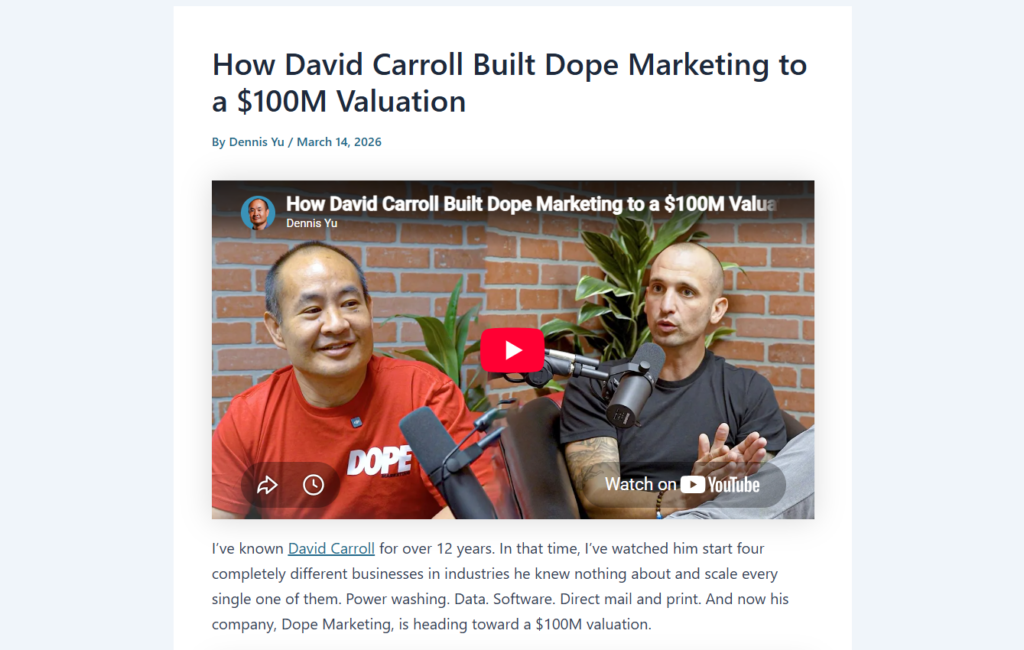
The interview writeup lives on Local Service Spotlight.
Here is what jumps out. Clip B wins on YouTube by almost three to one over Clip A. But Clip C wins on Facebook and LinkedIn. Same three clips, different winners depending on the room.
You would never know that if you had posted one long video and left it there. This is exactly why you break content into chunks. You cannot boost one part of a 58 minute video, and the algorithm cannot tell you which two minutes of it people actually cared about.
Promote
We have not applied Dollar a Day to any of these yet. They are running purely organic.
That is the honest state of this example. Stage four has not run. LinkedIn is sitting there telling us how much additional reach is available on the top clip, and we have not taken it.
I am including this because most case studies quietly leave out the part that did not happen. The gap is the useful information. It tells you exactly where the next dollar goes.
What it produced in search
Google “David Carroll Dope Marketing” and our interview shows up in the video pack, sitting alongside two other interviews with him.

This is the entire reason you interview authoritative people. We are not trying to outrank David for his own name. We are appearing beside it. He gets a citation, we get a citation, and Google sees two real entities connected by a real conversation.
That is a link you cannot buy and an AI cannot fake. Real endorsements are the new links.
MAA
Metrics. The public long-form video reached 343,513 views as of September 5, 2026. The original case-study measurements were 343,318 long-form views, 1.1 thousand watch hours, 1,736 clip views across YouTube, TikTok, Instagram, and Facebook, and 363 LinkedIn impressions. The published traffic-source snapshot showed 100 percent external traffic in its reporting period. Search placement and zero ad spend describe that original snapshot; this update refreshes the public YouTube view count.
Analysis. In the original snapshot, Facebook led clip delivery at 684 views, roughly double every other platform. YouTube and Facebook disagreed on which clip won, so no single clip should be promoted everywhere. External traffic dominated the published report. That makes distribution worth examining before deciding where to put the next dollar. Stage four had not run in the original case study.
Action. Start Dollar a Day on Clip B on YouTube and Clip C on Facebook and LinkedIn. LinkedIn is showing the clearest headroom on Clip C. Enhance the existing interview article rather than publishing new pages against the same term. Re-measure in thirty days.
The authority score of the source content, graded on the thirty point scale of who is saying it, where it is being said, and what they are talking about, determines how much human and agent effort goes in and what the starting budget is. MAA determines everything after that.
Originally published .
Dennis Yu
Dennis Yu is the CEO of Local Service Spotlight, a platform that amplifies the reputations of contractors and local service businesses using the Content Factory process. He is a former search engine engineer who has spent a billion dollars on Google and Facebook ads for Nike, Quiznos, Ashley Furniture, Red Bull, State Farm, and other brands.
Dennis has achieved 25% of his goal of creating a million digital marketing jobs by partnering with universities, professional organizations, and agencies. Through Local Service Spotlight, he teaches the Dollar a Day strategy and Content Factory training to help local service businesses enhance their existing local reputation and make the phone ring.
Dennis coaches young adult agency owners serving plumbers, AC technicians, landscapers, roofers, electricians, and believes there should be a standard in measuring local marketing efforts, much like doctors and plumbers must be certified. He has appeared on 353 podcasts with 619 credited episodes — see the full list of his podcast appearances.