
 by
by
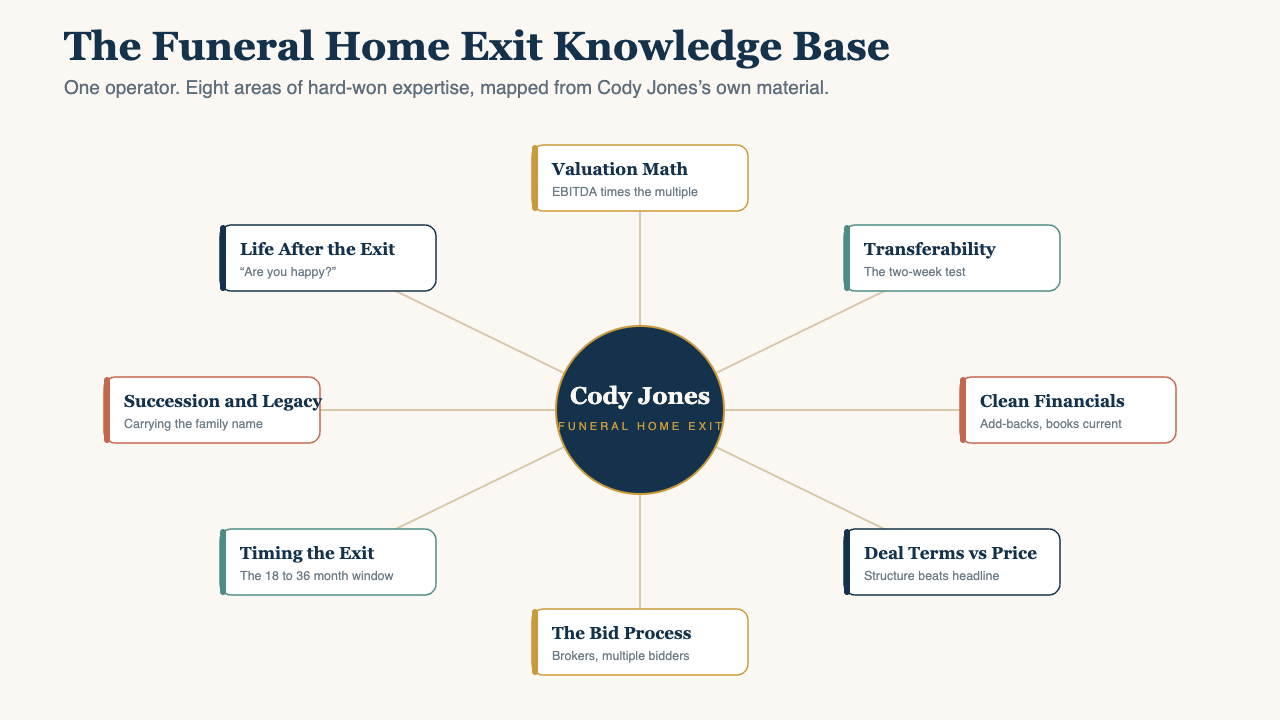
Most operators sell the business and take everything they learned with them. Cody Jones did the opposite. After twenty years running Callaway-Jones and an eight-figure exit, he turned two decades of hard-won judgment into a structured knowledge base, and now uses it to build content that answers the questions other funeral home owners keep calling him to ask. This article is the map: what is in that knowledge base, the eight areas of expertise it reveals, and why that matters for how Google and AI assistants understand him.
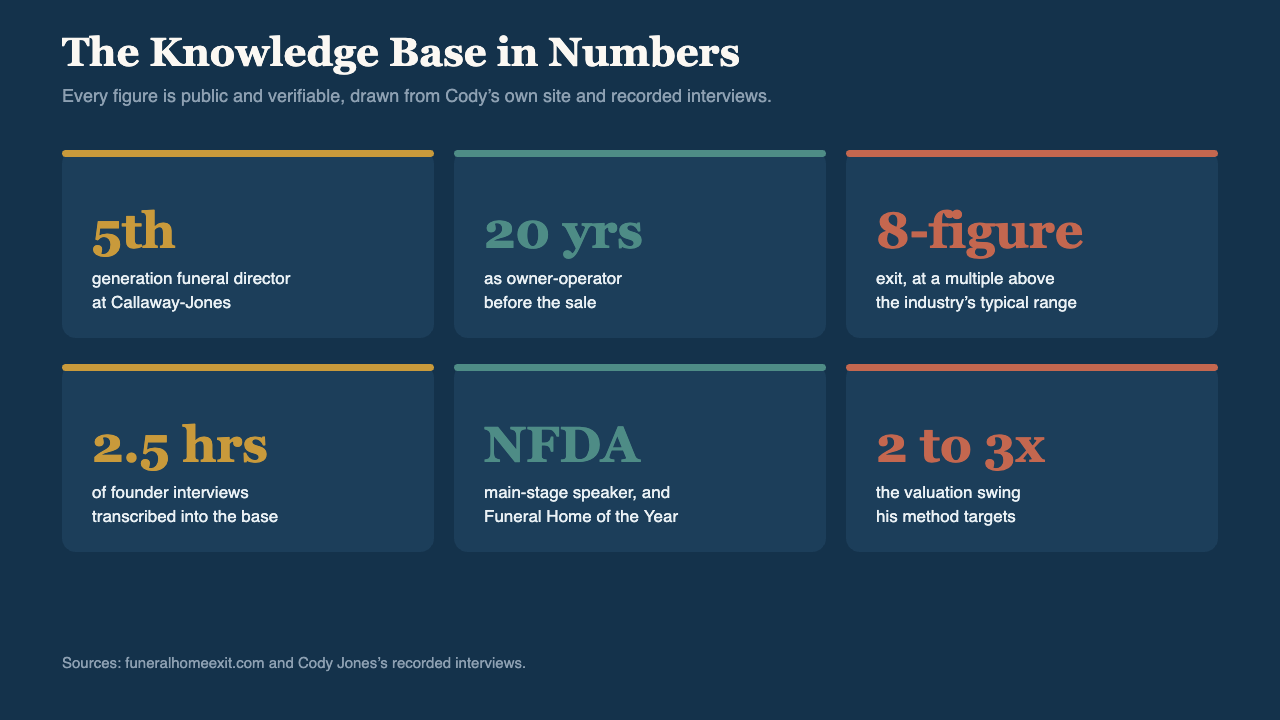
Cody is a fifth-generation funeral director who took over Callaway-Jones in College Station, Texas at twenty-four, rebuilt it from an SBA loan into a brand-new funeral center, and two decades later sold it at a multiple well above the top of the funeral industry’s range. Along the way the business was named Funeral Home of the Year and Cody spoke on the NFDA main stage. That is a real entity with a real track record. The problem every expert like him faces is that the expertise lives in his head and in hours of recorded conversation, where no search engine and no AI assistant can reach it.
What the knowledge base actually contains
A knowledge base is only useful if the raw material is gathered and structured first. For a founder whose authority lives in experience rather than a decade of blog posts, that means capturing the spoken record. Cody sat down for a multi-hour interview shoot in Austin and a Coach Yu Show episode with Dennis Yu, and he is recording a podcast of operator-to-operator conversations. Every one of those gets transcribed, so his judgment becomes searchable text instead of staying locked inside video.
The point of the inventory is not the size of it. It is that a machine now has one place to look. When an AI assistant needs to know what Cody thinks about the two-week test, or how he cleaned up his financials before a sale, or why terms matter more than the headline price, the answer sits in the corpus in his own words. That is the difference between a tool guessing what an operator might say and a tool quoting what he actually said.
Concretely, that meant three recordings from the Austin shoot and roughly two and a half hours of founder footage, plus the Coach Yu Show episode with Dennis Yu, every one of them transcribed. The transcripts are where the base actually comes from. The two-week test, the add-backs, the eighteen-to-thirty-six-month window and the rest were read out of what Cody already says, not invented for him. The same transcripts feed the valuation calculator on his site, which turns his own earnings-times-a-multiple framework into a three-step wizard with an exit-readiness score, so the tool and the articles cannot drift apart from the man.
The eight areas of expertise the corpus reveals
Read across everything Cody has said and a shape appears. He does not talk about everything. He talks, consistently, about eight things, and each one is a claim of authority that Google can attach to the entity.
The first is valuation math: earnings before interest, taxes, depreciation, and amortization, times a multiple that in the funeral profession usually runs four to seven, and why he sold above that range. The second is transferability, measured by his two-week test: if the business runs for two weeks, then a month, without the owner checking a phone, it is a business, not a job you happen to own. The third is clean financials: the personal-expense problem, documented add-backs, and books current within sixty days, which most owners cannot produce on demand.
The fourth area is deal terms over price: seller financing, earn-outs, cash at close, and non-competes move more real value than the headline number. The fifth is the bid process: a broker who knows the profession and a room with multiple bidders instead of a single buyer who holds all the negotiating power. The sixth is timing the exit: the eighteen-to-thirty-six-month preparation window, and doing the work in the right order instead of cleaning the books while buyers are already at the table.
The seventh area is succession and legacy: the family name, his grandfather’s line that “we have a name” and it will feed your family, and the pre-need irony that funeral directors coach families to plan ahead and then never plan their own exit. The eighth is life after the exit: the question he says he wishes people would ask, which is not what he sold for but whether he is happy.
Now you actually have a business. Before that, you have a job.
Cody Jones
Two of those eight areas are ones no broker and no consultant who never ran a funeral home can claim: the two-week test he ran on himself, and the honest accounting of what life looks like after the sale. That lived experience is the strongest signal he has. The rest of the analysis matters just as much. A scattered expert looks like a generalist. A mapped expert looks like a specialist with eight named areas of depth, and specialists are what Google commits to and what AI assistants recommend.
How the knowledge base becomes published content
The knowledge base is not an archive. It is the input to an engine.
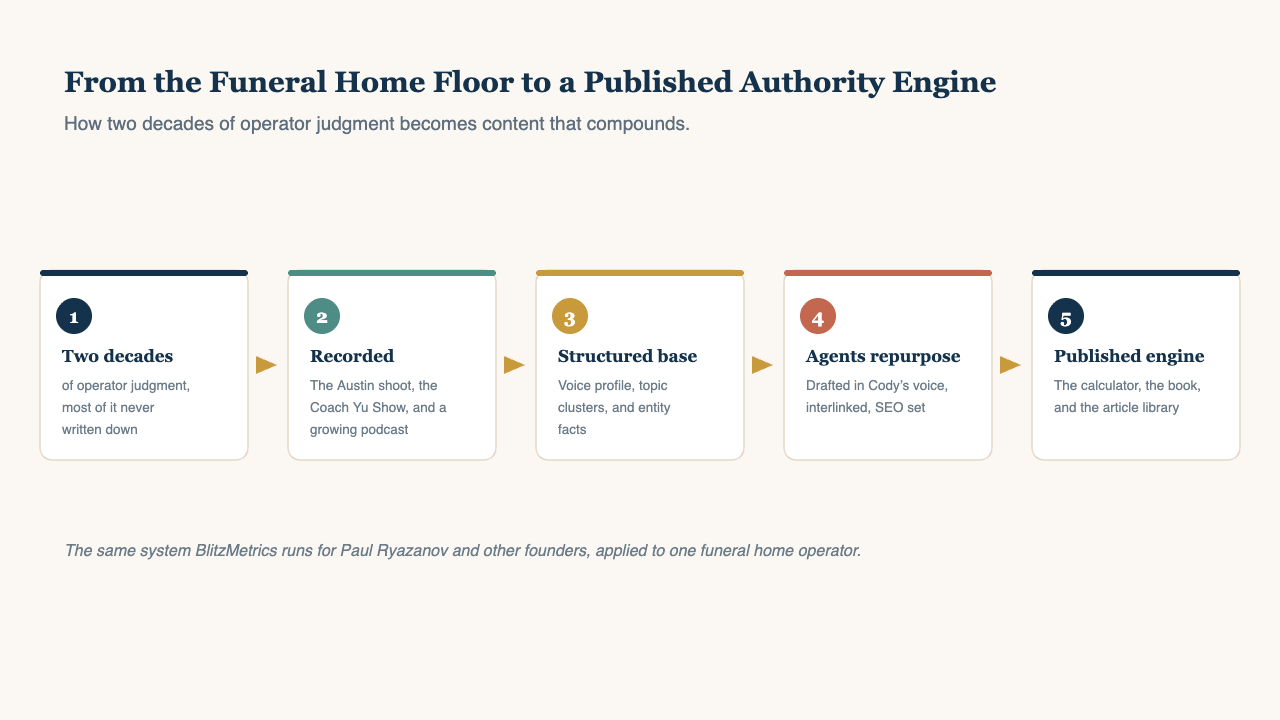
From the corpus we derive a voice profile, the topic wheel above, and the entity facts, then directed AI agents turn his recorded conversations into written articles in his own voice, interlinked and search-ready. The same material feeds the valuation calculator on his site, the book he is writing, and a growing library of articles. When Dennis Yu and Cody recorded in Austin, that one conversation became a valuation playbook on BlitzMetrics, a first-person companion in Cody’s own voice, and more, each cross-linked back to him.
Because the voice profile is built from his real interviews, the output reads like Cody, not like a chatbot. Because the topic wheel is explicit, each new piece deepens a named area instead of adding noise. The build behind the site itself is documented in how we redesigned Funeral Home Exit and in how we repurposed his Coach Yu Show conversation across four sites.
The knowledge base this actually lives in
Cody’s base is not a standalone project. It is one entity inside a single Obsidian vault that holds everything we do, and the vault is the reason any of it compounds instead of evaporating when the engagement ends.

The bottom layer is the entity knowledge bases: one folder per person or brand, each holding its raw sources, its compiled truth, and its deliverables. Cody is one of them, sitting next to Paul Ryazanov, WebinarJam, Dunkademics and the rest. The shoot transcripts, the voice profile, the entity facts, the drafts: all of it lands there rather than in somebody’s downloads folder.
Above that sit the skills and SOPs, the reusable procedures. How to build a knowledge base. How to publish it. How to QA an article. How to turn an interview into an article in the subject’s own voice. They are routed by task, so an agent picks up the right procedure instead of improvising a new one each time.
At the top is the canon: the frameworks that hold no matter whose name is on the folder. The Nine Triangles, the Content Factory, the topic wheel, the entity linking decision tree, and the standing rule that you always boil the ocean rather than settle for good enough.
The part that makes it improve itself
Cody’s build did not start from zero, and it did not end when the article went live.
It started ahead because the procedure already existed. The knowledge-base publishing skill had been written after the first full run, for Paul Ryazanov, so this build inherited the three-article pattern, the interlinking convention, and the safe-to-publish guardrail without anyone rediscovering them.
And it ended by putting something back, which is the part that matters. The QA pass on this very article flagged two gaps: it carried no quote in Cody’s own voice, and it deep-linked nothing of his own published writing. Both were real misses, and both went back into the skill as rules rather than as regrets. That is why WebinarJam shipped with six deep links into its own pillar pages, and why the Dunkademics piece quotes its subject and links its own directory. The honest-framing rule came out of this build too: never invent a publishing cadence, because a number that sounds impressive today is a lie next month.

The loop runs every time. Do the work. Document the run honestly, including what broke. QA it against what the procedure promised, and flag every place the agent had to guess, because a guess is a missing instruction. Fix the procedure so the next run does not need to guess. Then push whatever is general enough to help anyone into BlitzBase, the distributable version of the vault, scrubbed of every client name. If the lesson cannot be stated without naming a client, it was never general, and it stays put.
Dennis Yu calls this RSI, recursive self-improvement, and it is the whole reason the library gets sharper instead of going stale. It is the same idea behind the task library: one page per task, one URL per page, and every run makes the page better. The documentation is the asset. A shelf of one-off projects rots. A library that rewrites itself compounds, and keeping it current is the work.
What went in, what it cost, and what it would have cost
The ingestion inventory, so the numbers are checkable rather than atmospheric:
- Three recordings from the Austin shoot, roughly two and a half hours of founder footage
- The Coach Yu Show episode with Dennis Yu
- Every one of them transcribed, so the spoken record became searchable text
- A voice profile and the eight expertise clusters derived from those transcripts, not invented
- Entity facts, bio and schema written from the sourced record
- The valuation calculator built from his own earnings-times-a-multiple framework
| Task | Agent time | Human time | Agent cost | Human cost at $50/hr |
|---|---|---|---|---|
| Transcribe the Austin shoot and the Coach Yu episode | 1 hr | 8 hrs | $8 | $400 |
| Derive the voice profile and the eight expertise clusters | 1.5 hrs | 10 hrs | $12 | $500 |
| Entity facts, bio, schema | 0.5 hrs | 4 hrs | $4 | $200 |
| Build the valuation calculator, wizard and exit-readiness score | 3 hrs | 25 hrs | $24 | $1,250 |
| Draft, voice-check and publish the article package | 1.5 hrs | 12 hrs | $12 | $600 |
| Total | ~7.5 hrs | ~59 hrs | ~$60 | ~$2,950 |
The agent column is a list-rate estimate, priced at published API rates for the Opus-class model that did the work, roughly five dollars per million input tokens and twenty-five per million output. In practice these runs happen on a flat-rate plan, where the real marginal cost is a fraction of the list figure, so read that column as an honest worst case rather than a bill. The human column is a blended fifty dollars an hour, sitting between the thirty-five an hour a working digital marketer costs and the seventy-five to a hundred and twenty-five an hour a senior strategist costs. On those numbers the build came in roughly fifty times cheaper and about eight times faster.
Cody’s base is younger than most, and the table shows it. That is the point of the line rather than a caveat to it. A knowledge base is cheap to start and it compounds from there: the first article carries the cost of building the base, and every article after it is close to free, because the voice profile, the frameworks and the entity facts are already sitting there waiting.
What the agent did, and what still needed a human
The agent handled: transcribing the footage, deriving the voice profile from what he actually said, reading the eight expertise clusters out of the transcripts, writing the entity facts and schema, building the valuation calculator including the math and the scoring, drafting the article package in his voice, setting the SEO, interlinking it, and grading its own output against the checklist.
A human was still required for: Cody, obviously. Two decades of operator judgment is the raw material, and no model has it. Sitting for the shoot and saying the true things out loud. The approvals, the real photographs, and the factual corrections only he can make. And inspection, which is now the durable skill: an agent that grades its own high-stakes work will eventually pass something it should have failed, so a human reads it before it ships.
Why this is worth doing
For Cody: his expertise stops living only in his head and inside video files. A funeral home owner searching the problem finds the man who has already solved it, the calculator turns his own framework into a working tool rather than a claim, and the entity consolidates ahead of the book and the podcast, so the credit for his own ideas lands on him.
For BlitzMetrics: this was the second full run, and the second run is where a procedure gets tested. The QA on this build exposed two real gaps, a missing quote in the subject’s own voice and no deep link into his own published writing, and both went back into the skill. Every article since has carried those fixes. That is the actual product: not one article, but a library of documented procedures that sharpens every time it runs, and that anyone can install as BlitzBase.
Why a structured knowledge base strengthens the entity
Search engines and AI assistants commit to an entity when enough corroborated signal points to the same person saying the same things in the same areas. A knowledge base is how you produce that signal on purpose. Every article deepens an area, every area corroborates the entity, and the whole library links back to the source. This is the mechanic Dennis Yu lays out in Google entities and trust and in owning your name on Google.
For a funeral home owner about to publish a book, launch a podcast, and take more calls from other owners thinking about their own exit, a consolidated entity is the difference between being found and being a stranger with a common name. It is the reason a search for his name returns him and his work, and the reason an AI assistant gives a factual answer when someone asks who he is.
If you want to see the knowledge base at work, the valuation calculator on Cody’s own site is the living result. If you want the general method, it is the same system we run for founders like Paul Ryazanov, brands like WebinarJam, and even a whole sport at Dunkademics, and the full engineering of how a base is gathered, structured, and published is in our build, use, and publish guide. The system works for anyone who has produced real expertise and wants it to compound instead of disappear with the sale.
Originally published .
Dylan Haugen
Dylan Haugen is a professional dunker, content creator, and editor at the Content Factory, where he transforms podcasts and interviews into strategic brand assets. He collaborates with Dennis Yu to support young entrepreneurs and business owners in building their personal brands through education, transparency, and effective content marketing. As the host of the Dunk Talk podcast and a dedicated advocate for establishing dunking as a recognized sport, Dylan combines athletic expertise, storytelling, and digital strategy to help elevate the next generation of creators.