
 by
by
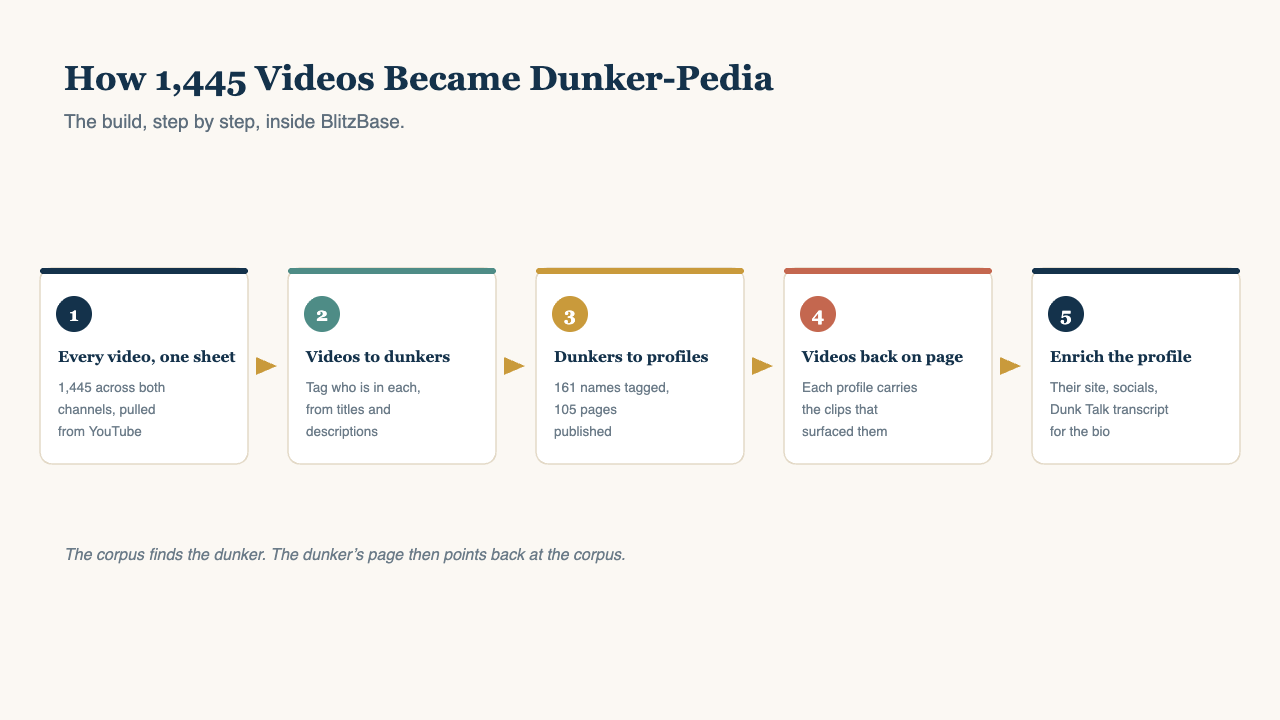
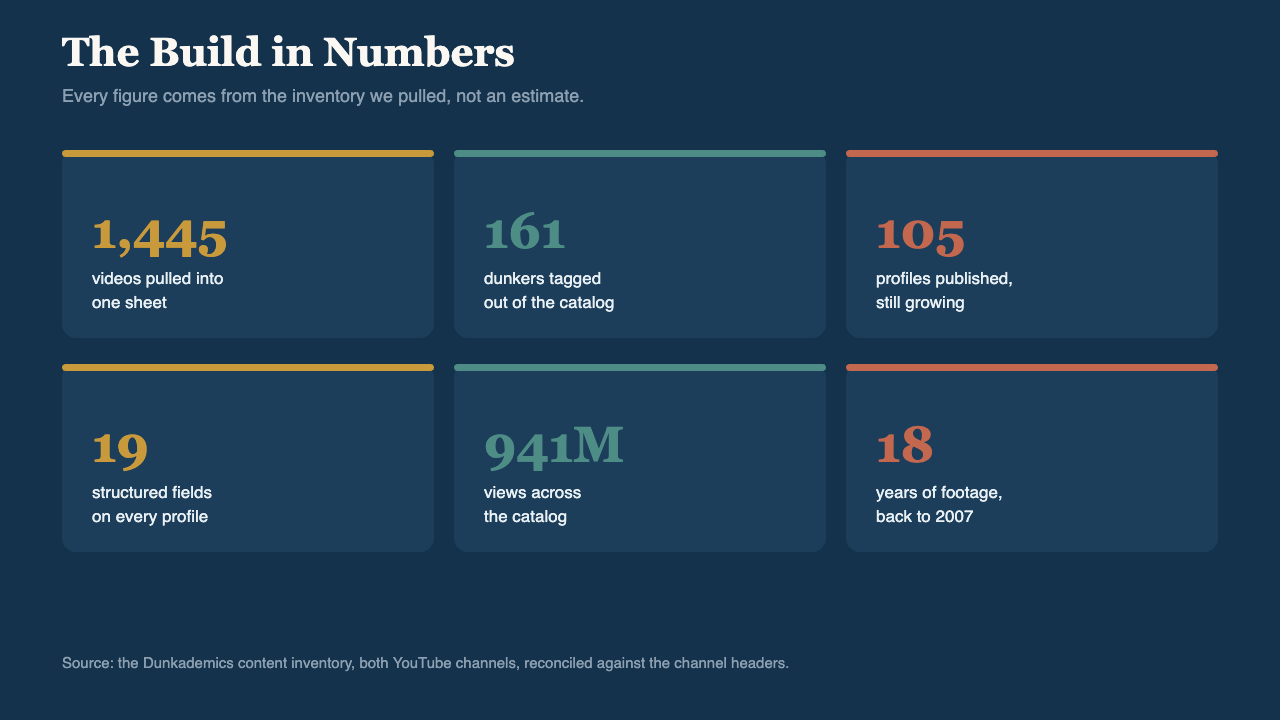
Billy Doran has been filming the world’s best dunkers for eighteen years. That work adds up to 1,445 videos across two YouTube channels and roughly 941 million views, and until this year almost none of it was organized. This article is the build: how we pulled every video Dunkademics has ever published into a single sheet inside BlitzBase, broke that catalog down into the dunkers who appear in it, and turned those dunkers into Dunker-Pedia, a structured directory of the sport that Google and AI can actually read.
Step one: put every video in one place
You cannot build a knowledge base out of a channel. You need the corpus, all of it, in one place and in rows. So we pulled both channels grid by grid, straight out of YouTube’s own data, and reconciled the totals against the channel headers so nothing quietly went missing: 833 long-form videos and 344 Shorts on the flagship, another 118 and 150 on the legacy channel. 1,445 items in all, the oldest of them Billy’s own White Flight clips from 2007.
Every row carries the title, the link, the view count, the length, the publish date, and the one column the entire build hangs on: which dunkers are in it. That sheet does not sit on somebody’s laptop. It lives in the knowledge base, in BlitzBase, where an agent can read it, correct it, and write from it.
The inventory paid for itself the day it was finished, because it corrected the record. Shorts, not long-form, are the reach engine: 344 Shorts carry 769 million views against 131 million for 833 long-form videos. Anyone pitching a sponsor off the long-form numbers had been pitching the wrong ones.
Step two: turn the videos into dunkers
A video library is a list of files. A knowledge base is a list of people. So the next pass reads every row and pulls out who is actually in it.
Titles get you most of the way. Descriptions get you the rest, and they are where the handles live: @hyt_check resolves to Hyrum Fechser, and a dunker who only ever appeared as a tag becomes a person with a name. Do that across 1,445 videos and the sport organizes itself. 161 distinct dunkers fall out of the catalog, each with a count of how many times they show up.
That count is the part an opinion cannot give you. Tyler Currie appears in 95 Dunkademics videos, more than anyone. Young Hollywood is in 87, Chris Staples 78, J Clark 70, Isaiah Rivera 66. The catalog, not a ranking and not a hot take, tells you who the central figures of this sport actually are, and it surfaced names that no shortlist drawn from memory would have included.
The catalog, not a ranking, tells you who the central figures of the sport actually are.
Step three: every dunker becomes a page
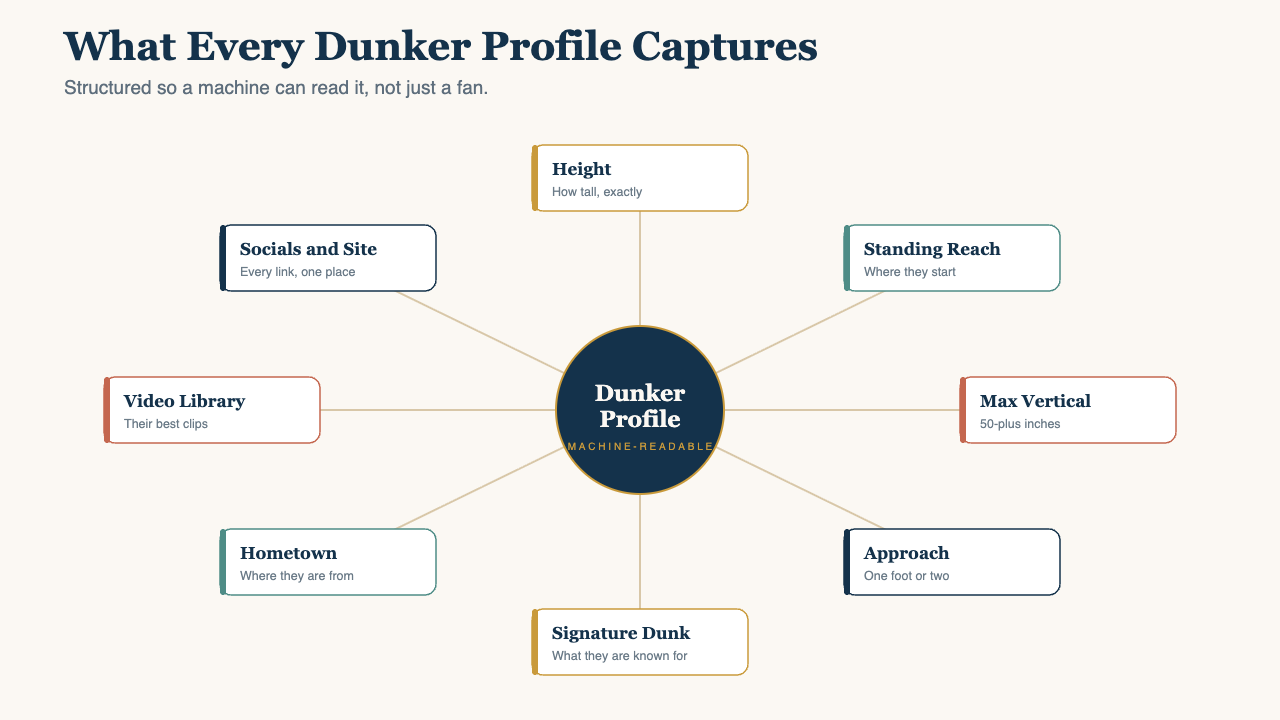
Each of those names becomes a real profile. Not hand-typed HTML: a structured record in the site’s own directory, with nineteen fields, from height and standing reach to max vertical, approach, signature dunk, hometown, and every social link. More than a hundred are published so far and the list is still growing.
Step four: give the videos back to the dunker
This is the step that makes it a knowledge base instead of two lists sitting next to each other.
Every dunker was found because they appeared in videos, so every profile carries those videos back. Open a profile and you get the sessions that dunker is actually in, the same clips that surfaced their name in the first place. The corpus finds the person, the person’s page points back at the corpus, and every video points at everyone else who was in it.
That is what turns 1,445 rows and 161 names into a graph instead of two flat lists. A sponsor who lands on one dunker can walk to the videos, and from the videos to every other dunker in them. Browse the result on the Dunker-Pedia directory.
Step five: enrich the profile until it is a real record
Once the person exists, you pull the rest of them in.
Their own website, so a profile links out to camhazzard.com or nathanielkenney.com and those sites link back, which is how a hub gets built rather than declared. Their socials. Their measurements, which for a dunker are the whole story: standing reach, approach, max vertical.
And if they have been a guest on Dunk Talk, the dunking podcast, we pull that in too, and use the episode transcript to write their bio in their own words instead of ours. A dunker who has already sat down and told his own story should not have a biography invented for him. The transcript is right there.
The knowledge base this actually lives in
Dunker-Pedia is not a standalone project. It is one entity inside a single Obsidian vault that holds everything we do, and the vault is the reason any of it compounds instead of evaporating when the job ends.

The bottom layer is the entity knowledge bases: one folder per person or brand, each holding its raw sources, its compiled truth, and its deliverables. Dunkademics is one of them, sitting next to Paul Ryazanov, Cody Jones, WebinarJam and the rest. Billy’s 1,445-row video sheet, the dunker frequency table, the transcripts, the fact sheet: all of it lands there rather than in someone’s downloads folder.
Above that sit the skills and SOPs, the reusable procedures. How to build a knowledge base. How to publish it. How to QA an article. How to pull a transcript off a video that does not want to give one up. They are routed by task, so an agent picks up the right procedure instead of improvising a new one.
At the top is the canon: the frameworks that hold no matter whose name is on the folder. The Nine Triangles, the Content Factory, the topic wheel, the entity linking decision tree, and the standing rule that you always boil the ocean rather than settle for good enough.
The part that makes it improve itself
The Dunkademics build did not start from zero, and it did not end when the profiles went live.
It started ahead because the procedure already existed. The knowledge-base publishing skill was written after we did this the first time for Paul Ryazanov, then sharpened after Cody Jones, then sharpened again after WebinarJam. Dunkademics inherited all of it: the interlinking convention, the rule about deep-linking into the subject’s own content, the discipline of never publishing a number that will be stale next week.
And it ended by putting something back. Nobody had turned a 1,445-video catalog into a directory of people before, so that pipeline is now a written procedure: pull the whole catalog, tag who is in each item, build the profiles, wire the videos back onto them. The next client sitting on a decade of video starts with that instead of inventing it. The handle-resolution rule went back too, because the first pass tagged only titles and quietly missed every dunker who appears as an @handle in a description. That is now a step, not a lesson someone has to relearn.

The loop is simple and it runs every time. Do the work. Document the run honestly, including what broke. QA it against what the procedure promised, and flag every place the agent had to guess, because a guess is a missing instruction. Fix the procedure so the next run does not need to guess. Then push whatever is general enough to help anyone into BlitzBase, the distributable version of the vault, scrubbed of every client name. If the lesson cannot be stated without naming a client, it was never general, and it stays put.
Dennis Yu calls this RSI, recursive self-improvement, and it is the entire reason the library gets sharper instead of going stale. It is the same idea behind the task library: one page per task, one URL per page, and every run makes the page better. The documentation is the asset. A shelf of one-off projects rots. A library that rewrites itself compounds, and keeping it current is the work.
This article is itself a turn of that loop. It was published once, reviewed, found to be describing the brand instead of the build, and rewritten. That flag is now a rule in the playbook: an article about a knowledge base has to explain the knowledge base.
What went in, what it cost, and what it would have cost
The ingestion inventory, so the numbers are checkable rather than atmospheric:
- Two YouTube channels pulled grid by grid and reconciled against the channel headers
- 1,445 videos inventoried: 951 long-form and 494 Shorts
- All 494 Shorts caption-swept; the narrated ones transcribed in full
- 161 distinct dunkers tagged out of the catalog and frequency-counted
- 105 dunker profiles created and populated, nineteen fields each
- Person, ItemList and Organization schema written across the directory
| Task | Agent time | Human time | Agent cost | Human cost at $50/hr |
|---|---|---|---|---|
| Inventory both channels, 1,445 videos, reconciled | 2.5 hrs | 60 hrs | $20 | $3,000 |
| Tag dunkers per video, resolve handles, build the frequency table | 2 hrs | 30 hrs | $16 | $1,500 |
| Create and populate 105 profiles, nineteen fields each | 4 hrs | 35 hrs | $32 | $1,750 |
| Wire the videos back onto every profile | 1 hr | 10 hrs | $8 | $500 |
| Caption-sweep 494 Shorts, extract the narrations | 1.5 hrs | 12 hrs | $12 | $600 |
| Schema, directory template, QA | 1 hr | 8 hrs | $8 | $400 |
| Total | ~12 hrs | ~155 hrs | ~$96 | ~$7,750 |
The agent column is a list-rate estimate, priced at published API rates for the Opus-class model that did the work, roughly five dollars per million input tokens and twenty-five per million output. In practice these runs happen on a flat-rate plan, where the real marginal cost is a fraction of the list figure, so read that column as an honest worst case rather than a bill. The human column is a blended fifty dollars an hour, which sits deliberately between the thirty-five an hour a working digital marketer costs and the seventy-five to a hundred and twenty-five an hour a senior strategist costs. On those numbers the build came in roughly eighty times cheaper and about thirteen times faster.
The honest way to read that is not “we saved seven thousand dollars.” It is that nobody was ever going to spend a hundred and fifty-five hours hand-cataloguing eighteen years of dunk footage. The work simply would not have happened. That is what changes when the marginal cost of completeness falls this far: the question stops being whether the project is worth the hours and becomes whether it is worth the agent-minutes.
What the agent did, and what still needed a human
The agent handled: pulling both channels and reconciling the counts, inventorying every video, tagging the dunkers and resolving the handles, building the frequency table, creating and populating all 105 profiles through the API, wiring the videos back onto each one, sweeping the captions and pulling the transcripts, writing the schema, and running the QA checklist against its own output.
A human was still required for: the relationship, which is the part no model has. Billy pointing the domain and deciding what Dunkademics is for. The judgment calls about what belongs in public and what stays private. Real photographs. Factual corrections that only the people in the room can make, like catching a dunker credited to a video he is not actually in. And inspection, which is now the durable skill: the agent produced a first version of this very article that told the brand’s story instead of the build’s, and it took a human reading it to say so. Never let the model be the only thing grading the model.
Why this is worth doing
For Dunkademics: eighteen years of footage stops being a pile of clips and becomes a record a machine can cite. A dunker who existed only as a viral moment now has a page with his measurements, his clips, and his links. A sponsor can evaluate the roster in one place. And the asset is owned rather than rented, which matters the day an algorithm changes and a feed stops delivering.
For BlitzMetrics: every build like this makes the next one cheaper. The catalog-to-people pipeline written here is now a procedure, so the next brand with a decade of video does not pay for its invention. That is the actual product: not the article, not even the directory, but a library of documented procedures that gets sharper every time it runs, and that anyone can install as BlitzBase.
Why this makes the entity real
On top of the structure sits the schema. Each profile is marked up as a Person, the directory as an ItemList, and Dunkademics itself as the Organization that ties them together. That is the layer that lets Google and an AI assistant answer “who is this dunker, and how high can he jump” with a real answer instead of a guess.
It is also what makes the site a trust hub. When a sponsor, a league, or a media partner wants to work with Dunkademics or with one of its dunkers, they land on a page that states the measurements, the clips, the socials, and the record, rather than a scrolling feed. This is the entity mechanic Dennis Yu lays out in Google entities and trust and in owning your name on Google. Eighteen years of footage stops being a pile of clips and starts being a record of a sport.
None of this is bespoke. It is the same knowledge base system, BlitzBase, that we run for founders like Paul Ryazanov and Cody Jones and for brands like WebinarJam, pointed this time at a video catalog and a whole sport. The method is in our build, use, and publish guide. Any brand sitting on years of content and no structured record of it can be run the same way.
Originally published .
Dylan Haugen
Dylan Haugen is a professional dunker, content creator, and editor at the Content Factory, where he transforms podcasts and interviews into strategic brand assets. He collaborates with Dennis Yu to support young entrepreneurs and business owners in building their personal brands through education, transparency, and effective content marketing. As the host of the Dunk Talk podcast and a dedicated advocate for establishing dunking as a recognized sport, Dylan combines athletic expertise, storytelling, and digital strategy to help elevate the next generation of creators.