
 by
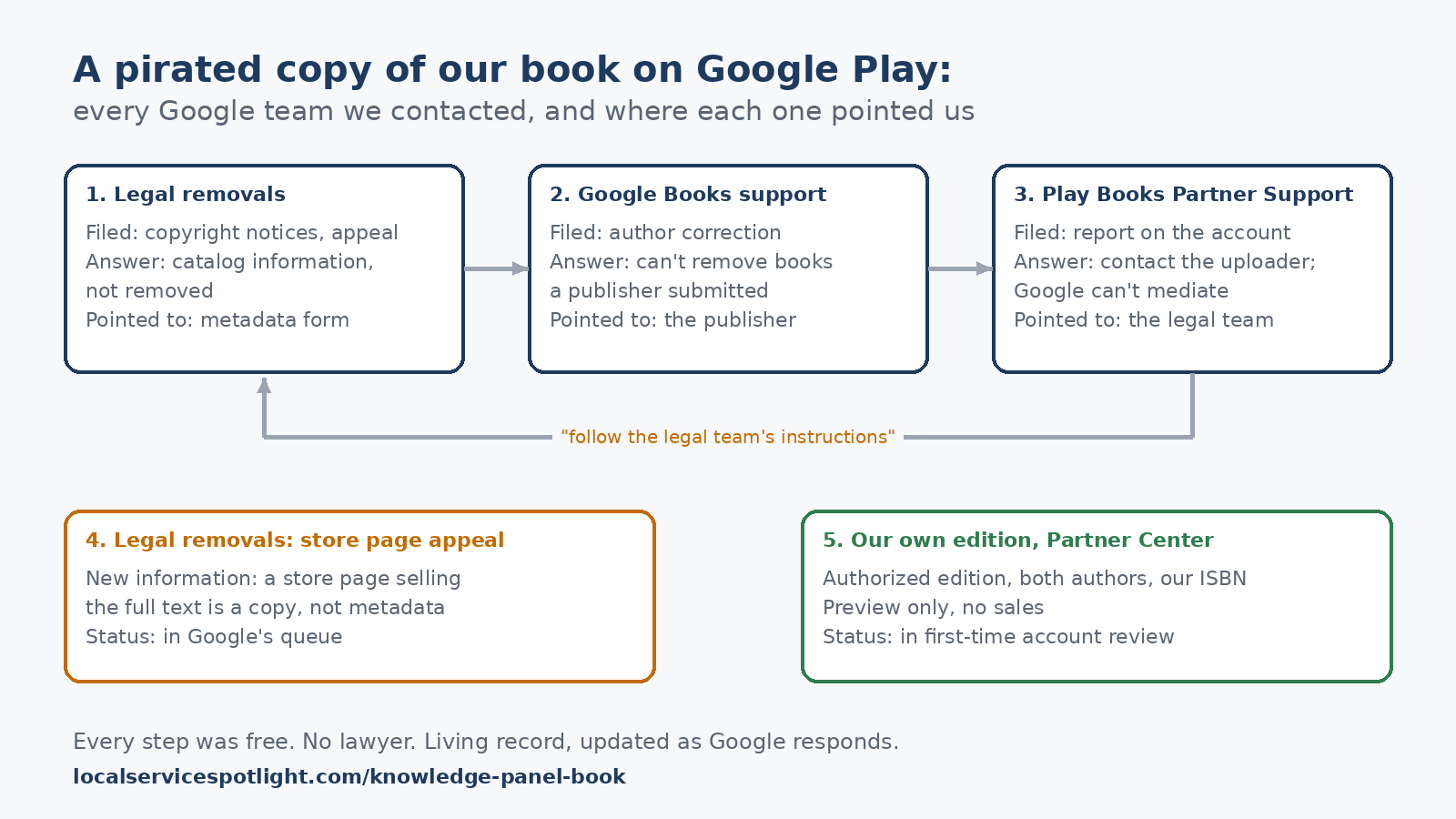
An early draft of our book, How to Get a Google Knowledge Panel by Dennis Yu and Dylan Haugen, showed up on Google Play Books under a stranger’s imprint, for sale, with our names on it. Then our names came off and his stayed. I’m Dylan, and this is the record of everything we did to get it taken down: every Google team we contacted, what each one told us, where each one sent us next, and what we would do differently.
Status as of this update (Day 14): the copy can no longer be bought. Google declined our last appeal, but the listing now shows as unavailable in every country we checked and is kept out of search results. This is a living article, and we update it if anything changes.
This is the fifth meta article on the book. How we finished the book covers the manuscript, getting the book print-ready covers the print build, how we launched the book covers the Amazon listings, and how we took it to #1 Best Seller covers the campaign after launch. It follows the meta-article prompt template. A Claude agent did the research, filled in every form, drafted every reply, and kept the dated record. Dennis and I made the calls, signed the legal forms, and clicked submit.
What We Found
A teammate spotted it first: a Google Books listing for our title that named a third person as an author alongside Dennis and me, under a publisher imprint none of us had heard of.
The agent compared it to our real editions the same morning. It was not our book. It was a separate upload of an early draft:
- 203 pages instead of our final 225, with an older table of contents
- No ISBN, filed under an unrelated subject category
- Our title, subtitle, and book page description, copied word for word
- For sale on Google Play as an ebook for under one euro
Our real editions were clean. The paperback and Kindle edition on Amazon listed only Dennis and me, with the correct ISBN and publisher, and both came from our own KDP account. Nobody on our side had ever published the book on Google.
Days later the copy changed. Our names were removed, the cover was replaced with one carrying the uploader’s name, and the listing credited him as the sole author of our book.
The Timeline: Who We Contacted and What Each Team Said
Google has several teams that touch a book listing, and each one handles a different kind of problem. Here is the full sequence, in order.
Day 1: Copyright notice to Google’s legal removals team
We filed a copyright notice through Google’s legal content removal form (Google Play, then Books, then Copyright). It listed both the Google Play store page and the Google Books catalog page, named Dennis and me as the copyright holders, and pointed to our Amazon editions as the authorized ones. A teammate also emailed the uploader directly. Google confirmed it received the notice the same day.
Day 5: Legal declines as “metadata”
Google’s legal removals team declined to act. Their reply said the listing shows metadata, information about a book similar to a library card catalog, and that Google doesn’t remove metadata-only results. They pointed us to the Google Books metadata form and offered an appeal.
The appeal form only let us select the Google Books catalog page, not the Google Play store page that was selling the ebook. So we filed the appeal for the catalog page and a second, separate copyright notice for the Google Play page alone, explaining that the first notice never addressed it.
Day 6: Both declined the same way
The appeal came back declined, saying the content does not appear to violate copyright. The second notice, the one that listed only the Google Play store page, came back with the same “library card catalog” answer as the first.
By then the store page showed “This item isn’t available in your country” from the US, with no price. In our region it now looked like a catalog record, which matched what the legal team kept telling us.
Day 6: A different plan
Filing a third notice wasn’t going to work. The agent researched how other authors had handled the same problem and found that the Alliance of Independent Authors’ Watchdog Desk had written about it. Their advice matched what we were seeing: Google Play Books lets anyone register as a publisher, responses are slow, and the strongest moves are to report the uploading account, prove your own authorship inside Google’s publisher program, follow up, and keep dated records.
We set three moves, all free:
- Ask the Google Books team to correct the false author credit
- Report the uploading account to Google Play Books Partner Support
- Set up our own Google Play Books publisher account and add our real edition
Day 7: All three moves filed
Google Books metadata team. We used the metadata form the legal team had pointed us to, under “author, title, or summary is wrong,” and asked Google to remove the record or correct the authors to Dennis Yu and Dylan Haugen.
Google Play Books Partner Support. We reported the account itself, not just the one title: an unauthorized upload of our book, a false author credit, and a pattern of the same account listing real public figures as co-authors of books they didn’t write. Partner Support opened a case.
Our own edition. We confirmed the Kindle edition was not enrolled in KDP Select, which would have required ebook exclusivity with Amazon. Then we created a Google Play Books Partner Center account under our publisher name, Local Service Spotlight, and added the book with the paperback’s ISBN, both authors, and a short preview only, with no sales. Google put it into a first-time account review that can take up to 30 days.
Day 8: Two teams, two different directions
Google Books support replied that if we believed the listing violated our rights, we should file a legal complaint. We replied that we had, three times, and that the legal team had sent all three back as a metadata issue. They answered that they had escalated it to the appropriate team, and that changes on Google Books can take up to a month to appear.
Partner Support replied that if we hold the rights, we should contact the uploader and ask him to deactivate the book in his own partner account, and that Google cannot mediate between authors and publishers.
Day 9: The uploader, and a pushback
Google Books support followed up: their team cannot remove books that publishers submitted, and we should contact the publisher.
We did exactly what both teams asked. We emailed the uploader a formal request to deactivate the listing, with step-by-step instructions and a seven-day deadline. He had not answered the first email, and he has not answered this one.
We also replied to Partner Support to clarify that this was not a disagreement between an author and our own publisher. The uploader has never been our publisher. We pointed to Google Play Books’ own content policy on misleading metadata and unauthorized content, which only Google can enforce, and asked them to review the account or escalate.
Partner Support answered that if we believe the content violates our rights, we should contact the legal team through the legal form.
We replied once more and laid out the whole loop: the legal team calls it metadata, the Books team cannot act on publisher uploads, and Partner Support points back to the legal team. We asked which team reviews partner accounts for policy violations.
Day 11 and 12: The loop closes, and one door was still open
Google Books support closed its case with a satisfaction survey.
Partner Support replied that if we had already received a response from the legal team, we should follow their instructions, and reply to them if we had questions about their decision.
So we went back and reread the legal team’s decision on the second notice, the one about the Google Play store page alone. It included an appeal link we had never used, because our earlier appeal covered only the catalog page. We filed that appeal with new information: a store page that sells the full text of a book is a copy of the book, not information about it, and every other Google team had pointed us back to the legal team. Filing it takes a sworn statement and a typed signature, so I signed it myself.
We also sent a report to the ALLi Watchdog Desk, so other authors can find this account if their books show up there, and asked whether ALLi has a working escalation route at Google Play.
Day 13: Waiting in the queue
Google acknowledged the new appeal and placed it in its queue. The copy is still listed. Our own edition is still in Google’s account review. The uploader has not replied.
Day 14: The appeal is declined, and the copy is off sale
Google finished its review of the store page appeal and decided not to take action, again finding that the content does not appear to violate copyright.
The same day, we checked the store page with five different country settings: the US, Germany, France, the UK, and India. All five now say the item isn’t available in that country, while the uploader’s other book is still on sale in each one. The page also carries a tag that keeps it out of search results. Two weeks earlier, the same page was selling the ebook for under one euro.
So the outcome that matters most has happened: nobody can buy the copy, and nobody will find it by searching. A page with our title and description is still up, but we’ve decided it isn’t worth more appeals. We’ll keep an eye on it, and if it ever goes back on sale, we’ll file again with the full record attached.
Which Google Team Handles What
This is the part we wish we had on day one. Each team answered within its own scope, and none of them owned the whole problem.
| Google team | What we asked | What they said | Where they pointed us |
|---|---|---|---|
| Legal removals (copyright form) | Remove the copied book from Google Play and Google Books | The listing is metadata, like a library card catalog, and isn’t removed | The Google Books metadata form, or an appeal |
| Legal removals (appeal, catalog page) | Reconsider the first decision | Does not appear to violate copyright | Nowhere new |
| Google Books support (metadata form) | Remove the record or fix the false author credit | File a legal complaint; then escalated; then can’t remove books publishers submit | The legal team, then the publisher |
| Google Play Books Partner Support | Review the uploading account for policy violations | Contact the uploader; Google can’t mediate between authors and publishers | The uploader, then the legal team |
| Legal removals (appeal, store page) | Reconsider the store page decision with new information | Does not appear to violate copyright | Nowhere new; by then the copy was no longer for sale |
| Play Books Partner Center (our own edition) | List the authorized edition under our publisher name | In first-time account review | Pending |
Critical Decisions
We split the store page from the catalog page. The first notice listed both, and the legal team answered with its standard Google Books reply. The appeal form then let us select only the catalog page. Filing the store page on its own, and later appealing that decision separately, is the only route that put the page actually selling the ebook in front of a reviewer.
We stopped refiling and changed teams. Three declines in two days, all treating the listing as catalog information, meant the form itself was routing us to reviewers who look at metadata. The agent switched to the three moves the ALLi guidance recommends instead of a fourth copy of the same notice.
We reported the account, not just the title. One pirated book can look like a one-off dispute. An account that also credits real public figures on books they didn’t write is a pattern, and a pattern is something a policy team can act on.
We listed our own edition on Google, preview only. Staying out of KDP Select left us free to put an authorized record on Google Books with our ISBN and both authors. It costs nothing and gives every Google reviewer something official to compare the copy against.
We spent nothing. Every step here is free. A lawyer’s letter was on the list as a last resort, and we chose not to use one. That decision is why the timeline is long, and it is also why any author can follow it.
Effort and Cost Comparison
| Task | Agent Time | Human Time | Agent Cost | Human Cost ($35/hr) |
|---|---|---|---|---|
| Investigating the listing and confirming our editions were clean | ~10 min | 1-2 hours | $0.60 | $35-$70 |
| Copyright notices and both appeals (drafting and form filling) | ~25 min | 2-3 hours | $1.50 | $70-$105 |
| Research on how other authors handled it | ~10 min | 1-2 hours | $0.60 | $35-$70 |
| Metadata form, account report, and Partner Center edition | ~40 min | 3-4 hours | $2.40 | $105-$140 |
| Reading and answering Google’s replies | ~20 min | 1-2 hours | $1.20 | $35-$70 |
| Dated record keeping and team updates | ~15 min | 1-2 hours | $0.90 | $35-$70 |
| TOTAL | ~2 hours | 9-15 hours | $7.20 | $315-$525 |
Agent cost assumes about 1.2 million input tokens and 48,000 output tokens on Claude Opus, at $5 per million input and $25 per million output. Most of it is reading Google’s replies and help pages. The human time is spread over two weeks of waiting, which no tool shortens.
What the Agent Handled vs What Needed a Human
The agent handled: comparing the copy to our real editions, finding every Google form and the right path to it, drafting and filling every notice, appeal, and report, researching the ALLi guidance, building our Partner Center listing, reading each Google reply and deciding the next move, and keeping a dated record of every step.
A human handled: signing every legal form and clicking submit, creating the Partner Center account and accepting Google’s agreements, the “I’m not a robot” checks, approving every email before it went out, and the decision not to pay for a lawyer.
Information Ingestion Inventory
- Google replies read: about a dozen, across four teams
- Google help and policy pages reviewed: about 10
- Outside research: the ALLi Watchdog guidance and related articles
- Our own records compared: both Amazon listings, the KDP bookshelf, and the copied listing’s table of contents, page count, and description
- Forms filed: two copyright notices, two appeals, one metadata correction, one account report, one Partner Center edition
Guidelines Compliance Scorecard
| Guideline | Status | Notes |
|---|---|---|
| Hook opens with a specific situation | PASS | The copied listing, first paragraph |
| Scope of work in the first paragraph | PASS | |
| Written in the figurehead’s voice | PASS | First person, Dylan |
| Short paragraphs, active voice | PASS | |
| No AI fluff phrases | PASS | Checked against the banned list |
| Title under 60 characters | PASS | 51 characters |
| H2/H3 structure without heading abuse | PASS | H3s only inside the timeline |
| Internal links to BlitzMetrics content | PASS | The four book articles, the meta-article template, and the Knowledge Panel guide |
| Entity links follow the decision tree | PASS | People to their own sites |
| Parent definitive article linked | NEEDS HUMAN | BlitzMetrics has no definitive guide to book piracy or copyright takedowns yet; recommend one |
| Lead visual and featured image | PASS | Diagram of the Google teams, no personal details |
| No sensitive details | PASS | No uploader name, contact, or listing link; no case numbers; no staff names |
| RankMath configured | PASS | Focus keyword, title, and description set |
| Evergreen | PARTIAL | Day numbers instead of calendar dates; living article by design |
| Specific CTA | PASS | Run the post-launch check |
How This Connects to the Bigger Picture
Our book teaches people to make sure Google and AI assistants know exactly who they are. A copy of that book crediting someone else is the problem the book solves, aimed at us. Every search engine and AI tool that reads Google Books sees our title credited to someone else.
That is why the authorized Google Books edition matters even if the copy comes down tomorrow. Once Google approves it, it puts the paperback’s ISBN, both authors, and our publisher name in Google’s own catalog, which backs up the Amazon listings and the author pages that support a Knowledge Panel for contractors and for us. It is the same entity work we do for clients: make the official record easy to find, consistent everywhere, and hard to confuse with anything else.
Still open:
- The copy is off sale in every country we checked; we recheck the page now and then
- Our own edition is in Google’s first-time account review; once it’s live, we report the copy as a duplicate from inside Partner Center
- If the copy ever goes back on sale, we file again with the full record attached
The Post-Launch Check Every Author Should Run
This now runs after every book we launch:
- Search Google Books and Google Play for your exact title and subtitle the week you launch, and again a month later
- Check that every listing shows the right authors, publisher, and ISBN
- Add your own edition to Google Play Books Partner Center early, even as a preview with no sales
- If you find a copy, file the store page and the catalog page as separate copyright notices
- Report the uploading account, not just the title
- Keep a dated record of every form, reference number, and reply
If you want the system behind our book, the same one this copy tried to borrow, get the Knowledge Panel book from the official page, with the authorized editions on Amazon.
Originally published .
Dylan Haugen
Dylan Haugen is a professional dunker, content creator, and editor at the Content Factory, where he transforms podcasts and interviews into strategic brand assets. He collaborates with Dennis Yu to support young entrepreneurs and business owners in building their personal brands through education, transparency, and effective content marketing. As the host of the Dunk Talk podcast and a dedicated advocate for establishing dunking as a recognized sport, Dylan combines athletic expertise, storytelling, and digital strategy to help elevate the next generation of creators.