
 by /
by /
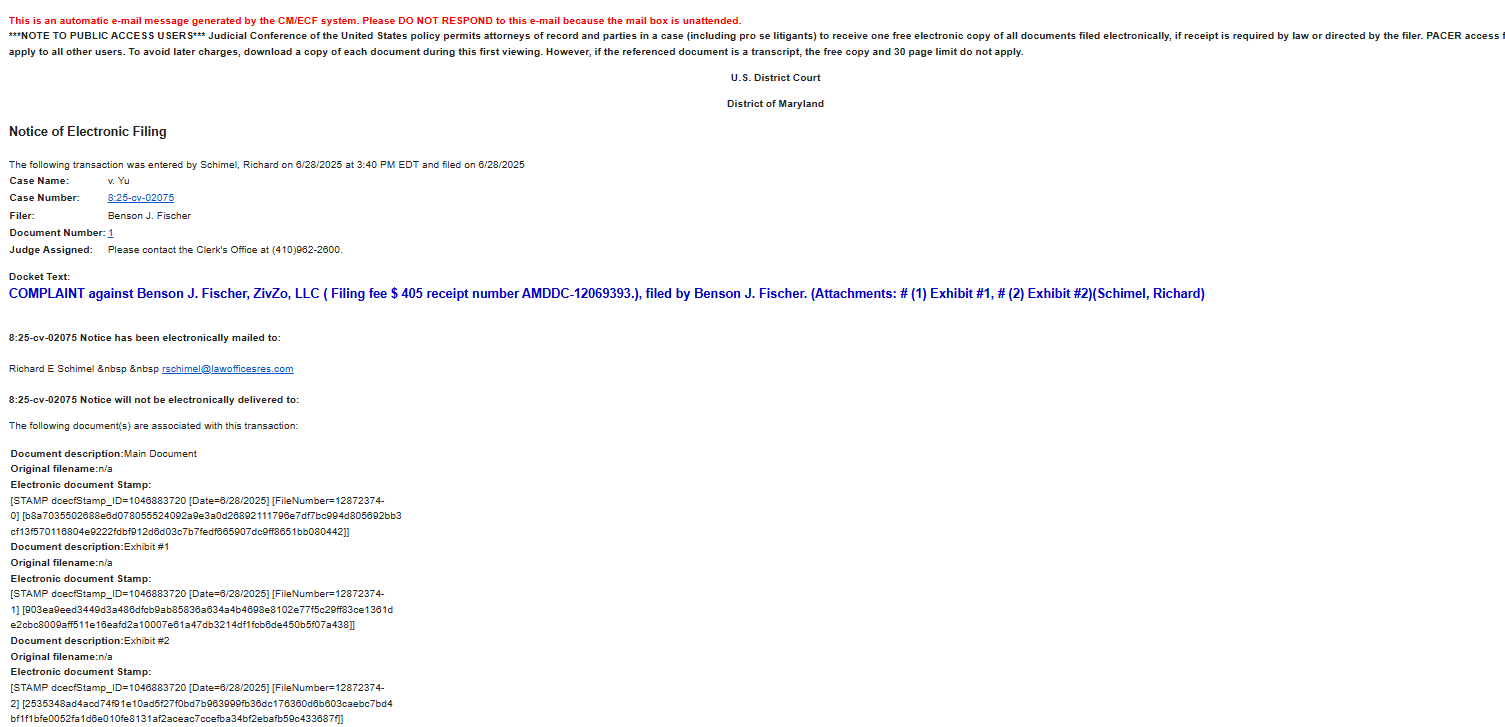
Benson J. Fischer and his attorney Richard E. Schimel have filed a lawsuit against me in federal court — case 8:25-cv-02075, U.S. District Court for the District of Maryland — demanding $6 million in damages. They paid the $405 filing fee. My view, then and now: putting this dispute into a public court system is a gift, because it puts the whole record where everyone can read it.
$6M
in damages the complaint demands
$405
filing fee they paid to open the case
8:25-cv-02075
the case number, U.S. District Court, District of Maryland
UPDATE
Update (Oct. 3, 2025): the peace order described below was dismissed because the petitioner failed to appear. The court docket is the proof, and the background is in my related posts linked throughout.
Read What The Complaint Actually Says
The complaint demands $6 million in damages because I published content about Fischer’s business history and about the legal threats he and Schimel had been sending me for weeks. It accuses me of defamation, cybersquatting, and even cyberstalking — based, as I read it, on public domain registrations and LinkedIn messages.
Here is the part I find telling: as I read the filing, they admit most of the facts are accurate — they object to how I framed them — while voluntarily moving the entire dispute into a public court system, which is what airs it for everyone to see. Those characterizations are my opinion of the filing; the underlying documents speak for themselves.
RUN THIS YOURSELF
When a dispute names a business, pull the primary source before you trust anyone’s summary — mine included. A federal case number like 8:25-cv-02075 is searchable on PACER; the docket tells you what was filed, by whom, and what the court did with it. Read the document, not the headline.
Understand The Streisand Effect
My view is that suing over search results tends to backfire: you threaten someone over what shows up, then file a lawsuit that gets even more people searching. That dynamic has a name — the Streisand Effect — and in my opinion this filing demonstrates it.
I have already responded to the threats point-by-point in earlier posts, explaining why I consider the arguments weak and why I believe anti-SLAPP principles cut against this kind of suit. Those are my characterizations of a dispute I am party to; readers should weigh them as such and check the record.
Note The Early Filing Errors
Per a notice from the U.S. District Court in Maryland, the initial complaint (Document #1) was flagged as incomplete — with missing attachments including the Civil Cover Sheet and Summons — and the clerk issued a Quality Control (QC) notice instructing the team to correct and refile.
My opinion: that is a basic step to get right on the first try. How I read it is that early stumbles like this raise questions about the case; others may read the same docket differently, which is exactly why the primary documents matter more than any framing — including mine.
RUN THIS YOURSELF
Learning to vet a dispute? On a docket, check the case status and any clerk notices before forming a view: was a complaint flagged incomplete, was a Civil Cover Sheet or Summons missing, was a related order dismissed for failure to appear? Those entries are facts you can cite without characterizing anyone — let the docket do the talking.
| From the record | Detail |
|---|---|
| Case | 8:25-cv-02075, U.S. District Court, District of Maryland |
| Parties | Benson J. Fischer & Richard E. Schimel v. Dennis Yu |
| Demand | $6 million; $405 filing fee paid |
| Claims | Defamation, cybersquatting, cyberstalking (as stated in the complaint) |
| QC notice | Document #1 flagged incomplete — missing Civil Cover Sheet & Summons |
| Peace order | Dismissed Oct. 3, 2025 — petitioner failed to appear |
For business owners watching this, the lesson is the same one I teach in every audit: own your record and document everything, so the facts are on your side if a dispute ever lands in public. That is the discipline behind the free Quick Audit process, and the measurement framework that keeps claims grounded is the MAA framework for measurement.
THE DELIVERABLE
Own Your Record Before Anyone Disputes It
Document your marketing, your assets, and your results so the facts are on your side — we’ll show you exactly how in a Quick Audit or a Power Hour.
Dennis Yu
Dennis Yu is the CEO of Local Service Spotlight, a platform that amplifies the reputations of contractors and local service businesses using the Content Factory process. He is a former search engine engineer who has spent a billion dollars on Google and Facebook ads for Nike, Quiznos, Ashley Furniture, Red Bull, State Farm, and other brands.
Dennis has achieved 25% of his goal of creating a million digital marketing jobs by partnering with universities, professional organizations, and agencies. Through Local Service Spotlight, he teaches the Dollar a Day strategy and Content Factory training to help local service businesses enhance their existing local reputation and make the phone ring.
Dennis coaches young adult agency owners serving plumbers, AC technicians, landscapers, roofers, electricians, and believes there should be a standard in measuring local marketing efforts, much like doctors and plumbers must be certified. He has appeared on 353 podcasts with 619 credited episodes — see the full list of his podcast appearances.