

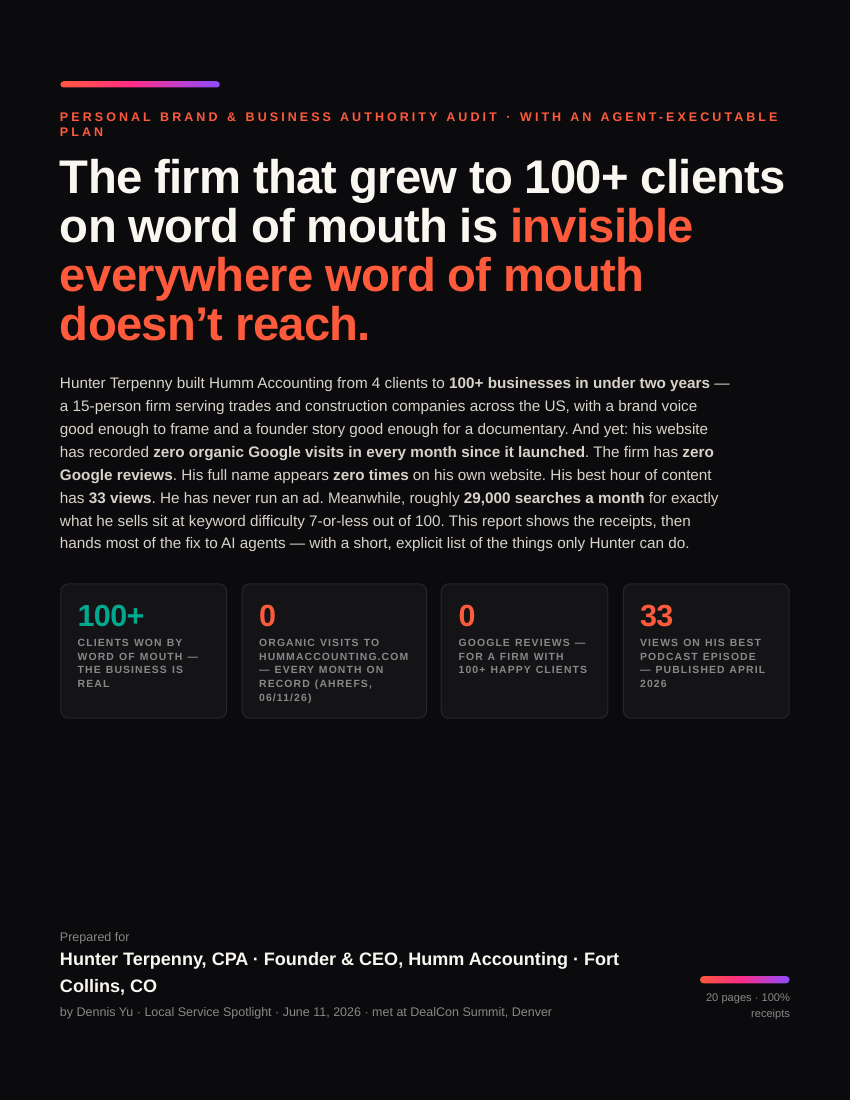
The morning after DealCon Denver, Hunter Terpenny — CPA and founder of Humm Accounting, a 15-person firm serving trades and construction companies — sent Dennis a LinkedIn message: he wants to start producing content and educational material for entrepreneurs. Instead of a discovery call and a two-week wait, an AI agent ran the entire personal-brand-and-business audit in one sitting: every page of his site, his SEO reality, his Knowledge Graph entities, his Google Business Profile, his podcast trail, his Colorado corporate records — then wrote and typeset a 20-page report with 8 charts. This article documents exactly what the agent did, step by step, what it cost in tokens and dollars, and what the same work costs when humans do it.
The subject: a real firm that’s a digital ghost
Hunter Terpenny is not a beginner with nothing to audit. He grew Humm Accounting from 4 clients to 100+ businesses in under two years, entirely on word of mouth. Fifteen people. A genuine niche — trades and construction. A founder story most marketers would kill for: he walked away from his own funded startup (Holdr) and spent three years living out of his truck with a climbing rack, a surfboard, and a futon mattress. There’s a 58-minute podcast about it called “Being Poor is a Calling.”
And here is what the agent found in the first twenty minutes:
- Zero organic Google visits to hummaccounting.com — in every single month since the site launched (Ahrefs, June 11, 2026). Domain Rating: 0.8. Organic keywords: 0.
- Zero Google reviews — for a firm with 100+ happy clients. The Business Profile has no address, no photos, no services, no posts.
- His full name appears zero times on his own website. The About page says “our founder Hunter.” No surname. Anywhere.
- No analytics of any kind. No GA4, no Tag Manager, no Meta pixel. Five years in business, not one byte of marketing data collected.
- That 58-minute podcast? 33 views.
- Meanwhile, ~29,000 monthly US searches for exactly what Humm sells — “fractional CFO” (11,901/mo), “construction accounting” (1,975/mo), “outsourced bookkeeping” (4,143/mo) — sit at keyword difficulty 7 or less out of 100.
Strong inputs, zero plumbing. The most common diagnosis in local service businesses — and the most fixable.
What the agent actually did, step by step
This was one continuous session by a Claude agent (Fable 5) running inside Cowork with tool access — the same setup we teach at dennisyu.com/dealcon. The log, condensed:
- Loaded the playbook from memory. The agent recalled the Local Service Spotlight method and the format of five previous DealCon audits (Garrett McClure, Ryan White, Ben Forstie, Terry Shintani, NAZ Electric) before touching the web. Persistent memory means audit #6 starts smarter than audit #1.
- Crawled the entire website. All five pages plus the sitemap — which revealed a /master-styling-page design-scratch URL being submitted to Google daily, a stray /cart link, and a last-modified date of December 4, 2024.
- Pulled the SEO reality from the Ahrefs API. Twelve calls: domain rating, backlink stats, organic keywords (zero), 13 months of traffic history (a perfect flatline at zero), the full referring-domains table, SERP overviews, and search volumes for 20 keywords. Finding: of 185 referring domains, ~94% are link-farm spam (fourteen .shop PBN domains, literally “buybacklinks.agency”) — and the links he actually earned, from three podcast appearances, don’t exist.
- Resolved his Knowledge Graph entities. Using Google’s entity autocomplete API — no key required — the agent found Hunter already has a Topic entity (/g/11fyy5g3f6), Humm has one too (/g/11z6727qmh), plus three orphaned podcast-episode entities and a brand collision with a UK firm and a buy-now-pay-later fintech. Knowledge-Panel eligible, completely unbuilt.
- Ran live checks in the browser. Google SERPs for his name and brand, the Maps listing (zero reviews confirmed), his LinkedIn (377 followers — and a post from three days ago announcing he wants to acquire an accounting firm doing $1M+), both Instagram accounts, Google Ads Transparency (no advertiser record, ever), and the live JSON-LD on his homepage — a Squarespace default LocalBusiness schema with empty strings for address and hours.
- Pulled the corporate records. Colorado Department of State: Terpenny Consulting Inc., formed December 1, 2020, trade name “Humm Accounting,” status GOOD. The legal trail that anchors the entity work.
- Checked his entity home. hunterterpenny.com is registered but parked on a blank GoDaddy lander. The agent verified 40 alternative TLDs in one call (.co, .net, .org, .ai all open).
- Dodged the identity traps. A podcast called “The Bottom Line” hosted by a different Hunter. A swim-team record from 2009. An old Twitter handle from his Lujure sales days. All checked, all correctly excluded — disambiguation is most of what makes entity work trustworthy.
- Generated 8 charts and wrote the 20-page report. Matplotlib for the flatline, the keyword market, the backlink autopsy donut, the SERP winnability scatter, the 90-day Gantt, the cost comparison, and the revenue scenarios — then typeset everything against our report template and rendered the PDF with a headless browser. Verified page by page before delivery.
One human checkpoint worth highlighting: the Colorado DORA license lookup — the registry where you verify a CPA license — is CAPTCHA-gated. The agent stopped at the CAPTCHA, as it should, and put license verification on the human checklist. That’s the boundary working as designed.
The token bill
Across roughly 90 tool calls — web fetches, twelve Ahrefs API pulls, browser automation, chart generation, PDF rendering, and the writing itself — the session processed approximately 2.6 million tokens. At list pricing that’s about $30; with prompt caching (which any production setup uses), the effective cost lands around $12–15. Wall-clock time: about two and a half hours, in one sitting, including the 20-page report and this article.
The human bill for the same scope
| Task | Human hours |
|---|---|
| SEO, backlink & keyword audit (tools + analysis) | 6 |
| Entity & public-records research, disambiguation | 5 |
| Website teardown, schema & tracker inspection | 3 |
| GBP / social / ads sweep | 2.5 |
| Strategy: 90-day plan, economics, scenarios | 4 |
| Writing 20 designed pages + 8 charts | 10 |
| Total at a blended $60/hr | 30.5 hours ≈ $1,830 |
That’s a 61× cost difference and roughly 12× faster — and the agent version ships with receipts on every claim, because every number came from a logged API call or a screenshot, not a memory of having checked.
What only the human can do
The report hands Hunter a 90-day plan where agents do ~150 hours of work and he does nine. His nine hours are the things that cannot and should not be delegated: claiming his Google Business Profile and Knowledge Panel (identity verification), the CAPTCHA-gated license lookup, granting access, one headshot session, three 60-minute recordings of him talking — the raw material the whole content engine runs on — and sending review asks inside relationships he actually owns. Agents do labor. Owners do trust.
Why this matters if you run an agency — or want to buy one
Hunter’s case is the pattern we see everywhere: the work product is excellent, the proof exists, and none of it is plumbed into the machine that compounds — an entity home, a review engine, canonical articles, and a dollar-a-day distribution layer. The marginal cost of completeness has collapsed to about thirty dollars. The bottleneck left is the handful of hours only the founder can supply.
And one more thing the audit surfaced that a generic SEO report never would: Hunter is shopping to acquire a $1M+ accounting firm. Every seller he approaches will Google him. The same entity home, Knowledge Panel, and reviews that win clients are the diligence trail that wins LOIs. Brand work double-counts when you’re an acquirer.
The 10 agent skills used to produce this audit are free at dennisyu.com/dealcon. If you want this run on your business, that’s what Local Service Spotlight is.
Data snapshot June 11, 2026: Ahrefs API; Google Trends entity API; Google Search, Maps & Ads Transparency; LinkedIn; Instagram; Colorado Department of State (OpenGovCO #20208048954 / #20208048861); Apple Podcasts; YouTube; RDAP/GoDaddy. All findings on file.
GO DEEPER: HOW THIS FITS THE BLITZMETRICS SYSTEM
• The Quick Audit: how we audit any business
• MAA (Metrics, Analysis, Action): the framework behind every audit
• The SEO Tree: how all our content connects
• Entity Linking: the decision tree for every link
• Knowledge Panels: getting Google to recognize you
• Every digital audit Dennis Yu has done
THE DELIVERABLE
Read the actual audit we delivered
The complete 20-page Humm Accounting audit — scorecard, findings, and roadmap.
Dennis Yu
Dennis Yu is the CEO of Local Service Spotlight, a platform that amplifies the reputations of contractors and local service businesses using the Content Factory process. He is a former search engine engineer who has spent a billion dollars on Google and Facebook ads for Nike, Quiznos, Ashley Furniture, Red Bull, State Farm, and other brands.
Dennis has achieved 25% of his goal of creating a million digital marketing jobs by partnering with universities, professional organizations, and agencies. Through Local Service Spotlight, he teaches the Dollar a Day strategy and Content Factory training to help local service businesses enhance their existing local reputation and make the phone ring.
Dennis coaches young adult agency owners serving plumbers, AC technicians, landscapers, roofers, electricians, and believes there should be a standard in measuring local marketing efforts, much like doctors and plumbers must be certified.