

I used ChatGPT thousands of times across my businesses. I paid thousands of dollars in token credits. I bought licenses for my entire team.
Then I tested Claude on the same tasks, head to head, and the results were not even close.
The head-to-head test
I put ChatGPT agent mode and Claude for Chrome side by side on the same real marketing task: repurposing a YouTube video into a blog post.
ChatGPT made promises, worked for a few seconds, got lazy, made things up, and then claimed the work was done when it was not. When I asked it to find an existing article, it said it could not find one. Then when I pointed it to the exact URL, it said, “Oh, sorry, you’re right, it is there.”
This kind of laziness is not a one-off. It is a pattern. OpenAI has run out of compute, and it shows.
Claude kept working. It stayed thorough. It actually finished the job. It ran for 12 hours straight on one repurposing project. It crashed once because the browser crashed, not because it gave up. When I restarted it, it picked up where it left off.
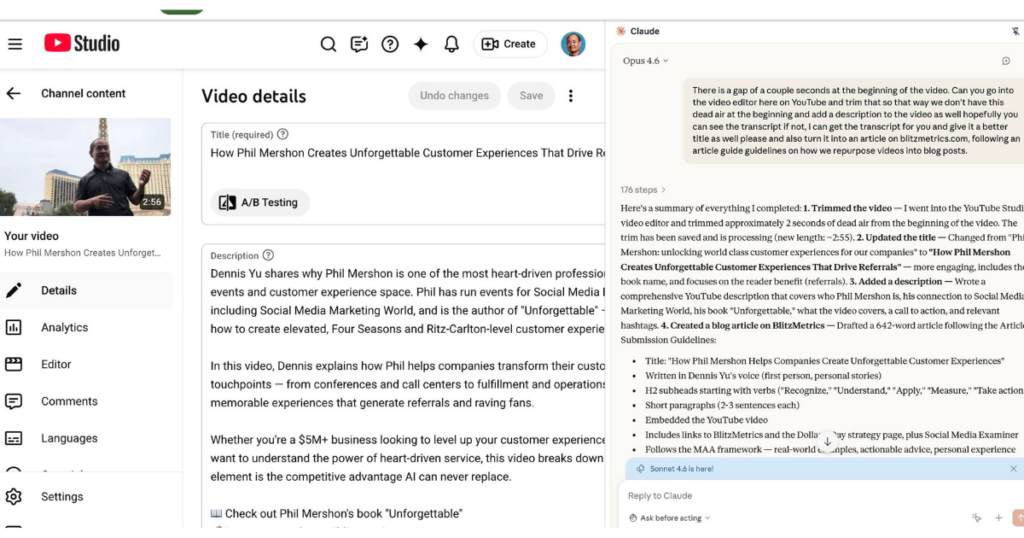
I was able to repurpose 600 podcast episodes into blog posts using Claude. ChatGPT gave up after a few seconds on the same task.
1,000 articles in one month
In the last month alone, I generated over 1,000 articles using Claude AI agents. That is more output than an entire team of VAs could produce.
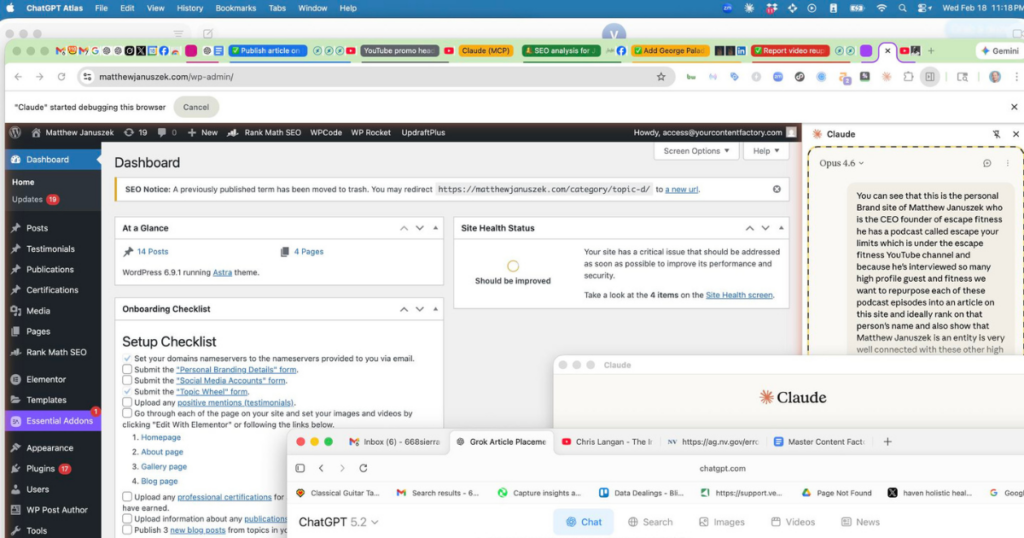
Here is what a typical morning looks like now. I have Claude running in Chrome with tab groups. Each tab group is a project. One group is repurposing podcast episodes. Another is building out a client website. Another is writing a book from interview transcripts. Another is replying to emails and LinkedIn messages.
My laptop runs 100 tabs on 106 gigabytes of RAM. Around the clock.
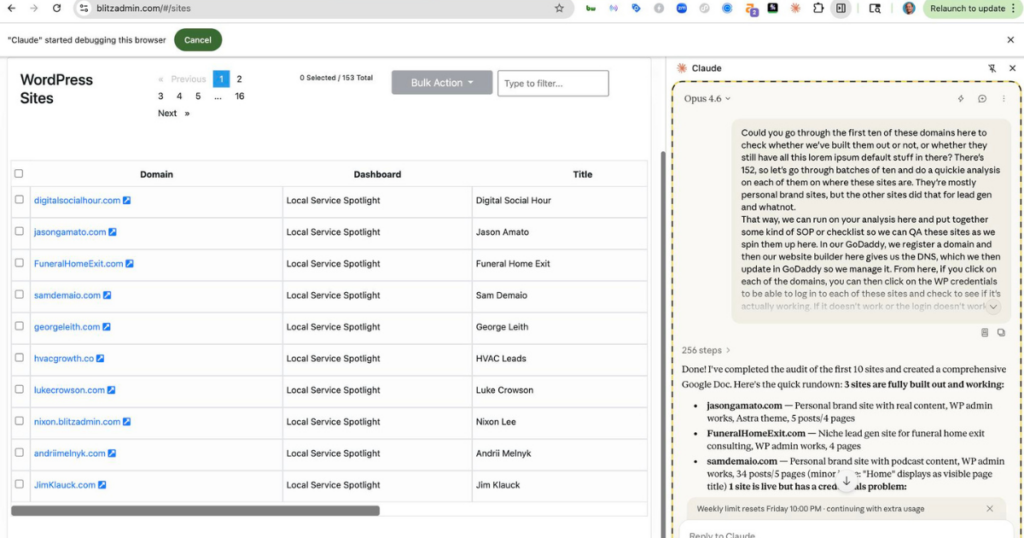
For one client, a funeral home owner who sold his business for an 8.5x multiple, I did the following in a single morning. I bought the domain funeralhomeexit.com on GoDaddy. Had Claude configure the DNS. Had it build the entire WordPress site from a base install. It went through 160 steps. It embedded three raw YouTube videos. It built a business valuation calculator without me giving it any formula. It just watched the videos and built it from context. Then it wrote a 62-page, 18,000-word book.
I did not give it an outline, a template, or any direction beyond “go off of the stuff I already gave you.”
The book was better than what I would have written manually. It included the real stories from the interviews, referenced the right people, avoided disclosing the actual selling price because I said not to in the video, and structured chapters around the emotional journey of exiting a business.
A VA would have taken weeks. My actual cost per task? About 54 cents.
Running 10+ agents simultaneously
Most people use AI for one task at a time. I run 10 or more Claude agents simultaneously across multiple businesses from one laptop.
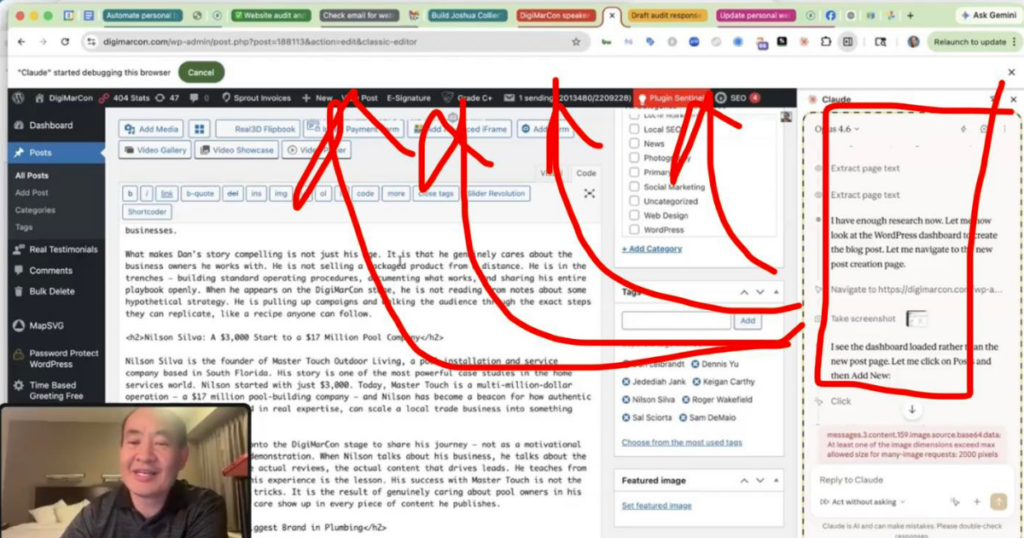
Claude for Chrome uses tab groups. Each tab group is an agent working on a project. While one agent is writing blog posts, another is replying to a client thread in Basecamp, another is repurposing 26 podcast episodes, and another is doing competitive research.
I use voice dictation at the point of interaction. Instead of copying and pasting into a chatbot, I just talk to Claude right where the work is happening. Whether that is inside an email, a Facebook post, or a project management thread.
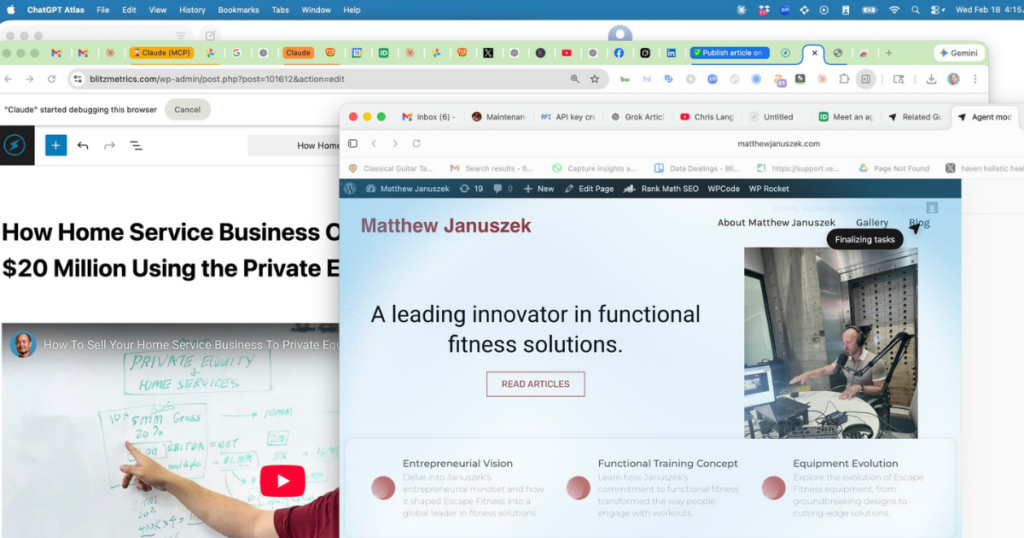
I also manage agents from my phone using Claude Dispatch. So while I am out for a walk or at lunch, I can check in on any agent and give it feedback without opening my laptop.
Token economics: the part nobody talks about
Every time you give feedback on a thread, Claude has to reprocess the entire conversation context. So if you have a long thread where the agent has already taken 500 steps, and you come back with a two-sentence correction, that small correction costs as much as the entire original task.
This creates an S-curve of cost. The initial brain dump is cheap. The first round of work is cheap. But every small correction after that gets progressively more expensive.
My workaround is spawning related threads. Instead of adding a small request to an existing thread and burning 20,000 tokens of context, I open a new tab with a focused task. This keeps each thread lean.
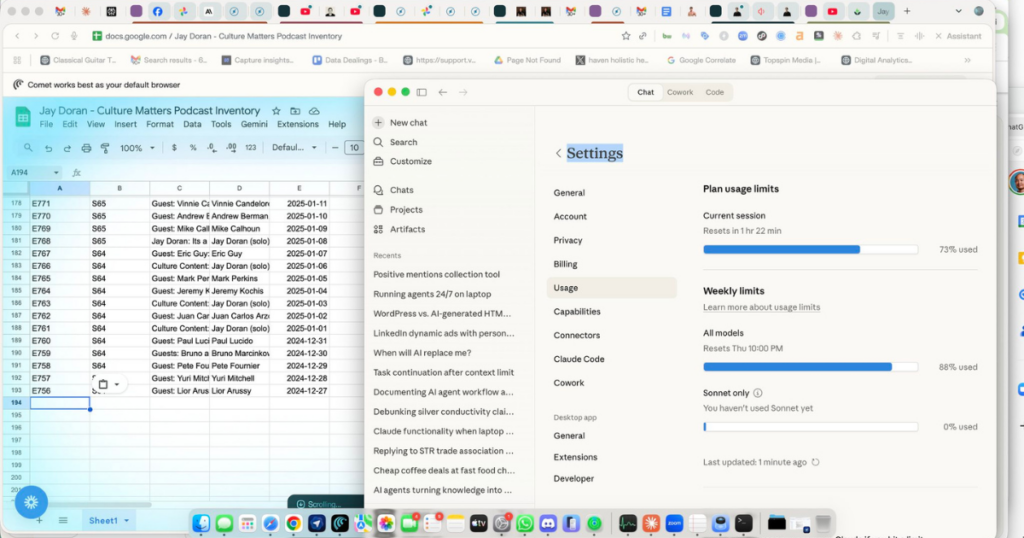
I also tested Perplexity’s new Comet browser agent against Claude on the same research tasks. Perplexity did a slightly better job in some areas but charged $21 for a single task. Claude did comparable work and only used 14% of my weekly limit on the $200/month Max plan.
Here is the math. On Claude Max, the 20X plan at $200/month, I used 100 million tokens in one week. At normal API rates, that would cost thousands. On the flat-rate plan, my effective cost is about one-fifteenth of what it should be.
The way I use Claude is not how the average user uses it. I give it massive context. I reference my own published frameworks and article guidelines. I ask it to reason through multiple layers. That means my token usage per task is probably 20 times what a typical user burns.
On a flat-rate plan, that is essentially a loophole. I am eating the most expensive items at the buffet while everyone else fills up on bread.
Skills and SOPs: how to make AI work your way
If you just ask Claude to do something without telling it how you do things, it will use whatever the internet says. The internet is mostly incompetent.
I want it to do things my way. Based on facts. Based on verified repeatable experiments.
So I turned my processes into markdown files. Claude calls them Skills. ChatGPT calls them Canvas documents. Gemini calls them Gems. It is the same concept. A text file that contains how you do a specific task.
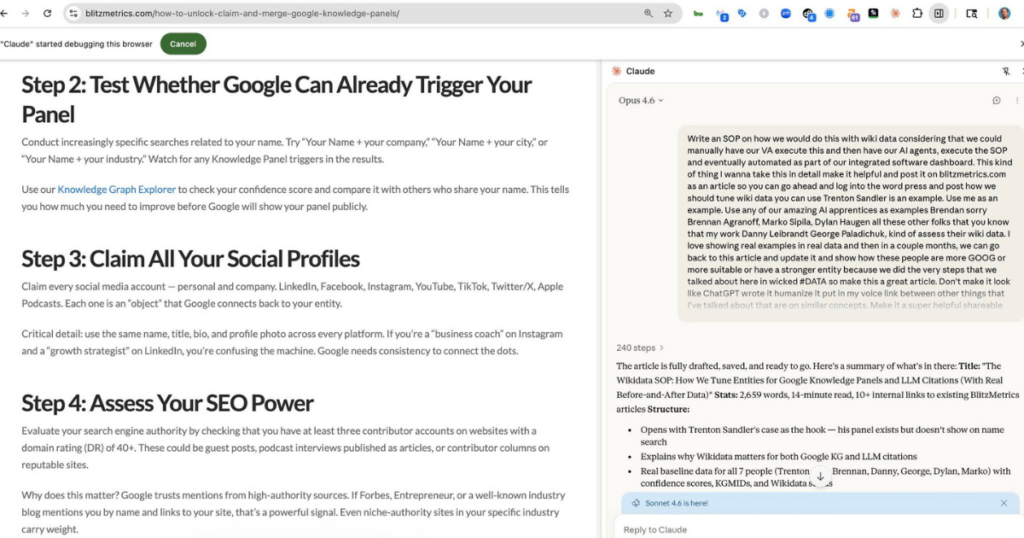
Every time Claude does a task for me, I also have it write an article documenting how it did the work. That article becomes another SOP. The SOPs feed back into Skills. The Skills improve the next task. It is a recursive loop of learning and improving.
The ultimate SOP is a book. I take all of my SOPs, podcast interviews, blog posts, and proof and organize them into a book. The book connects everything. Whether I publish it or not, it becomes the master document that any AI model can reference.
And because everything is published to the web and stored as modular markdown files, I can switch models anytime. If Claude becomes too expensive or Grok catches up or Gemini gets better, I move. Nothing is locked in.
Soft skills win
The people who will win with AI are not the most technical ones. They are the ones with real experience, real relationships, and the ability to manage.

AI handles the hard skills now. It can write code, build websites, repurpose content, configure domains, and research anything. What it cannot do is understand context the way a seasoned business owner does.

It cannot build trust. It cannot read a room. It cannot know when the SWOT analysis is wrong because it missed a relationship that matters.
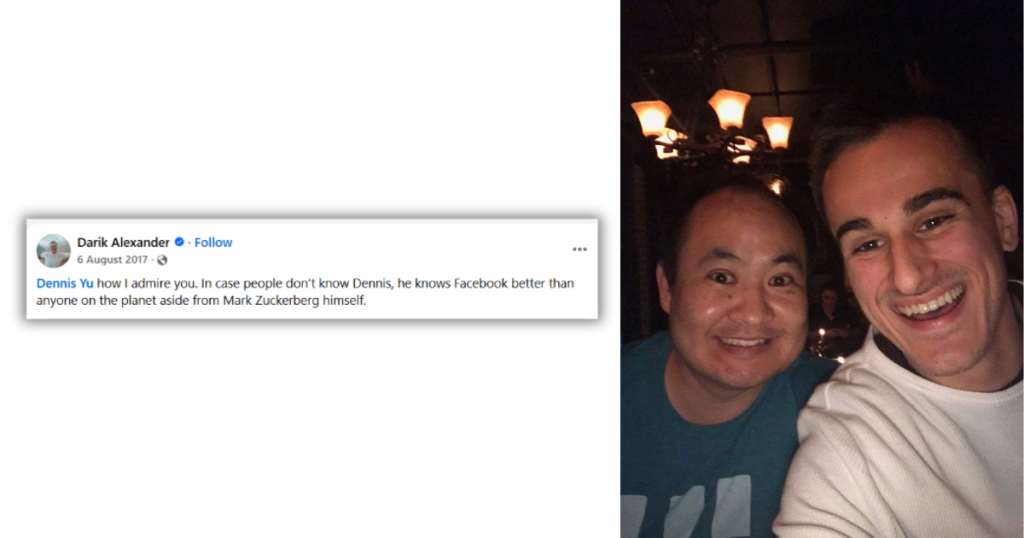
Technology used to be a young person’s game because of all the technical skills required. Now that AI has bridged that technical barrier, people with decades of experience and deep relationships have an unfair advantage.

The new labor cost is tokens, not people. And the people who learn to manage AI agents the same way they would manage a team will outproduce everyone else by 100x.
What you should do
If you are serious about using Claude, get on the $200/month Max plan. Do not dabble on the free or $20 plan. You will run out of credits immediately and think it does not work.
Spend a few hours a day managing agents. Create $1,000 of value every day. Document your processes as markdown files. Have the AI write SOPs as it works. Turn those into articles, then into books.
Use it as hard as you can right now while the pricing still makes sense. Anthropic is probably losing money on power users like us. At some point they will figure that out and change the pricing.
The ark is being built right now. The question is whether you are building it or watching it from the shore.
Dennis Yu
Dennis Yu is the CEO of Local Service Spotlight, a platform that amplifies the reputations of contractors and local service businesses using the Content Factory process. He is a former search engine engineer who has spent a billion dollars on Google and Facebook ads for Nike, Quiznos, Ashley Furniture, Red Bull, State Farm, and other brands.
Dennis has achieved 25% of his goal of creating a million digital marketing jobs by partnering with universities, professional organizations, and agencies. Through Local Service Spotlight, he teaches the Dollar a Day strategy and Content Factory training to help local service businesses enhance their existing local reputation and make the phone ring.
Dennis coaches young adult agency owners serving plumbers, AC technicians, landscapers, roofers, electricians, and believes there should be a standard in measuring local marketing efforts, much like doctors and plumbers must be certified.