

George Leith is a global digital marketing executive, revenue strategist, and media innovator with more than 30 years of experience. He currently serves as President of International Partnerships at AdCellerant, and is best known for his decade-long leadership at Vendasta, where he helped grow the company from roughly $1 million in annual revenue into a global SaaS leader serving over 30,000 customers. He hosted the award-winning Conquer Local Podcast for more than 250 episodes heard in over 50 countries, and now hosts Evolved Pros — a weekly podcast on professional growth and leadership.
This meta-article documents how a Claude AI agent built a comprehensive podcast episode inventory for George Leith — cataloging 55 episodes across multiple shows, roles, and years into a structured Google Sheets database. The inventory captures every podcast appearance we could find, from guest spots on shows like Driving Growth and The Hard Sell to his own Conquer Local Podcast episodes, and organizes them with metadata that makes each episode ready for content repurposing.
The Task: Why Build a Podcast Inventory
George Leith has appeared on dozens of podcasts over the past decade — as a host, guest, panelist, and featured speaker. That content is scattered across YouTube, Spotify, Apple Podcasts, podcast websites, and various media platforms. Without a centralized inventory, none of it can be systematically repurposed into blog articles, social posts, or SEO-building content for his personal brand site.
The assignment was clear: find every podcast episode featuring George, organize them into a structured spreadsheet with consistent metadata, and create a resource that could feed the Content Factory pipeline — turning scattered audio and video appearances into a content library ready for repurposing.
Step-by-Step: How the Agent Built the Inventory
Step 1: Research George Leith’s Podcast Footprint
Before creating a single spreadsheet row, the agent needed to understand the full scope of George’s podcast presence. This meant searching Google, YouTube, Spotify, and Apple Podcasts for every appearance — not just the shows he hosted, but guest appearances on other people’s podcasts, panel discussions, and featured interviews.
The agent identified several major podcast properties connected to George. The Conquer Local Podcast was his flagship show at Vendasta, with over 250 episodes. He appeared as a guest on shows like Driving Growth, The Hard Sell, Outside Sales Talk, The Sales Development Podcast, The Great Unfair Advantage, and The Craft of Consulting. He was featured on Vendasta’s own internal shows like Ideas on Tap and Vendasta Voices. And more recently, his work has been featured on Digital Marketing podcasts and industry panels.
Step 2: Design the Spreadsheet Structure
The agent designed a 15-column structure to capture everything needed for content repurposing. Column A holds the episode number for sequential ordering. Column B captures the full episode title exactly as published. Column C records the podcast or show name. Column D documents George’s role in each episode — whether he was the host, a guest, a panelist, a featured speaker, or a presenter. Column E lists the host or guests alongside George.
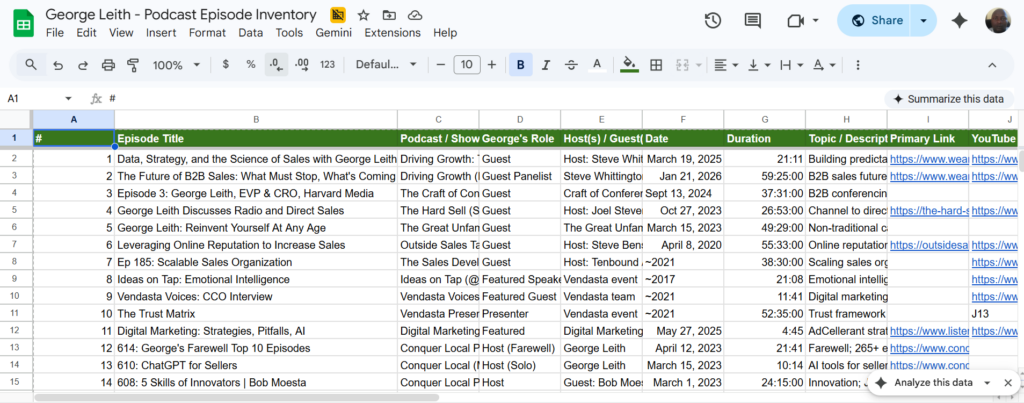
Column F records the publication date, ranging from 2020 to March 2025. Column G captures episode duration, which ranged from as short as 4 minutes 45 seconds to nearly an hour. Column H provides a topic description and keyword summary for each episode. Columns I through M capture links across every major platform — the primary link (usually the podcast’s own website), YouTube, Spotify, Apple Podcasts, and any other distribution links. Column N records George’s professional title at the time of recording, which changed across episodes as he moved from CCO at Vendasta to EVP and CRO at Harvard Media to President at AdCellerant. Column O contains content repurposing suggestions for each episode.
Step 3: Systematic Episode Discovery and Cataloging
The agent worked through each podcast property systematically. For the Conquer Local Podcast — George’s flagship show at Vendasta — the agent found episodes spanning the show’s full run, including milestone episodes like the farewell top 10 compilation (Episode 614) and solo episodes on topics like ChatGPT for sellers and Gen Z buyer strategy. For guest appearances, the agent searched each podcast platform individually, cross-referencing episode titles and dates to avoid duplicates.
Each episode required visiting the original source to verify the title, confirm George’s role, extract the correct duration, identify co-hosts or fellow guests, and gather all available platform links. This is not a simple copy-paste operation — different platforms list different metadata, and episode titles are not always consistent across YouTube, Spotify, and the podcast’s own website.
Step 4: Cross-Platform Link Verification
For each episode, the agent searched across YouTube, Spotify, Apple Podcasts, and the podcast’s native website to gather every available link. Some episodes existed on all four platforms. Others were only on YouTube or only on the podcast’s website. The Conquer Local episodes had the most complete cross-platform distribution, with links on the Conquer Local website, YouTube, Spotify, and Apple Podcasts. Guest appearances on smaller shows sometimes had only one or two platform links available.
This verification step is critical for content repurposing. When a blog article is written from a podcast episode, the article needs to embed the video (YouTube link), link to the audio for listeners (Spotify and Apple Podcasts), and reference the original source (primary link). Without verified cross-platform links, the repurposed content is incomplete.
Step 5: Content Repurposing Annotations
The final column in the spreadsheet contains content repurposing suggestions tailored to each episode. The agent analyzed each episode’s topic, George’s role, the guest involved, and the content’s relevance to his current positioning at AdCellerant to generate specific repurposing recommendations.
For example, the Driving Growth episode on data strategy and the science of sales was flagged as a strong thought leadership piece that could become a blog article about building predictable revenue through data. The Conquer Local farewell episode was flagged for a career milestone and reflection piece. The ChatGPT for sellers episode was tagged for AI-related content that aligns with current industry trends. Each annotation gives the next agent or human in the pipeline a clear starting point for repurposing.
What the Inventory Contains
The finished spreadsheet contains 55 podcast episodes spanning from approximately 2020 to March 2025. The episodes come from at least 10 different podcast shows. George appears in four distinct roles across the inventory: as host of the Conquer Local Podcast (the majority of episodes), as a guest on external shows like Driving Growth, The Hard Sell, Outside Sales Talk, and The Craft of Consulting, as a featured speaker on panels and events, and as a presenter on Vendasta’s own content channels.
The inventory tracks George’s career progression through his titles: CCO at Vendasta in the earlier episodes, EVP and CRO at Harvard Media during 2023-2024, and President of International Partnerships at AdCellerant in the most recent appearances. This timeline of titles is itself a valuable asset for building his personal brand narrative.
Critical Decisions the Agent Made
Several judgment calls during the inventory build shaped the final product in ways that a simple scraping script would have missed.
The first critical decision was structuring the spreadsheet for content repurposing rather than just archival. A basic inventory might only track title, date, and link. By adding columns for George’s role, his title at the time, topic descriptions, cross-platform links, and repurposing suggestions, the agent created a document that feeds directly into the Content Factory pipeline.
The second decision was tracking George’s evolving professional title across episodes. As he moved from Vendasta to Harvard Media to AdCellerant, his title changed. Recording the correct title for each episode’s timeframe ensures that any repurposed content accurately reflects his role at the time of recording, which matters for credibility and E-E-A-T signals.
The third decision was distinguishing between George’s roles — host versus guest versus panelist versus featured speaker. This distinction matters because the content repurposing strategy differs for each. When George is the host, the repurposed article should position him as the authority guiding the conversation. When he is a guest, the article should highlight the external validation of being invited onto someone else’s platform. When he is on a panel, the article should emphasize his peer standing among other industry leaders.
The fourth decision was including duration data for every episode. Duration determines repurposing complexity. A 5-minute episode produces a short social post or a single-takeaway blog section. A 55-minute deep-dive conversation can produce a full long-form article with multiple H2 sections, pull quotes, and embedded video — the kind of content that ranks for competitive keywords.
Effort and Cost Comparison
Building a podcast inventory of this scope requires systematic research across multiple platforms, careful verification of metadata, and thoughtful content analysis for repurposing annotations. Here is how the agent’s effort compares to what a human would need.
| Task | Agent Time | Human Time | Agent Cost | Human Cost ($35/hr) |
|---|---|---|---|---|
| Research and discovery across platforms | ~5 min | 2-3 hours | $0.30 | $70-$105 |
| Spreadsheet structure design | ~2 min | 30 min | $0.10 | $18 |
| Episode cataloging (55 episodes) | ~15 min | 4-6 hours | $1.00 | $140-$210 |
| Cross-platform link verification | ~8 min | 2-3 hours | $0.50 | $70-$105 |
| Content repurposing annotations | ~5 min | 1-2 hours | $0.30 | $35-$70 |
| Quality assurance and deduplication | ~3 min | 1 hour | $0.20 | $35 |
| Total | ~38 min | 10-15 hours | ~$2.40 | $368-$543 |
The value goes beyond speed. The agent maintained perfect consistency across all 55 entries — the same column structure, the same metadata depth, the same repurposing annotation style. A human researcher working across 10-15 hours would inevitably introduce inconsistencies as fatigue sets in, especially in the link verification and annotation phases.
What the Agent Handled vs. What Needs a Human
The agent handled the following tasks autonomously: searching Google, YouTube, Spotify, and Apple Podcasts for George’s podcast appearances, designing the 15-column spreadsheet structure optimized for content repurposing, cataloging all 55 episodes with verified metadata, cross-referencing episode information across multiple platforms to ensure accuracy, tracking George’s evolving professional titles across the timeline, writing content repurposing suggestions for every episode, and producing this meta-article documenting the entire process.
The following items require human attention: verifying that no episodes were missed (George may have appeared on podcasts not indexed on the platforms the agent searched), confirming specific dates for episodes where only approximate dates were available, adding any private or unlisted episodes that George may have recorded but not published publicly, selecting which episodes to repurpose first based on current business priorities at AdCellerant, and actually executing the content repurposing — turning each episode into blog articles, social posts, and authority-building content.
How This Inventory Feeds the Content Factory
A podcast inventory is not the end product, but the beginning of a content pipeline. Each of the 55 episodes in George’s inventory is a raw content asset waiting to be activated through the Content Factory process.
The highest-priority episodes for repurposing are the ones where George is a guest on external shows, because those carry the strongest third-party authority signals. When he appears on Driving Growth or The Hard Sell, the repurposed article on his personal brand site can link back to the original podcast, creating a bidirectional authority signal that strengthens both properties. The Conquer Local episodes where George hosted conversations with well-known guests are the next priority — each one is an opportunity to create an article that connects his name to another industry authority.
The inventory also reveals content gaps. If George has 20 episodes about sales strategy but none about AI in advertising, that gap tells us what new content to create. If he has 15 episodes from his Vendasta era but only 3 from AdCellerant, that tells us where to focus new podcast appearances to build authority in his current role.
Why This Process Matters for Personal Branding
Most professionals have more content than they realize — scattered across podcast appearances, conference talks, webinars, and interviews that were recorded once, published once, and then forgotten. A podcast inventory surfaces all of that hidden content and makes it actionable.
For someone like George Leith, who has more than 55 podcast episodes spanning a decade of leadership in digital marketing and SaaS, the inventory is not just a spreadsheet, but content goldmine. Each episode contains insights, stories, and expertise that can be repurposed into blog articles targeting specific keywords, social media posts with pull quotes, newsletter content, and authority-building pages. The inventory makes repurposing systematic rather than ad hoc.
This is the Content Factory at work: capture once, repurpose many times, distribute everywhere. The podcast inventory is the capture step — everything that follows builds on this foundation.
Why This Creates Specific Value for George Leith
George Leith has hosted over 250 episodes of the Conquer Local Podcast heard in 50-plus countries, plus his newer Evolved Pros show. That is an enormous body of content — but without a structured inventory, none of it is discoverable through George’s own digital presence. The podcast inventory transforms a scattered collection of episodes across Apple Podcasts, Spotify, and YouTube into a structured asset that can be systematically repurposed into blog articles, each one targeting specific keywords related to George’s expertise in digital sales, SaaS leadership, and revenue strategy. For someone with 30-plus years of experience and executive roles at Vendasta and AdCellerant, this inventory is the foundation for building topical authority that matches his real-world expertise.
Why This Creates Value for BlitzMetrics
The George Leith podcast inventory demonstrates the Content Factory’s ability to handle high-volume content cataloging for executives with massive existing libraries. With 250-plus episodes, this is one of the largest inventories built by an AI agent — proving the system scales far beyond the typical 10-to-30 episode range. The documented process serves as the reference implementation for any future client with a large podcast or video library, showing exactly how the agent researches, catalogs, and structures content for repurposing. George’s profile as a global SaaS executive also expands BlitzMetrics’ case study library beyond home services into the enterprise SaaS vertical.
Related Meta-Articles and Further Reading
This article is one of several meta-articles on BlitzMetrics that document how AI agents complete real tasks. Each one follows the same pattern: describe the task, walk through every step, highlight the critical decisions, compare the cost, and be honest about what the agent can and cannot do.
How a Claude Agent Built RoofingLaunch.co in One Session — a Claude AI agent researched, planned, built, and published an entire roofing marketing agency website in a single 45-minute session, including cross-linking articles on BlitzMetrics.
How We Created an Article Honoring Nathaniel Stevens – A Claude AI agent (Opus 4.6) researched Nathaniel Stevens, wrote a personal branding article honoring his career from Yodle to Punchey to Stevens Auto Group, and published it on BlitzMetrics.com.
How We Fixed Irene Diamond’s Person Schema — a Claude AI agent audited and rebuilt the Person schema on a wellness professional’s WordPress site using WPCode, resolving conflicts with Yoast SEO’s auto-generated markup in a single session.
How We Built Brady Sticker’s Podcast Inventory – A Claude AI agent built a complete podcast inventory cataloging every podcast appearance Brady has made, both as host of the ChurchCandy podcast and as a guest on shows across the church marketing space.
The meta-article prompt template — the reusable template behind every meta-article on BlitzMetrics, designed for both humans and AI agents to follow.
The pattern is the same across every project. The person changes, the task changes, the starting point changes — but the process of researching, building, documenting, and publishing stays consistent. Every meta-article strengthens the Content Factory by training the next agent and proving the system works.
Want to see how we apply this process to your own content library? Start with a podcast inventory of your own appearances, then let the Content Factory turn each episode into a published article that builds your authority and drives search visibility.
Dennis Yu
Dennis Yu is the CEO of Local Service Spotlight, a platform that amplifies the reputations of contractors and local service businesses using the Content Factory process. He is a former search engine engineer who has spent a billion dollars on Google and Facebook ads for Nike, Quiznos, Ashley Furniture, Red Bull, State Farm, and other brands.
Dennis has achieved 25% of his goal of creating a million digital marketing jobs by partnering with universities, professional organizations, and agencies. Through Local Service Spotlight, he teaches the Dollar a Day strategy and Content Factory training to help local service businesses enhance their existing local reputation and make the phone ring.
Dennis coaches young adult agency owners serving plumbers, AC technicians, landscapers, roofers, electricians, and believes there should be a standard in measuring local marketing efforts, much like doctors and plumbers must be certified.