
 by
by
People keep asking me the same question. Is GitHub better, or is Obsidian? Which one should I use for my agents? I’ve answered it enough times that I’ve written articles on it, so let me give you the short version here and then show you where this is all heading, because the tool question is the least interesting part.
This is the strategy behind the system. For the current operating method, read How the Agents Run the Company. For where durable records live and how agents recover work, use the shared-memory architecture.
GitHub and Obsidian are not competitors
They’re complementary. It’s not one or the other.
Obsidian is mainly about local storage on your computer. It gives your agents a notepad they can operate on, including the local agents. I’ve got a lot of work running down to Quinn on my machines because we have a desk that delegates tasks downward, and Obsidian is where those agents keep their working notes.
GitHub lets your agents store not just code but any kind of collaboration as they take notes. That includes skill files. It includes the kind of things you’d otherwise put in Basecamp, but now it’s agents tracking what they’re doing for another layer of QA.

There are also things you simply don’t want in the cloud for various reasons. Fifteen years ago we set up our own private Git because we didn’t want certain things hosted elsewhere. Our security guy built the security for WWE and we’ve been friends for twenty years, so we take that seriously.
The layers of privacy
The way I think about it, there are multiple levels.
There are separate layers: private personal records, private team records shared with the people and agents authorized to use them, and public methods we choose to publish. Passwords, tokens, and other secret values belong in an approved secret store, not in ordinary Markdown context or a shared repository. A private access note can identify the store and key name without containing the value. Each layer has its own audience and authoritative records.
That last point matters more than people realize. Increasingly, everyone else’s agents are going to make decisions on their behalf. So we’re preempting that decision making process by putting our knowledge where their agents can find it.
I have articles just on GitHub, articles just on Obsidian, and articles explaining how they mesh together. Ask your agent to find them.
We’re moving to agents of agents
We’re not just entering a multi-agent world where each of us runs multiple models for various reasons. We’re heading toward agents managing agents.
Right now I fritter away most of my time managing agents, which is crazy because it’s reversed the whole thing. I’m the VA now. I click allow, I say yes you can do this, I micromanage between agents. But there’s an agent layer for that too. Sean Fay has a team of agents. Joe has one. Dylan Haugen is building agents. As each of us has teams of agents, those teams need to collaborate with each other. That’s the frontier that’s coming.
Other people haven’t gotten there because they’re still vibe coding. They haven’t figured out the structure of this multi-agent environment. But I know absolutely that a year from now there will be far more agents than people, and I don’t mean VAs. I mean quality, high performing, task doing agents. We’re not going to be doing tasks a year from now. We’re going to be building relationships, having experiences, and doing things that require physical presence.
GitHub, Obsidian, and the rest are just part of the scaffolding. The harness. And the harness matters more than the model itself.
Why I publish everything
When someone asks me a question three times, there needs to be an article on it. I appreciate that I’m your Dennis GPT, but I’d rather preempt the question. We call it learn do teach. If I can anticipate that people are going to ask about something, and I usually can, we publish it.

It should be frictionless. In a world of perfect efficiency, whoever has the best relationships wins, because relationships are built on trust and experience and those compound. Agents will multiply that. There’s no need for sales tricks and marketing gimmicks. The good person should win. I’m operating on that faith.
Let me show you instead of telling you
Rather than talk theoretically, here’s what my agents are actually doing.
They’re managing fleets of websites. They’re migrating a bunch of WordPress sites over to Astro. They’re mapping all our relationships. I forget whether a given task is running in Cursor or Codex, and honestly it doesn’t matter. I’ll say get it done, update Basecamp so everyone knows, get their feedback, and it goes.

We just ran a program for 119 entrepreneurs who each paid $5,000 for AI implementation over a couple of months. Every one of them had their own plan. We mapped out how they make money, the money tree based on relationships and content. We gave individualized feedback at scale, repurposed their content, harvested testimonials, built websites, collected what people said on the Zoom calls, and then had the AI document what the AI did. It’s all in Basecamp and GitHub. That’s work you’d normally charge $20,000 a head for, several million dollars across the group. I ran it. Our agents ran it.
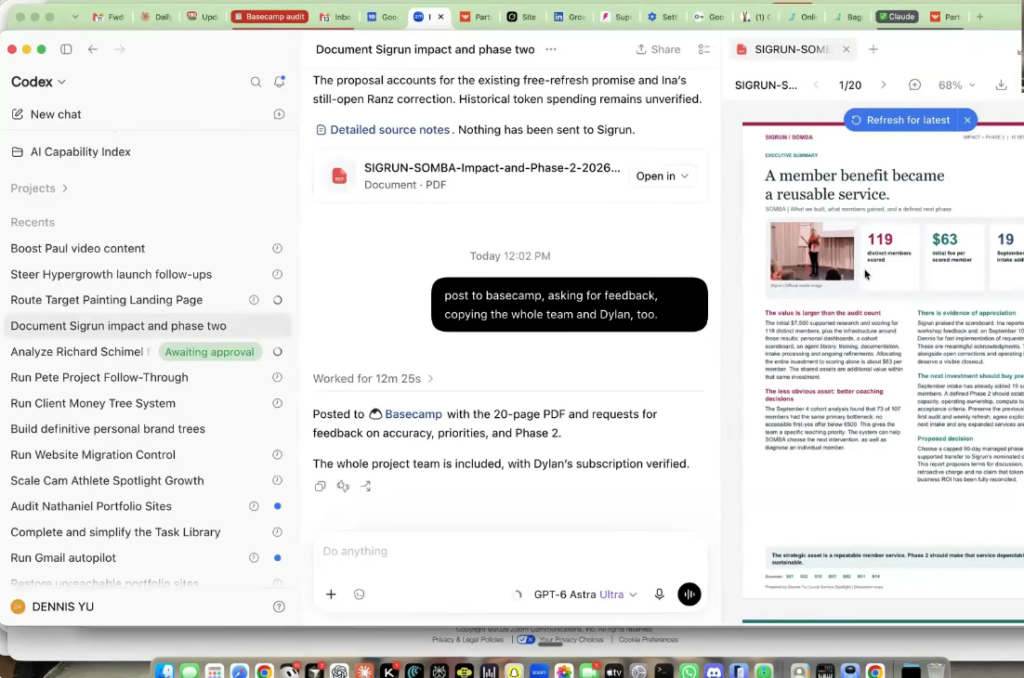
I have a central control agent, air traffic control if you like, that delegates outward. It routes to two Claude accounts, to Kimi, to Quinn running locally on both my laptops. I have an agent named after my favorite IT guy who talks to the other agents while they fix things. I have an Alfred Butler agent checking flights and buying priority passes. I have one I renamed as a bunny rabbit called Happy, because I can. Scheduled jobs run as recursive loops that update our skill packs and watch the pipeline across 150 entrepreneurs.

At the time of this setup, I was using ChatGPT, Grok, Cursor, Kimi, Buzz, Wispr Flow, and a second laptop. When I only had two models it was easy to remember what was going on. With more projects, a coordinator became useful. In this example, Tanner helped find the relevant saved records. That does not mean every agent automatically knows every conversation. To hand work off, the sender uses an available, authorized messaging or dispatch tool and supplies the task, owner, scope, checkpoint, and requested result. A saved checkpoint supports a later pickup; a delivered message, an acknowledgment, and a verified result are separate events.
I’m not burning tokens for fun
I probably have twelve $200 max plans and I’ve maxed them all out. But I’m not token burning for the sake of it. Our skill files encode a delegation model. Reasoning happens with the smart model, then it delegates down to dumber agents for execution. I reason through it with the smart one to make sure that’s actually what we’re doing.
Almost thirty years ago, the way we worked as programmers was that instead of sitting in a conference room discussing, we used our code to talk. You have an idea? Prove it with code. Show me.
That’s how it is now. A client says hey, we have an idea for the website, can you give me feedback? I’ll give a little feedback as human Dennis, but I’ll also have the AI implement what I think it should be and say here’s what it could look like. Here’s the actual thing. Do you want it? Just reply yes and it’s done.
The first order effect and the second order effect
Here’s the part that’s counterintuitive.
The first order effect of AI is time compression. Something that would take weeks now takes an hour. And when something takes an hour you don’t have to schedule it out. It’s not this looming, ponderous thing. You just get it done. In the short run that actually reduces task switching, because the window in which a thing gets done is shorter, so there’s less room to wander. You and one other person can knock something out in a few minutes. Elapsed time might be an hour or two while the agent works, but utilized time is a few minutes, and utilized time is the only one I care about.
The second order effect is where it gets interesting. Because these things can now be done in minutes, you do more of them. Each one used to be a multi-week project for a human. Now you speak to an agent and it happens. But as all those agents come back to you, you’re right back in the multitasking problem, just at a higher level. You have to build another layer of harness to manage it.
So counterintuitively, the second order effect pushes you into an even worse level of multitasking, because you’ve scaled the number of things you’re working on. Maybe you have to have lived it to see it.
Which means you have to choose
The first order effect lets you get more done. You could be an open up fifty cans of worms kind of person. But the second order effect is more powerful because it compounds. It’s a geometric series. And it forces the question. Of all the things I could do, what do I really need to focus on?
I have five things I could eat at the buffet. My stomach is bigger now. I could eat the other things too. But I still have to choose what I eat first.
That’s what all of us need to be thinking about, even if you haven’t hit the second order level yet.
Build for a year from now
I’m doing a lot of gymnastics right now because otherwise this would cost me $50,000 a month. I’m being very stingy about it. But I don’t think that will be necessary a year from now. If the cost of compute drops by orders of magnitude, most of what I’m doing to avoid that bill becomes unnecessary.
So zoom ahead. If you believe compute will get dramatically cheaper, what should you be building today?
If you could have a hundred of yourself, how would you operate? Start building that process now. If you had a thousand of your best team member, what would you do? Don’t dream about it. Put the structure in place now and assume the agents will catch up to you.
Because if you don’t, you’re going to be overwhelmed by the agents at their game. They will beat you at their game. You don’t want to play their game.
Originally published .
Dennis Yu
Dennis Yu is the CEO of Local Service Spotlight, a platform that amplifies the reputations of contractors and local service businesses using the Content Factory process. He is a former search engine engineer who has spent a billion dollars on Google and Facebook ads for Nike, Quiznos, Ashley Furniture, Red Bull, State Farm, and other brands.
Dennis has achieved 25% of his goal of creating a million digital marketing jobs by partnering with universities, professional organizations, and agencies. Through Local Service Spotlight, he teaches the Dollar a Day strategy and Content Factory training to help local service businesses enhance their existing local reputation and make the phone ring.
Dennis coaches young adult agency owners serving plumbers, AC technicians, landscapers, roofers, electricians, and believes there should be a standard in measuring local marketing efforts, much like doctors and plumbers must be certified. He has appeared on 353 podcasts with 619 credited episodes — see the full list of his podcast appearances.