
 by
by
Every person and every business is sitting on more credibility than they realize. They just never collected it. The Positive Mentions System fixes that: it finds what people are already saying about you, scores it by authority, and turns it into a page that converts.
The Positive Mentions System at a glance
STEP 1
GCT
Goals · Content · Targeting
→
STEP 2
Sweep
Everywhere you are mentioned
→
STEP 3
Score
WHO + WHERE + WHAT /30
→
STEP 4
Tracker
Every mention logged
→
STEP 5
Page
“What People Are Saying”
→
STEP 6
Amplify
Site, ad, or weekly email
Run it weekly and it compounds: every new mention gets scored, logged, and flagged AD-READY for your site or an ad.
Somewhere right now there is a podcast host calling you the go-to expert in your field. A client wrote a Google review naming the exact problem you solved. A peer dropped your name on LinkedIn. A conference organizer called you a dream panelist. None of it is doing anything for you, because it is scattered across YouTube comments, Facebook posts, podcast episodes, review sites, and conference recaps: everywhere except the one place a prospect actually looks, which is your website.
This is a supporting implementation guide that preserves a worked implementation of the current method. The thing here is the Positive Mentions System, a repeatable way to find organic praise, score it, and publish it. This update adds the biggest change since the system launched: a guided intake form that replaces the old back-and-forth of answering setup questions by hand. We will walk through the framework, the new form, and the exact before-and-after we built on Dennis Yu’s own site so you can copy it.
If you only take one idea away: a positive mention is not a review you asked for or a testimonial you prompted. It is something someone said on their own. That is what makes it impossible to fake, and that is what makes it worth collecting properly.
The Positive Mentions System, end to end
1. GCT
Goals, Content, Targeting
→
2. Sweep
Every platform, logged in
→
3. Score
WHO + WHERE + WHAT, out of 30
→
4. Tracker
Keepers, deduped and tiered
→
5. Page
“What People Are Saying”
↻ It runs every week, so your proof compounds and the same comment never re-enters. See how the WHO + WHERE + WHAT score works.
Why Positive Mentions Beat Reviews
Reviews and testimonials are solicited. You hand someone a form, you get five stars. Useful, but everyone has them, so they prove less than they used to.
A positive mention happened without you asking. When the number one ranked SEO in the world invites you onto his podcast and calls you the go-to expert on Knowledge Panels, that carries weight no testimonial request can manufacture. The whole game is collecting these organic signals and presenting them where they matter.
This ties directly into the rest of the BlitzMetrics framework. In the Topic Wheel, the outer ring is your WHY: the stories, collaborations, and proof points that build trust. Positive mentions are that outer ring made tangible. They are also entity signals: every third-party mention of your name and expertise is what Google uses to build your Knowledge Panel and what AI engines use to decide whether to recommend you. Collecting mentions is not a vanity page. It is authority infrastructure.
The Framework: WHO, WHERE, WHAT
Not all praise is equal. To sort signal from noise, score every mention on three dimensions, one to ten each, for a total out of thirty.
WHO said it. A comment from a recognized leader in your field outweighs an enthusiastic comment from a stranger. Source credibility transfers to you.
WHERE it appeared. The same sentence is worth more in a major publication or on a high-authority channel than on a personal page. Platform authority transfers too.
WHAT they actually said. A quick nice work and the best I have seen in twenty years are both positive. They are not equivalent. Reward specificity and strength.
Add them up:
- 25 to 30, Tier 1 (Gold): hero material. Feature it prominently.
- 18 to 24, Tier 2 (Blue): strong support. Include it.
- 10 to 17, Tier 3: log it in the tracker, hold for later.
- Below 10: archive. Do not publish.
The scoring keeps you honest. It stops you from giving a vague love this guy the same real estate as a named client telling a specific success story.
Start With GCT: Goals, Content, Targeting
Before you search for a single mention, you need three inputs, what Dennis calls GCT:
- Goals: who you are, your name and handles, and what you do.
- Content: what you want to be known for, in a sentence or two. Your mission.
- Targeting: who your audience is.
GCT is what makes the system work for anyone. A plumber’s authority hierarchy looks nothing like a digital marketer’s, and a marketer’s looks nothing like a university professor’s. Feed in the GCT and the system infers the right categories, the right high-authority sources, and the right way to frame the page, instead of forcing everyone into the same hardcoded buckets. For Dennis, the GCT produced three audiences, and that single insight shaped the entire page: digital marketing, home services, and education.
The Intake Form: One Front Door for the Positive Mentions System
In earlier versions you started the system by answering setup questions one at a time in a chat. That worked, but it was easy to forget a handle or skip a step. This update replaces that with a single guided intake form that opens the moment you start the agent. You fill it in once, click Launch, and the sweep begins.
The form collects everything the system needs in one pass:
- Who you are, and your subject type. A simple toggle between personal brand and local business. This is what tells the system whether to weight social media and press higher, or review platforms like Google and Yelp.
- Your GCT. Goals, Content, and Targeting, in three short fields. This is the strategy core that drives which platforms matter, who counts as high authority, and how mentions get categorized.
- Handles and links. Instagram, YouTube, TikTok, Facebook, LinkedIn, X, your website, and review pages.
- Specific videos to check. Paste any YouTube videos where you are a guest or get mentioned, and the system reads the transcript rather than relying on the title. More on why this matters below.
- Sharpening inputs. Name variations and common misspellings so quotes that spell your name wrong still get caught, and a list of authorities to recognize so the right names automatically score high on WHO.
- Settings. How far back to search, auto or approval mode, which deliverables you want, and whether to set up a weekly sweep.
Only your name is required. Everything else simply sharpens the results. The point is to remove every reason to put this off: one screen, a few minutes, and the agent has what it needs to work unattended.
The Sweep: Where to Look
You do not tell the system where to look. As long as you are logged into your accounts, it sweeps everywhere a mention could live.
Social and content: YouTube, both your own channel comments and third-party videos that feature you, plus Instagram, TikTok, Facebook including Recommendations, and LinkedIn recommendations, endorsements, and posts.
Review and map platforms, especially important for local businesses: Google Business Profile, Yelp including Elite reviewers, TripAdvisor, Angi, HomeAdvisor, Thumbtack, Nextdoor, Houzz, and the Better Business Bureau.
Press and institutional: Google and web search for articles and blog coverage, university and school publications, and industry governing bodies or official databases.
One step most people skip: YouTube transcripts. The most valuable endorsements are often spoken mid-video, a host praising a guest in the intro, or a panelist naming someone as the authority. Title and description searches miss these entirely. The system opens the transcript, searches the name, and captures the quote with its timestamp. This is exactly why the intake form lets you hand over specific video links.
The Tracker
Every mention, every tier, goes into a spreadsheet before anything reaches the website. The tracker is the source of truth: date, who said it, title and source, description, author, platform, the full quote, the URL, the category, and the three authority scores with a total. Tier 1 rows are filled gold, Tier 2 blue.
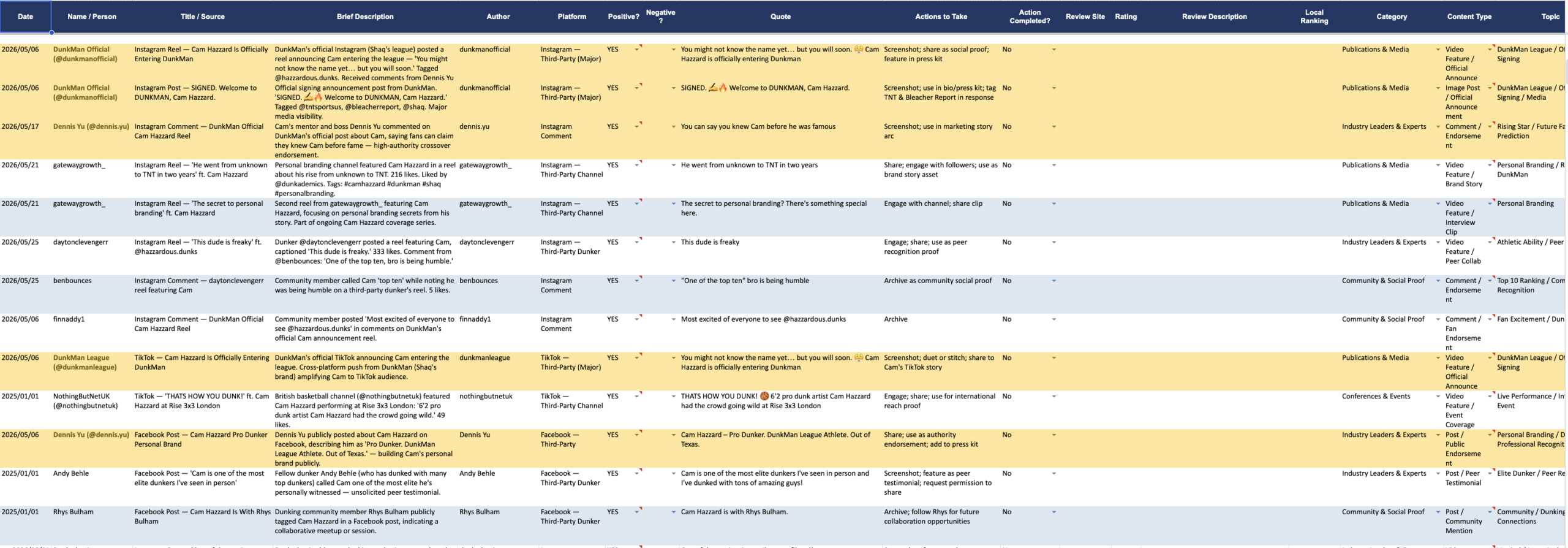
Two reasons the tracker comes first. First, it is the inventory, and assembling it is often the most striking part. As Dennis puts it, for some of his friends he has done this, and the reaction is, wow, that is really impressive, I forgot that five years ago this thing happened. People are too busy doing the work to remember who praised it. The tracker remembers for them.
Second, the full quote always lives in the tracker even when a trimmed version goes on the website. Nothing is lost.
The Page: Quote Trimming and Real Faces
When a mention moves from tracker to website, three rules apply.
Trim the quote to what matters. Strip any platform-specific opener that will not make sense to a stranger. Dope episode, Cam is the future becomes Cam is the future. Keep the part that speaks to skill, character, or results.
Use real faces and logos. A wall of grey initials reads as generic. Pull the person’s actual photo from their Instagram, YouTube, LinkedIn, or company site, host it on your own site, and fall back to a clean initials avatar only when no verified photo exists. Add a small platform icon so visitors instantly know the source.
Link to the original, externally. If every view source link points back to your own website, the proof is circular and a skeptic notices. Whenever the original exists publicly, the actual podcast episode, the LinkedIn post, the news article, link there. An external link to where someone actually said it is worth far more than a screenshot hosted on your own domain.
The Real Example: Rebuilding Dennis Yu’s Mentions Page
Here is the before-and-after, using Dennis’s own site.
Before. The predecessor to the current mentions page was a single scrolling column of embedded testimonial videos and screenshotted Facebook praise. All of it genuine and valuable, but presented as one undifferentiated stream. A home-services contractor and a university dean landed on the same wall of marketing-flavored content, and most visitors would not read past the first screen.
The insight from GCT. Dennis serves three distinct audiences, so the page should let each one self-select. That became the central design move.
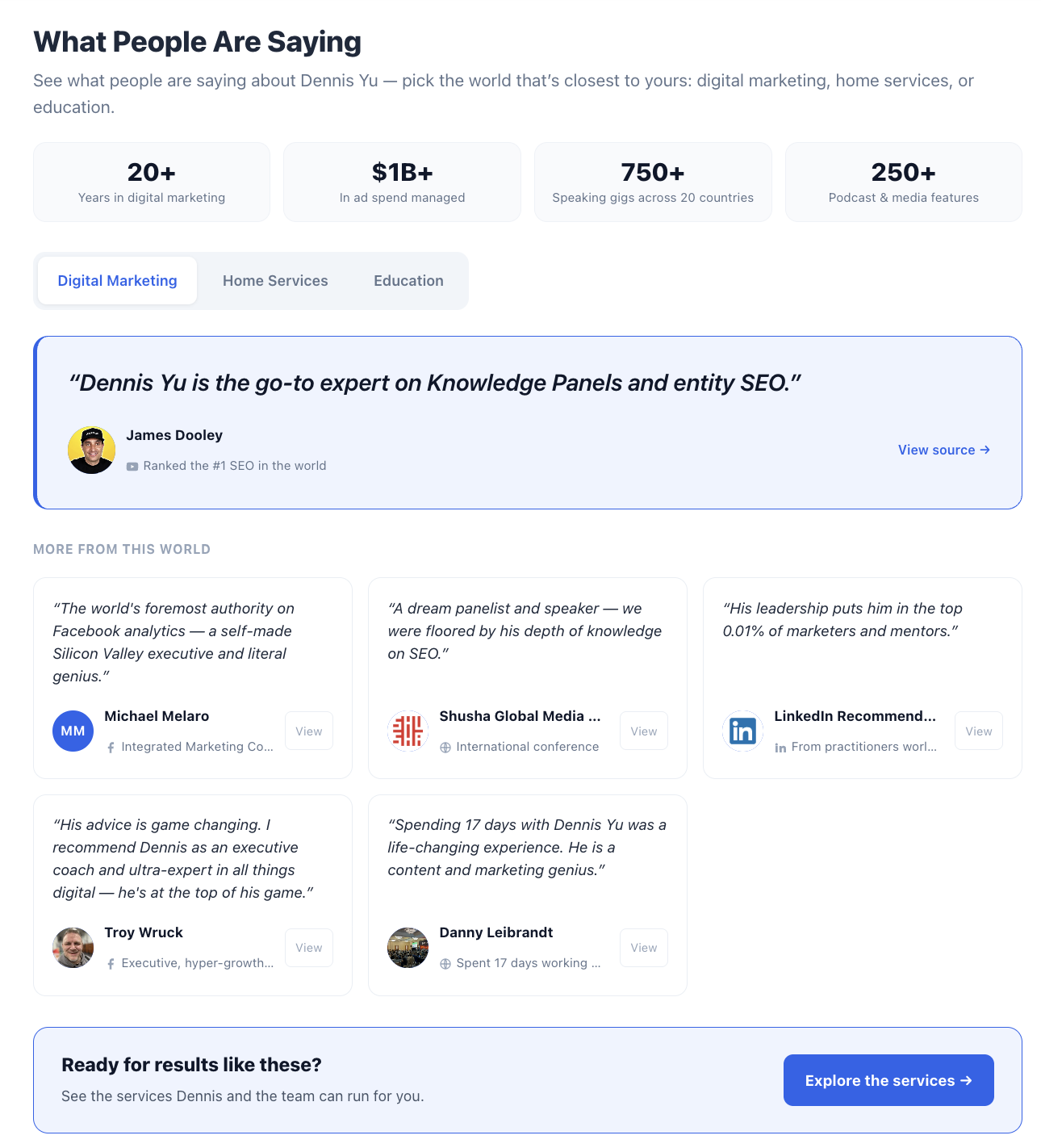
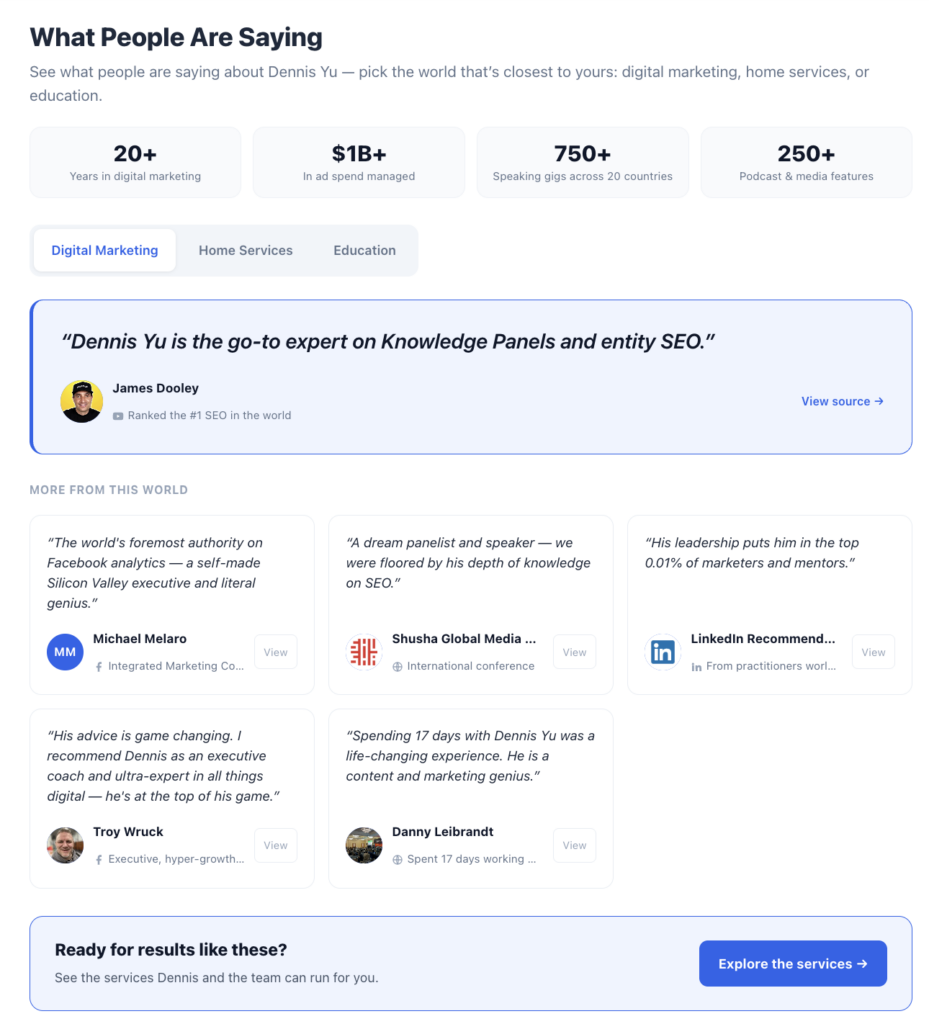
After. A What People Are Saying page with three navigable tabs, Digital Marketing, Home Services, and Education, each with its own feature quote and supporting cards.
Digital Marketing leads with James Dooley, ranked the number one SEO in the world, calling Dennis the go-to expert on Knowledge Panels and entity SEO, backed by HubSpot, the Shusha Global Media Forum (a dream panelist, we were floored by his depth of knowledge), a top 0.01 percent of marketers LinkedIn recommendation, Troy Wruck (his advice is game changing), and Danny Leibrandt (spending 17 days with Dennis Yu was a life-changing experience, a content and marketing genius).
Home Services leads with Salvatore Sciorta of Plumbing Pros, who grew his business 75 percent (Dennis gave us the roadmap we needed, we went from one van to three), alongside Dan Leibrandt naming him the authority on local marketing for service businesses, and Plumbing Pros’ 250-plus Google reviews.
Education leads with the Content Factory’s free university curriculum, plus Johns Hopkins, where Dennis teaches Applied Digital Marketing, the AI Builder student testimonials, Tony Taylor, and a student voice.
Above the tabs, a stat bar makes the scope legible at a glance: 20-plus years in digital marketing, 1 billion dollars-plus in ad spend managed, 750-plus speaking gigs across 20 countries, 250-plus podcast and media features. Below everything, a single call to action sends interested visitors to the services that match what they just read.
Two craft details carried over from the framework: every feature person got a real photo or logo, sourced and hosted on-site, and every self-link we could replace was swapped for the true external source.
More Real Builds
The same system runs for anyone. Here are pages it produced for very different people, with the full build logs of how each came together.
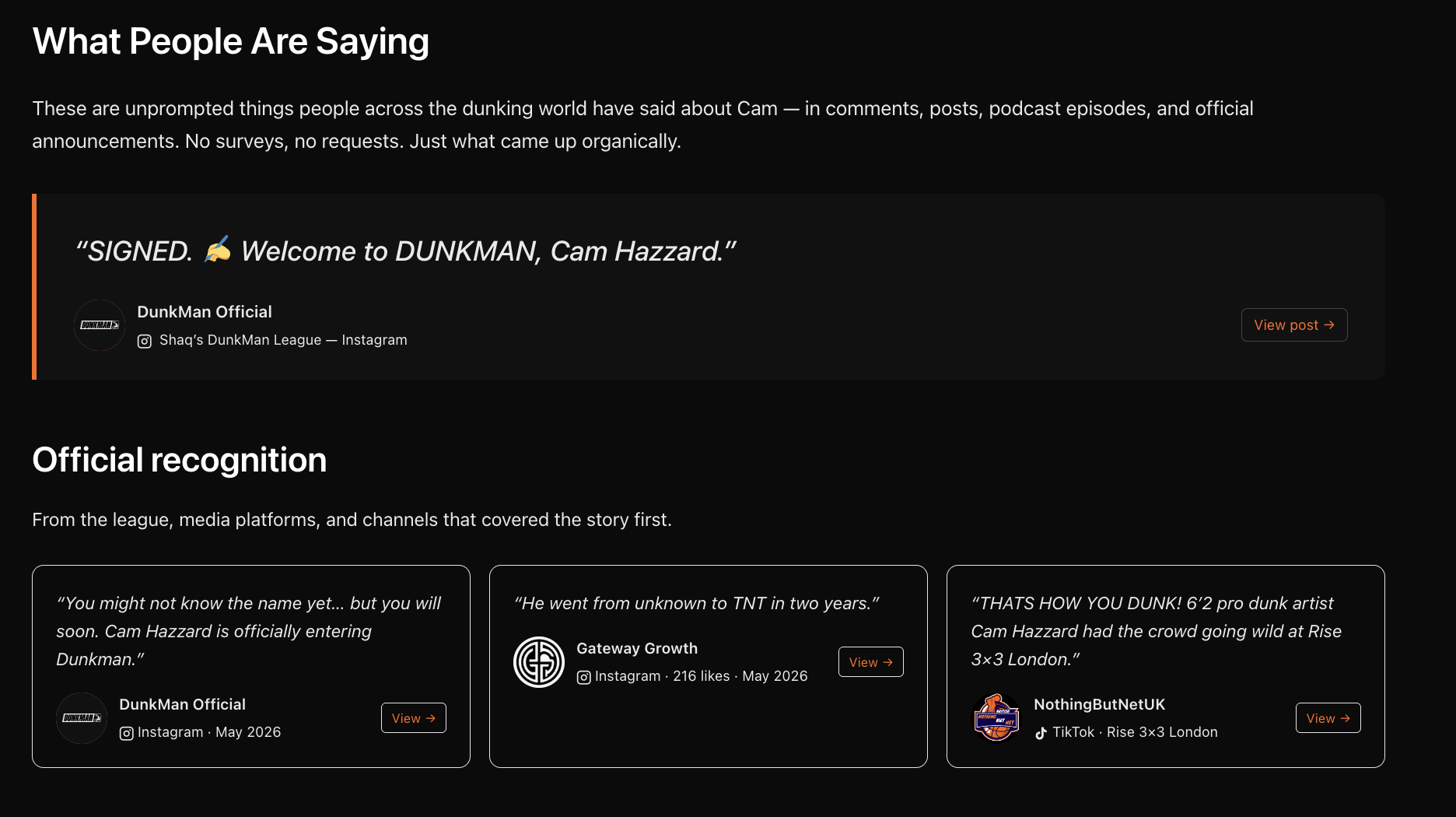
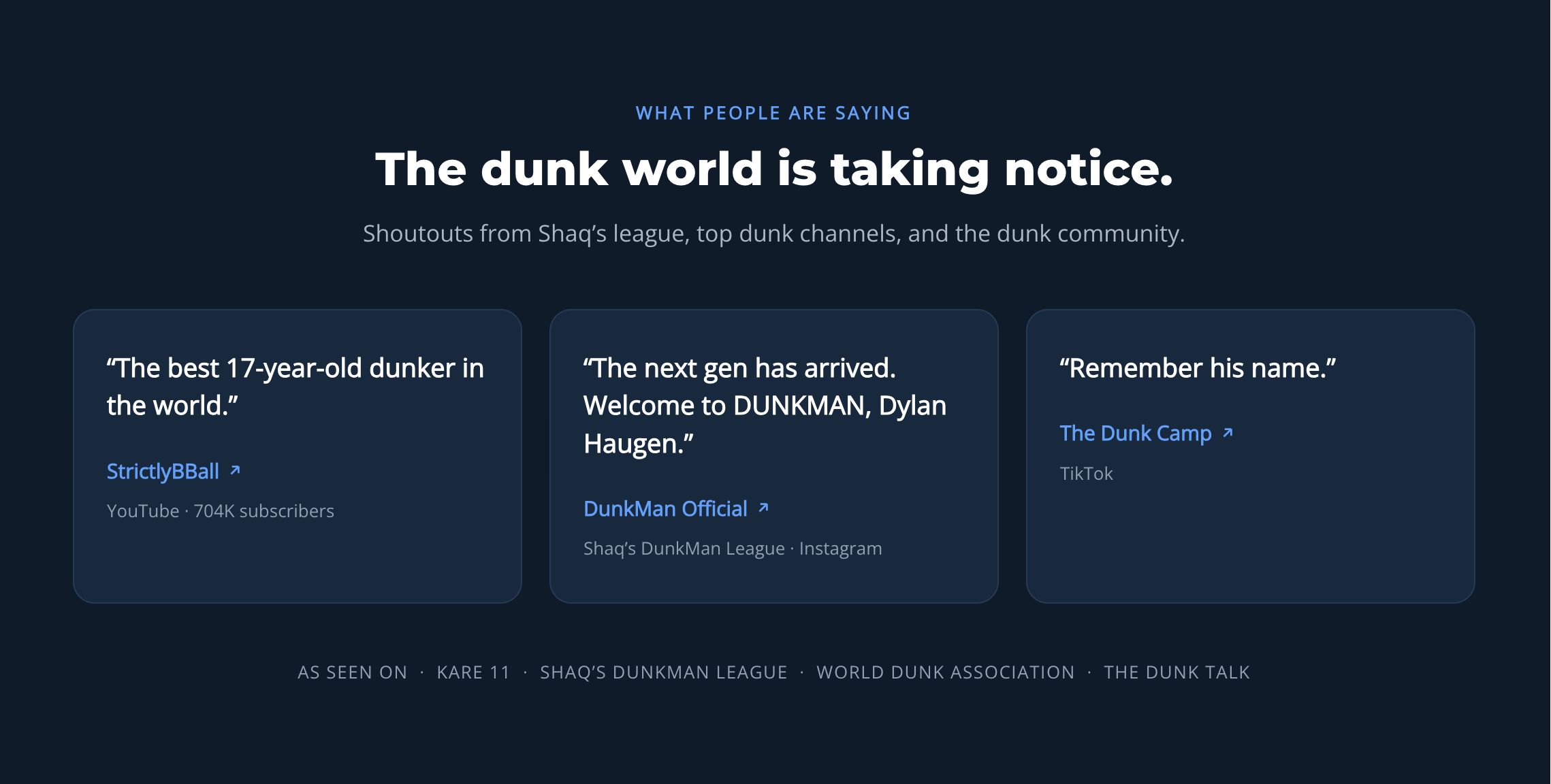
Full build logs: how we pulled Nate Carver’s positive mentions (a mortgage lender, 38 scored mentions mined from 71 transcripts, including Carl White and a Marquis Who’s Who honor) and how we built Cam Hazzard’s personal brand site.
More recent builds, each documented end to end: how we built Jonathan Mast’s positive mentions tracker (137 mentions merged from three sweeps), how we built Justin Sonnenreich’s tracker (10 mentions, 8 ad-ready), and how we swept George Paladichuk’s mentions (11 net-new, scored and shipped as a weekly client digest).
What This Looks Like for a Small Business
The logic is identical regardless of industry. Only the sources change.
A homeowner writes a detailed Google review: I had three other companies try to fix this, they sent the technician out and he solved it in 45 minutes, six-year customers, never let us down. That is a solid Tier 2, and if the technician is named, it becomes a personal endorsement and jumps toward Tier 1.
A Yelp Elite reviewer calls you the best in the city. A Nextdoor thread asking for a recommendation gets twelve neighbors naming you. A Best of Houzz or Traveler’s Choice award is institutional recognition. All of it sweeps, scores, and publishes the same way the digital-marketing mentions do.
Run It on a Schedule
The best version of this system is not a one-time project. It runs in the background. Set it to sweep weekly: it finds new mentions since the last run, scores them, adds Tier 1 and Tier 2 to the tracker, and surfaces what is worth adding to the page. You pick the mode, auto where it just does it, or approval where it asks first. The point, in Dennis’s words, is that the agent should come to you rather than you remembering to go looking. You can turn this on right inside the intake form.
Where This Is Going: Your Week in Praise
The system is built to improve itself. Every run documents what it found and feeds the next one, so the agent gets sharper each time, the same recursive self-improvement loop Dennis breaks down in Marketing Mechanic Episode 39. The next step is delivery: instead of you checking, the agent comes to you.
Picture a weekly email. Every new positive mention from the past seven days, scored and sorted, with the strongest ones flagged AD-READY. One click puts a quote on your site. One click turns it into a Dollar-a-Day ad under your own name. You stop going looking for proof, it shows up already sorted.

How to Run the Positive Mentions System Yourself
- Install the skill file, linked below.
- Start it. The intake form opens automatically.
- Fill in your GCT, handles, any specific videos, and your settings. Only your name is required.
- Make sure you are logged into the accounts you want swept.
- Click Launch and review the tracker it builds and the page it drafts.
- Turn on the weekly sweep so it keeps collecting without being asked.
It works on any WordPress site, builds the tracker as a spreadsheet, and everything it produces is editable. You can run it with the same dollar-a-day discipline we teach everywhere else: small, consistent, repeatable.
Two Ways to Run This: Free DIY or Done-For-You
Every BlitzMetrics how-to comes with two paths, so you can pick the one that fits your time and budget.
Do it yourself, free. Download the skill below and run it on your own site. You get the same intake form, the same WHO, WHERE, WHAT scoring, and the same tracker and page templates the team uses. Everything it produces is yours and fully editable.
Done for you. If you would rather have it handled, the BlitzMetrics team will deploy the Positive Mentions System for you: run the sweep, build and score your tracker, and publish your What People Are Saying page. See the done-for-you option.
Download the Skill
The Positive Mentions System skill is free. It includes the main instructions, the guided intake form, and reference files covering the scoring rubric, the full platform-by-platform search method including the YouTube-transcript and real-photo techniques, and the website templates.
Download the positive-mentions skill. To install in Cowork, open the file and hit Save skill. It appears in your skill list immediately, and the intake form greets you the first time you run it.
This is a supporting BlitzMetrics implementation guide, built to be copied, and part of the BlitzMetrics Task Library. The Positive Mentions System and its agent were created by Cam Hazzard, developed with Dennis Yu, and refined on a real personal brand before being generalized for any person or business. The same WHO, WHERE, WHAT scoring, GCT inputs, platform sweep, and page structure apply whether you are a pro athlete, a plumber, a professor, or a marketing agency. Only the sources change.
Originally published .