
 by
by
Would you like to rank number one on your name and show a Google Knowledge Panel? How frustrating is it when people Google you and they can’t find you? If you’re an entrepreneur, a local service business owner, or an author, you need to be able to rank on your name, even if other people share it.
I’m Dennis Yu, a former search engine engineer. I ran the internal analytics at Yahoo and I’ve spent a billion dollars on Google and Facebook ads. In this guide, I’m going to show you exactly what you need, where the common mistakes are, and how to fix them. By the end, you’ll have a clear path to diagnose what’s causing you to rank or not rank on your name in Google, as well as when people ask ChatGPT who the best person is for whatever you do.
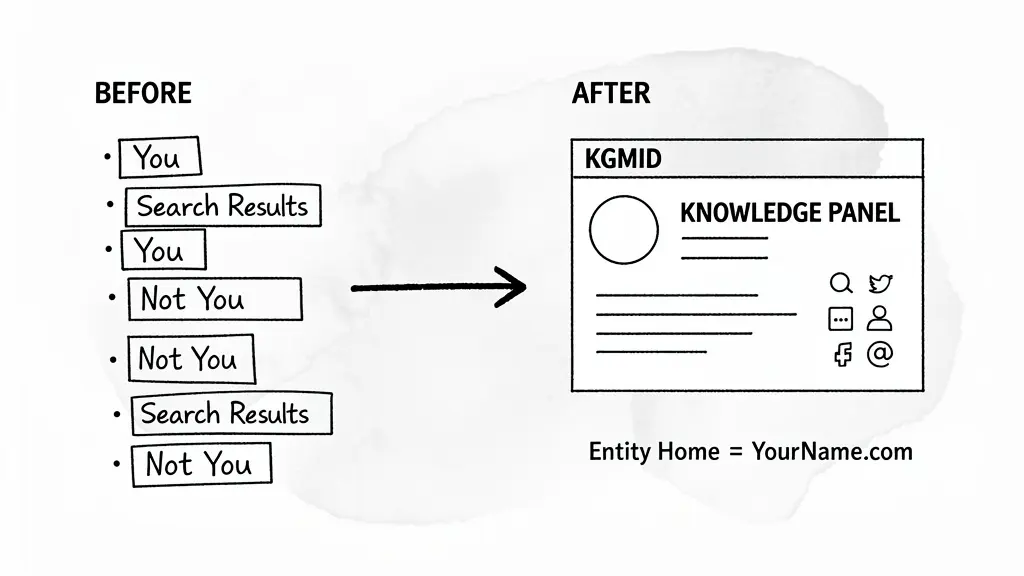
This is based on Episode 5 of The Marketing Mechanic, which builds on the concepts from our earlier episodes on entities, the geo-vertical grid, content strategy, and MAA (Metrics, Analysis, Action).
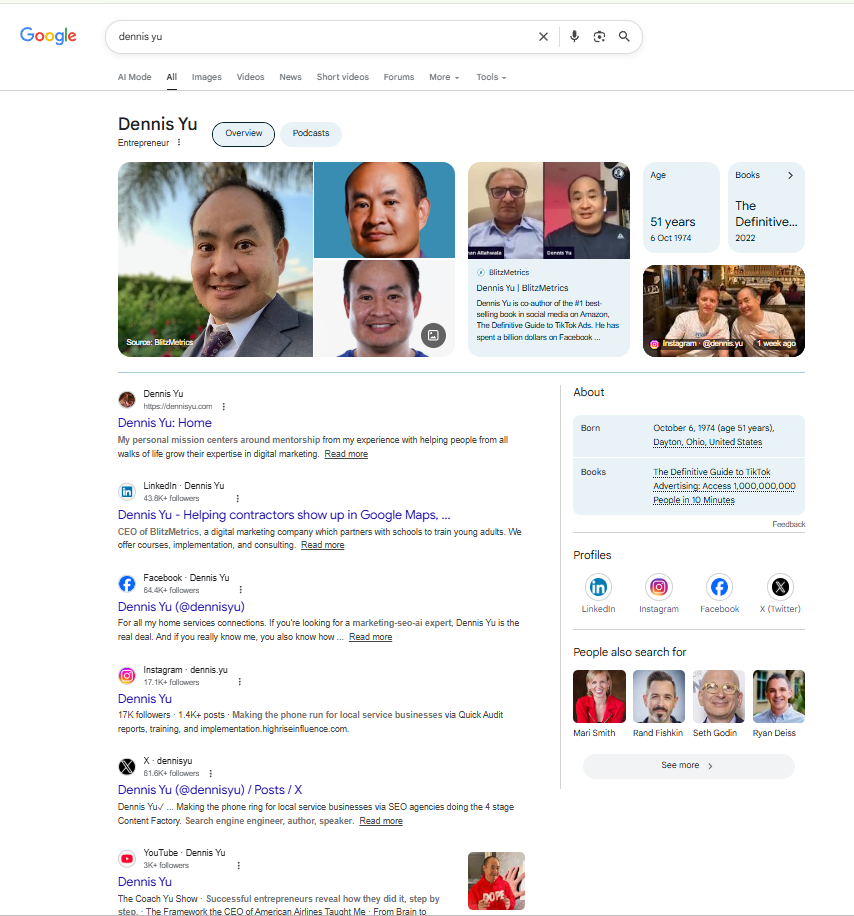
What happens when someone Googles your name right now
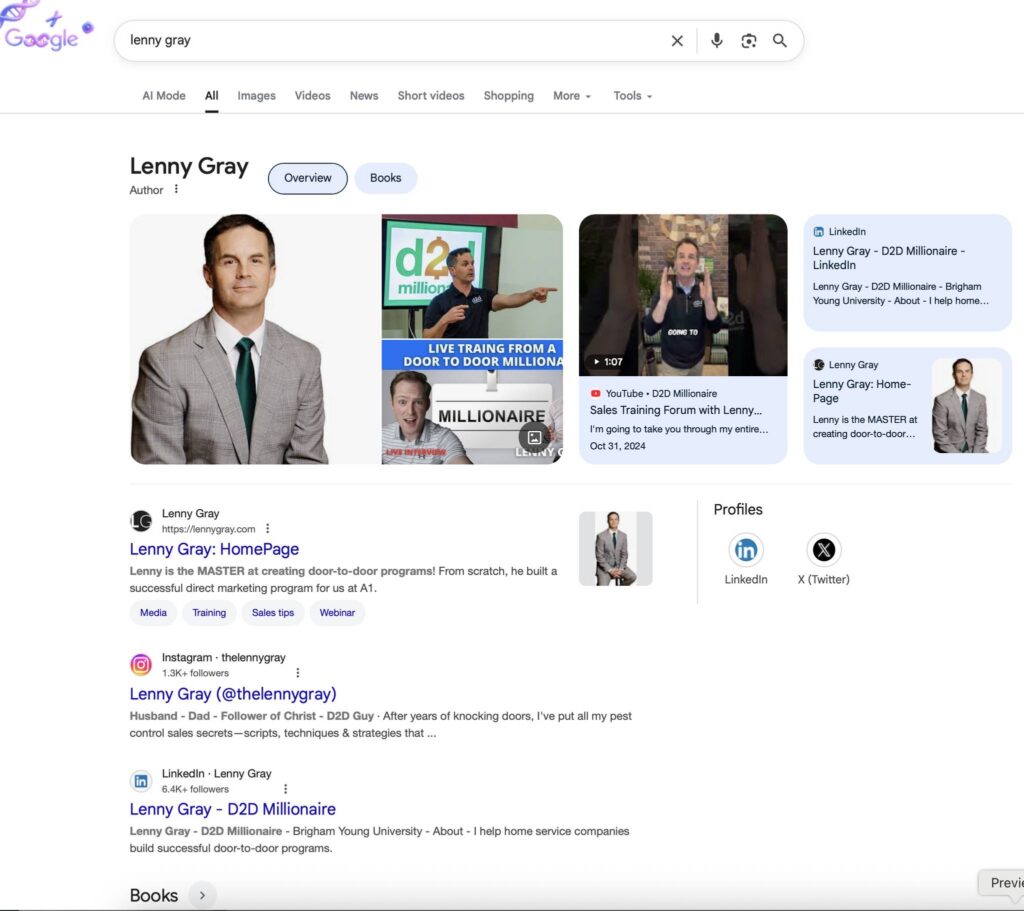
For most people, the search results look something like this. At the very top, LinkedIn takes the number one spot because LinkedIn was built to rank on everyone’s name. Below that, maybe your Instagram, Facebook, Twitter, or YouTube shows up. Then maybe your company’s website, specifically the about page.
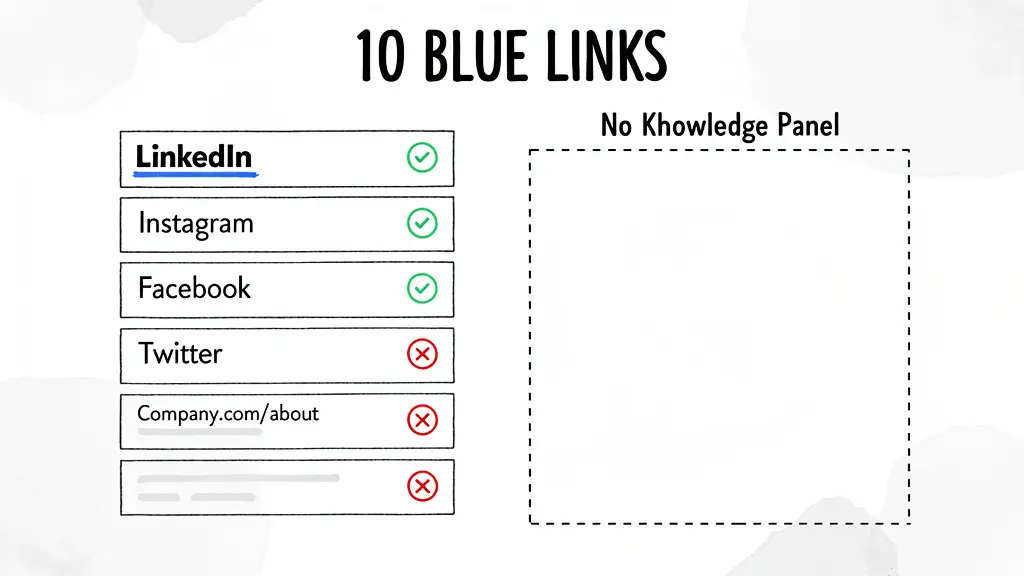
All of those are rented property. You don’t own them. You can be on social media and get a ton of views, but you need owned properties that are yours.
Mixed in with your results, you’ll probably see other people who share your name. Athletes, historical figures, professionals in other fields. Sometimes there are dozens. Google returns up to 32 entity matches for any name, and if it shows 32, there are probably more than that.
This is the 10 blue links problem. Some are you, some aren’t, and there’s no clear signal to Google about which one is the real you.
What a knowledge panel is and why it matters
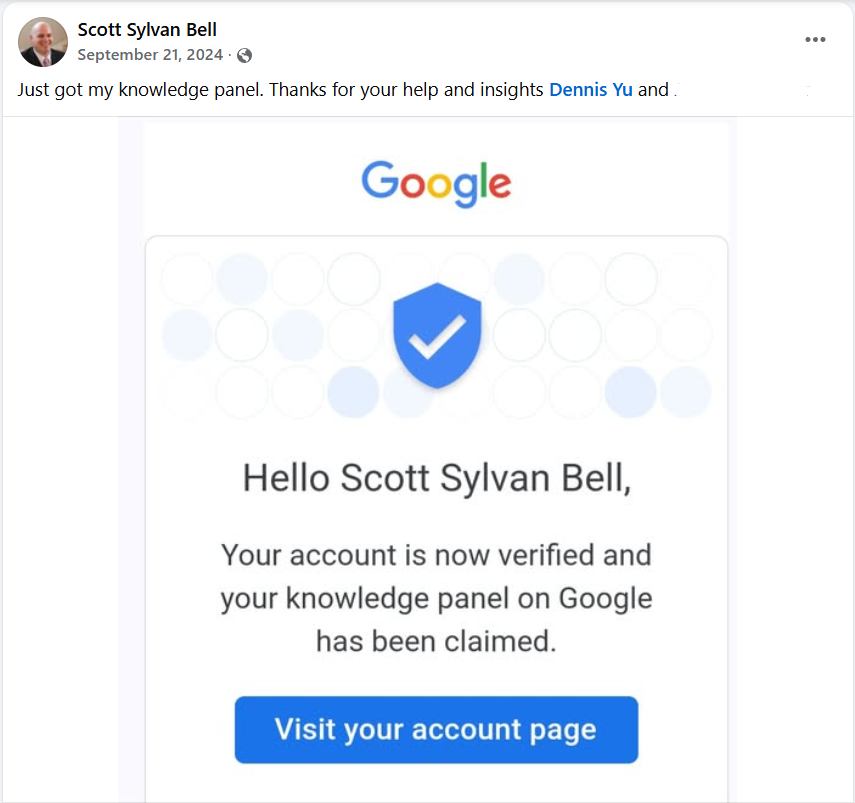
A knowledge panel is the box that shows up on the right side of Google search results. It contains your photo, biographical facts, your social channels, and a link to your entity home, the one URL that Google considers the most authoritative source about who you are.
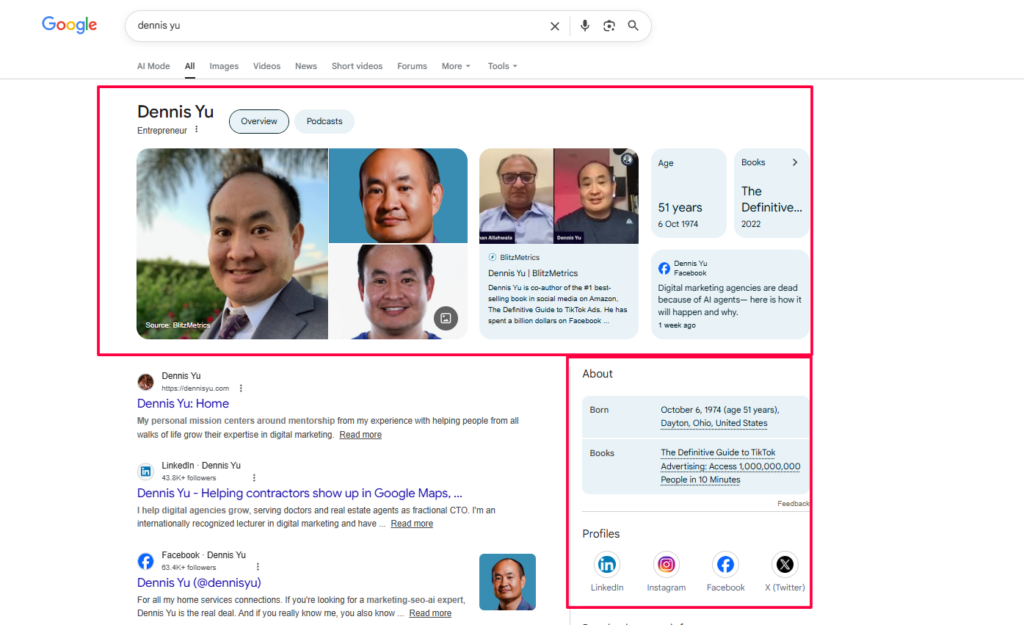
When you have a knowledge panel, everything associated with your name gets organized under a single entity ID called a KGMID. All the other search results about you, people also ask questions, related searches, associated people, all of it gets tied to that one identity.
This is fundamentally different from just having a bunch of links scattered across the first page. A knowledge panel tells Google and users that you are a verified, disambiguated entity.
You don’t have to be famous to get one. We’ve helped hundreds of people get knowledge panels. But there are structural components that have to be in place.
The biggest mistake: putting your bio on your company’s about page
This is where most people go wrong. They put all their personal biographical information on company.com/about. That creates confusion in the knowledge graph because you and your company are different entities. They have different IDs.
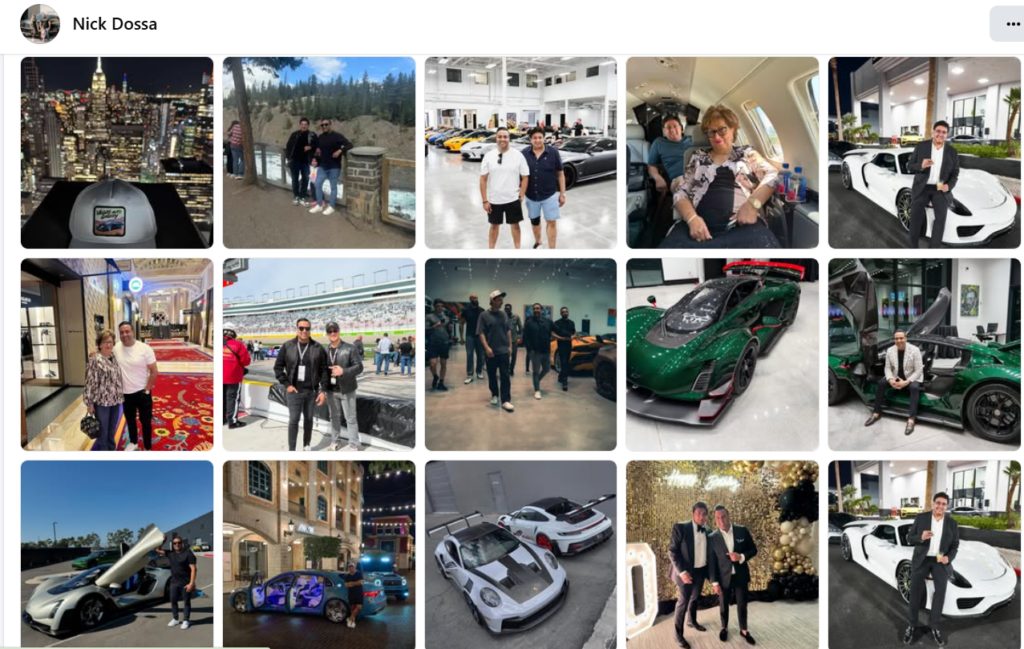
For example, Nick Dossa of Vegas Auto Gallery doesn’t have a personal brand site. When you look at the about page on the company site, it reads like an advertisement, not factual information. There’s only a paragraph about him, and it’s written like a sales page. That’s not what Google needs.
Your company’s about page should be about the company: why it was started, what it believes in, how it’s different. It can mention you as the founder, but the page should not be a personal bio.
If Google sees your personal facts living on a company URL, it can’t cleanly separate you from the business. That confusion prevents you from getting a knowledge panel.
You need a personal brand website
The foundation of ranking on your name is a personal brand website. This is the entity home, the one URL that Google considers the most authoritative source about who you are.
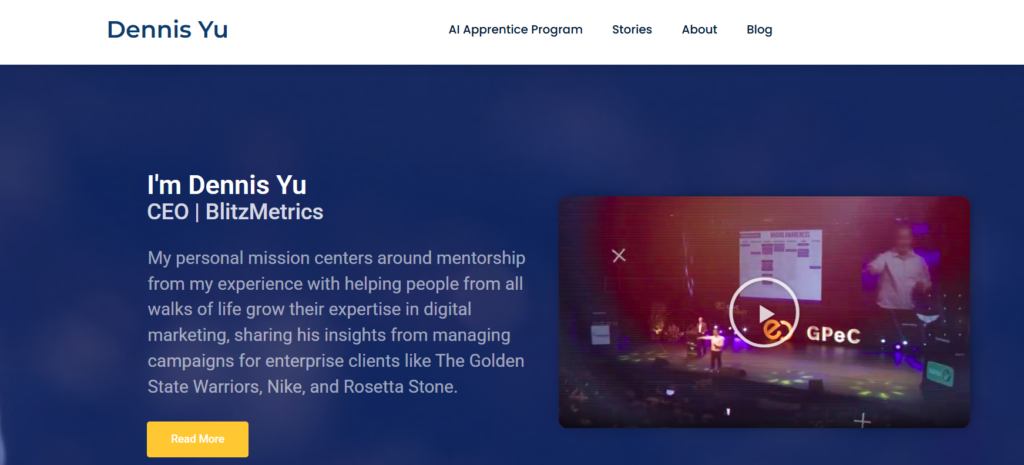
We recommend WordPress because it’s fast, flexible, and already designed to support the schema and linking structures that help trigger knowledge panels.
The homepage: factual, biographical information
The homepage of your personal brand site should contain the most authoritative set of facts about you. Not a sales page. Not a pretty carousel with a “hire me” button. Facts.
Where you were born. What you do. Companies you’ve founded. Milestones in your career. Where you’ve spoken. Podcasts you’ve been on. News coverage. Books you’ve written. All of it factual, provable, and linked to the sources that verify it.
Most people’s personal brand sites read like advertisements. “So-and-so is an incredible entrepreneur who…” That’s an opinion. Google doesn’t care about opinions. Google cares about facts that can be verified across multiple sources.
And stop paying for Forbes Council placements and press releases thinking they’ll help. Google can see that those don’t tie back to real factual information. They don’t count.

The about page: your stories
The about page is different from the homepage. The homepage has the facts. The about page tells the stories behind those facts, your mission, your values, why you do what you do. It goes into the detail of the experiences that shaped you.
For example, the about page is where you’d tell the story of how Matthew Januszek invited you on the Escape Your Limits podcast, or how you met Bradley Lee and ended up creating content together. Those stories provide context for the factual claims on the homepage.
The about page should link to and from the homepage. It connects to your blog posts, which connect to your topic wheel, which is the content strategy we covered in earlier episodes.
How the confidence score works
Every entity in Google’s knowledge graph has a confidence score. When you do the right things, your confidence score goes up relative to everyone else who shares your name.
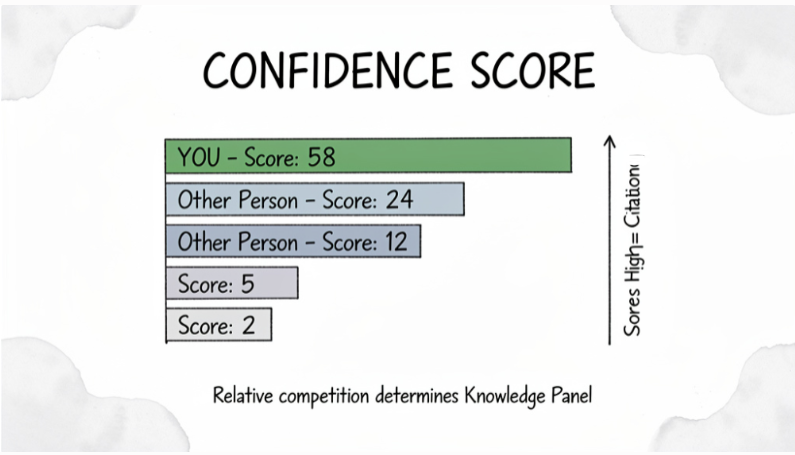

There’s no magic number. I’ve seen full knowledge panels trigger at a confidence score of 50, and I’ve seen people at 400 plus without one.
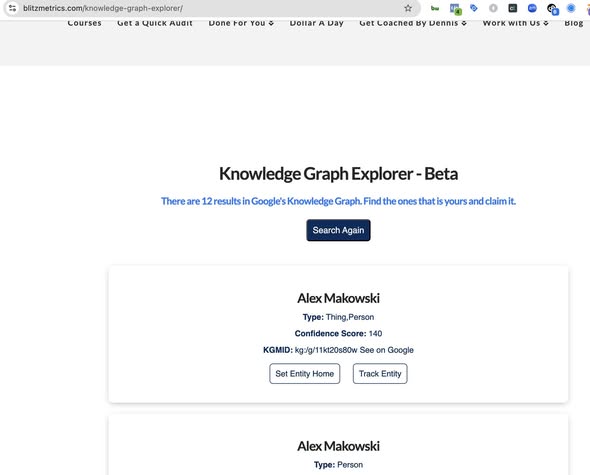

What matters is your score relative to the other people with the same name, and the query volume behind your name.
More citations pointing to your entity home means more confidence. More consistent information across your properties means more confidence. More people searching for your name means more confidence.
How to increase your query volume
The more content about you that exists and gets seen, the more people search your name. Every podcast appearance, every speaking engagement, every article, every video that gets repurposed and shared increases the number of people typing your name into Google.
Nick Dosa, for example, had a viral moment with Sylvester Stallone doing a car giveaway and appeared with Jimmy Kimmel. You don’t need celebrities, but those kinds of moments generate branded searches.
You can also run dollar-a-day ads on your best content. Take a YouTube video from a few years ago where you’re doing something relevant to your expertise and boost it. We did this with Andrii of ARDMOR Windows & Doors, showing him replacing windows at a customer’s house. More views lead to more branded searches, which shifts your share of queries.
This is how paid ads can actually improve your SEO. Not through direct ranking manipulation, but by increasing the volume of people searching for your name, which strengthens your entity signal.
Claim your rented properties and point them home
Most people don’t realize this, but you can point all your social profiles back to your personal brand site. Your LinkedIn, Facebook, Instagram, Twitter, YouTube, all of them have a field where you can add your website URL.
Stop sending people to Linktree. Why would you push all your authority to Linktree? Every one of your social profiles should point back to your personal brand site as the main URL. This tells Google that all of these properties belong to the same person, and they all reinforce that your personal brand site is the entity home.
When you eventually claim your knowledge panel, Google will check whether the URL you’re claiming matches what all your other properties point to. If everything is consistent and points to the same place, you’re far more likely to get approved.
The claim process
Once you have a knowledge panel, even a partial one, you can claim it. This is a formal process where you tell Google that you are the entity represented by the panel.
You have to answer why you want this, and there’s a specific way to do it. You show all the facts, the screenshots, the proof. You don’t just say “I want this knowledge panel.” That gets you rejected.
If all your rented properties already point to your personal brand site, and the bios are consistent across all platforms, you’re in a much stronger position to get approved.
Keep your information consistent and updated
Google literally checks your information across sources and compares them. If your website says you have 70,000 customers, a podcast says 80,000, and your company page says 85,000, that’s a problem. If your LinkedIn still shows a job title from five years ago, that creates confusion.
Go through all your properties and make sure the facts are consistent. Update old content when numbers change. Make sure your current role, company, and biographical details match everywhere.
How personal brand connects to company brand
When you as the founder build a strong personal brand with a high confidence score, that authority passes to your company. Your company’s team page can link to each team member’s personal brand site. The more team members who have strong personal brands, the more trust flows to the company.
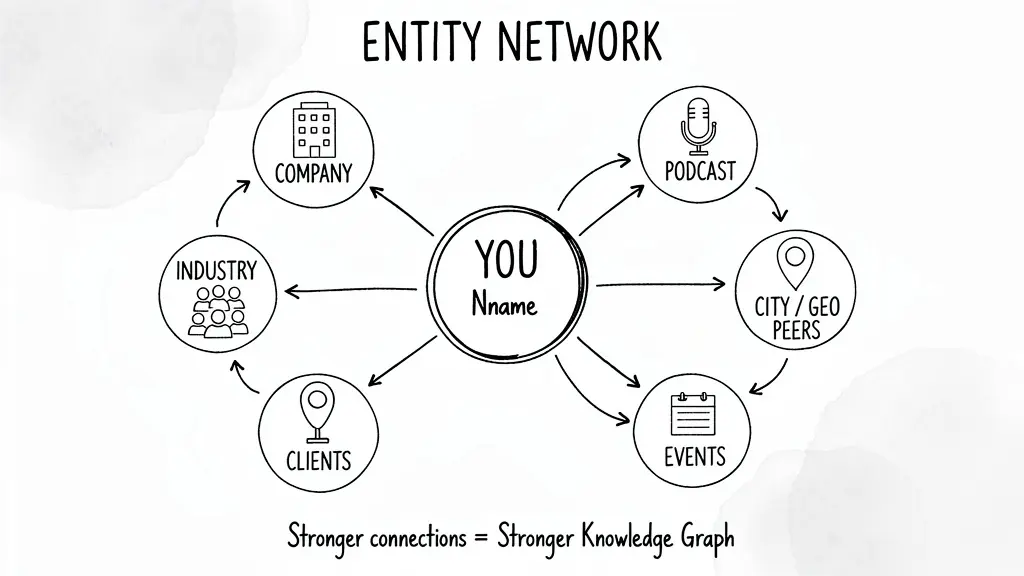
This also works across your network. When you create content with other people in your industry or your city, when you’re associated with respected figures in your field, those connections strengthen everyone’s knowledge graph presence.
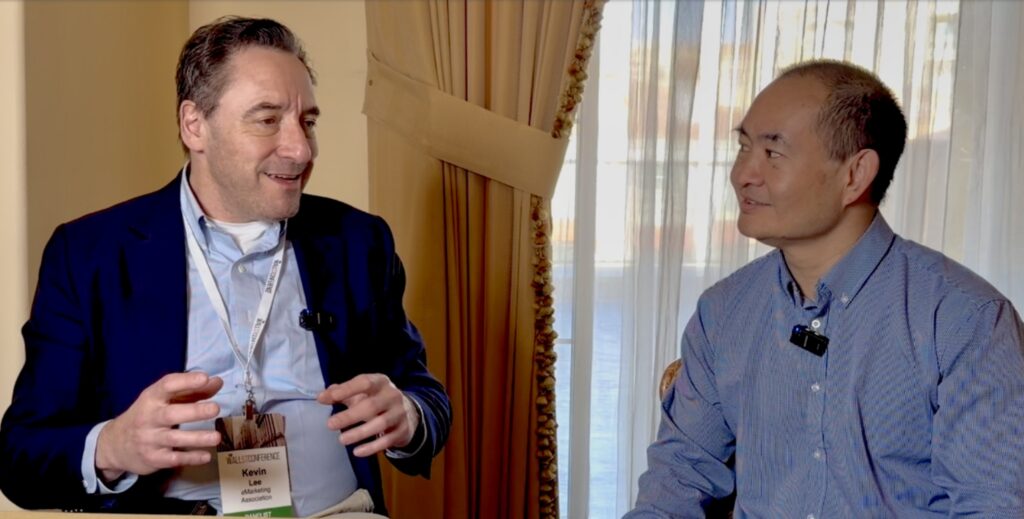

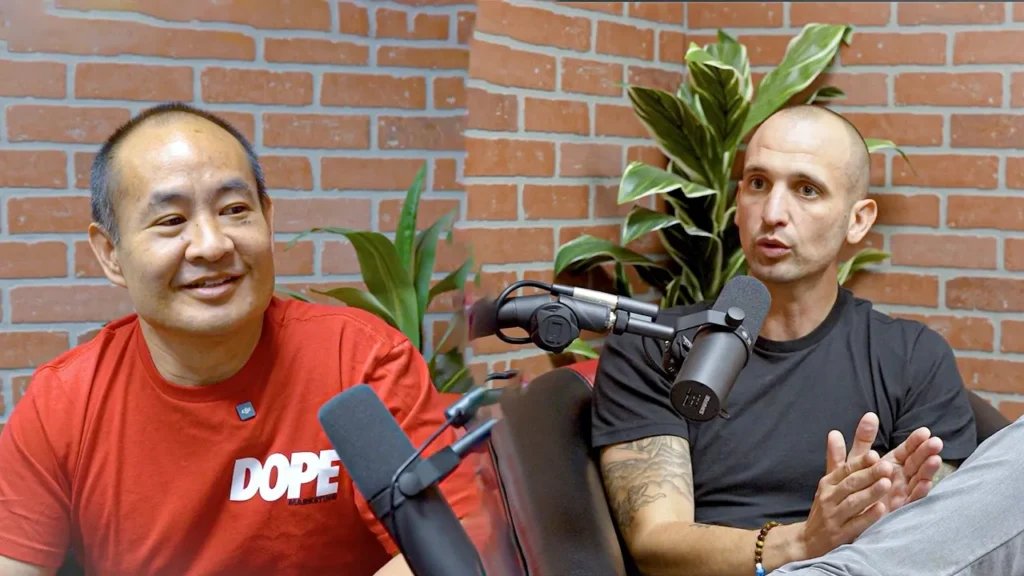
Look at what happens when people search Mari Smith, Ryan D. Lee, Ross Franklin, or Neil Patel. They all show up as “people also searched for” on each other’s knowledge panels. That’s because we’re all connected in the knowledge graph through shared content, shared events, and consistent cross-referencing.
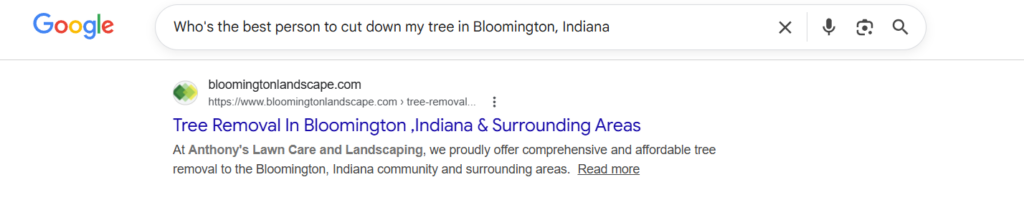
The same principle works at a local level. Anthony Hilb of Anthony’s Lawn Care and Landscaping in Bloomington, Indiana helps other landscapers and connects with people like Perry Marshall, Frank Kern, and John McGee. Every time he elevates someone he respects, it naturally lifts them up, but it helps his ranking too. When people type “who’s the best person to cut down my tree in Bloomington, Indiana,” it should be Anthony.
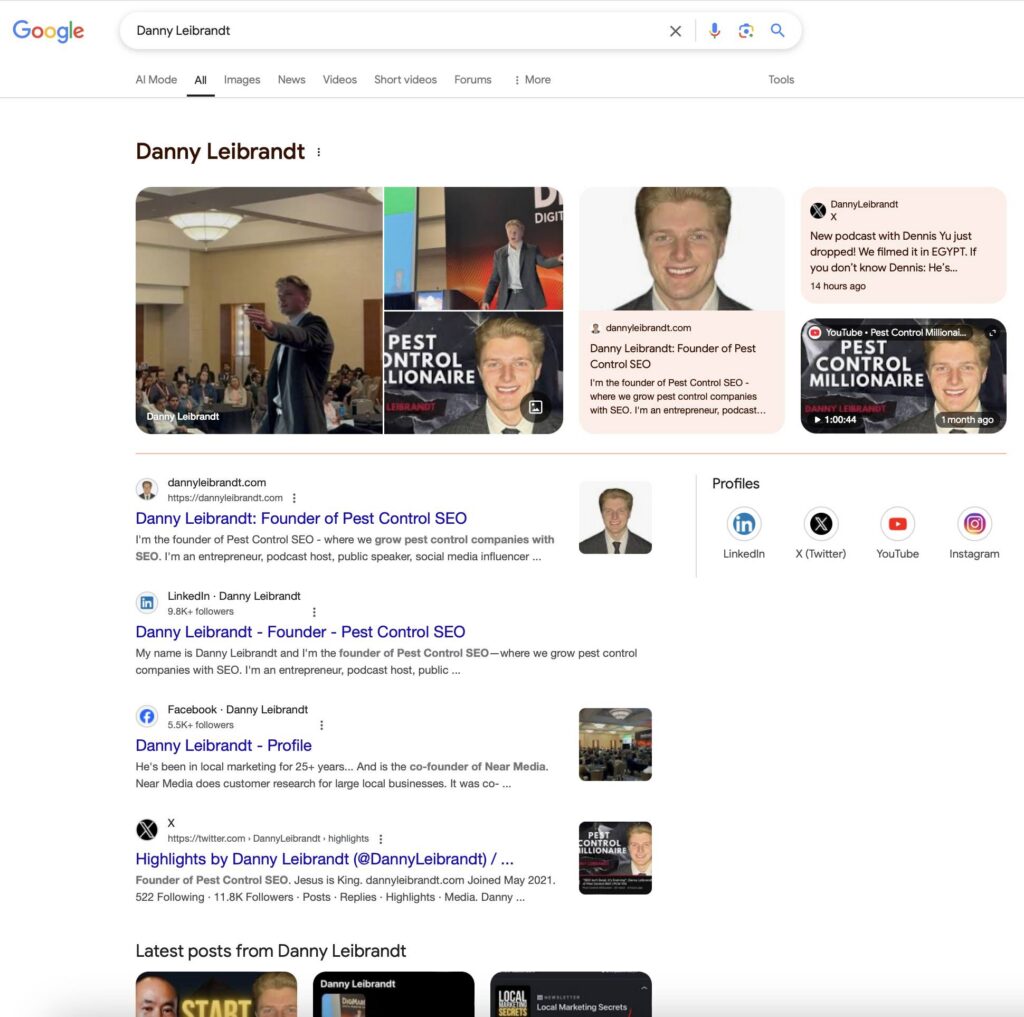
Dan Leibrandt is another great example. He hosts the Local Secrets SEO podcast and works in pest control marketing. When people search his name and see his knowledge panel, it shows he’s associated with others in the digital marketing and home services space. Those connections reinforce everyone’s authority.
For people in the home services space, connecting with folks like Tommy Mello of A1 Garage Door Service and the Home Service Freedom community creates these network effects. Maybe you met Tommy at an event and made a one-minute video together. That content gets repurposed to multiple channels, and now you’ve demonstrated a real connection in the knowledge graph.
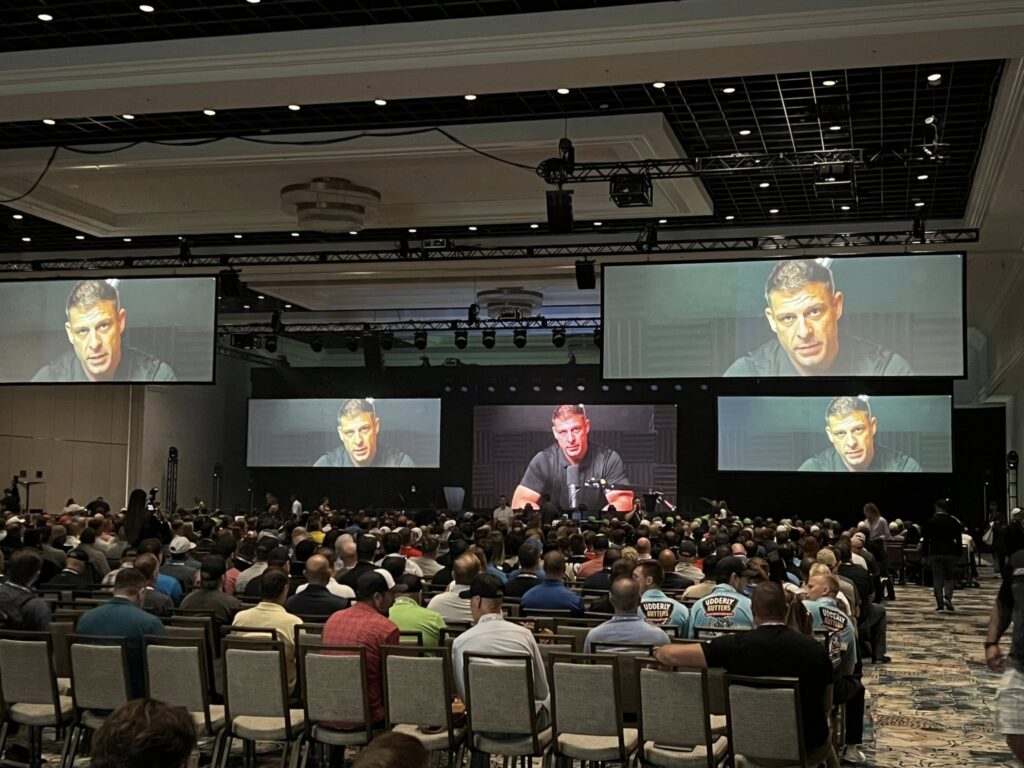
Sal Sciorta of Plumbing Pros in Easton, Pennsylvania is another example we work with. The more he shows up connected to other people in his trade and his community, the stronger his personal brand signal becomes.
What you can do right now
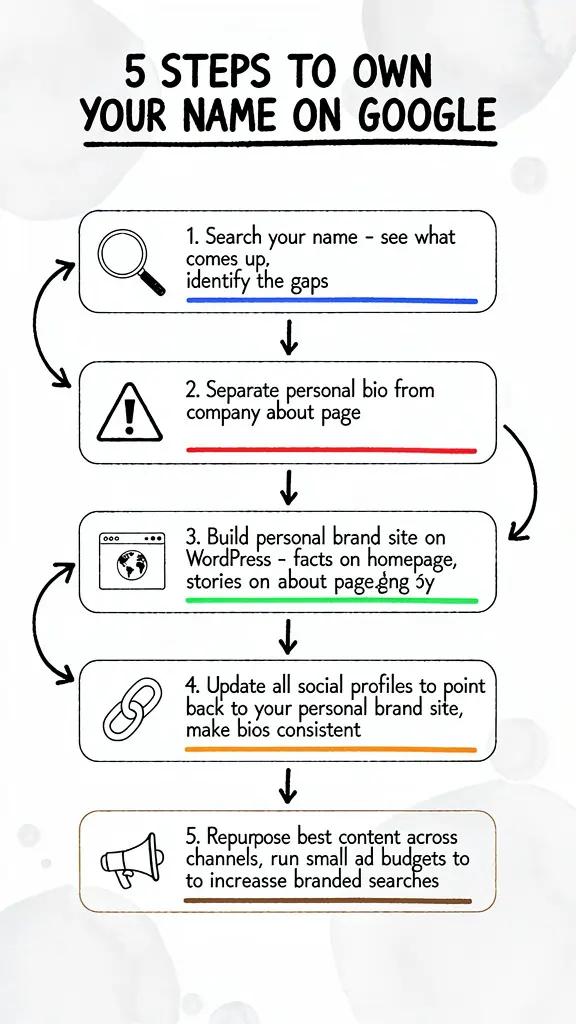
First, search your name in Google and see what comes up. Are the results mostly you? Is there a knowledge panel? Or is it a mix of other people and rented properties?
Second, check whether your personal information lives on your company’s about page instead of its own site. If so, that’s the first thing to fix.
Third, build a personal brand site on WordPress. Put factual biographical information on the homepage. Tell your stories on the about page. Link to everything that proves who you are.
Fourth, update all your social profiles to point back to your personal brand site. Make the bios consistent.
Fifth, start repurposing your best content across channels and consider running small ad budgets to increase your branded search volume.
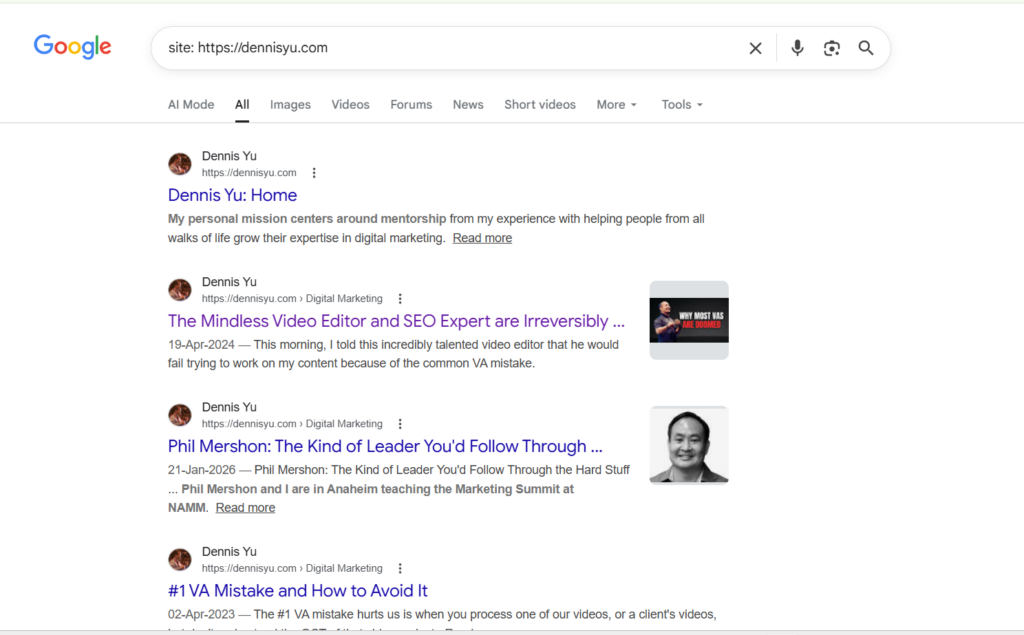
Your personal brand is arguably the one thing that AI can’t copy. AI can build websites, generate videos, and write content. But the way you stay ahead is through your relationships, your reputation, and the trust in your name. And it starts with structuring that trust so Google can see it.
Related: Owning your name on Google is only half the game now — buyers also ask ChatGPT, Perplexity, and Gemini. See How to Track If AI Cites You for the AI-answer side of the same playbook.
Originally published .
Dennis Yu
Dennis Yu is the CEO of Local Service Spotlight, a platform that amplifies the reputations of contractors and local service businesses using the Content Factory process. He is a former search engine engineer who has spent a billion dollars on Google and Facebook ads for Nike, Quiznos, Ashley Furniture, Red Bull, State Farm, and other brands.
Dennis has achieved 25% of his goal of creating a million digital marketing jobs by partnering with universities, professional organizations, and agencies. Through Local Service Spotlight, he teaches the Dollar a Day strategy and Content Factory training to help local service businesses enhance their existing local reputation and make the phone ring.
Dennis coaches young adult agency owners serving plumbers, AC technicians, landscapers, roofers, electricians, and believes there should be a standard in measuring local marketing efforts, much like doctors and plumbers must be certified. He has appeared on 353 podcasts with 619 credited episodes — see the full list of his podcast appearances.