 by /
by /
Google changed our client’s business hours without telling anyone. I’m not exaggerating.
Litsey Heating and Air in Louisville does 24/7 emergency HVAC work. They’re the kind of company that answers the phone at 2 AM when your furnace dies in January. One week, the weekend calls just stopped. Dead silent. When my team dug into it, we found Google had quietly changed their Google Business Profile hours to show them as closed on Saturdays and Sundays.
Nobody at Litsey made that change. Nobody on our team made it either. Google’s algorithm just decided their hours looked wrong and “fixed” them.
We caught it the same day because we had Local Falcon‘s monitoring running on their profile. Without it, that could have gone weeks before anyone noticed — and for a company that depends on weekend emergency calls, that’s real money walking out the door.
This is the kind of thing that happens more than people realize, and it’s why I want to walk you through exactly how we use this tool at BlitzMetrics.
What Local Falcon Actually Does
Most rank tracking tools give you a single number — “You’re #3 for ‘plumber near me.'” Sounds useful, right?
It’s not. Not for local.
Here’s why: if someone searches from two miles north of your shop, they get completely different results than someone searching two miles south. Local rankings shift block by block. A single number from a single location tells you almost nothing.
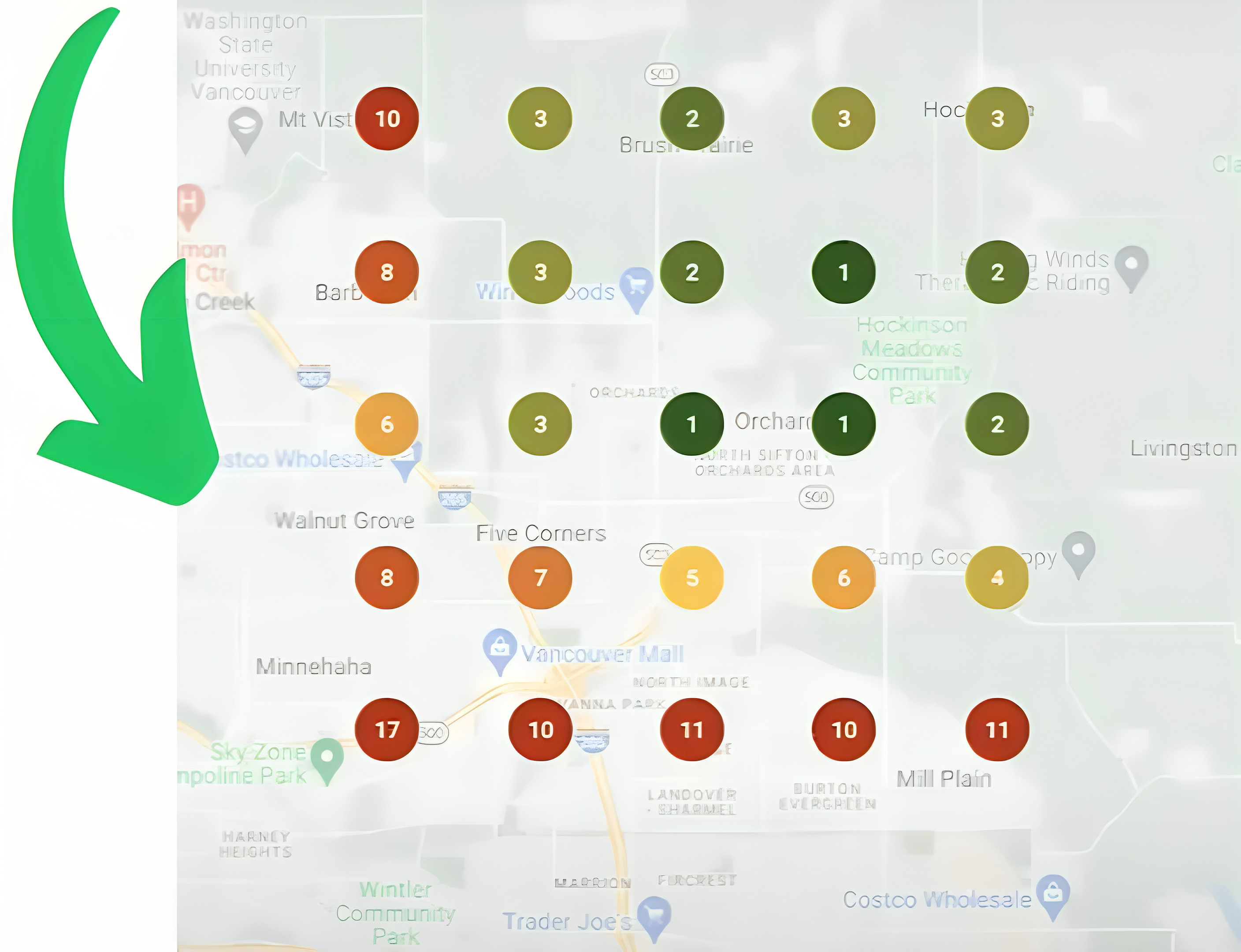
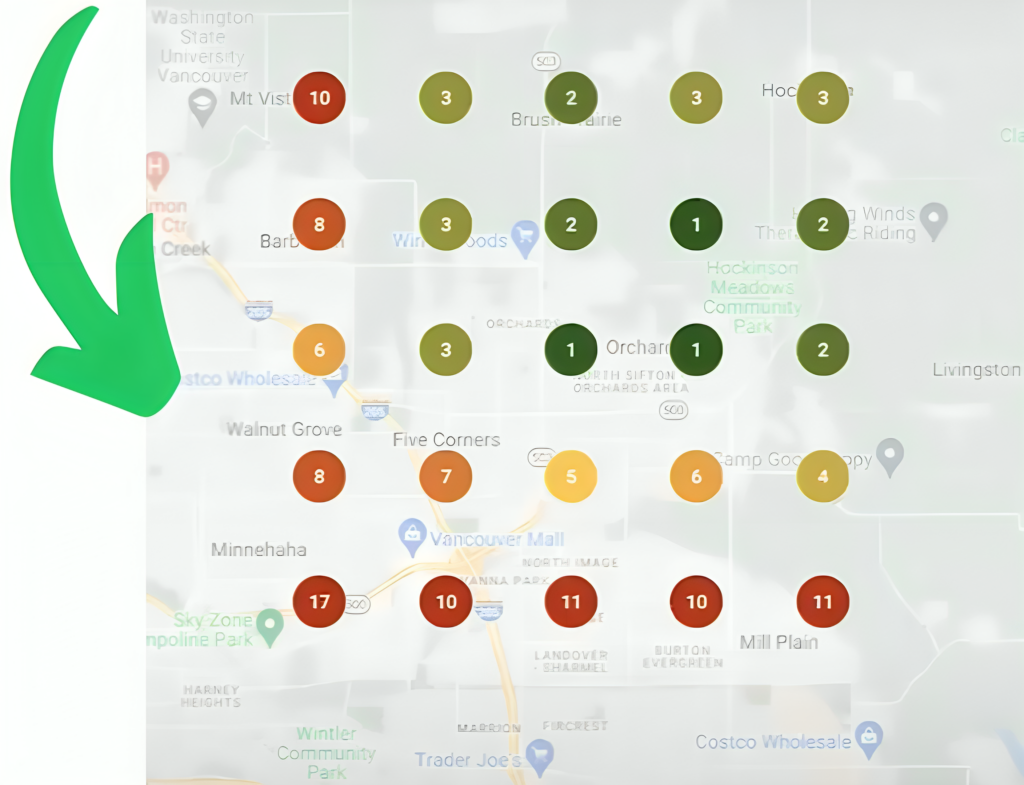
Local Falcon was the first tool I found that actually solved this problem. It drops a grid of scan points across your entire service area — imagine pinning a checkerboard over your city and checking your ranking at every single intersection. What you get back is a color-coded map. Green where you’re showing up. Red where competitors are beating you. You can see your weak spots instantly.
They measure something called SoLV — Share of Local Voice. If you’re showing up at 40% of the scan points, your SoLV is 40%. Your competitor has the other 60%. Now instead of guessing, you know exactly which neighborhoods need work.
What’s gotten really interesting lately is that Local Falcon doesn’t just track Google Maps anymore. They’ve expanded into Apple Maps, Google AI Overviews, ChatGPT, Gemini, and Grok. So when someone asks an AI “who’s the best plumber in Louisville,” we can actually see whether our clients are being mentioned or not. That matters a lot more than most people realize right now.
The People Behind It
I first learned about Local Falcon through Yan Gilbert, a Google Platinum Product Expert based on the Canadian side of Lake Erie. Yan saw what I’d been saying for years — that checking your local ranking from one point is meaningless. He built the concept of grid-based scanning, and it was one of those ideas where you see it and think, “Why didn’t this exist sooner?”
David Hunter out of Erie, Pennsylvania took it to the next level. His team acquired Local Falcon in July 2022 and has been adding features fast — Falcon Guard for profile monitoring, Apple Maps scanning, AI visibility tracking, and an MCP Server for agentic AI workflows. I’ve talked with David multiple times about where local search is heading, and his team is building for the right future.
How My Team Uses It Every Day
I want to be clear — we don’t make money recommending Local Falcon. No affiliate deal, no partnership. We use it because after trying everything else, this is what actually works for managing local visibility at scale. Here’s our real workflow:
Falcon Guard runs on every single client. This is how we caught the Litsey situation. Every client we manage gets enrolled. It watches their Google Business Profile 24/7. If Google auto-updates hours, if a competitor suggests a fake edit, if anything changes at all — we know immediately. Not a week later when the client calls asking why their phone stopped ringing.
We scan before and after every optimization. When we update a client’s GBP categories, add new photos, rewrite their description — we run a Local Falcon scan before we touch anything and again after. I never want to tell a client “trust us, it’s better now.” I want to show them the map. Green squares where there used to be red ones. That’s proof, not promises.
Ongoing monitoring for clients like Master Touch Outdoor Living. When you’re managing dozens of profiles, you can’t manually check every one every day. Local Falcon watches them for us. We check accuracy, look for competitor edits, and catch Google overrides before they cost money.
Figuring out what actually went wrong. When a client tells me “Dennis, the phone isn’t ringing like it used to” — I don’t guess. I pull up their geo-grid scan and look at what changed. Did a new competitor show up three blocks away? Did their ranking drop in a specific zip code? The scan tells me exactly where to look, and more importantly, what to do about it.
If you want to see the detailed breakdown of how Falcon Guard works in practice, I wrote about that here: How We’re Monitoring and Protecting Your Google Business Profile.
Why I Made This Page
I’ve been building entities my whole career — from my days as a search engine engineer at Yahoo, to managing ad campaigns for Nike and the Golden State Warriors, to now helping HVAC companies and pool builders show up on Google Maps.
Google doesn’t just rank web pages. It ranks entities — real people connected to real companies using real tools to serve real clients. If you want Google to trust you, you have to clearly show those connections. The tools you use, the people you work with, the results you’ve delivered.
That’s exactly what this page does. Local Falcon is a tool I use every single day on real accounts — Google Business Profile management, Falcon Guard monitoring, geo-grid scans for our clients. By documenting that relationship clearly, with real links to real work, I’m doing the same thing I tell every client to do: show Google what’s actually true.
Not gaming the system. Just accurately representing what we do.
Related
- Google Business Profile — the listing Local Falcon monitors
- How We’re Monitoring and Protecting Your Google Business Profile — our Falcon Guard process
- How to Set Up a Google Business Profile for Your Business
- How Google Actually Decides Who Ranks: Entities and Trust — Marketing Mechanic Episode 1
This article connects to BlitzMetrics processes including SEO Tree. Each of these concepts has a definitive article that explains the full framework.
Dennis Yu
Dennis Yu is the CEO of Local Service Spotlight, a platform that amplifies the reputations of contractors and local service businesses using the Content Factory process. He is a former search engine engineer who has spent a billion dollars on Google and Facebook ads for Nike, Quiznos, Ashley Furniture, Red Bull, State Farm, and other brands.
Dennis has achieved 25% of his goal of creating a million digital marketing jobs by partnering with universities, professional organizations, and agencies. Through Local Service Spotlight, he teaches the Dollar a Day strategy and Content Factory training to help local service businesses enhance their existing local reputation and make the phone ring.
Dennis coaches young adult agency owners serving plumbers, AC technicians, landscapers, roofers, electricians, and believes there should be a standard in measuring local marketing efforts, much like doctors and plumbers must be certified. He has appeared on 353 podcasts with 619 credited episodes — see the full list of his podcast appearances.