

This page is a worked example (a leaf). The canonical for how we audit is How we audit. The seven-component exam and the full published list: SEO Audits by Dennis Yu.
By Ethan Van De Hey, Marketing Director at MacGillis Wiemer, LLC
When you run marketing for a personal injury firm, you learn quickly that “just get us to the top of Google” is easier said than done. Milwaukee is a crowded market, every competitor is bidding on the same handful of keywords, and the person searching for us just got hurt and needs help now. So when Dennis Yu and I sat down to run a live SEO audit of our website, I didn’t want a scorecard — I wanted to understand why the pages that should rank weren’t ranking, and what we could actually do about it.
🔍 How We Graded Our Firm on Google E-E-A-T
The four signals Google uses to decide whether a law firm deserves to rank — and where we scored the day of the audit.
EXPERIENCE
Have you actually done it?
Real cases, real outcomes, real clients
AT AUDIT: GAP
EXPERTISE
Do you prove deep knowledge?
Attorney bios and Wisconsin legal guides
AT AUDIT: GAP
AUTHORITATIVENESS
Does the world recognize you?
Citations, features, reviews, earned links
AT AUDIT: GAP
TRUSTWORTHINESS
Can a hurt person feel safe?
Clear contact info, credentials, testimonials
AT AUDIT: PARTIAL
Google treats law firms as “Your Money or Your Life” pages, so the bar is higher. See the full audit framework.
The E-E-A-T scorecard we used to grade the firm’s website, and the grade each signal earned at the audit.
Introduction
What I got was better than a checklist. Watching someone pull up our own homepage and walk through it the way Google sees it changed how I think about our site. Below is what came out of that audit: the framework we used to judge the site, the specific gaps we found, what it took to fix them, and where we landed. I’m writing this partly so our own team remembers the reasoning, and partly because every local service business — not just law firms — makes the same mistakes we did.
The audit followed the same repeatable process the team runs on every client site. If you want to see the method applied across other industries, there’s a full inventory of published audits — plumbing, roofing, HVAC, power washing, concrete coatings — each one graded the same way this one was.
Where This Audit Came From
This article is repurposed from a recorded audit session where we screen-shared the firm’s website and went through it page by page. If you’re on our team, the recording lives in Basecamp under “Cloud Recording — Audit of MacGillis Wiemer SEO.” If you’re reading this externally, the walkthrough below captures the substance of what we covered.
The Framework: Google E-E-A-T
The whole audit hangs on one framework Google itself uses to judge whether a site deserves to rank for sensitive topics — and personal injury law is about as sensitive as it gets. It’s called E-E-A-T:
- Experience — Have you actually done the thing? For us, that’s real cases, real outcomes, real clients.
- Expertise — Do you demonstrate deep knowledge? Attorney bios, Wisconsin-specific legal guides, and detailed practice-area content.
- Authoritativeness — Does the wider world recognize you? Being cited, featured, reviewed, and linked to by reputable sources.
- Trustworthiness — Can a hurt person feel safe here? Clear contact info, transparent credentials, genuine testimonials, and a secure site.
Google treats legal, medical, and financial sites as “Your Money or Your Life” (YMYL) pages, and it holds them to a higher standard. That’s the lens we used to grade every part of our website. The question was never “does this page look nice” — it was “does this page prove Experience, Expertise, Authoritativeness, and Trustworthiness to a stranger who’s scared and searching?”
What the Audit Found
Here’s what we saw when we went through the site against the E-E-A-T framework. I’m keeping this honest, because the gaps are the whole point.
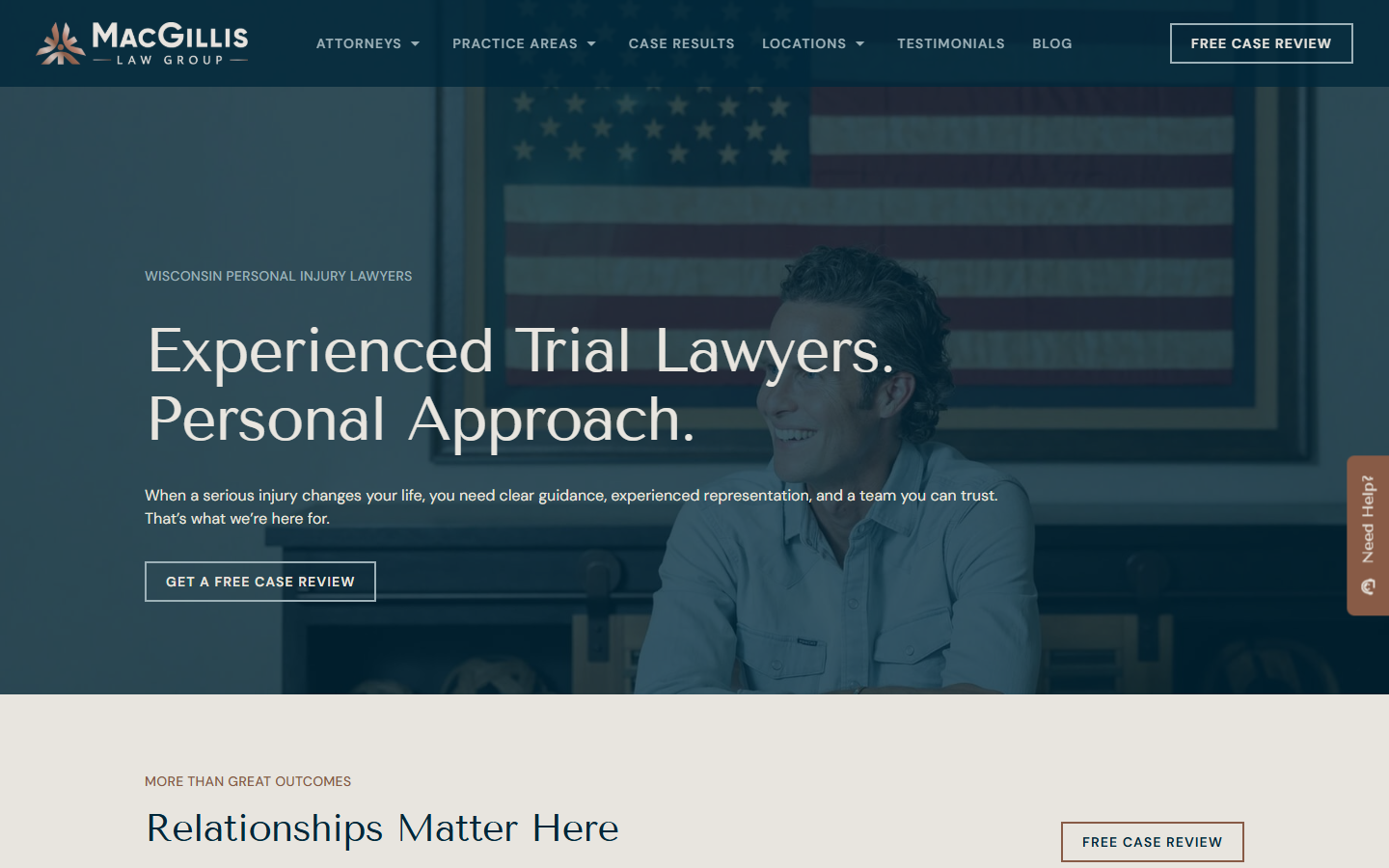
Experience — thin. The homepage led with positioning (“Experienced Trial Lawyers. Personal Approach.”) but a searcher couldn’t quickly find proof. Case results and client stories weren’t surfaced where they mattered, so we were asserting experience instead of showing it.
Expertise — underused. We had attorneys with real depth, but almost none of that knowledge was published. There was no library of Wisconsin personal-injury guides, no “what to do after a car accident” content, nothing answering the questions people actually type into Google. Expertise that lives only in the attorneys’ heads doesn’t rank.
Authoritativeness — invisible. The firm sponsors community events and does real work in Milwaukee, but that authority-building wasn’t being documented online where Google could see it. Off-site signals — features, mentions, links — were the weakest area.
Trustworthiness — decent foundation, incomplete signals. We had the right conversion messaging (“free consultations,” “24/7 support,” “no fee unless we win”), but testimonials and clear NAP (Name, Address, Phone) consistency needed reinforcement to fully earn trust.
The single biggest theme: we were not consistently creating content.
Google rewards sites that regularly publish fresh, relevant material. A stale site tells Google the firm might not even be active — and that one gap touched every part of E-E-A-T.
Effort and Cost to Fix
None of the fixes were expensive in dollars — they were expensive in discipline. Here’s the honest breakdown of what each one actually takes:
Publishing consistently
The hard one. A weekly habit of turning cases, questions, and community work into posts, videos, and social updates. Budget for a repeatable workflow, not a one-off project.
EFFORT: HIGH · CASH: LOW
Building out site structure
Adding and strengthening Attorneys, Practice Areas, Case Results, Locations, Testimonials, and a Blog. Mostly design and development time, done once.
EFFORT: MEDIUM · CASH: MEDIUM
Documenting authority
Turning things we already do — sponsoring the Jay Balchunas Memorial Golf Tournament, community service work — into published content and earned features.
EFFORT: ONGOING · CASH: LOW
Trust signals
Collecting and displaying real testimonials, and keeping contact details consistent everywhere they appear online.
EFFORT: LOW · PAYOFF: HIGH
The lesson: SEO for a law firm isn’t a line item you pay once. It’s a habit you fund continuously. The firms that win are the ones that treat content like a recurring operating cost, not a project.
Compliance Scorecard
Here’s how the site scores against the E-E-A-T framework after the audit and the work that followed.
Before-and-after grades for each E-E-A-T signal, scored by our team against the audit findings.
The site today reflects real progress: the navigation now leads with Attorneys, Practice Areas, Case Results, Locations, Testimonials, and a Blog — exactly the E-E-A-T proof points the audit said were missing. The remaining yellow rows are all about consistency, which is the work that never really ends.
Meta-Article: How We Repurposed This Audit
This blog post itself is an example of the content habit the audit called for. One recorded audit becomes an article, which can then be sliced into short clips, a checklist, and social posts. That’s the Content Factory in action:
🏭 One Recorded Audit, Four Kinds of Content
1
Record the audit
→
2
Write the article
→
3
Grade and publish
→
4
Slice into clips
The same pipeline we follow in the BlitzMetrics blog posting guidelines.
How one recorded audit session turns into an article, a checklist, and a month of social posts.
Here’s how this specific post was made, so anyone on our team can repeat it:
- We recorded the live SEO audit as a Zoom session and saved it to Basecamp.
- Rather than let a two-hour recording sit unused, we repurposed it into this long-form article.
- We graded the findings against the E-E-A-T framework, pulled a live look at the current site for before/after context, and captured a homepage screenshot for visual proof.
- We wrote it in first person, in my voice as Marketing Director, and stripped out anything that sounded generic or AI-written.
- It gets published with tags for discoverability and a single primary category to preserve link juice.
skill.md — Repeatable Process
skill: repurpose-seo-audit-into-article
input: A recorded audit walkthrough of a client site (Zoom/Basecamp), the live site URL, and any existing companion articles.
steps:
1. Identify the audited domain and the auditor, then pull the recording context.
2. Review the current live site and capture a screenshot for visual context.
3. Grade findings against E-E-A-T plus content consistency and location targeting. Here’s how we run these audits.
4. Write in first person for the client’s brand voice; remove AI-sounding language.
5. Follow the 8-section structure: Introduction, Source, Framework, Findings, Effort & Cost, Scorecard, Meta-Article, skill.md.
6. Place the lead diagram above the fold, add one primary category and up to five tags, and link back to the definitive articles.
output: A publish-ready long-form article that doubles as a client deliverable and an SEO asset.
The repeatable skill definition our team follows to turn any recorded audit into a published article.
What would this audit find on your site?
Every gap we found was fixable, and none of them cost much money — they cost consistency. If you run a local service business, the same four signals decide whether you rank.
Get a quick audit of your website
Already graded your own site against E-E-A-T? I’d like to hear which of the four signals was hardest to fix — leave a comment below.
Related reading: 4 things I learned about SEO from the same engagement · How we audit local business websites · Why we build an SEO tree