
 by /
by /
This works for local service businesses that already have some rankings. We’re not just reselling Jumper. We use this as one of many techniques that clarify and strengthen the signal that Google Maps is looking for.
Jumper Media is a simple tool. There’s not much to it and it’s pretty self-explanatory, but it’s still worth your time to watch me explain what you likely already know. We got charged over $4,000 a few days ago because one of us didn’t pay attention to the instructions on how the tool works. So let’s make sure everyone understands how it works.
Understanding map grid results and why they matter
When you log into Jumper Media, you’ll see a grid of dots for each keyword you’re monitoring. Green means you’re in the top 3 for that search location. The goal is green dots everywhere, but here’s the thing most people miss: those green dots are meaningless if the keyword has no search volume.
I’ve seen people set up campaigns on terms like “medication assisted treatment center Chillicothe Ohio” and then celebrate because they ranked number one. Nobody is searching for that. You’re multiplying zero by a bigger number and getting zero.
The right approach is to choose keywords where you already have some traction, maybe positions 4 through 10, and use Jumper Media to push into the top 3. That’s where the real gains happen. Moving from position 7 to position 3 is valuable. Moving from position 37 to position 13 doesn’t make a noticeable difference because you’re still not on the first page of the map results.
It’s also important to understand what the performance percentage actually means. A 40% improvement in Jumper Media is a coverage improvement, not a traffic improvement. You still need to connect that back to your Google Business Profile to see if more people are actually finding you, clicking, and calling.
How free trials and billing work
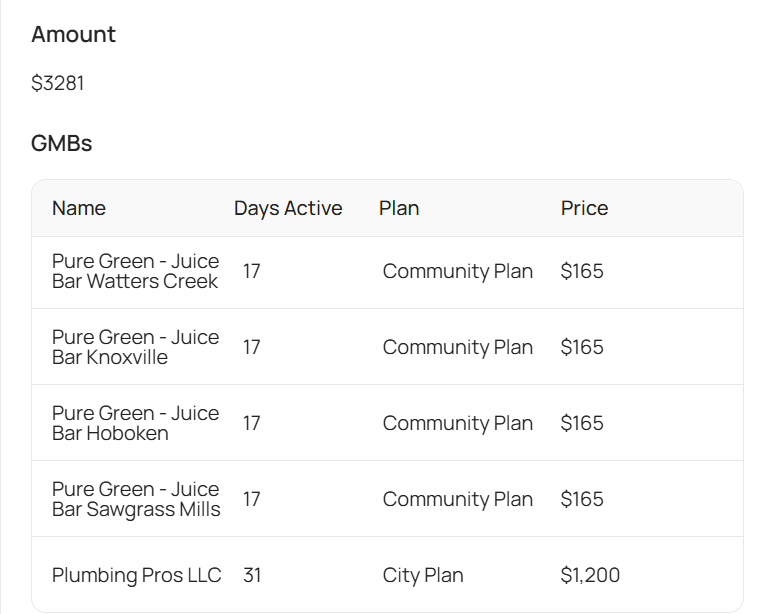
Every account starts with a one-week free trial. After the trial the account cancels automatically, and reactivating starts billing immediately.
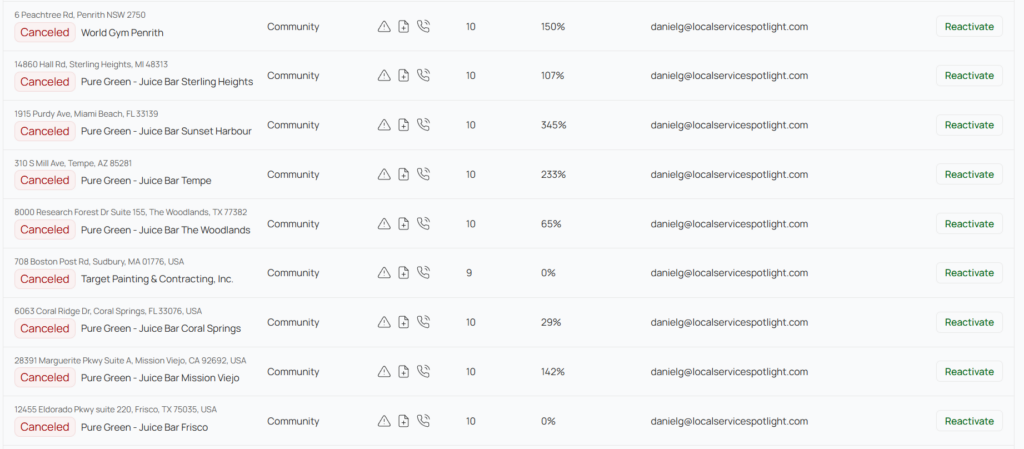
There are two plan tiers. The Community Plan runs roughly $300 a month. The City Plan runs roughly $1,200 a month and is what you need for dense, competitive metros. Most accounts sit on Community. Across our own client base, only one is on a City Plan.
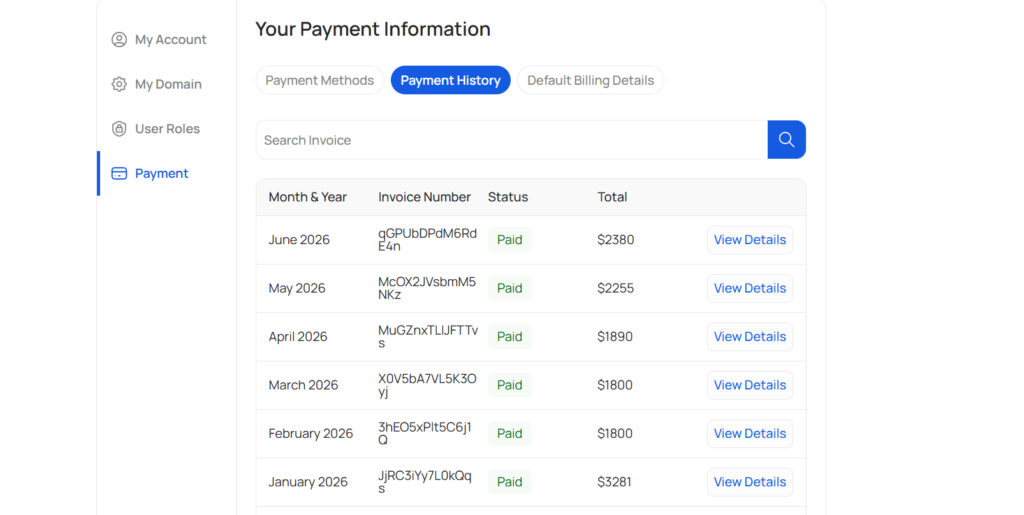
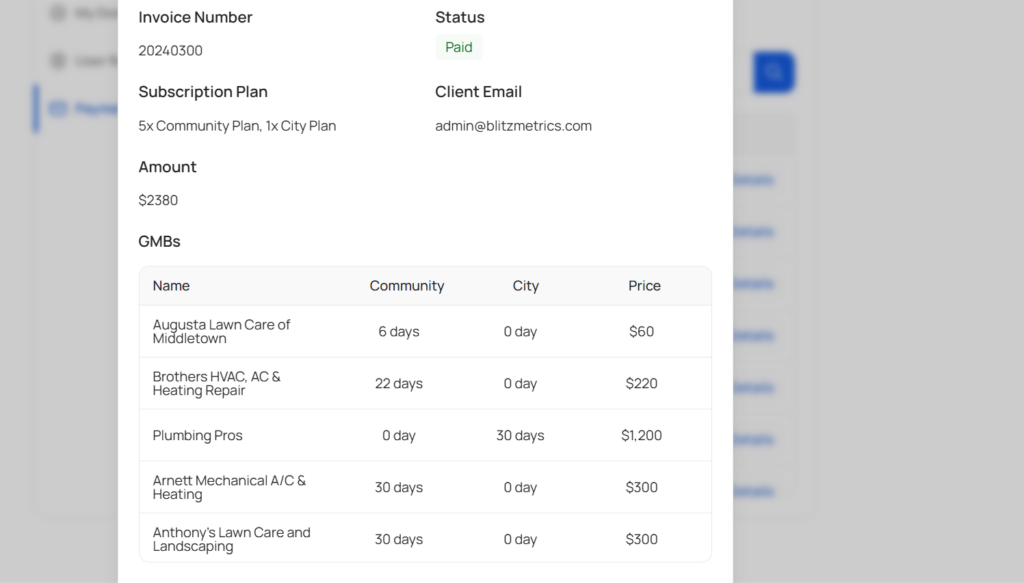
Billing is prorated by the day rather than charged as a flat monthly fee. A Community account that runs six days bills around $60. One that runs 22 days bills around $220. This matters when you’re testing, because a short run costs very little, but leaving several accounts reactivated adds up fast.
If the results justify it and the GBP data backs it up, reactivate. Otherwise let it stay cancelled.
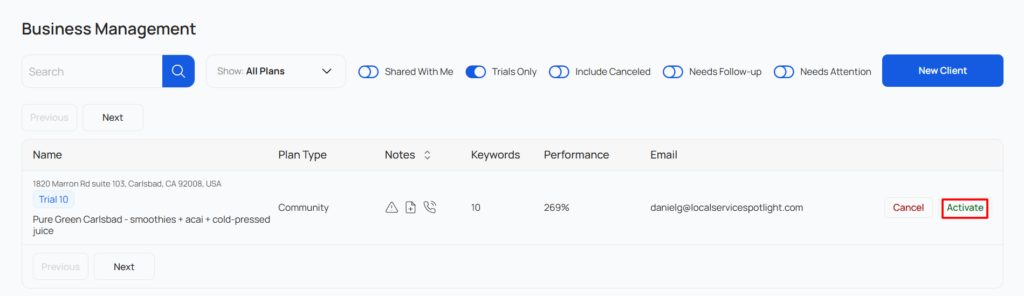
This is critical. If you reactivate accounts without reviewing the data first, the charges add up fast. That’s exactly how we got hit with a $4,000 bill because someone wasn’t paying attention.
Pricing has changed more than once since we started using this tool, so verify current rates before quoting a client.
Choosing the right keywords
This is where most people go wrong, and I’ve seen it happen across dozens of accounts.
First, don’t use your brand name as a keyword. If your business is called “Pure Green,” you’re already ranking 100% on that term. Putting “Pure Green near me” or “Pure Green juice bar” into Jumper Media is wasting a keyword slot on something you’ve already won.
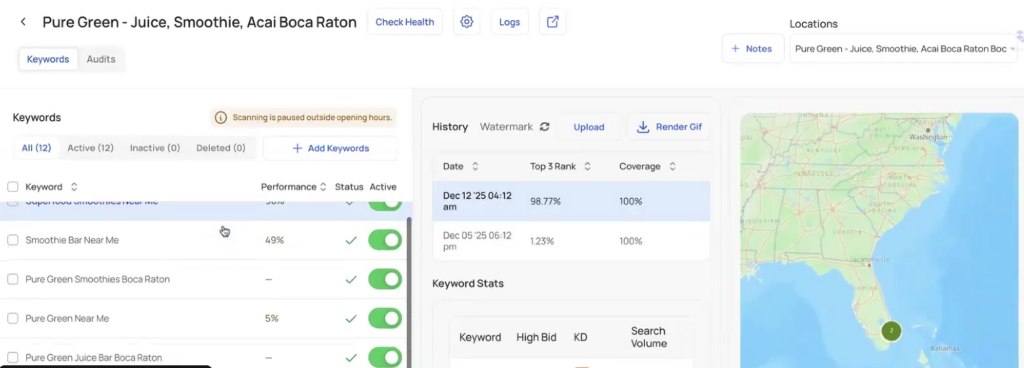
Second, don’t get too specific. Terms like “outpatient rehab Chillicothe Ohio” have no volume. Stick to terms that real people actually search for, things like “landscaping,” “emergency plumber,” “acai bowls,” or “tree service.” Use your Google Business Profile data and your SEO tools to see what terms are already driving traffic. If nothing is coming in on a term organically, putting it in Jumper Media won’t change that.
Third, you don’t always need to add the city name or “near me.” Jumper Media is already local. Google is smart enough to know that when someone searches “lawn mowing” from Bloomington, they mean lawn mowing in Bloomington. Adding the geo term can help on more competitive terms, but it’s not always necessary.
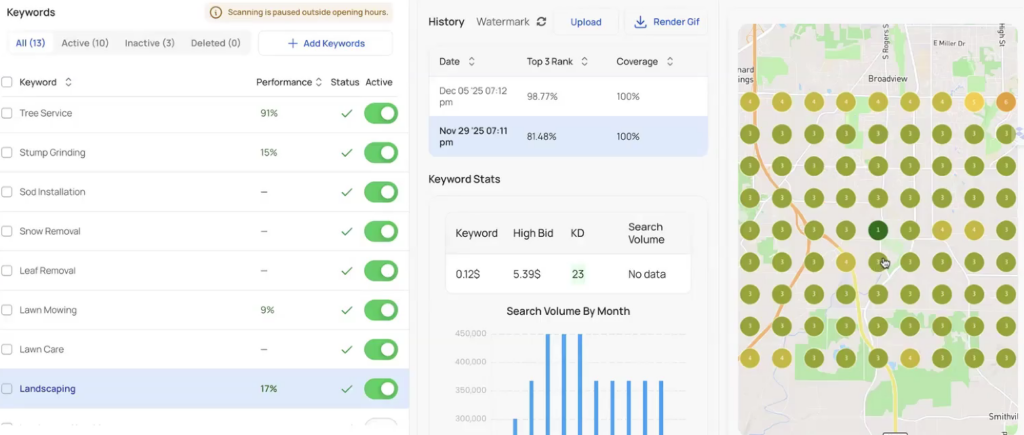
Fourth, think about keyword value. “Emergency plumber” is different from “drain cleaning.” Lawn mowing is recurring revenue. Tree trimming is higher ticket but one-off. Consider what’s actually going to move the needle for the business.
You can even use ChatGPT to brainstorm keyword ideas. Just tell it the business name, location, and category, and ask for 10 terms you could rank for in the local map pack. It’ll give you a solid starting list that you can refine based on actual ranking data.

Connecting map rankings to real business results
Improving your map grid doesn’t automatically mean the phone is ringing more. You have to look at the Google Business Profile performance data to see the actual impact.
Inside GBP, Google shows four categories of how people found you: Google Search desktop, Google Search mobile, Google Maps desktop, and Google Maps mobile. The Maps numbers are the cleanest indicator of whether Jumper Media is working because that’s exactly where the behavioral traffic is being directed.
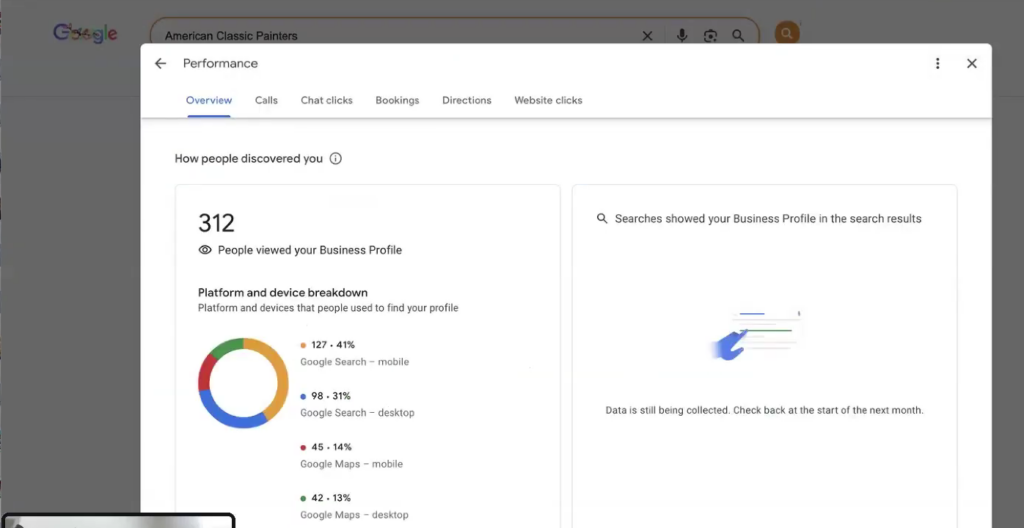
For example, with a painting company we worked with, we saw Maps traffic go from a small portion to two-thirds of all discovery traffic after activating Jumper Media. With a landscaping business doing $5 million a year, we saw a clear bump in daily profile views right around the time the campaign kicked in.
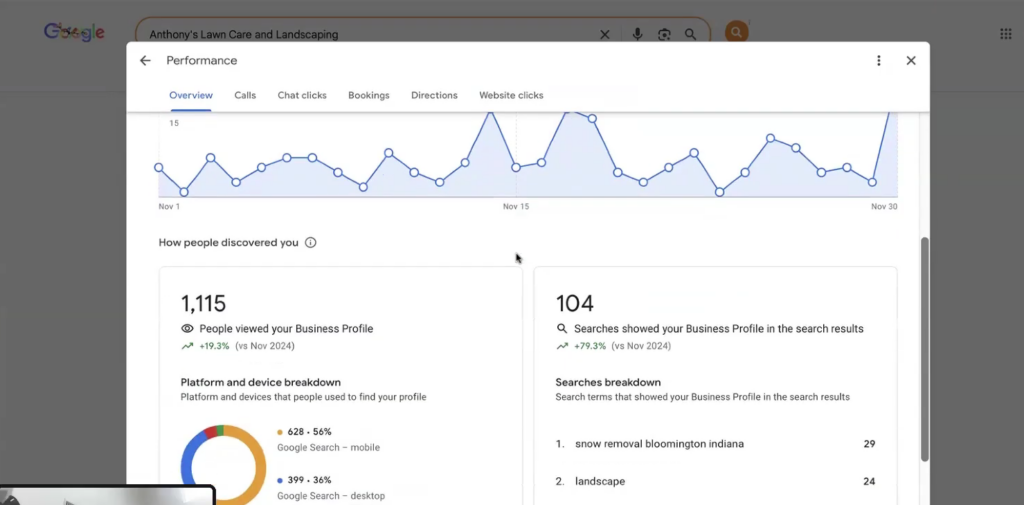
Mobile is especially important. People searching on mobile have higher intent. They need someone now. They’re looking for directions. They’re ready to call. So when you see your Maps mobile numbers go up, that’s a strong signal.
One important note: map rankings and website rankings are separate competitions. Just because your website ranks well for “how much does it cost to repaint cabinets” doesn’t mean you’ll show up in the map pack. And vice versa. They do bleed into each other somewhat, especially on mobile where map results show up in regular search, but they’re fundamentally different.
Real client case studies: what works and what doesn’t
I’ve run Jumper Media across multiple client accounts, and the results vary a lot depending on the business.
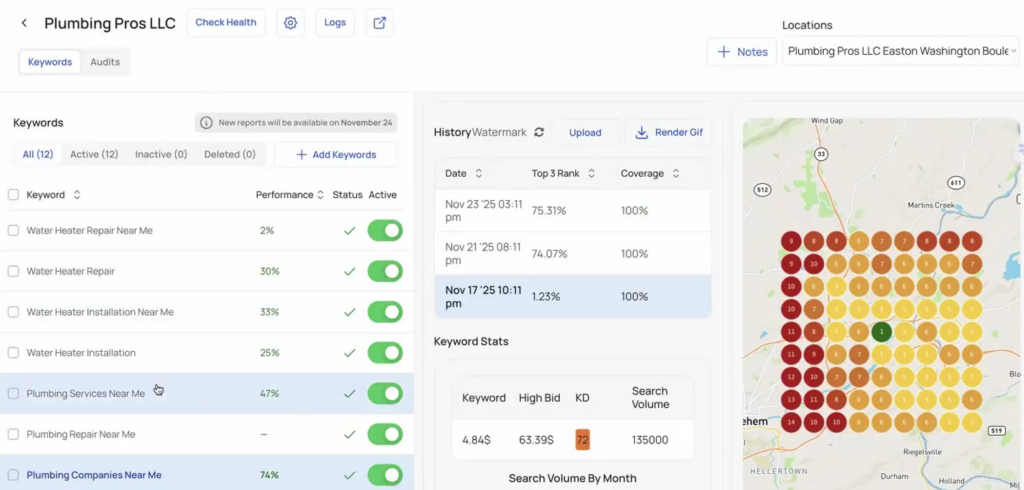
Plumbing Pros (Easton, PA) did extremely well. On “plumbing services near me” they went from 28% top-3 coverage to nearly 100% number-one rankings across the grid. They had a strong GBP already, they answer the phone 24/7, and we paired Jumper Media with content creation, ads, and ongoing optimization. This is a textbook case of the tool working because the foundation was solid.
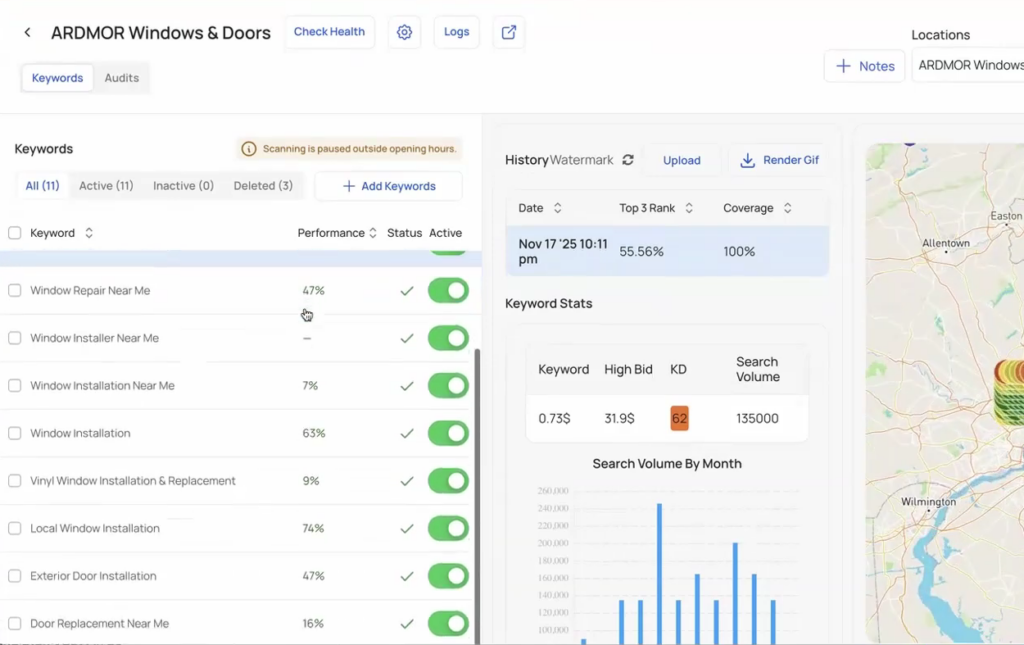
ARDMOR Windows & Doors also saw great results. Window installation went from 1% to 64% top-3 coverage. Window repair went from 1% to 48%. At $300 a month, the ROI on this was obvious.
Ibrahim Awad, Personal Injury Attorney didn’t work. We did everything right from a Google perspective, car accident attorney, truck accident, all the standard terms. But almost all of his clients are Muslim.
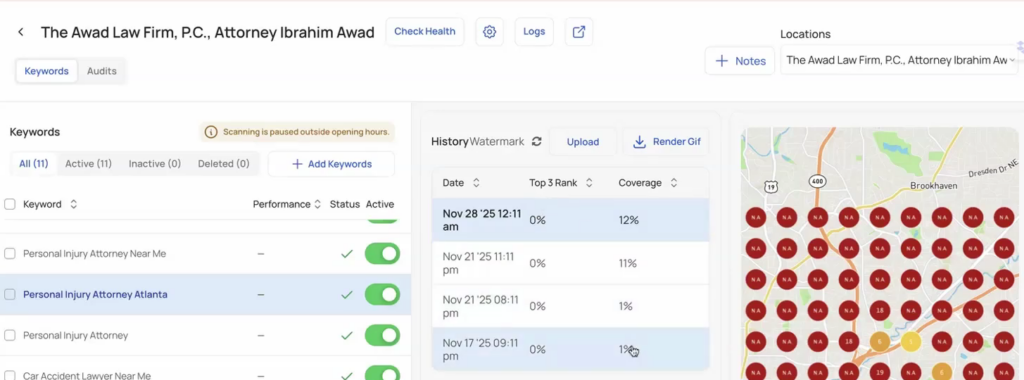
His content is heavily cultural. When a random person in Atlanta searches “car accident lawyer” and sees his profile, they don’t convert.

The fix wasn’t better map rankings. It was changing the channel entirely to YouTube and social media where we can target by audience interest rather than just keyword intent.
The lesson is clear. Jumper Media works best when the business already has a solid Google Business Profile, is ranking in positions 4 through 10 on competitive terms, and doesn’t have a niche audience that keyword targeting can’t reach.
Setting up a new client step by step
Here’s exactly how to set up a new business in Jumper Media. I’ll use Anthony’s Lawn Care and Landscaping in Bloomington, Indiana as the example.
Start by searching for the business through their Google Business Profile.
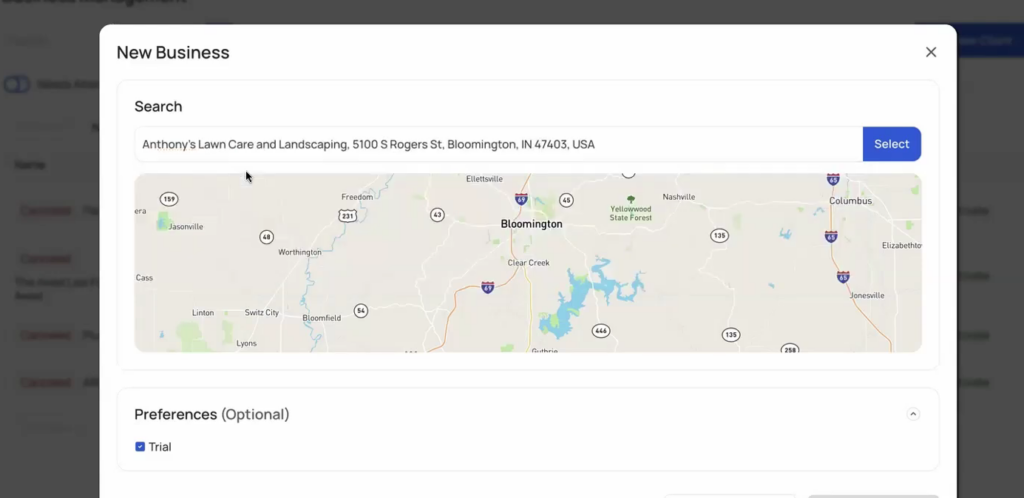
Jumper Media has a search function that pulls from GBP. Find the right location, confirm it, and move to the next step. Add your email so you can monitor the account, or use the client’s email if they want direct access.
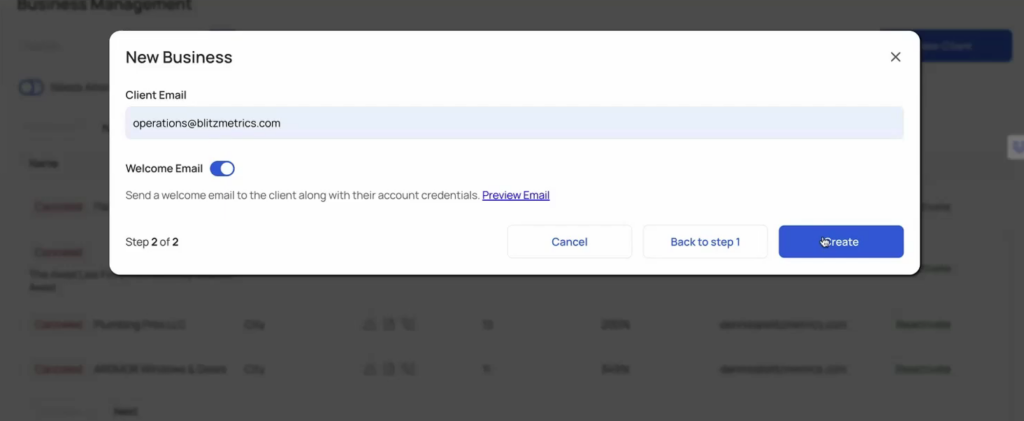
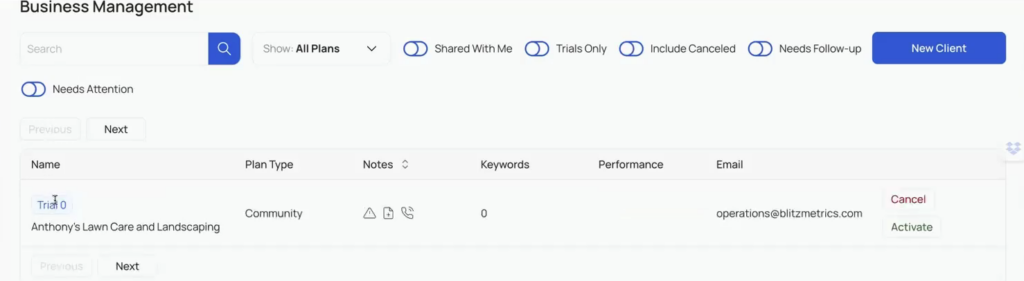
Next, add your keywords.
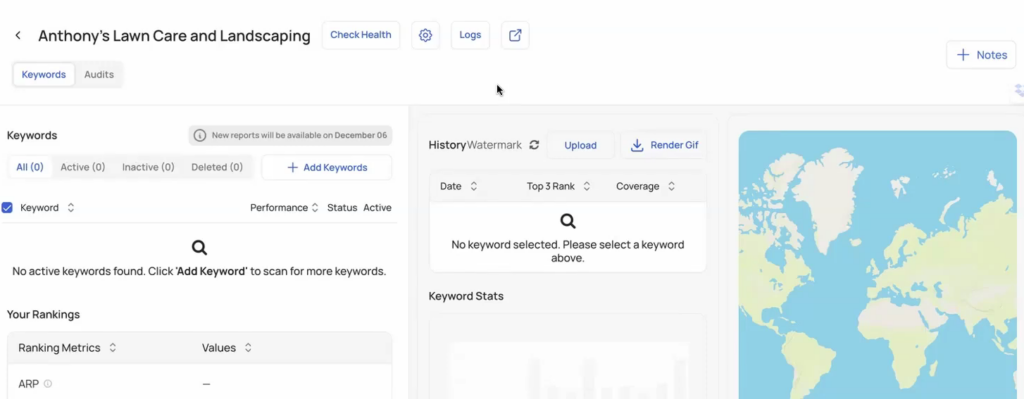
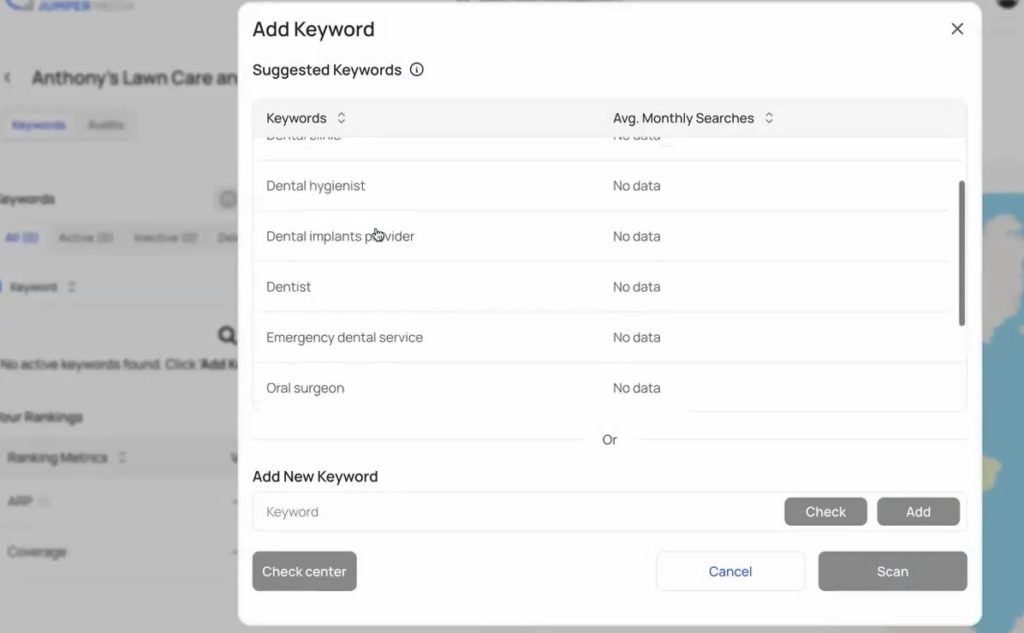
Do not hit “activate” because that starts billing immediately. Take your time choosing the right terms. For a landscaping business, you’d add things like landscaping, lawn care, lawn mowing, tree service, stump grinding, leaf removal, mulching, and snow removal if it’s seasonal. You don’t need to over-think this. It’s basic category terms that real people search for.
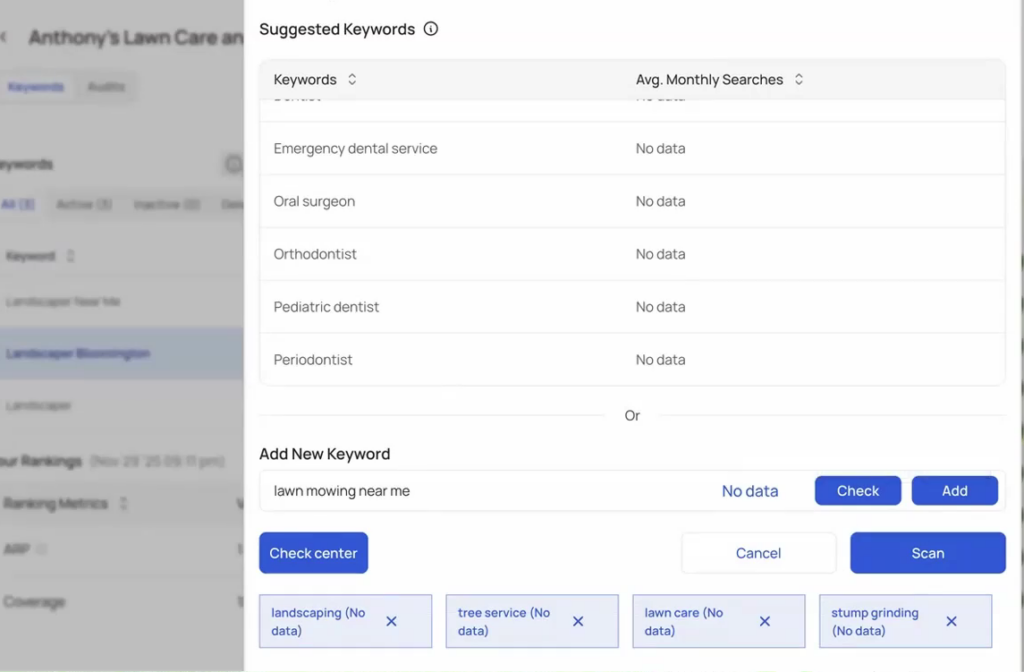
Once your keywords are in, let the system take its initial snapshot. This baseline is critical because it’s how you’ll prove improvement later. Clients often think they rank better than they actually do because Google personalizes results based on their own search history and location.
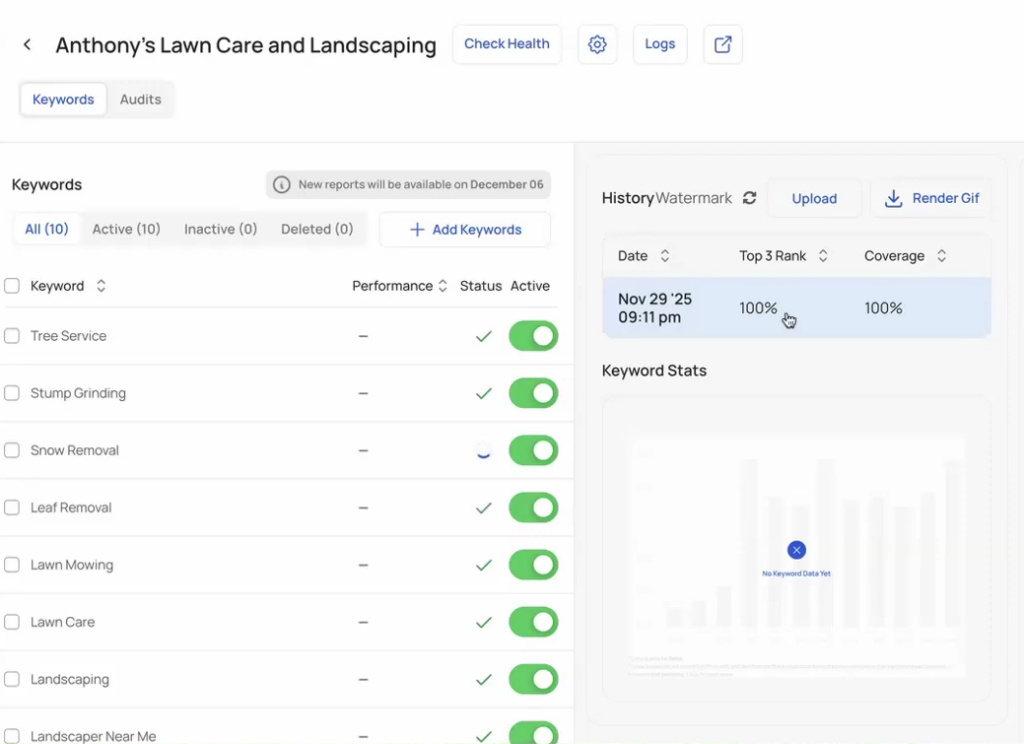
After the snapshot, review the data. If you’re already ranking number one on a term, you might swap it out for something more competitive where there’s room to grow. If a term shows zero traction after a week, turn it off and try something else.
The whole setup takes just a few minutes once you know what you’re doing. The hard part isn’t the tool. It’s convincing people to actually do it.
Run the prep with an agent
The setup above is mechanical once you know the rules. So we wrote it down as a skill file with the qualification criteria, the six keyword rules, and the baseline capture, and packaged it for Claude.
Give it a business name and city. It reads the Google Business Profile, checks whether the business is even a fit, and either tells you what to fix or hands back a keyword list and a baseline ready to enter. Every keyword it rejects cites the rule that rejected it, so you can see the reasoning rather than trusting a list.
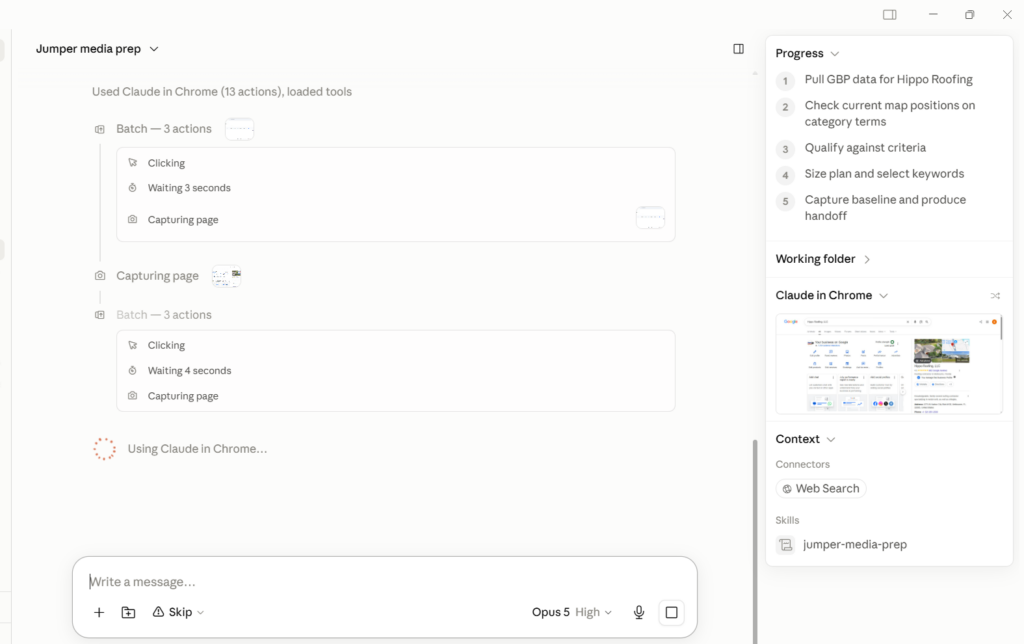


It stops before activation, leaving that decision with you.
The bigger picture
Jumper Media is not magic. It’s one tool in a larger system. We use this as one of many techniques that clarify and strengthen the signal that Google Maps is looking for. If you use it by itself without doing the organic posting, without fixing the website, without getting reviews, without having a strong GBP with accurate hours and real humans answering the phone, the results won’t stick.
Google is looking at combinations of signals. Behavioral traffic from Jumper Media is one signal. Reviews are another. Location service pages, site speed, content quality, response rate to calls, all of it matters. The businesses where we see the biggest wins are the ones where everything is working together.
Start with the fundamentals. Choose the right keywords. Watch the data. Connect map rankings back to real leads. And don’t blame the tool when the strategy is wrong.
Where Jumper Media fits in the bigger picture
Everything in this article covers one component of what we do: using Jumper Media to improve Google Maps grid rankings through behavioral traffic. It’s effective, but it’s one tool inside a larger system.
Our Maps Visibility System (MVS) is the full package. It combines Google Maps visibility optimization, location service page improvements, and ongoing monitoring into a single managed service for established home service businesses generating $2M+ in revenue with 200+ five-star reviews.
The Maps visibility optimization piece is where Jumper Media lives. We select the right keywords, run the behavioral traffic campaigns, monitor the grid results, and continuously adjust. But we also do everything else that strengthens the map signal: making sure your GBP hours are accurate, that you’re answering the phone, that your reviews are strong, and that your profile is fully optimized. Jumper Media amplifies what’s already working. The MVS ensures everything is working.
Then there’s location service page optimization. When your map rankings improve, more people click through to your website. If that page is generic, they leave. We optimize your core location service page with real proof from your business, including reviews, job photos, before-and-after visuals, credentials, and ownership details, so it actually converts that traffic into calls.
You also get monthly progress reporting. A clear summary of map visibility movement, page updates, and local engagement impact each month. No vanity metrics.
We start with a 7-day initial visibility campaign. If we don’t produce measurable improvement in Google Maps during that period, there’s no charge and the engagement ends. If improvement is confirmed, the system continues at $1,500/month as ongoing optimization.
Every task we do has training behind it
This article exists because we document everything. Jumper Media setup, keyword selection, reading GBP data, interpreting map grids. Each of these is a task in our Task Library, with step-by-step training videos just like the three this article was built from.
We don’t just run campaigns and send reports. We build repeatable systems where every team member, whether they’ve been here three years or three days, follows the same process and makes the same quality decisions. The Task Library is how we train our people, how we onboard new clients, and how we maintain consistency across every account we manage.
So when we say we know how to do this, it’s not because one person figured it out. It’s because we recorded it, documented it, tested it across real clients, and made it available to the entire team. That’s what separates a service from a system.
If you’re an established home service business and want to see whether your Google Maps visibility can improve, apply for a Quick Audit to get started with the Maps Visibility System.
Dennis Yu
Dennis Yu is the CEO of Local Service Spotlight, a platform that amplifies the reputations of contractors and local service businesses using the Content Factory process. He is a former search engine engineer who has spent a billion dollars on Google and Facebook ads for Nike, Quiznos, Ashley Furniture, Red Bull, State Farm, and other brands.
Dennis has achieved 25% of his goal of creating a million digital marketing jobs by partnering with universities, professional organizations, and agencies. Through Local Service Spotlight, he teaches the Dollar a Day strategy and Content Factory training to help local service businesses enhance their existing local reputation and make the phone ring.
Dennis coaches young adult agency owners serving plumbers, AC technicians, landscapers, roofers, electricians, and believes there should be a standard in measuring local marketing efforts, much like doctors and plumbers must be certified. He has appeared on 353 podcasts with 619 credited episodes — see the full list of his podcast appearances.