
 by
by
- 114 Videos in 1 Hour
- 2The Results: 50% Watch Rates and Qualified Traffic
- 3The $6.68 YouTube Promotion
Completed recording run: Marko Sipilä and I used the One-Minute Video method to record 14 HVAC clips in about an hour. The saved proof below shows one Unlisted YouTube video, several Drafts, and one $6.68 promotion that produced 53 website visits. It does not prove all 14 clips were published or that those visits became leads.
14clips recorded
1evidenced video
$6.68promotion cost
53website visits
Most local businesses overcomplicate marketing.
They think they need high-end video production, marketing agencies with secret formulas, and big ad budgets.
They don’t.
This test used a specific audience, one problem per clip, a simple recording setup, and a small paid test. The screenshots tell us what happened in YouTube Studio; they do not tell us who became a lead or customer.
14 Videos in 1 Hour
Marko Sipilä and I decided to prove this with HVACQuote.AI, a tool that helps HVAC companies show their prices online.
We shot 14 short videos in about an hour — no lights, no crew, no editing software. Just a simple setup:
A whiteboard with “HVAC BUSINESS OWNERS” written in big letters.
A clear, conversational tone.
Each video addressing one specific pain point HVAC companies face.
“HVAC business owners—you’re losing money by not showing your prices online.”
That’s it. Straight to the point. Within seconds, the viewer knows this is for them.
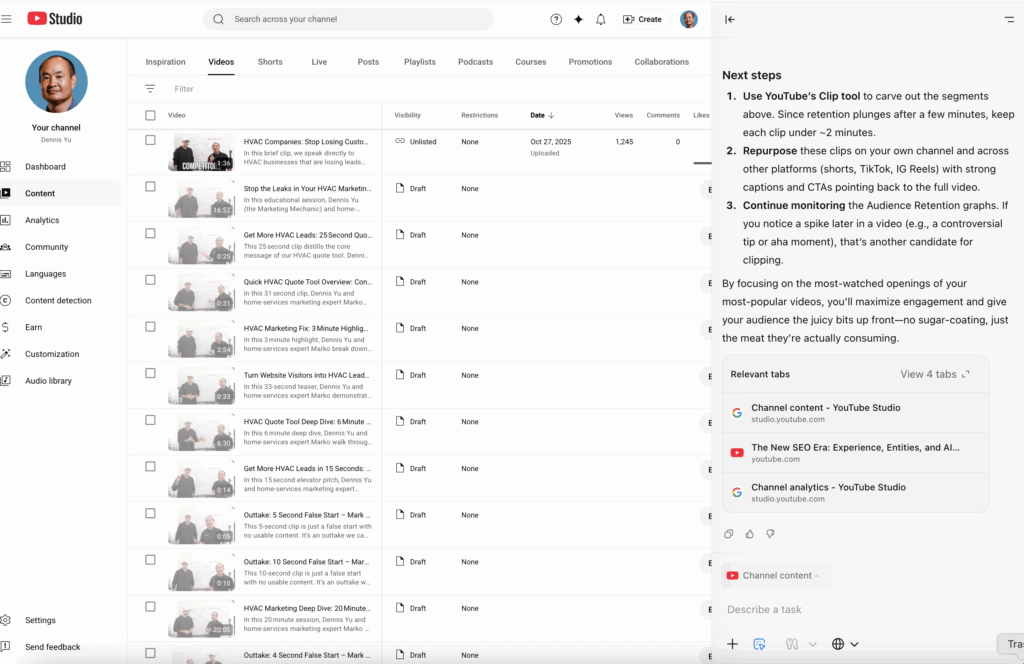
The source captures show at least one Unlisted YouTube upload and several additional videos still in Draft. We promoted the evidenced video. The captures do not establish that all 14 clips were published on YouTube or Facebook.
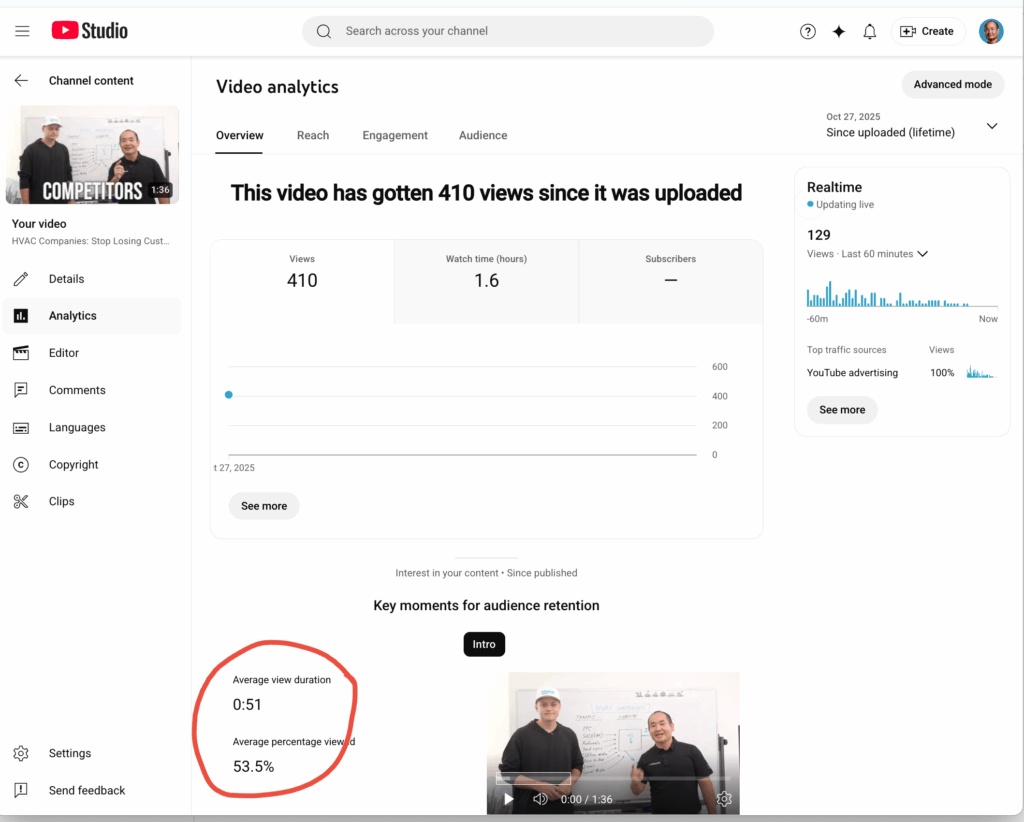
The Results: 50% Watch Rates and Qualified Traffic
The next capture is a channel-content view. It is separate evidence, not a proven continuation of the 410-view capture above.
The recorded average watch time and completion rate show that viewers stayed for much of the video. Those metrics do not identify the viewers or prove they owned HVAC businesses.
The $6.68 YouTube Promotion
Next, we boosted the same video using YouTube ads.
The results?
- Cost: $6.68
- Impressions: 1,842
- Views: 254
- Website visits: 53
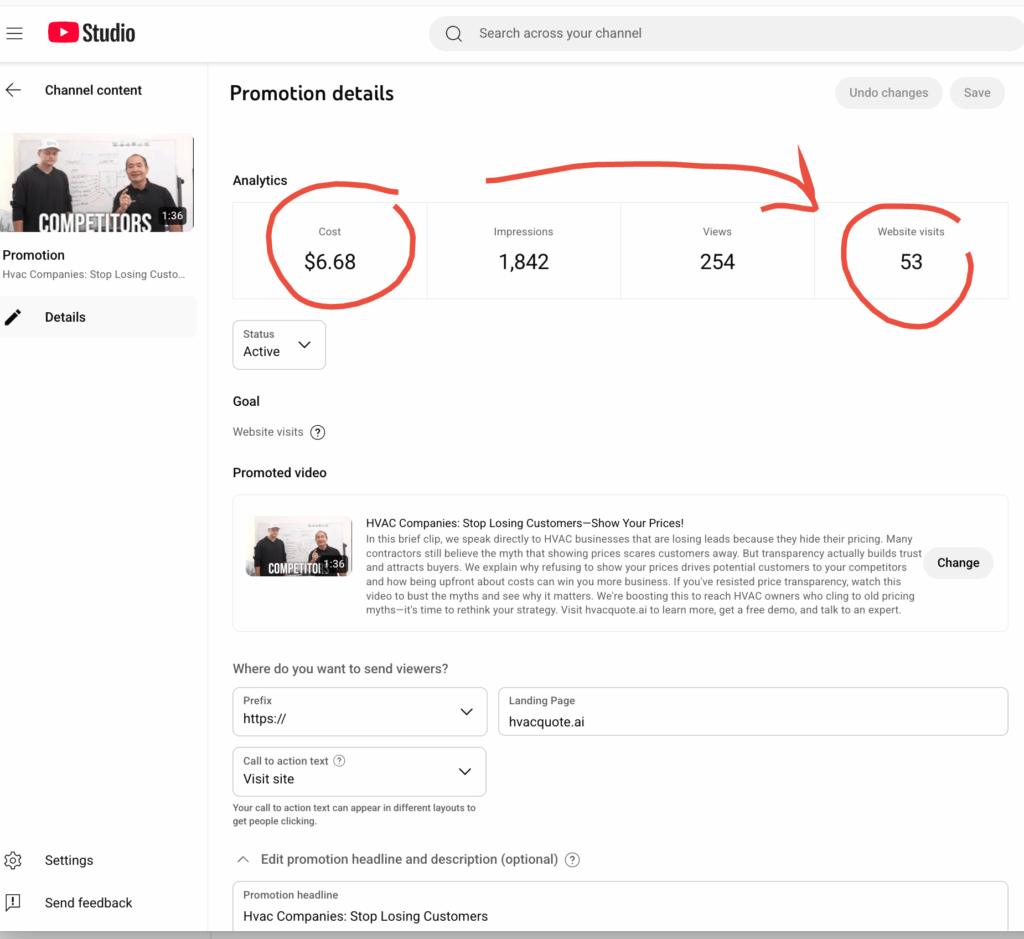
The promotion report records 53 visits to HVACQuote.AI. It does not identify visitor roles or prove qualified leads, customers, or sales. This is a small distribution test, not a comparison with an unrelated company.
What This Run Actually Tested
- A specific opening.
The first sentence names HVAC business owners and one pricing problem. - Batch production.
Marko and I recorded 14 clips in one session. The article does not claim every take passed a current sound or publishing check. - One bounded promotion.
The saved report records cost, impressions, views, and website visits for one video. - Measured evidence.
We keep the view, watch-time, draft-state, and promotion captures separate instead of combining them into a result the screenshots do not prove.
Step-by-Step: How Young Adults Can Replicate This in Under an Hour
If you’re part of our AI Builder Program (or training young adults on your team), here’s the recipe anyone can follow:
- Define the audience and pain point.
Decide who you’re speaking to (e.g., HVAC business owners) and what key problem you’re solving (e.g., they’re losing leads by hiding their prices). - Set up a simple shot.
Use your smartphone, decent lighting and a whiteboard or piece of paper. Write your target audience in big letters at the top of the board so viewers know immediately the video is for them. - Record a batch of one‑minute clips.
For each video, start with a clear hook that calls out the audience and states the problem. Deliver value right away; avoid long intros. This run produced 14 recorded clips in about an hour; your pace may differ. - Save and check each take.
Name the file, save it in the approved folder, record its source question and permission state, and hand it to the editor. Publishing is a later step; a Draft or Unlisted item is not a public post. - Promote only an approved clip.
Promotion is a separate task with its own budget and targeting approval. This run’s saved YouTube report records one $6.68 test; it does not authorize a new campaign. - Watch the analytics and iterate.
Check metrics like view duration, watch percentage and link clicks. Use these insights to refine your hooks and topics in future videos. The Content Factory is all about learning quickly and iterating.
This article connects to BlitzMetrics processes including Digital Plumbing, one-minute video, Content Factory, SEO Tree. Each of these concepts has a definitive article that explains the full framework.
Download the Skill File
The download below is a dated companion archive. Use the current Record one-minute videos task for the maintained checklist. An agent can help plan and organize the handoff; a person records the true story and an actual reviewer must check sound before the take is marked ready.
Originally published .
Dennis Yu
Dennis Yu is the CEO of Local Service Spotlight, a platform that amplifies the reputations of contractors and local service businesses using the Content Factory process. He is a former search engine engineer who has spent a billion dollars on Google and Facebook ads for Nike, Quiznos, Ashley Furniture, Red Bull, State Farm, and other brands.
Dennis has achieved 25% of his goal of creating a million digital marketing jobs by partnering with universities, professional organizations, and agencies. Through Local Service Spotlight, he teaches the Dollar a Day strategy and Content Factory training to help local service businesses enhance their existing local reputation and make the phone ring.
Dennis coaches young adult agency owners serving plumbers, AC technicians, landscapers, roofers, electricians, and believes there should be a standard in measuring local marketing efforts, much like doctors and plumbers must be certified. He has appeared on 353 podcasts with 619 credited episodes — see the full list of his podcast appearances.