

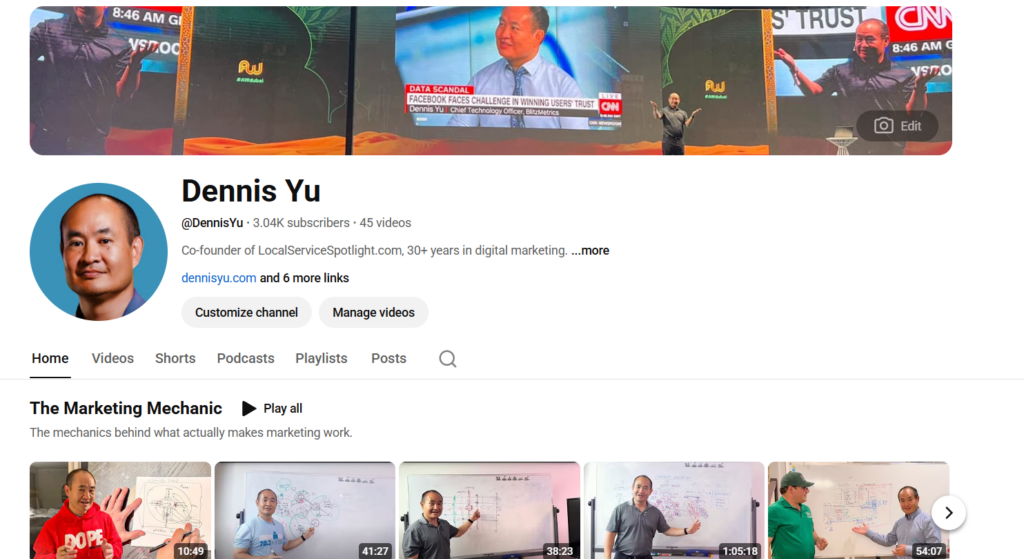
Every Thursday at 11 AM Eastern, we drop a new episode of the Marketing Mechanic on YouTube. I stand at a whiteboard, draw frameworks, tell stories from real businesses, and walk through the strategy step by step. But a YouTube video lives inside a walled garden. Google can’t fully index what’s said and drawn in a video the way it can index a well-structured article.
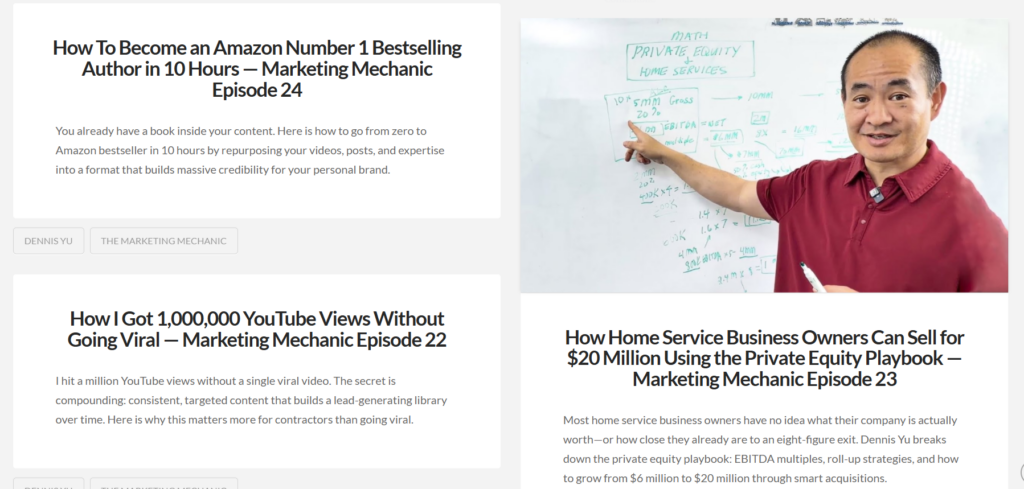
So we take every episode and turn it into a definitive article. Not a transcript dump. Not a ChatGPT summary. A structured article with clean diagrams, real proof, SEO metadata, and internal links that connect it to our entire content architecture.
I’m going to walk you through exactly how we did this with Episode 29, the MOF framework I learned from Al Casey, the CEO of American Airlines. This is the same process we follow for every episode, and it’s the same process you can follow to repurpose any long-form video into an article that ranks on Google for years.
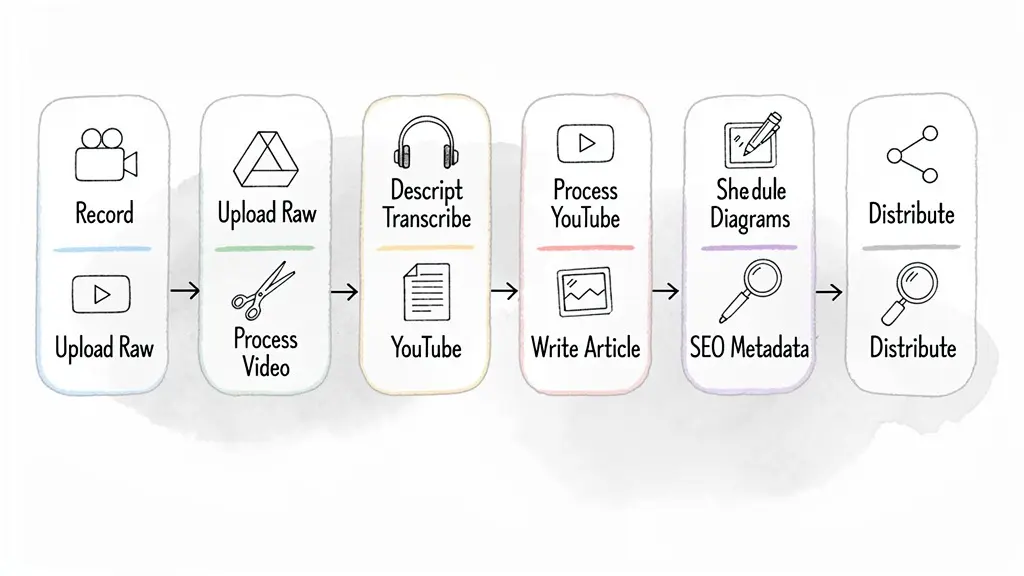
The raw video goes into Descript
I record the episode as a whiteboard session. The raw file goes into our shared Google Drive, and from there into Descript for automatic transcription. The transcript becomes our raw material. It captures everything I said, the tangents, the repeated points, the filler words, the off-the-cuff examples. That transcript is the ingredient list, not the finished dish.
For Episode 29, the raw transcript was about 29 minutes of me talking about how Al Casey broke every business into three components: Marketing, Operations, and Finance. I used examples from Nick Dosa of Vegas Auto Gallery, Anthony Hilb of Anthony’s Lawn Care, my friend Avi in Israel, Mark Cuban before he was famous, and several others. All of that needed to be reorganized into something a reader can scan in five minutes and reference later.
Identify the one framework
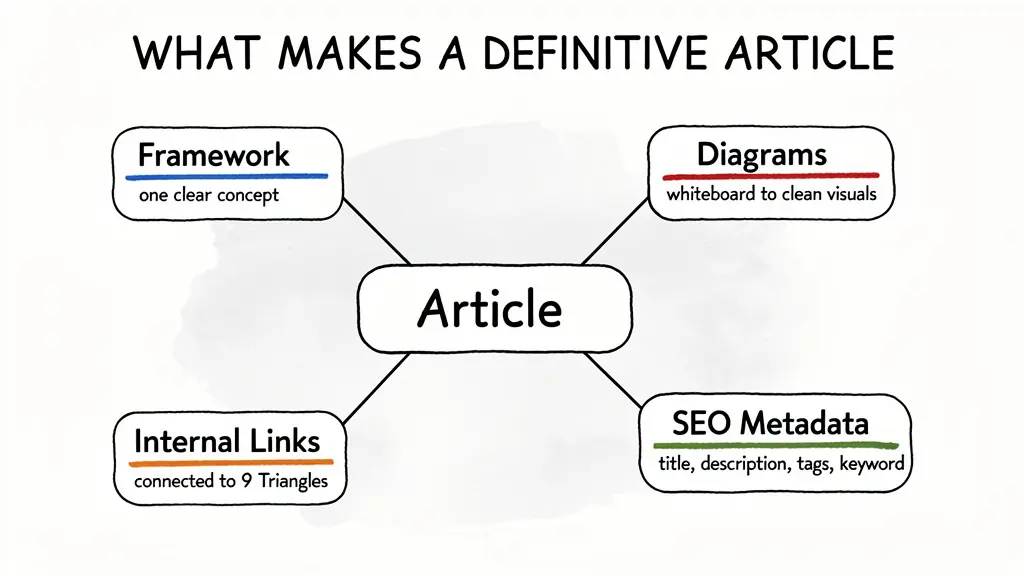
Before writing a single word, we ask: what is the one framework this episode teaches? For Episode 29, it was MOF. Marketing is getting people to buy. Operations is delivering what you promised. Finance is tracking whether you’re making money. That’s the spine of the article. Everything else either supports it or gets cut.

This is the same principle I teach about content strategy. Focus on one thing. The riches are in the niches. One article, one framework, one clear takeaway.
Reorganize by section, not by timestamp
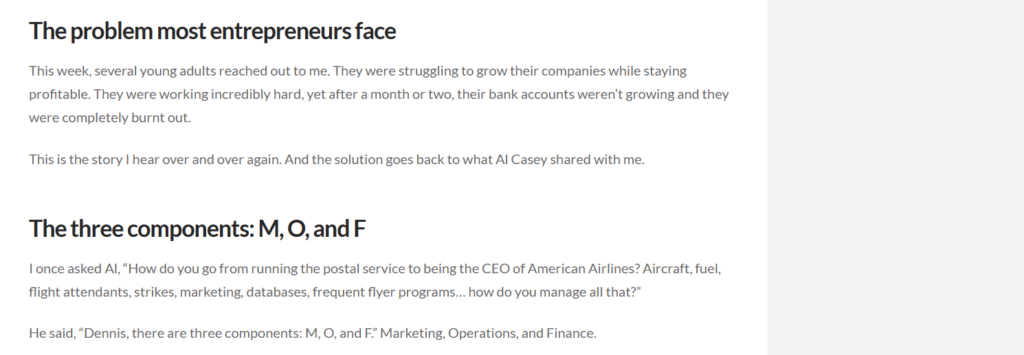
The video follows a conversational flow. I start with a hook about young adults reaching out to me who are burnt out and not making money. Then I introduce Al Casey. Then I draw the MOF triangle. Then I go into stories about Chick-fil-A, Golden Corral, the roofer who does 85% residential, the leaky bucket problem, and so on. I circle back multiple times.
That flow works on video. It doesn’t work as a written article. We reorganize the content into logical sections with clear headings. For the MOF article, the sections became: the problem most entrepreneurs face, the three components MOF, marketing focus on one thing, operations deliver what you promised, the reinforcement loop, finance revenue does not equal profit, pricing and the right clients, building your team with personality types, and where to start.
Each section stands on its own. A reader can jump to any heading and get value without reading everything above it.
Replace whiteboard drawings with clean diagrams
I draw on a whiteboard during every episode. Those drawings are essential for understanding the concepts, but a photo of a whiteboard doesn’t look good in an article and is hard to read on mobile.
We generate clean diagrams that match the visual style of our other articles. For the MOF article, we created diagrams showing the MOF triangle with Marketing, Operations, and Finance as the three pillars, and the reinforcement loop showing how good operations drive marketing which drives more of the right customers back into operations.
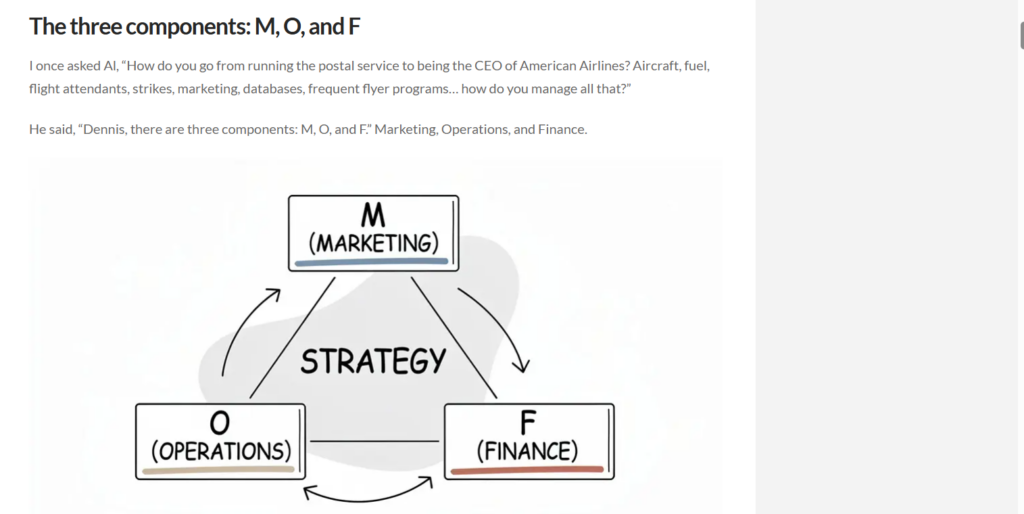
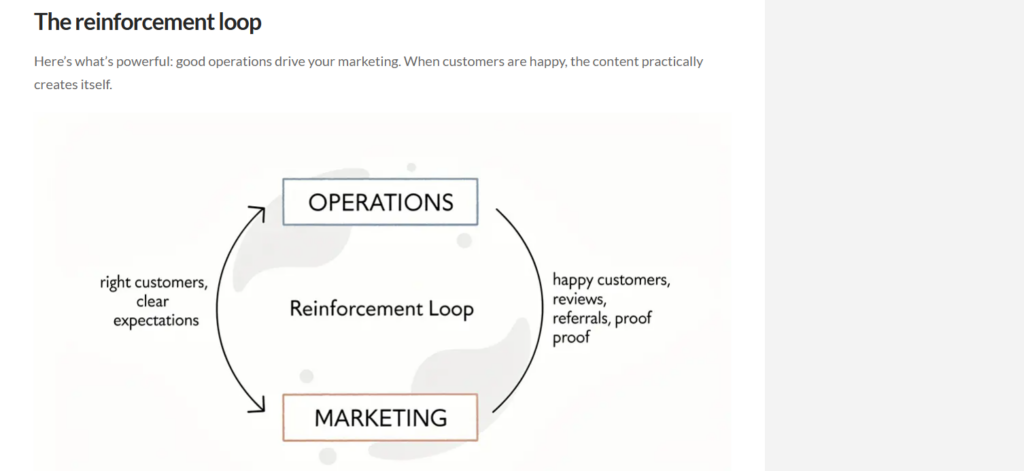
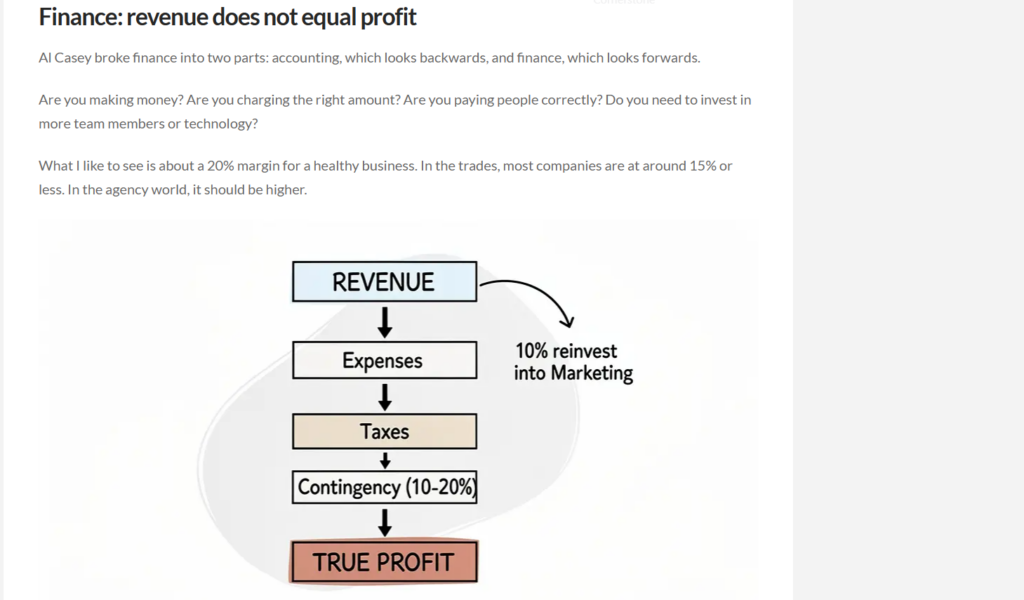
These diagrams map directly to what I drew on the whiteboard. They’re the same concepts, just cleaner and more readable in article format. We keep text minimal in the generated images to avoid spelling errors from AI generation, and add labels and captions in the article editor.
Add real proof from real people
This is what separates our articles from AI-generated content. We add screenshots, photos, and real examples from real people.
The MOF article includes a photo with George Paladichuk, founder of Nail AI. A photo with Anthony Hilb, who built a $5 million landscaping business. A photo with Liana Ling. A screenshot of a real P&L showing week-over-week revenue growth. A handwritten note from Frankie Fihn about the Dollar a Day strategy. A screenshot of Brad Strawbridge‘s unsolicited recommendation showing the reinforcement loop in action.


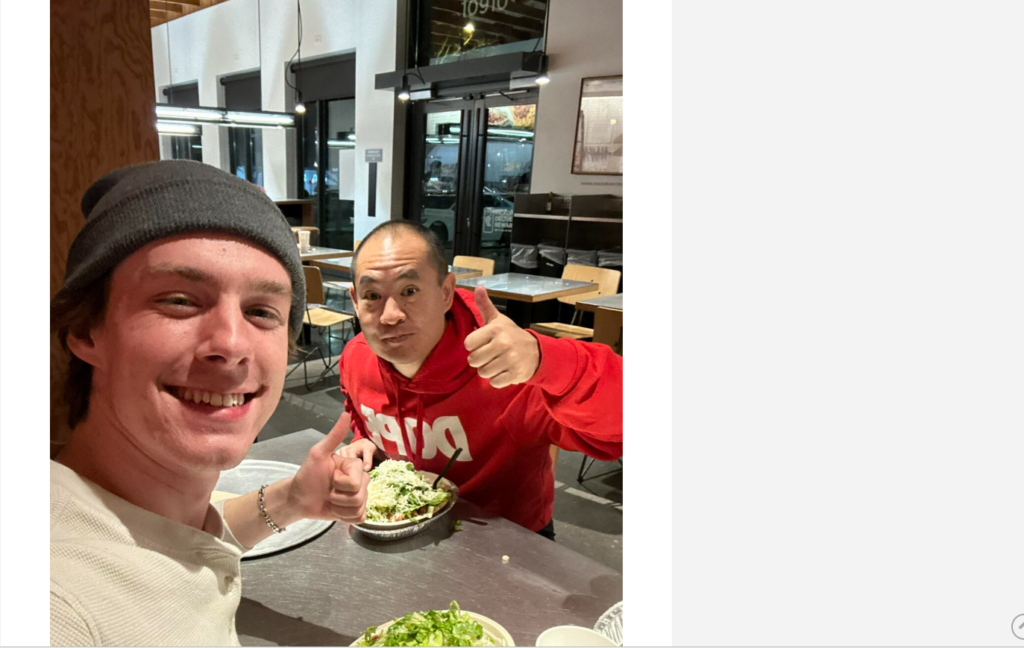
This proof is what builds EEAT. Experience, Expertise, Authority, and Trust. Google can verify these claims because they link to real entities with real knowledge graph presence. AI-generated articles can’t replicate this because they don’t have the raw ingredients. This is exactly what I teach in the Marketing Mechanic about why real content beats AI-generated content.
Connect to the 9 Triangles
No article exists in isolation. MOF is one of the 9 Triangles, the operating system behind how businesses scale from operator-driven shops into systemized companies. The article needs to say that explicitly and link to the 9 Triangles framework page so readers understand the larger context.
We also link to related episodes and articles. The MOF article references episodes 1 through 4 of the Marketing Mechanic on entities, the geo-vertical grid, content strategy, and MAA. It connects to the Leadership triangle (Communicate, Iterate, Delegate) and the Personal Efficiency triangle (Do, Delegate, Delete) because those come up naturally when discussing how to build a team across marketing, operations, and finance.
These internal links create the same kind of structured, connected information that we teach our clients to build on their personal brand websites. The entity linking decision tree guides which links go where, so every reference connects back to the right definitive article.
Write the SEO metadata
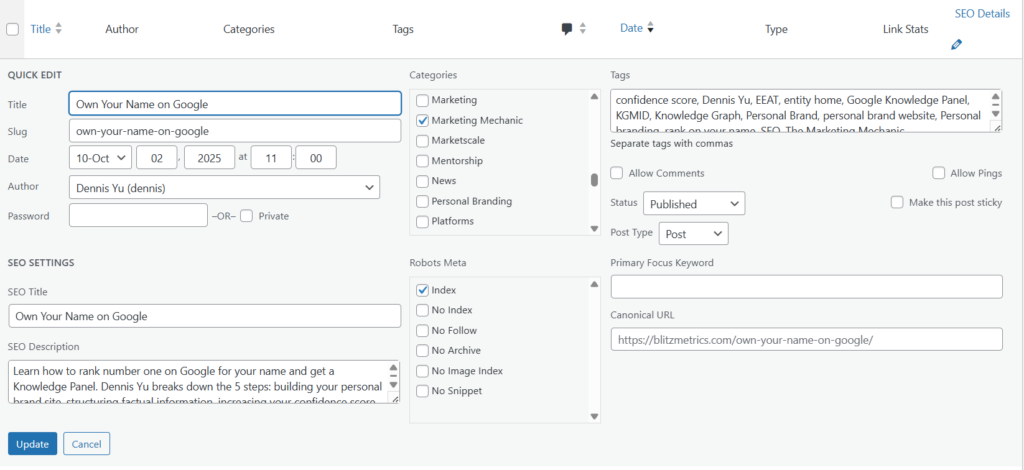
Every article gets an SEO title optimized for search, an SEO description with the primary keyword, a focus keyword, and tags that connect to relevant topics and people.
Create social distribution assets
The article is the hub. We also create a Facebook caption, a YouTube title, and shareable diagrams. If I’m posting on my profile, the caption is first person. If someone on the team is sharing it, the caption is third person and credits me.
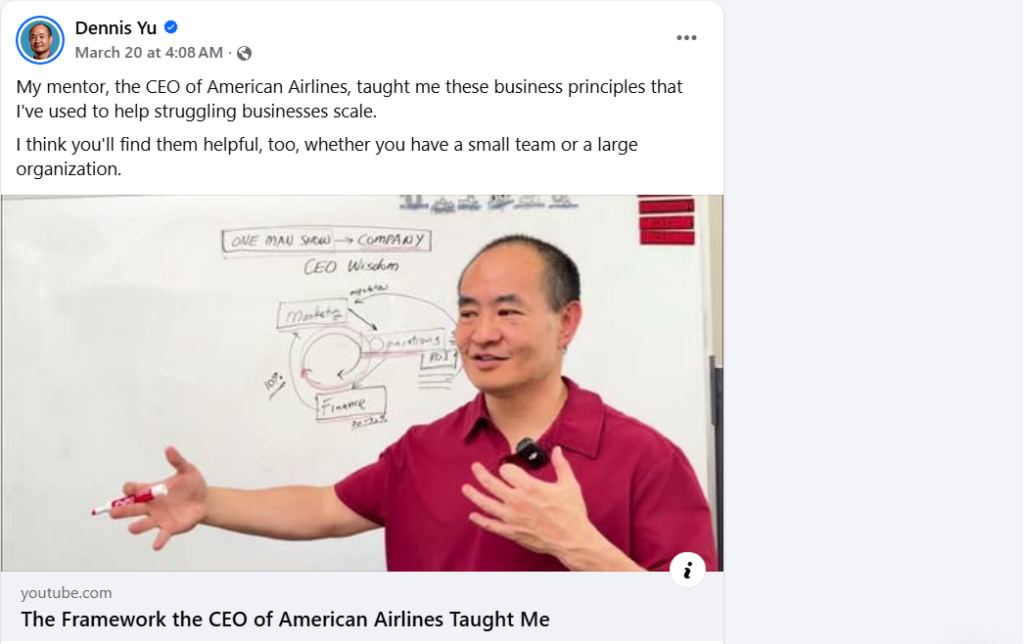
Each of these assets points back to the article, which points back to the video, which points back to the 9 Triangles. Everything reinforces everything else.
Publish, interlink, and update older articles
Once the article is live, we go back to older articles and add links to the new one where relevant. If a previous article mentions business strategy, scaling, or building a team, we link to the MOF article as the definitive resource on that topic.

This is how you build a content ecosystem, not just a blog. Every new article strengthens every previous article because they’re all connected through the same entity architecture we teach in the Marketing Mechanic.
This is the process for every episode
Episode 29 went from raw video in Google Drive to processed video in Descript to scheduled YouTube upload to published article with diagrams, proof, SEO metadata, social captions, and internal links to the 9 Triangles framework. All in the same day.
This is the Content, Checklists, and Software triangle in action. The content is the video and article. The checklist is this process you’re reading right now. The software is Descript for transcription, WordPress for publishing, and AI for generating diagrams and drafting the initial structure.
We do this every week. That’s how you stack thousands of examples. Not by creating more content from scratch, but by systematizing how every piece of content gets repurposed, structured, and connected to everything else you’ve already built.
The 9 Triangles framework is the operating system. The Marketing Mechanic episodes are the weekly inputs. The definitive articles are the outputs that rank on Google for years. And this article is the SOP that makes the whole thing repeatable.
Download the Skill File
This article has a companion Claude skill file that automates the process described above. Download it below, rename from .zip to .skill, and install it in Claude to get step-by-step guidance.
Dennis Yu
Dennis Yu is the CEO of Local Service Spotlight, a platform that amplifies the reputations of contractors and local service businesses using the Content Factory process. He is a former search engine engineer who has spent a billion dollars on Google and Facebook ads for Nike, Quiznos, Ashley Furniture, Red Bull, State Farm, and other brands.
Dennis has achieved 25% of his goal of creating a million digital marketing jobs by partnering with universities, professional organizations, and agencies. Through Local Service Spotlight, he teaches the Dollar a Day strategy and Content Factory training to help local service businesses enhance their existing local reputation and make the phone ring.
Dennis coaches young adult agency owners serving plumbers, AC technicians, landscapers, roofers, electricians, and believes there should be a standard in measuring local marketing efforts, much like doctors and plumbers must be certified.