
 by
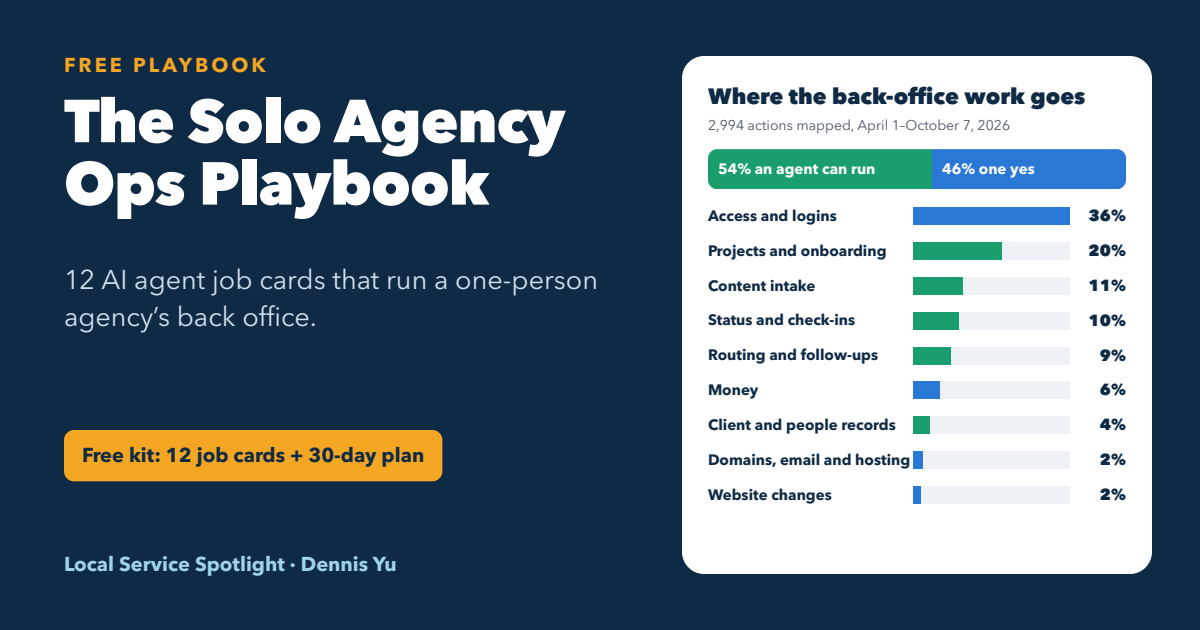
On October 7, 2026 we built an internal plan to hand our Operations work to AI agents. The same day we rebuilt it for people who run an agency alone: no names, no clients, no credential details, and every job sized for one person with a laptop. This is the run record.
Read the Solo Agency Ops Playbook
The run at a glance
| Execution ID | OPS-PUBLIC-2026-10-07-01 |
| Date and operator | Built October 7, 2026, published October 8, 2026. Claude in Cowork, working for Dennis Yu. |
| Trigger | Dennis Yu asked to publish the Operations plan so anyone can run it in their own agency, without personal information, tuned for a young solo agency owner. |
| Starting state | An internal 20-page Operations plan and 25 tasks (17 for agents, 8 for people), built the same day from six months of our project-system activity. |
| Inputs | Function-level counts only (5,016 events, 2,994 hands-on actions, nine kinds of work), the live AI Builder Program page, and photos already published on this site. |
| Outputs | The playbook page, a 20-page PDF and a 22-file kit with 12 job cards. |
| Result | 16 of 16 live checks passed when we opened the published page and downloads. |
What we did
- Kept only function-level counts: six months, nine kinds of work, and the access pattern (83% of 2,423 grants on 2 days).
- Rebuilt the plan for one person: 12 job cards, a six-rule policy, and a 30-day rollout of 20 tasks.
- Generated the page, the PDF and the kit from one data file, so every number on all three surfaces comes from the same place.
- Checked privacy (no team or client names; the only people named are Dennis Yu and Dan Leibrandt, on purpose), wording, links, and the house rules: no black buttons, a real photo, and the lead chart visible in the first screen at 1280 by 800 and 390 by 844.
- Published through the site’s REST API, then opened the live page and downloaded both files and matched their fingerprints byte for byte.
What the checks caught before anyone saw it
- The fold. This theme spends about 440 pixels on navigation, title and byline. With a paragraph first, only a third of the chart showed on a laptop. Putting the chart first and tightening the rows brought it into the first screen on both a laptop and a phone.
- The PDF. Two job cards and the rollout table each spilled onto an extra page. Tightening type and merging the week labels brought it to 20 pages, one topic per page.
- The scanner. A test file showed the location-only Secret Sweep missed the plural “backup codes.” The pattern now catches both forms, and it still never prints a value.
- The share image. Rebuilt on the publishing machine, which runs an older PDF engine, the bars in the share image slipped below their tracks. Declaring each bar an explicit block fixed it on both machines, and we looked at the image again before uploading it.
Live checks
- page 200: pass
- marker: pass
- kit link: pass
- pdf link: pass
- lead visual: pass
- real image: pass
- no placeholder: pass
- faq jsonld: pass
- gtm: pass
- byline author: pass
- kit 200: pass
- kit sha match: pass
- pdf 200: pass
- pdf sha match: pass
- featured 200: pass
- featured sha match: pass
Next
The playbook says we will add measured time-saved numbers. Our Friday reviews track hours returned, time from ask to done, and errors; after the first four, the numbers go on the page. Related: how agents run the company and how we check that done means done.
Originally published .
Dennis Yu
Dennis Yu is the CEO of Local Service Spotlight, a platform that amplifies the reputations of contractors and local service businesses using the Content Factory process. He is a former search engine engineer who has spent a billion dollars on Google and Facebook ads for Nike, Quiznos, Ashley Furniture, Red Bull, State Farm, and other brands.
Dennis has achieved 25% of his goal of creating a million digital marketing jobs by partnering with universities, professional organizations, and agencies. Through Local Service Spotlight, he teaches the Dollar a Day strategy and Content Factory training to help local service businesses enhance their existing local reputation and make the phone ring.
Dennis coaches young adult agency owners serving plumbers, AC technicians, landscapers, roofers, electricians, and believes there should be a standard in measuring local marketing efforts, much like doctors and plumbers must be certified. He has appeared on 353 podcasts with 619 credited episodes — see the full list of his podcast appearances.