
 by
by
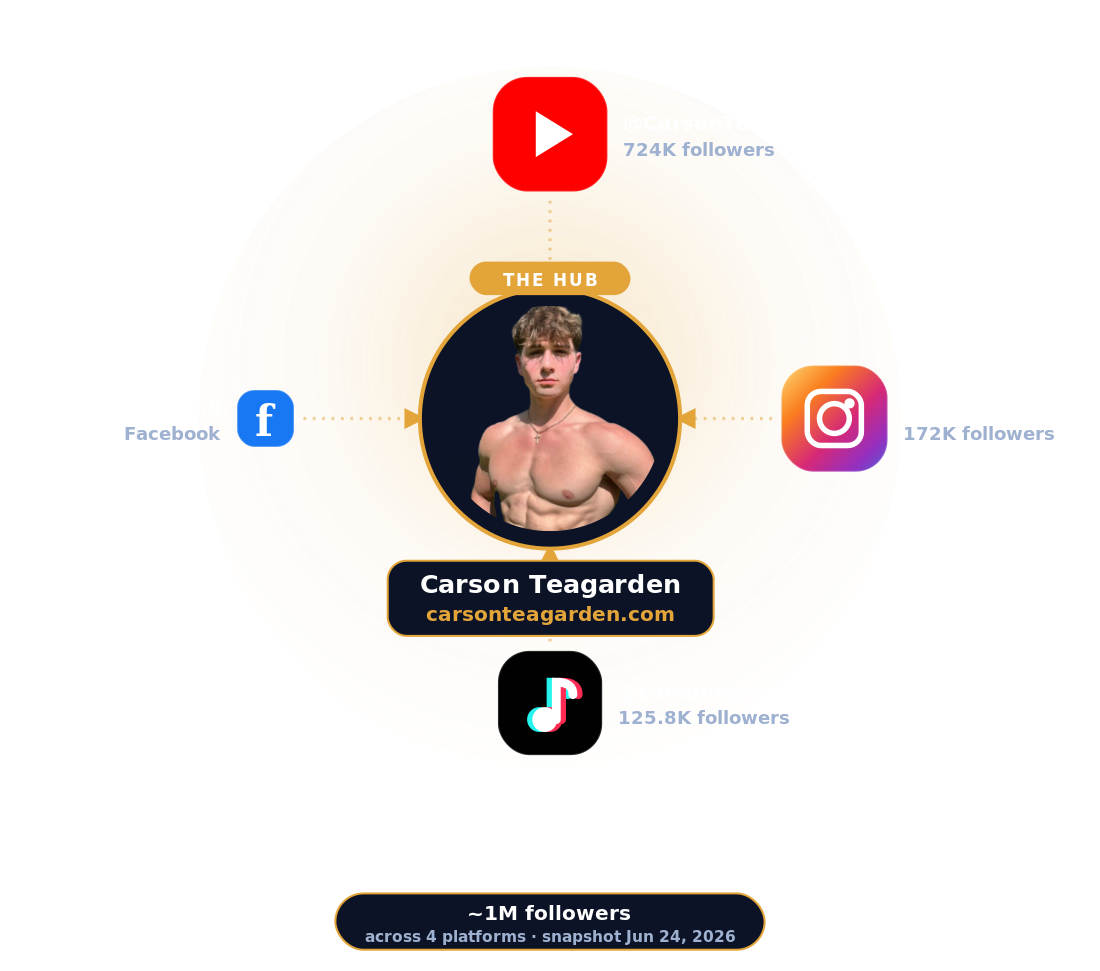
An AI agent (Claude Opus 4.8) wrote the definitive guide on the hub model, then researched 57 live personal-brand sites, drew each one a web-footprint diagram, and wired the whole tree back to one master article. The deliverable is live at blitzmetrics.com/your-website-is-your-hub.
72
personal brands getting the hub diagram
57
footprint wheels generated in one pass
0
per-site logins needed, going forward
One wheel per person: their site in the center, every profile pointing in. This is Carson Teagarden’s.
We Started With One Definitive Article
The system has a master teaching at its center: the definitive guide on why your website is your hub, not a Linktree. It lays out the entity-and-SEO argument, the anatomy of the footprint wheel, a four-step how-to, a gallery of 13 real hubs, and FAQ schema. Every example we build links back to it — the standard definitive-article tree, where a thousand examples make one teaching stronger instead of floating in isolation.
We Mapped the Whole Fleet in One Call
Instead of touching sites one by one, the agent pulled all 198 managed sites from the BlitzAdmin fleet API in a single request, filtered to the 136 active personal-brand sites, and narrowed to 91 real people — dropping category sites, products, test installs, and the already-done dunkers. No spreadsheet, no manual list.
We Researched 57 Footprints in Parallel
Eight research sub-agents fanned out at once, each reading a batch of homepages and extracting the person’s name, photo, and every linked social profile. They came back with 57 real personal brands carrying a social footprint — and correctly flagged ~34 sites as parked, template, default-WordPress, or not-a-person, so we wasted zero effort on pages that aren’t brands. Follower numbers were recorded only where a site actually printed one; none were invented.
We Generated Every Wheel From One Template
A single generator turned each research record into a brand-styled wheel (Instagram gradient, YouTube red, TikTok glitch, sized to following) wrapped in a short “this site is my hub” post that links back to the master. Examples already live include Carson Teagarden, Dennis Yu, and Alex Iltchev.
We Killed the Per-Site Login for Good
The real bottleneck was never the content — it was logging into 198 WordPress sites by hand. The fix is architectural: provision one revocable Application Password per site (never the raw admin login password), stored centrally, so any tool publishes to the whole fleet from one place with zero logins. The agent wrote the provisioning script, the publisher, and the documentation, and shipped them to the web team. One server-side run flips the entire fleet to publish-ready, forever.
What the Agent Did vs. What a Human Would
The Token Receipt
Proof ledger: Follower counts appear only where the site itself printed one (Billy Batt, Jack Allard, Jason Chieu, Sam DeMaio) — never invented; everyone else shows footprint breadth. ~34 sites were skipped as parked/template/non-person. And the agent never used a raw admin login password to authenticate — only revocable Application Passwords, the WordPress-native API mechanism.
What It Could and Couldn’t Do
Did autonomously: fleet mapping, social research, wheel + post generation, the master article with schema, the provisioning script and docs, the team email, and publishing every hub it had credentials for. Needs a human: one server-side run of the provisioning script (the agent holds the line on not using raw admin passwords and has no shell on the fleet host), final RankMath entry, and featured-image selection. Honest about the seams — that’s what makes the rest trustworthy.
Guidelines Compliance Scorecard
THE DELIVERABLE
The definitive guide every hub links back to
The master teaching on the hub model — with the entity argument, the anatomy of the wheel, a four-step how-to, 13 real examples, and schema.
Originally published .
Dennis Yu
Dennis Yu is the CEO of Local Service Spotlight, a platform that amplifies the reputations of contractors and local service businesses using the Content Factory process. He is a former search engine engineer who has spent a billion dollars on Google and Facebook ads for Nike, Quiznos, Ashley Furniture, Red Bull, State Farm, and other brands.
Dennis has achieved 25% of his goal of creating a million digital marketing jobs by partnering with universities, professional organizations, and agencies. Through Local Service Spotlight, he teaches the Dollar a Day strategy and Content Factory training to help local service businesses enhance their existing local reputation and make the phone ring.
Dennis coaches young adult agency owners serving plumbers, AC technicians, landscapers, roofers, electricians, and believes there should be a standard in measuring local marketing efforts, much like doctors and plumbers must be certified. He has appeared on 353 podcasts with 619 credited episodes — see the full list of his podcast appearances.