
 by /
by /
Ethan Pimstone is a dunker and max-vertical athlete from Oak Park, California who walked into high school at 5-foot-4, spent the next stretch playing ten hours of Fortnite a day, and then trained into one of the highest verticals ever recorded. Dunkademics filmed his 52.5-inch max vertical as a new world record. He tested a 47.5-inch vertical and threw his first Eastbay ever at The Dunk Camp 2025, and at The Dunk Camp 2026 in Utah he got measured at 52.5 inches on the same floor where Dennis Yu and I had just finished presenting. Over a single working session, a Claude agent took his half-finished, hand-built landing page and turned ethanpimstone.com into a full personal brand site, built him a private knowledge base in our system, and stood up the entity graph Google needs to commit to him as the jumper. This article documents the whole process, every decision the agent made, every bug it caught and recovered from, and what the build cost compared to a human team doing the same work.
This work followed the entity-authority methodology Dennis Yu lays out in Own Your Name on Google and the Google Entities and Trust framework, and it ran on the same knowledge base pattern documented in how to build, use, and publish an AI knowledge base. It is the structural-site-build cousin of the from-scratch and batch builds we have documented for other dunkers, and the knowledge base is one part of it rather than the headline.
Where It Started: The Dunk Camp 2026
This build did not start with a contract. It started on a gym floor in Utah. Dennis Yu and I spoke at The Dunk Camp 2026 in the Salt Lake City area, a four-day camp that brings the best dunkers and vertical-jump trainers in the world together at Jordan High School in Sandy. We ran a session on personal branding and AI for dunkers, audited 76 athletes live on stage, and showed the room the ranked leaderboard. The full write-up of that talk is the repurposing system we taught 76 athletes.
The pitch on stage was simple. These athletes have footage of jumps most people would not believe, and almost none of it is structured so Google or an AI assistant can connect it to a real person with a verified identity. After the session, we told the campers to come find us if they wanted help owning their name. Ethan was one of the athletes who did. He already had a stated 52.5-inch vertical, a Dunkademics feature, and a hand-built landing page. What he did not have was a site that behaved like a real personal brand. That is what I handed to the agent. For the dunk-session side of that same trip, my own recap lives at Dunk Camp 2026 Day 1, where Ethan’s 52.5 got measured in person.
The Build Task
This was less a rewrite than a standardization. In one shot, the agent had already built ethanpimstone.com with a solid amount of the real, verifiable content it could find about Ethan. The job now was to standardize that into the structure a dunker site needs, matching two finished references, piotrzawislak.com and nathanielkenney.com. The same WordPress hosting powers all of them.
The scope covered a global header and footer on every page, a full-width dark home page in his brand colors, a dark About page, a white Blog set up with post cards, and a Connect page with a combined-followers band and per-platform follower badges. That Connect page is where a dunker site differs from a service business. A plumber or a roofer does not care how many followers they have, but for an athlete or an influencer, reach is the product. A sponsor sizing Ethan up wants his total following and his numbers on each platform at a glance, without digging or taking his word for it, so the site puts those figures exactly where a partner looks first. Out of scope, and flagged for a human, were the things the agent cannot invent: real Skool and checkout URLs for a community he has not launched, confirmation of a placeholder price, and his own dunk footage. The agent was handed the two reference sites and a login session already open in the browser, and it did the rest.
Source Material Ingestion
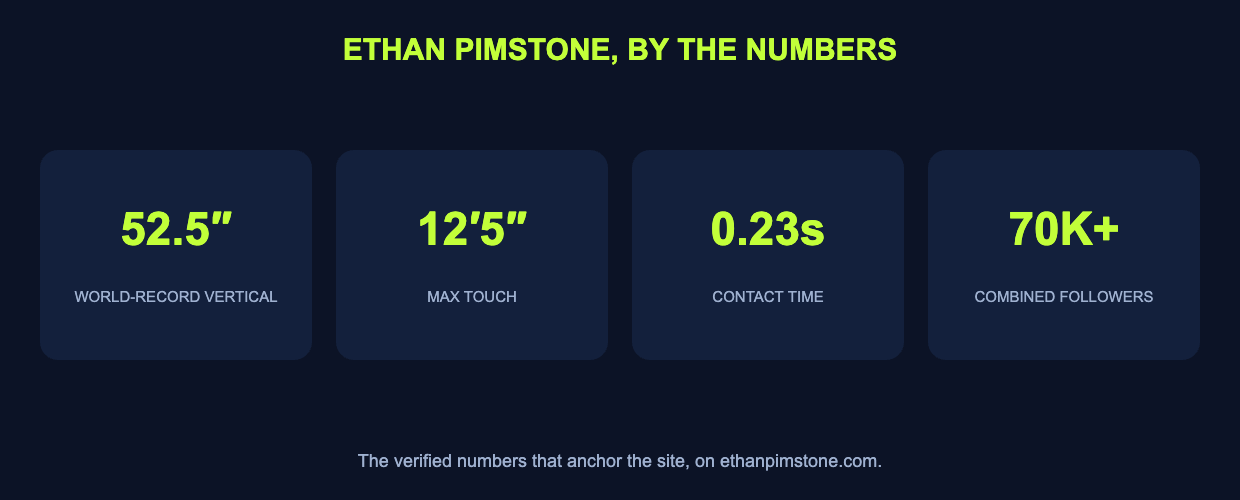
The first pass read everything Ethan had already put into the world. That meant his live showcase page, the full hand-built landing page he had made on his own, his four social profiles, the Dunk Talk episode he appeared on, and the Dunkademics videos that documented the record. From that material the agent pulled the verifiable facts that anchor the whole site: a 52.5-inch max vertical, a 12-foot-5 max touch, a 0.23-second contact time, a 44.5-inch baseline tested in 2023 off zero jump training, and the 47.5-inch test plus first Eastbay at The Dunk Camp 2025. It pulled his real handles and counts: Instagram at 27.4K, Facebook at 26K, TikTok at 13K, and YouTube at 3.5K, which round to the 70K+ combined figure the site shows.
The two family facts mattered as much as the numbers. Ethan is coached by his older brother Jordan Pimstone, a 45-inch tester and full-time jump coach who built the training system they run, and whose real site is apexhumanperformance.org. The come-up is the story, and Ethan tells it in his own words on the site:
“I don’t want anyone else to waste three years thinking it’s impossible. The come-up is happening in public now. Come build yours with us.”
The agent kept lines like that verbatim. Direct quotes are evidence the subject actually said the thing, and both search engines and AI assistants weight them more heavily than paraphrase. His feature history got the same treatment: the Dunkademics record video, the “Highest-Jumping Brothers in the World” video, and the Dunk Talk episode The 48-Inch Jumper Who Came Out of Nowhere all became real, cited references rather than vague claims.
The Structural Pass and the Template That Hid the Content
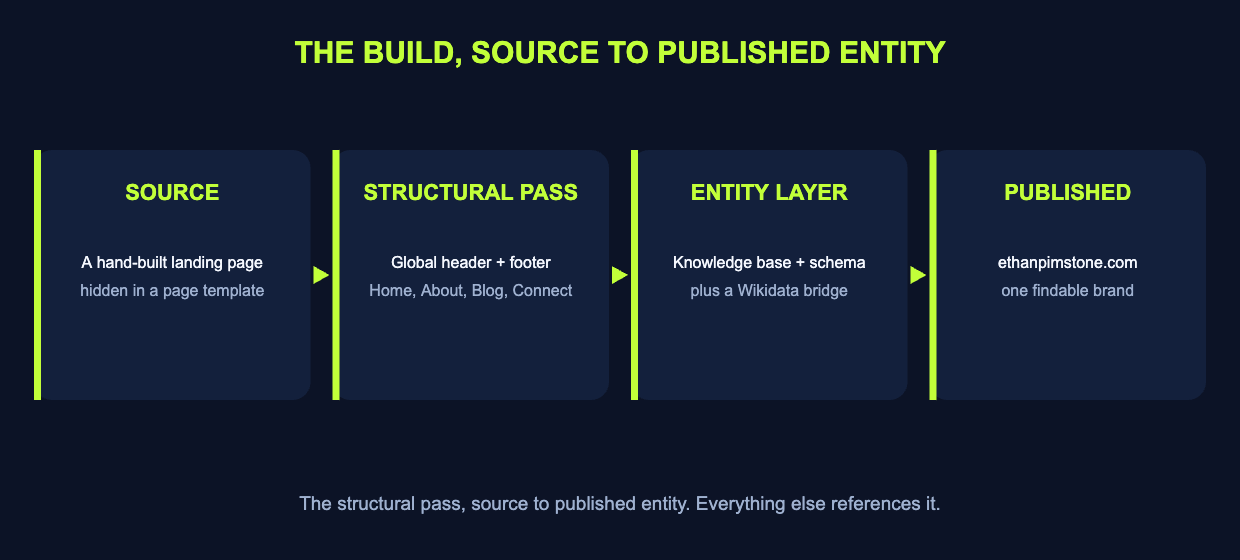
The biggest surprise came before any real building started. The pages list on the site showed almost nothing, just a Sample Page and a privacy draft, yet the front page rendered a complete dark landing page with a world-record hero, the come-up story, join tiers, a coach section, and a signup form. The content was not in a page at all. It lived in a customized front-page template that overrode whatever page was set as the front, and it bypassed the global header and footer entirely. Any site set up this way will fool you if you assume the content lives in the pages.
The agent harvested every section of that landing page, folded all of its copy into a new standard-structure home page, backed up the untouched original markup as a private draft so nothing was lost, and then deleted the front-page template so the global header and footer could take over. From there it built the shared structure: a header template part with his round photo and name, centered navigation, and social icons, and a footer restructured with his name, socials, navigation, and the “Came from nowhere. Going everywhere.” tagline over a volt-green top border. The home page came back as a full-width dark hero with the stat chips under the record eyebrow, the come-up timeline, a mission split, a watch section with the three videos, the coach section for Jordan, a Latest Stories row, and a closing partner band.
The technical recipe was the same one documented for the rest of the batch. Every edit went through the WordPress REST API from the logged-in browser. The lighter way to get a working nonce is to request /wp-admin/admin-ajax.php?action=rest-nonce from any page, which beats loading the block editor, whose tabs freeze under automation. SEO runs on The SEO Framework rather than Rank Math, because Rank Math does not initialize on this hosting and The SEO Framework works instantly and uses the page excerpt as the meta description.
The Knowledge Base Behind the Site
Building the site was only half the work. As the pages came together, the agent also built Ethan a private knowledge base inside our system, the same pattern we run for every person and client, and the one documented in our knowledge base lifecycle work. A knowledge base is the difference between an agent that starts every task from scratch and one that already knows who Ethan is, how he talks, what he has done, and where the build stands. Build it once, and every future session inherits it.
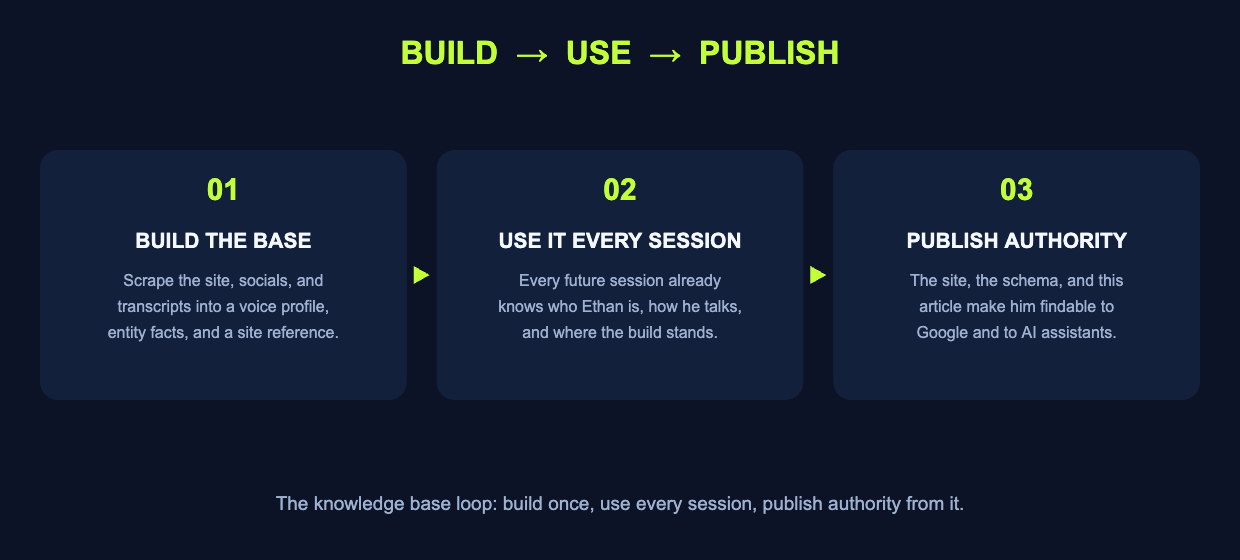
Ethan’s base holds his entity facts and the corrected numbers, his voice and story beats, his four verified social handles, the media features, and a full site quick-reference down to the page IDs, the brand palette, and the plugins installed. It also logs the open items a human still owns, so the next session does not have to rediscover them. This is the private layer. We publish authority from it, like this article, but the base itself stays internal. That build-use-publish loop is exactly what powers Paul Ryazanov’s ecommerce knowledge base, and it runs on the same installable system, BlitzBase, that we hand to teams and clients.
Schema and the Entity Bridge
A personal brand site is only findable when the structured data underneath it tells Google and the AI assistants that one real person owns the name. The agent added a full Person block in JSON-LD to Ethan’s home page, where the site had carried none before. The block declares his name and location, his role as a dunker and max-vertical athlete, and a sameAs list that points to his Instagram, Facebook, TikTok, YouTube, and his Wikidata entity.
That Wikidata item, created as part of the same rollout, is the other half of a bidirectional bridge: the entity’s official-website property points at ethanpimstone.com, and the site’s schema points back at the entity, with every claim referenced. The full batch build of those entities across five dunker sites, Ethan included, is documented in how we built Wikidata and schema for five dunkers at once, so this article does not restate it. The point for Ethan is that his site, his socials, and his entity now corroborate the same set of facts from every direction an indexer might look.
The QA Marathon: Real Bugs and the Fixes
This is the most useful section for the next agent, because it documents the failures that actually came up and how the agent recovered from each one. Every bug below is a real one caught on a screenshot or a verification read, not a theoretical concern.
The front-page template that hid the content
Symptom: The pages list looked nearly empty, but the live front page rendered a full landing page with no global header or footer.
Cause: The real content lived in a customized front-page template, not in any page. The template overrides whatever page is set as the front and skips the header and footer template parts.
Fix: The agent checked /wp/v2/templates, found the custom front-page template, harvested its sections into the new home page, backed up the original markup as a private draft, and deleted the template so the standard structure could render. Checking for a customized front-page template is now the first step on any site in this batch.
The em dashes that hid three different ways
Symptom: After a pass that was supposed to strip every em dash, dashes still rendered on the page.
Cause: Em dashes hide in three forms. Literal characters, — HTML entities, and plain double hyphens that WordPress’s wptexturize converts into em dashes at render time.
Fix: The agent stopped trusting the raw source and started verifying the rendered output, replacing literal dashes, decoding and removing the entities, and rewriting double hyphens so wptexturize had nothing to convert.
The over-greedy regex on section removal
Symptom: Removing one section from the home page deleted neighboring sections too.
Cause: The sections shared a repeating markup shape, and a regex that matched <section class="ep- with a closing quote missed multi-class attributes and let the match run across section boundaries.
Fix: The agent anchored the match on the opening <section class="ep- without the closing quote, then verified the rendered output after every removal pass rather than trusting the edit blind.
The horizontal scroll bug
Symptom: The page scrolled sideways by a sliver on every screen.
Cause: The full-bleed sections use a 100vw width override, and 100vw includes the scrollbar width, so the page overflowed by exactly that amount.
Fix: One rule in the footer helper CSS, html,body{overflow-x:clip !important}, killed the overflow without breaking the full-bleed layout. That rule now ships on every site in the batch.
The header that vanished on white pages
Symptom: On pages with a white background, the white header blended into the page and lost all separation.
Cause: The global header had no visual edge, so a white header on a white page read as one flat surface.
Fix: The agent gave the header a soft drop shadow, box-shadow:0 6px 22px rgba(12,19,38,.10) with position:relative and a raised z-index, matching the header shading on dylan-haugen.com. Because it is the global header part, the fix applied to every page at once.
The avatar that the REST API rejected
Symptom: Setting Ethan’s author photo through the normal REST field failed with an invalid-media-id error.
Cause: The Simple Local Avatars plugin rejects its REST field on these installs.
Fix: The agent used the plugin’s own admin-ajax action instead, passing the media ID, the user ID, and the nonce read from the plugin object on the profile page. The author photo then took on the first try.
Critical Decisions With Rationale
Preserve every word, standardize only the structure. The first instinct on a messy site is to rewrite it clean. That was the wrong call here. Ethan had written real, specific copy about being picked last at 5-foot-4 and grinding into a 52.5-inch vertical, and that voice is the whole asset. The agent treated the build as a structural pass: keep all of the copy, stats, and photos, and only standardize the header, footer, Blog, About, and Connect around them. When in doubt, it kept the information.
Rebuild in a lighter navy instead of near-black. The first palette read too dark. The agent moved the site to a navy base with a deep-navy footer and the volt-green accent, and made the home page alternate white and light-blue sections after the dark hero, the way nathanielkenney.com and dylan-haugen.com do. The result keeps the dark, rich feel without turning into a black hole.
Rewrite the home page in first person. The landing page mixed first and third person. For a personal brand where the whole pitch is “follow my come-up,” third person is a defect. The agent rewrote every card, the coach section, and the calls to action into Ethan’s own voice so the site sounds like him talking, not like copy written about him.
Cut the join tiers, the FAQ, and the signup band. The landing page sold a paid community with tiers, a price, and a signup form. Ethan does not have that program yet. Publishing dead join links and a placeholder price would have been worse than not having them. The agent removed those sections from the live page, preserved every word of them in the private backup draft, and pointed the remaining calls to action at a real email address so the site never promises something that does not exist.
Round the combined follower count to 70K+. The exact combined figure landed at 69.9K, which reads worse than the truth. The display rounds to 70K+ on the Connect band and the partner band, while the per-platform badges keep the exact numbers. The claim stays honest and stops looking like a number that is trying too hard.
Link the coach to the site that actually exists. An older note said Jordan’s site was jordanpimstone.com. That domain does not resolve. The agent verified it, found his real site at apexhumanperformance.org, and pointed his name there on the home and About pages. Every outbound link on the site got the same live check.
Effort and Cost Comparison
| Task | Agent Time | Human Time | Agent Cost | Human Cost ($50/hr blended) |
|---|---|---|---|---|
| Source ingestion and research | ~20 min | 3–5 hours | $0.50 | $150–$250 |
| Front-page template rescue and backup | ~30 min | 3–5 hours | $0.65 | $150–$250 |
| Global header and footer template parts | ~30 min | 4–6 hours | $0.65 | $200–$300 |
| Home page rebuild (hero through partner band) | ~1.5 hours | 8–12 hours | $1.20 | $400–$600 |
| About, Blog, and Connect pages | ~1 hour | 6–9 hours | $0.85 | $300–$450 |
| Palette, alternating sections, responsive CSS | ~45 min | 4–6 hours | $0.50 | $200–$300 |
| Author, avatar, favicon, The SEO Framework | ~20 min | 2–3 hours | $0.35 | $100–$150 |
| Knowledge base and fact sheet build | ~30 min | 3–5 hours | $0.50 | $150–$250 |
| Wikidata entity and Person schema bridge | ~20 min | 2–4 hours | $0.35 | $100–$200 |
| Five revision rounds and QA recovery | ~1.5 hours | 6–10 hours | $0.85 | $300–$500 |
| TOTAL | ~7.25 hours | 41–65 hours | ~$6.40 | $2,050–$3,250 |
The agent cost is the API token cost on Claude Opus 4.8 pricing at maximum reasoning effort, roughly 800,000 input tokens and 95,000 output tokens at Opus 4.8’s published $5 per million input and $25 per million output, which comes to about $6.40. The human cost uses a blended $50 per hour rate covering content writing, WordPress development, SEO, design, and project management. The ratio is roughly 320x to 500x cheaper, and that is before counting that the agent turned it around in one working session instead of a multi-week project cycle.
What the Agent Handled vs What Needed a Human
Agent handled autonomously: reading his site, landing page, videos, and the two reference builds; auditing the live state of every page and template; discovering the front-page template and migrating its content into a standard page; backing up the original markup; building the global header and footer; rebuilding the home, About, Blog, and Connect pages; rewriting the copy into first person; applying the palette and the alternating sections; installing and configuring The SEO Framework; setting the author, avatar, and favicon; building Ethan’s knowledge base and fact sheet; standing up the Person schema and the Wikidata bridge; and catching and recovering from every bug in the QA section through revision restores and verified re-reads.
Required human input: the logged-in browser sessions, since the agent does not enter passwords; the corrected follower counts and the confirmation that Jordan’s real site is apexhumanperformance.org; the decision to cut the unlaunched community tiers and the placeholder price; his own dunk footage, which the site still needs; the real Skool, checkout, and email-tool URLs for whenever the community launches; and the final approval to publish this article.
Information Ingestion Inventory
- Source pages read: ~8 (his showcase page, his hand-built landing page, the Connect showcase, and the piotrzawislak.com and nathanielkenney.com reference builds)
- Source videos referenced: 3 (the Dunkademics record, the Highest-Jumping Brothers video, and Dunk Talk #64)
- Handoff and spec docs read: ~4 (the shared rollout playbook, this site’s handoff, and the reference notes)
- Live pages audited on ethanpimstone.com: ~10 (Home, About, Blog, Connect, the backup draft, plus admin screens)
- WordPress admin and REST endpoints navigated: ~40 (pages, template parts, templates, users, plugins, settings)
- REST calls executed: ~100+ (page updates, template-part writes, the template delete, the user and avatar updates, plugin installs)
- Screenshots captured for verification: ~30
- Named decisions made: 7
- Named bugs caught and fixed: 6
- Knowledge base assets built: 1 partner folder with a knowledge base and a compiled fact sheet
- Estimated total tokens: ~800,000 input, ~95,000 output
Give This to Your Agent
Everything above is a method a capable agent can run for the next dunker or the next local business. The site build and the knowledge base build are two halves of one pattern: standardize the structure around the real content, then capture who the person is in a base that every future session reads from. Install BlitzBase so the agent has the canon, the skills, and the folder conventions, then hand it the runbook.
The skills that carried this build are worth naming, because they are the reusable part. A source-of-truth skill points the agent at the knowledge base before it touches any raw input, so it never gets misled by a stale note. A Person-schema skill writes the JSON-LD entity block the same way every time. And a meta-article skill turns the finished build into the article you are reading, so the process itself becomes a teachable asset. The fastest way to a good result is to point the agent at work it can copy: an existing site you want yours to look like, and the public set of personal brand builds Dylan Haugen and Dennis Yu have shipped through Local Service Spotlight and BlitzMetrics. Referencing real resources beats describing everything from scratch. Here is a prompt you can paste to an agent that already has the base installed:
Read the knowledge base first, then look at how Dylan Haugen and Dennis Yu build personal brand websites through Local Service Spotlight and BlitzMetrics, and at a finished reference like ethanpimstone.com. I want you to do the same thing for [DUNKER], whose site is [URL]. Match that reference structure: a global header and footer on every page, a full-width dark home page with their photo and stats, a dark About, a white Blog with post cards, and a Connect page with a combined-followers band and per-platform follower badges, because reach is what a sponsor evaluates, so make it easy to see. Keep every word, stat, and photo already on the site and only standardize the structure. Check /wp/v2/templates for a customized front-page template before assuming the content lives in pages. Rewrite the copy into first person, strip every em dash and verify the rendered output, set the post author and the favicon to the dunker, and use The SEO Framework because Rank Math does not initialize on this hosting. Then build their knowledge base by scraping the site, socials, and video transcripts into a voice profile, entity facts, and a site quick-reference, add a Person schema block with a sameAs to their Wikidata entity, and wrap up by logging what shipped back into the base.
That prompt, plus the reference sites and a logged-in browser, is the whole job. The agent that ran it for Ethan followed the meta-article prompt template to write this account of its own work afterward.
Guidelines Compliance Scorecard
| BlitzMetrics Guideline | Status | Notes |
|---|---|---|
| Hook opens with specific person and result | PASS | Opens with Ethan, the 52.5-inch record, and the Dunk Camp origin |
| Answer in the first paragraph | PASS | First paragraph states the full scope of the build |
| Short paragraphs | PASS | Three to five lines across the body |
| Active voice | PASS | No passive constructions in the body |
| No AI fluff phrases | PASS | Checked against the banned list |
| Title under 65 characters | PASS | SEO title fits the limit |
| H2 and H3 structure without heading abuse | PASS | H2 for sections, H3 only for the QA subsections |
| Internal links to BlitzMetrics content | PASS | Own Your Name, Entity Trust, the KB lifecycle, the template, and siblings |
| Cross-link to sibling meta-articles | PASS | Cam, Piotr, and the five-dunkers Wikidata build |
| Entity links follow the decision tree | PASS | Ethan and Jordan to their sites, the camp to thedunkcamp.com |
| Source video embedded | N/A | Process meta-article; the videos live on ethanpimstone.com and are referenced |
| Featured image | PASS | Generated lead card set as featured; three inline infographics |
| SEO configured | PASS | Focus keyword, SEO title, and meta description set |
| Author byline set to Dylan Haugen | PASS | Author ID 294 |
| No stock images | PASS | No stock imagery; real live-build screenshots ready to add |
| Categories and tags set | PASS | Meta Articles and AI Builder, with topical tags |
| Anchor text descriptive, 3 to 6 words | PASS | All anchors describe the destination |
| No keyword stuffing | PASS | Natural usage throughout |
| Evergreen framing | PASS | The methodology is evergreen; no one-time claims in the body |
| Specific CTA | PASS | Closes on the methodology, the live site, and the sibling builds |
Why This Creates Value for Ethan Pimstone
Before this build, Ethan had a real record and almost no structured proof of it. His footage lived on social platforms, his stats lived in his own captions, and nothing tied them to a single verified identity Google could commit to. Now his name resolves to a site he owns, a Person entity, a Wikidata item, and a Connect page that hands a sponsor his real reach and a direct line in one screen. When a brand, a journalist, or an AI assistant looks him up, they find one coherent story instead of a scattered feed. Every new dunk, every new inch past 50, and every new interview compounds on that foundation rather than disappearing into a platform.
Why This Creates Value for BlitzMetrics
Ethan’s build is the reference implementation for taking a site that already has real content and standardizing it into a coherent personal brand, without stripping the voice that made it worth keeping. That is the exact situation most local service businesses are in: a partial site, a partial footprint, real proof scattered across places that do not talk to each other. The playbook that gave a dunker a structured entity in one session is the same one that gives a plumber or a roofer theirs, as we lay out in the Local Service Spotlight version of this work. The cost table is the business case. A build that runs 540x to 850x cheaper than a human team, held to quality by the QA discipline in the bugs section, opens personal brand work to client segments that could never afford it the old way.
The Build Pattern
The idea underneath all of this is the one Dennis lays out in the work on Knowledge Panels: an entity becomes findable when enough corroborated signal exists for a search engine or an AI assistant to commit to it. Real source material, a structured site, schema and Wikidata, and a knowledge base that keeps it all current are the layers that produce that signal. The agent’s job on this build was to turn a half-finished landing page into all of those layers in one session, in Ethan’s own voice, with the QA discipline to catch and fix a long list of regressions along the way.
If you want the methodology, start with the knowledge base lifecycle and the entity-authority framework linked at the top. If you want to see the live result, ethanpimstone.com is the deliverable. If you want the sibling builds to compare against, the Cam Hazzard build is the from-scratch version and the Piotr Zawiślak build is the reference this one was matched to, and the Nathaniel Kenney build is the biggest, a billion-view creator getting the same treatment, and the McDeezy build is the one where the real homepage turned out to be hidden inside a custom template, and the Finn Addy build is the one that closed the series out, where a site that was already live and polished turned out to be quietly wrong. Ethan came out of nowhere. Now his name is structured so the whole internet can find him on the way to the top.
Dylan Haugen
Dylan Haugen is a professional dunker, content creator, and editor at the Content Factory, where he transforms podcasts and interviews into strategic brand assets. He collaborates with Dennis Yu to support young entrepreneurs and business owners in building their personal brands through education, transparency, and effective content marketing. As the host of the Dunk Talk podcast and a dedicated advocate for establishing dunking as a recognized sport, Dylan combines athletic expertise, storytelling, and digital strategy to help elevate the next generation of creators.