
 by
by
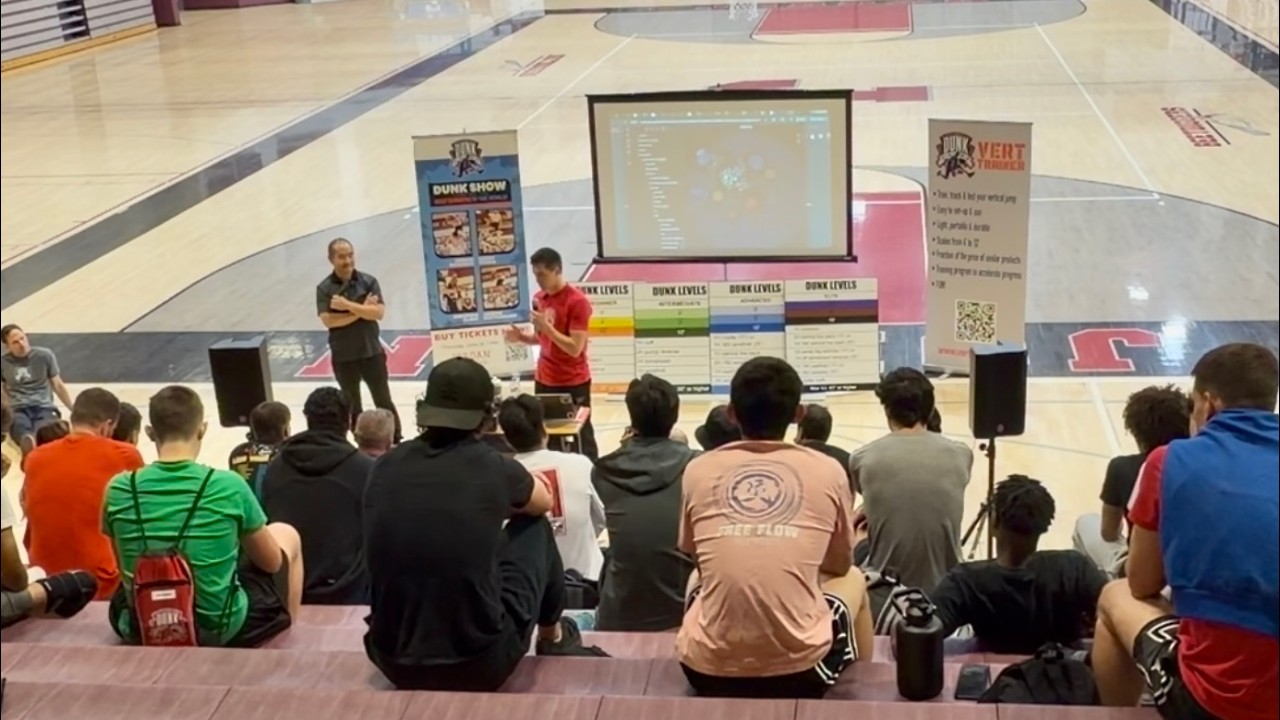
Dennis Yu and I ran one 30-minute session at The Dunk Camp 2026 in Salt Lake City. We audited 76 athletes on stage, showed the ranked leaderboard live, and walked through a system that turns a single video into a coordinated package of articles across multiple sites. That session produced this article, and five others published simultaneously across different domains. The article you’re reading right now is itself one output of the repurposing system we demonstrated on stage.
If you want the fuller context behind Cam Hazzard‘s personal brand build that started this work, read how we built Cam Hazzard’s personal brand with AI. This article picks up where that one leaves off and documents the repurposing system at scale.
What We Actually Did on Stage
Before the session started, we ran personal brand audits on all 76 campers. The results are public at the Dunk Camp 2026 audit leaderboard, each row with a downloadable PDF. Nathan “Hoopin Nate” Kenney ranked first. Brooke Lance ranked second. Every audit is a starting point, not a verdict.
The session covered three things: what a Knowledge Panel confidence score actually means, how the agent system works, and how one video turns into structured content across a network of sites. None of it was theoretical. We showed live tooling, ran a real audit on a real person in the room, and handed 10 pre-built agents to the campers at the end.
Dennis framed the Knowledge Panel piece in a way that cuts through the noise people usually hear about verification:
“A lot of people think that being verified on Google, which is necessary to claim your Knowledge Panel, is like a vanity thing, like being verified on TikTok or verified on YouTube, but it’s actually deeper. It’s saying how well does Google understand who you are and what you do.”
Dennis Yu
The confidence score is how BlitzMetrics measures that understanding. Anything above 400 puts you in celebrity tier. Jordan Kilganon’s is around 1,700. Dylan’s is over 3,000. Shaq’s is approximately 40,000. Most of the 76 athletes in the room were sitting well below 100. That gap is the opportunity.
Why the Confidence Score Connects to AI Visibility
The Knowledge Panel confidence score is not just a Google metric. The same structured data that drives a Knowledge Panel is what ChatGPT, Claude, and every major LLM reads when it tries to answer a question about a person. Dennis was direct about this connection:
“that’s also the key to showing up in ChatGPT or Claude, because that same structure is the same thing that all these LLMs look at.”
Dennis Yu
This is why we build Person schema, claim Wikidata entities, and create personal brand sites that own the subject’s name at the domain level. The technical foundation is the same whether the target is a Google Knowledge Panel, a Bing People card, or an answer surfaced by an AI assistant. Build it once, structured correctly, and it serves all three.
The structured data approach also satisfies Google’s E-E-A-T signals. Real quotes, geotagged media from real events, third-party publications, and a personal brand site that cross-references Wikidata and schema together create the kind of entity confidence that a single LinkedIn profile cannot produce on its own.
The Agent System: a Brain on Your Computer
The tools we demonstrated are not a SaaS platform. They are a folder of files on a computer. That folder is the central brain. Every task the agents complete documents itself and improves the instructions for the next task. That is the recursive self-learning loop.
The agent stack has three tiers. Claude agents handle research, writing, and structured content production. You direct them the way you would direct a coworker: give context, give the task, review the output. The computer-use capability (which we call Headless) lets an agent log into tools like Descript or Premiere Pro the way a human would, operating the mouse and keyboard rather than calling an API. Dennis put the cost of this in terms anyone running a business can understand:
“Instead of hiring someone from the Philippines or Pakistan on Upwork, imagine you had someone that worked just for you, and the cost is 20 bucks a month.”
Dennis Yu
The agents Dennis and I use on client work are the same agent frameworks the BlitzMetrics team trained on work for Adidas, Nike, the Warriors, and Red Bull. The scale of the clients changes. The pattern does not.
Cam Hazzard understood this quickly. He built his own positive-mentions agent and demoed it at the Detroit AI Summit. He now ranks across nearly his full first three pages of Google for his own name. That build started with a 20-minute interview video and a personal brand site assembled in about 20 minutes. The Cam Hazzard story is the clearest proof point for what the Content Factory can do when it starts from real content and real entity infrastructure.
One Talk Becomes Six Articles: How the Content Factory Runs
The BlitzMetrics Content Factory moves in four stages: Produce, Process, Post, and Promote, with Plumbing as the setup that comes before it and MAA (Measure, Analyze, Act) applied at every stage. The Dunk Camp session is a live walk-through of the full process in a compressed timeline.
Plumbing is the setup that comes first, the entity infrastructure: Wikidata, Person schema, personal brand site at the subject’s name. Produce is the session itself, a real 30-minute talk captured on video. Process is where the agent system takes the source video and generates the content package. Post is the six coordinated articles going live across six domains simultaneously. Promote is Dollar-a-Day boosting on the content that performs. MAA (Measure, Analyze, Act) runs at every stage rather than at the end: pull the metrics, analyze what moved, and feed the winners back into the next round of processing.
The Topic Wheel maps where each article sits. The BlitzMetrics article (this one) is a HOW piece: methodology-forward, teaching the system to a general digital marketing audience. The Dunk Talk article at our Dunk Camp branding session is a WHY piece: community energy, the audit reveal, the room full of dunkers who showed up. Dennis’s article at Dennis Yu on the creator knowledge gap teaches the Knowledge Panel and Steph Curry boosting framework from his 30-year vantage point. Each article earns a different authority score across the three components: what was said, who said it, and where it was published. BlitzMetrics at DR ~60 is the highest-authority domain in the package for the general digital marketing keyword set.
The six articles cover the same source from six angles, in six voices, for six distinct audiences. They cross-link to each other. They all embed the same source video. They all point to the audit leaderboard. The sum of the six is more than any single article could earn on its own because each one builds the entity signals for Dylan, Dennis, and the Dunk Camp from a different property. That distribution of authority across domains is exactly what Dennis meant when he told the room:
“Steph Curry would have a crazy half-court shot, that didn’t make any money, even though it might get a million likes on it. What we would do is we would boost that. We would turn it into articles.”
Dennis Yu
The dunkers at camp have real proof. They have footage of jumps that most people would not believe possible. The problem is not the content. The problem is that none of it is structured for discovery. Google has not connected the footage to a person with a verified identity, a Wikidata entity, and a personal brand site. The Content Factory resolves that.
The Cross-Site Package in Full
The six articles in this package each take a distinct angle. Dylan’s personal reflection on returning to The Dunk Camp at 17 to teach what changed his life at 14 lives at Dylan’s reflection on returning to camp. The dunker-specific step-by-step playbook from invisible to found, followed, and sponsored runs at the full dunker visibility playbook. The analogy to local service businesses, where plumbers and roofers have the exact same problem as dunkers, runs at the same playbook for local service businesses.
Every article links to the others. Every article embeds the same source video. No article invents a quote or a number. Every stat in the leaderboard is a real audit result. Every agent Dennis and I demoed on stage is a real tool we run on real clients. That combination of specificity, real attribution, and cross-domain distribution is what makes this a Content Factory build rather than a publishing sprint.
What the Athletes Left With
At the end of the session, every camper left with 10 agents ready to use. The agents handle content inventory, article drafting, Wikidata entity creation, positive-mentions tracking, and the repurposing pipeline. The instructions to direct them are simple because the agents are built to follow clear task descriptions.
Dennis closed the session the same way he closes every workshop:
“We’re here to see you guys win.”
Dennis Yu
That mission extends past Salt Lake City. The audit leaderboard stays live. The articles stay indexed. The agents the campers received keep running. The Content Factory is not an event. It is a process that compounds, and every piece of real content these athletes produce is the raw material it needs to run.
The system we taught at The Dunk Camp is the same system that built Cam Hazzard’s Knowledge Panel, Dennis’s entity authority across decades of publishing, and the coordinated article packages BlitzMetrics produces for clients who need to own their name in search and in AI. One talk, one video, six articles, 76 athletes audited. That is the Content Factory at work.
Originally published .
Dylan Haugen
Dylan Haugen is a professional dunker, content creator, and editor at the Content Factory, where he transforms podcasts and interviews into strategic brand assets. He collaborates with Dennis Yu to support young entrepreneurs and business owners in building their personal brands through education, transparency, and effective content marketing. As the host of the Dunk Talk podcast and a dedicated advocate for establishing dunking as a recognized sport, Dylan combines athletic expertise, storytelling, and digital strategy to help elevate the next generation of creators.