

Most B2B advertisers on YouTube make the same mistake: they target keywords like “roofing services” or “roof repair near me” and end up showing their ads to homeowners — not the roofing contractors they actually want to reach. If you sell software, supplies, coaching, or services to roofers, you need lateral targeting, not direct consumer targeting.
This article walks through exactly how we built a YouTube ad campaign in Google Ads to reach roofing industry professionals — the people who run roofing businesses, attend industry conferences like Roofing Process Con, follow thought leaders like Lance Bachmann, and use tools like JobNimbus and AccuLynx. We did it using our dollar-a-day strategy, spending just $100 over 11 days to get our podcast interviews in front of the right audience.
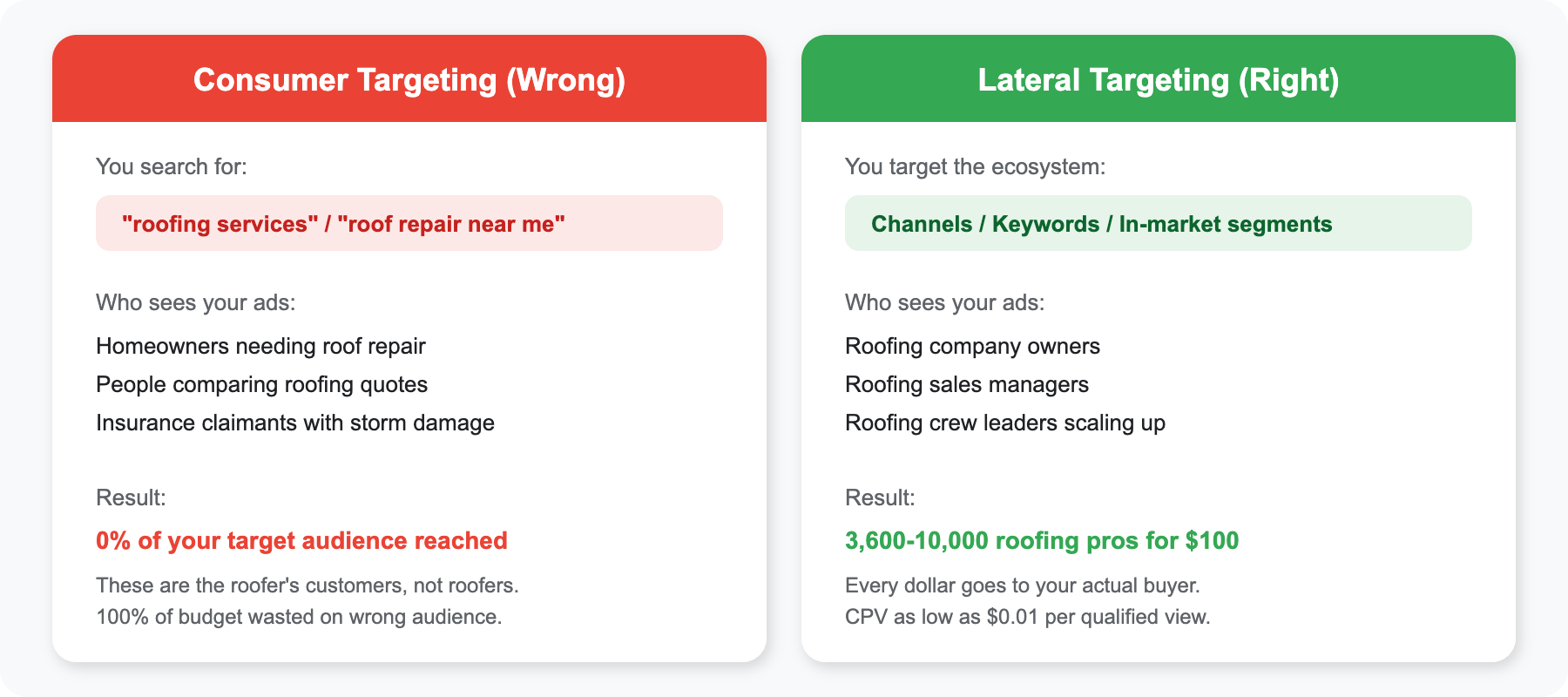
Consumer Targeting vs. Lateral Targeting at a Glance
❌ Consumer Targeting (Wrong)
You search for:
“roofing services” / “roof repair near me”
Who sees your ads:
Homeowners needing roof repairs
People comparing roofing quotes
Insurance claimants with storm damage
Result:
0% of your target audience reached.
These are the roofer’s customers, not roofers.
100% of budget wasted on wrong audience.
✅ Lateral Targeting (Right)
You search for:
“roofing business growth” / “JobNimbus CRM”
Who sees your ads:
Roofing company owners researching growth
Contractors watching Roofing Insights on YouTube
Professionals attending Roofing Process Con
Result:
Nearly 100% of your audience are roofers.
Every dollar reaches a decision-maker.
$100 budget gets 3,600–10,000 impressions.
What Is Lateral Targeting (and Why It Matters for B2B)?
Lateral targeting means reaching your audience through the content they consume rather than the services they provide. Instead of targeting what roofers sell (roofing services), you target what roofers buy, watch, attend, and search for when they are wearing their business-owner hat.
A roofing company owner searching “roofing sales training” or watching a video from Roofing Insights is not a homeowner — that person is a roofing professional looking to grow their business. That is your buyer. By targeting those signals, you skip past the homeowner noise and land directly in front of decision-makers.
The Campaign We Built: Home Service Leaders — Video Views
We created a YouTube Video Views campaign inside Google Ads called “Home Service Leaders — Video Views.” The goal was to boost interviews from our Local Service Spotlight podcast in front of roofing industry professionals.
Campaign Settings
- Campaign type: Video — Video views
- Network: YouTube videos only (Exclude Google video partners for tighter targeting)
- Locations: United States
- Language: English
- Budget: $100 total over 11 days (approximately $9/day)
- Bid strategy: Target CPV (cost per view)
- Target CPV bid: $0.10
- Start date: April 3, 2025
- End date: April 14, 2025
We excluded Google video partners to keep the campaign focused on YouTube itself, where we have the most control over placement targeting. This prevents ads from running on random third-party sites where the audience quality drops significantly.
The Ad Creative
We selected four podcast interview videos featuring guests who speak directly to the roofing and home service audience. Each ad was named descriptively so we can tell at a glance which content is performing:
- George Paladichuk — Agency Builder Interview
- Brad Strawbridge — Roofing Industry Marketing
- Erik Huberman — Scaling Home Service Brands
- Marco Cipolla — Local Service Business Growth
By running multiple videos in the same ad group, Google optimizes delivery toward the creative that earns the best engagement. The descriptive naming convention follows our standard operating procedure — “Ad #1” tells you nothing, while “George Paladichuk — Agency Builder Interview” tells you exactly what is running.
The Audience: Roofing Industry Professionals
The audience is the core of this campaign. We named it “Roofing Industry Professionals” and built it from three layers of targeting that overlap to create a precise B2B filter.
Layer 1: In-Market Audience Segments
These segments capture people actively researching and engaging with roofing content:
- Roofing Services (In-market)
- Roof Materials and Services
- Roof Installation
- Roofing Estimates
- Roof Maintenance Services
- Rubber Roofing
- Flat Roofing Services
- Roof Construction and Maintenance
- Damage Roof Repairing and Insurance Claiming Services
Layer 2: Industry Keywords
We added 15 keywords that only a roofing industry professional would search for — not a homeowner looking for a quote:
- roofing business, roofing contractor marketing, roofing sales training
- Lance Bachmann, Roofing Process Con
- JobNimbus, AccuLynx (roofing CRM and software tools)
- roofing lead generation, roofing company growth
- roofing industry conference, roofing business coaching
- roofing profit margins, commercial roofing bids
These keywords work because they reflect what a roofing business owner searches for, not what a homeowner types when their roof leaks. Nobody searching “roofing profit margins” needs a roof repair — they run a roofing company.
Layer 3: YouTube Channel Placements (The Power Move)
This is the most powerful and underused targeting option in Google Ads for B2B. We hand-picked 16 YouTube channels where roofing professionals spend their time:
- Roofing Insights (Dmitry Lipinskiy) — 183K subscribers, the largest roofing business channel on YouTube
- The Roof Strategist (Adam Bensman) — 63K subscribers, focused on roofing sales
- Roofing Process Con — conference content for roofing business owners
- Lance Bachmann — roofing industry thought leader and speaker
- Dirk Eversoll / Roofing Business School — education for roofing entrepreneurs
- Equipter — roofing equipment manufacturer (only roofers watch product demos)
- ABC Supply — the largest wholesale distributor of roofing materials in the U.S.
- JobNimbus — roofing CRM software (only roofing companies use this)
- AccuLynx — roofing project management software
- GAF Roofing — one of the biggest roofing material brands
- IKO Roofing — roofing material manufacturer
- Owens Corning Roofing — roofing materials and contractor programs
- Beacon Building Products — commercial roofing supply distributor
- SRS Distribution — roofing and building products distributor
- CompanyCam — photo documentation tool used by contractors
- ServiceTitan — field service management software for home service businesses
When you place your ad on Roofing Insights or The Roof Strategist, you know exactly who is watching. No homeowner subscribes to a channel about roofing profit margins. This is what makes channel placements the most precise B2B targeting lever on YouTube.
Why This Works Better Than LinkedIn for “Boring” B2B
LinkedIn is the default choice for B2B advertising, but it has two problems for reaching trade professionals. First, most roofing contractors, HVAC technicians, and plumbers do not spend meaningful time on LinkedIn. They spend time on YouTube watching how-to content, product reviews, and business growth videos. Second, LinkedIn’s minimum CPM for video ads typically runs $30 to $50 or more, making it expensive to test creative at small budgets.
YouTube with lateral targeting flips this equation. At a $0.10 target CPV, you pay only when someone watches your video. The channel placements guarantee that the viewer is a roofing professional. The total test budget is $100 — less than a single day’s spend on most LinkedIn campaigns.
The Dollar-a-Day Framework Applied to B2B YouTube
The dollar-a-day strategy is a system Dennis Yu developed for testing content with small budgets before scaling what works. Here is how it applies to this campaign:
- Start with $1/day ($30/month) — enough to get data on which videos, audiences, and placements perform best
- Target tightly — the 16 YouTube channels plus roofing keywords plus in-market segments mean every dollar goes to a roofing professional, not a random homeowner
- Test multiple videos — we boost interviews with George Paladichuk, Brad Strawbridge, Erik Huberman, and Marco Cipolla in the same campaign, letting them compete for the same budget
- Measure engagement, not just views — watch time, click-through rate, and subscriber growth tell you which content resonates with the roofing audience
- Scale what works — once you find a video that gets 30%+ view rates with the roofing audience, increase spend to $5/day, then $10/day
At $100 over 11 days, Google estimated 3,600 to 10,000 impressions, all served to people in our custom roofing industry audience. That is enough data to see which video resonates and which placement drives the most engaged viewers.
When to Reuse a Campaign vs. Create a New One
A common question when running dollar-a-day campaigns is whether to create a new campaign for each piece of content or add new ads to an existing one. The rule is simple:
Reuse the same campaign when:
- The audience is the same (roofing industry professionals)
- The goal is the same (video views for brand awareness)
- The new content fits the same targeting parameters
Create a new campaign when:
- You are targeting a different industry vertical (e.g., HVAC instead of roofing)
- The budget for one audience should not be cannibalized
- The campaign objective is different (e.g., conversions vs. views)
- You are testing a fundamentally different ad format or bid strategy
For our Local Service Spotlight podcast boosts, we keep all roofing industry interviews in the same campaign with the same “Roofing Industry Professionals” audience. Each video becomes a new ad within the same ad group, sharing the same audience targeting and budget.
This Works for Every Home Service Category
The lateral targeting playbook is not limited to roofing. The same three-layer approach — in-market segments, industry keywords, and YouTube channel placements — works for any trade vertical where professionals consume YouTube content.
HVAC: Target channels like HVAC School (280K+ subscribers) and keywords like “HVAC business growth,” “ServiceTitan training,” or “HVAC sales process.”
Pest Control: Target channels like PCT Magazine and keywords like “pest control route optimization,” “PestRoutes software,” or “pest control business scaling.”
Landscaping: Target channels like Holganix and Augusta Lawn Care Life, and keywords like “landscape business scaling,” “LMN software,” or “hardscape design training.”
Plumbing: Target channels like Roger Wakefield (600K+ subscribers) and keywords like “plumbing business owner,” “Housecall Pro setup,” or “plumbing company marketing.”
The pattern is always the same: find the YouTube channels where your target professionals spend time, identify the software and conferences they use, and build your audience around that ecosystem.
What SaaS Companies and Agencies Should Take Away
- Stop targeting consumer keywords. “Roofing services” reaches homeowners, not roofers. Use industry-specific keywords that only a business owner would search.
- Use YouTube channel placements. This is the most underutilized targeting option in Google Ads. When you place your ad on Roofing Insights or The Roof Strategist, you know exactly who is watching.
- Start with dollar-a-day. You do not need $10K/month to test B2B YouTube. Start with $30 to $100 and see what the data tells you.
- Name your ads and audiences properly. “George Paladichuk — Agency Builder Interview” tells you what is running. “Ad #1” tells you nothing.
- Stack your targeting layers. In-market segments plus industry keywords plus YouTube channel placements create a Venn diagram that zeroes in on your exact audience.
- Let AI agents help you build and scale. We used Claude AI to research channels, build audiences, configure campaign settings, and draft this article. The future of media buying is AI-assisted.
The Bigger Picture: AI Agents Running Ad Campaigns
This campaign was configured with the help of Claude AI acting as an agent inside Google Ads — selecting audience segments, adding YouTube channel placements, naming ads, and setting bids. This is part of our broader work at BlitzMetrics showing how AI agents can handle the repetitive, detail-oriented work of media buying while humans focus on strategy and creative.
The process fits inside the third stage of our Content Factory system: after you produce content and process it into articles, you post and promote it. This campaign is the promotion layer — taking podcast interviews we already recorded and putting them in front of the exact professionals who would benefit from watching them.
For the full step-by-step walkthrough of how Claude built this campaign from scratch in Google Ads, see our companion article: How Claude AI Built a YouTube Ad Campaign in Google Ads — Step by Step.
Ready to Launch Your Own Dollar-a-Day B2B YouTube Campaign?
Whether you are targeting roofers, HVAC technicians, pest control operators, or landscapers — the dollar-a-day lateral targeting playbook works. Start small, target tight, and let the data guide your scaling.
We would love to help you build your first campaign. Reach out to us at BlitzMetrics to learn how the dollar-a-day strategy can put your brand in front of the exact professionals you want to reach.
Dennis Yu
Dennis Yu is the CEO of Local Service Spotlight, a platform that amplifies the reputations of contractors and local service businesses using the Content Factory process. He is a former search engine engineer who has spent a billion dollars on Google and Facebook ads for Nike, Quiznos, Ashley Furniture, Red Bull, State Farm, and other brands.
Dennis has achieved 25% of his goal of creating a million digital marketing jobs by partnering with universities, professional organizations, and agencies. Through Local Service Spotlight, he teaches the Dollar a Day strategy and Content Factory training to help local service businesses enhance their existing local reputation and make the phone ring.
Dennis coaches young adult agency owners serving plumbers, AC technicians, landscapers, roofers, electricians, and believes there should be a standard in measuring local marketing efforts, much like doctors and plumbers must be certified.