

Most people think productivity is about cramming more into their day. It’s not. It’s about shifting what you spend your time on, moving from $10/hour tasks to $100/hour and $1,000/hour tasks. I get a thousand emails a day. I travel constantly. I’ve got projects and teammates all over the place. People think I must have a robot replying on Messenger, Skype, and LinkedIn, or that I never sleep. But I had eight hours of sleep last night. Let me show you how I do it.
The 3×3 grid that changed how I think about time
Imagine a tic-tac-toe grid. Across the top you have tasks worth $10/hour, $100/hour, and $1,000/hour. Down the side you have short-term, medium-term, and long-term.
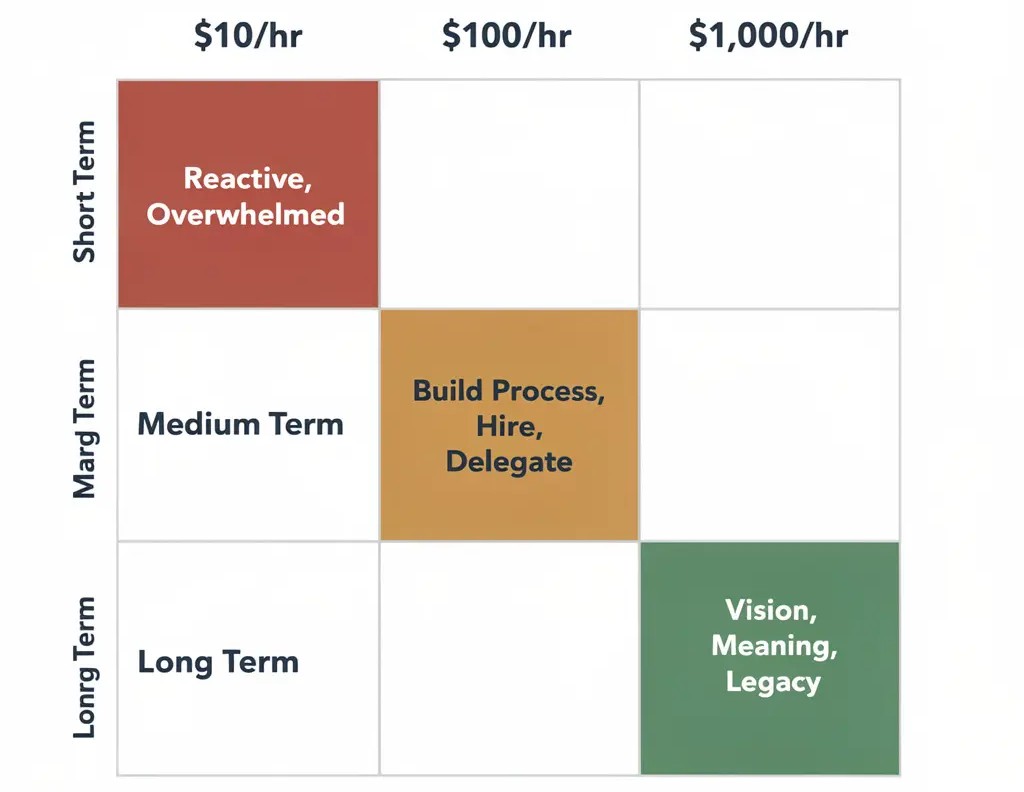
Now place everything you do into those buckets. Cleaning your house, doing laundry, driving to work, that’s $10/hour. Optimizing a PPC campaign, coaching a teammate, hiring a VA, making a presentation, that’s $100/hour. Building a piece of software you could sell as a SaaS product, going to an event and meeting someone who turns into a deal worth millions, forming a relationship that transforms your business, that’s $1,000/hour or more.
Be honest with yourself. Where does 80% of your time actually go? For most people, it’s crammed into that top-left corner. Low-value, short-term, reactive work. Your inbox is full, you feel overwhelmed, you feel super busy all the time, and almost all of it is spent on things coming at you. Skype chats, people bothering you, auto-interrupting by surfing the internet, and pretty soon you’ve lost three or four hours.
The trouble is that most people live in only two places on this grid. They either live in the top-left corner, freaking out, drowning in emergencies and constant interruptions because they’re not controlling their time. Or they live in the bottom-right corner as dreamers, fantasizing about what their business could be when they have a million users or a big staff. The secret is being able to bridge through the medium term, and that’s where most people get stuck.
The real cost of interruptions
Ever heard of the Mythical Man-Month? Paul Graham wrote a great piece called the Maker’s versus Manager’s Schedule that gets at the same idea. The core concept is that context switching is brutally expensive.
Think about it like this. You want to mow the lawn and eat a bowl of cereal. Instead of doing one then the other, you take one spoonful, walk outside, mow one line, walk back inside, take another spoonful. You’d never finish either task. That’s what your day looks like when you’re bouncing between Slack, email, texts, and social media.
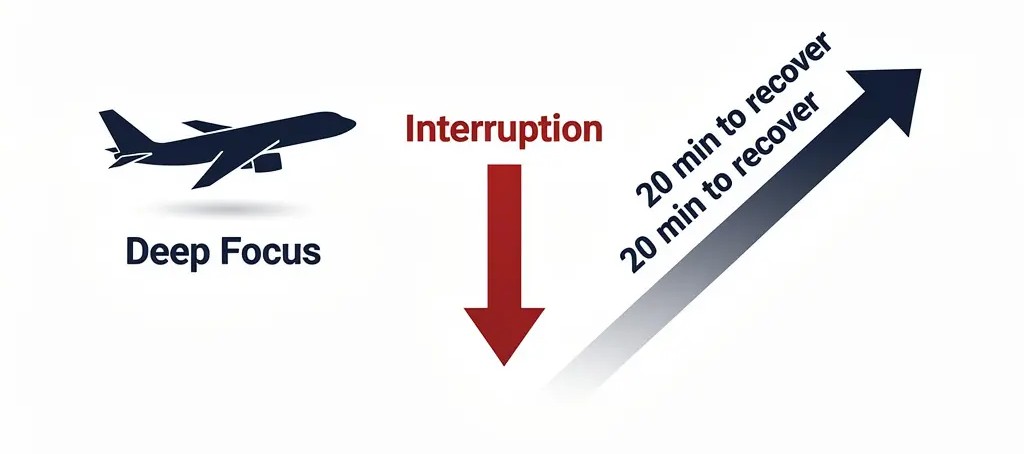
Every interruption is like slamming an airplane from cruise altitude at 40,000 feet back onto the runway. It takes 20 minutes to climb back to cruise speed, which for a 727 is 585 miles per hour. But most of us never get there because the next interruption hits first.
A manager blocks out time in one-hour intervals. Everything’s an hour. At Yahoo, people would brag about having five or six meetings a day and a call with London at 5 AM. Good for you, but that’s not how value gets created. A maker, someone building systems or software, needs three or four uninterrupted hours to do deep work. One interruption, even if it only takes 60 seconds, can cost you three hours or the entire day because you have to think about where you were, rebuild your context, and get back to altitude.
One of my clients yesterday kept hitting me up over and over on text and Facebook. What do you think about this idea? What about that? I told him, that’s a great idea, why don’t you think about it, put some thought into it, send me a note and we can schedule a time to talk. I was in the middle of a training and focusing on a particular component of our software. That interruption wasn’t worth it.
I think the average person touches their phone 150 times a day. Don’t do that.
Do, delegate, delete
This is the personal efficiency framework that makes the grid work. Every task that crosses your path gets one of three treatments.
If it takes less than 10 to 15 minutes and you’re the right person, do it. If someone else can handle it reliably as part of a process, delegate it. If it doesn’t need to happen at all, or can be deferred, delete it.

Most tasks can be completed in 10 to 15 minutes if you’re focused and not distracted. I can write most articles in 10 minutes. My buddy Leonard Kim, who I think is the top author on Quora, and I talked last night about how many articles we’ve each written over the last seven or eight years and how they mostly come in just a few minutes. It’s not because I’m faster or better. It’s because I feel the urgency of time.

Try what I call the Laptop Burndown Method. Take your laptop without your power cord. Go to Starbucks or wherever. Sit down and work on that one thing you’ve been avoiding. Watch the battery tick down. You’ve got two hours or however long your laptop lasts. Because you know the battery’s going down, you can’t fool around, surf the internet, or chat with people. You have to focus. It’s like defusing a bomb before it ticks down to zero and blows up in your face.
When I prepared for this webinar, I spent 10 to 15 minutes. It takes an hour to deliver it. That’s the power of Do, Delegate, Delete applied to personal efficiency.
Communicate, iterate, delegate
This is the teamwork version of the same principle. Think of it as a sandwich.
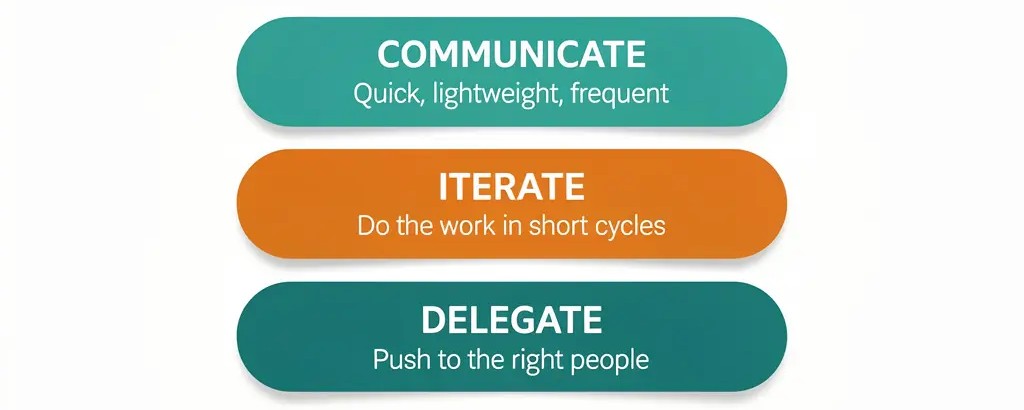
The top bun is communicate. It’s quick, lightweight, and frequent. Tell people what they need to know. It literally takes 10 seconds. “Hey, I’m not gonna be available tomorrow because I have to get my car fixed.” “Hey, there’s this deadline coming up.” “Hey, this one thing’s doing really well.” Most communication failures aren’t about big misunderstandings. They’re about someone simply not being told. The lack of communication is where things fall apart, where people get mad, where feelings get hurt, where the ball gets dropped.
The meat is iterate. That’s actually doing the work, using Do, Delegate, Delete. Keep cycles short. Get 80% of the value of any task done in 10 minutes. Not because you’re taking shortcuts, but because you feel the urgency and you’re not being distracted.
The bottom bun is delegate. Push work to the people and processes best suited for it. If you’re operating inside a team, think about the RACI model: responsible, accountable, consulted, informed. That’s project management, and it’s a derivation of this Communicate, Iterate, Delegate framework.
Do this asynchronously whenever possible. Not everything needs a meeting. Not everything needs a call. I don’t even attend most of the weekly client meetings. Why? Because that’s tactical execution on project management. When it comes to strategy, I can get involved when I need to via email or Basecamp. I can respond when it’s most convenient to me instead of being on call for people who can hit me up anytime they want.
Say no to almost everything
The most successful people I know say no to almost everything. Not rudely, but firmly.
“Let’s hop on the phone for five minutes.” No, because there is no five minutes. It always ends up being an hour. “Oh, but here’s somebody who might be a client, let me get on the phone with them because I really need the money.” No, you must have a process. The whole FOMO, fear of missing out, is an easy way to waste your time.
My friend Jillian Musig has five magic words to grow your agency: “We’re not right for everybody.” When you’re growing, just like kids who can’t fit into their two-year-old clothes because now they’re three, you’re going to outgrow some clients. The clients you started with aren’t necessarily the ones you’ll grow with. Instead of saying “you’re not right for us,” say “we’re not right for everybody.” That lets you focus on fewer clients who can pay more and stop wasting your time.
Watch out for all the different ways people say “I have no money.” We’ll give you a share of profit. I can get it cheaper because these VAs can do it. How about a trade? We want to be a partner. Oh, it’s a friend of a friend who said we should work together. That just means they want the friend discount.
One of my mentors, someone incredibly important, sat me down and told me there’s always a trade-off. How do I make more money with less time? Anytime there’s an opportunity, he looks at it and asks what he’s willing to give up to say yes. Another person I spent time with yesterday said he wouldn’t take anything that wasn’t at least $20,000. Not because he’s greedy, but because that’s the value of his time to even look at something, given everything he’s built around it.
Put the big rocks in first
You’ve probably heard the jar analogy. A guy puts big tennis-ball-sized rocks into a jar. Is the jar full? No. He pours in pebbles. Full now? No. He pours in water. Now it’s full.
Most people think the lesson is that you can always keep jamming in more stuff. It’s not. The lesson is that if you don’t put the big rocks in first, they’ll never fit.
Your big rocks are the important but not urgent items. The website you’ve been meaning to build. The one-minute videos you keep making excuses about. The course you’ve been meaning to create. The relationship you’ve been meaning to invest in. Those go on the calendar first. Everything else fills in around them.
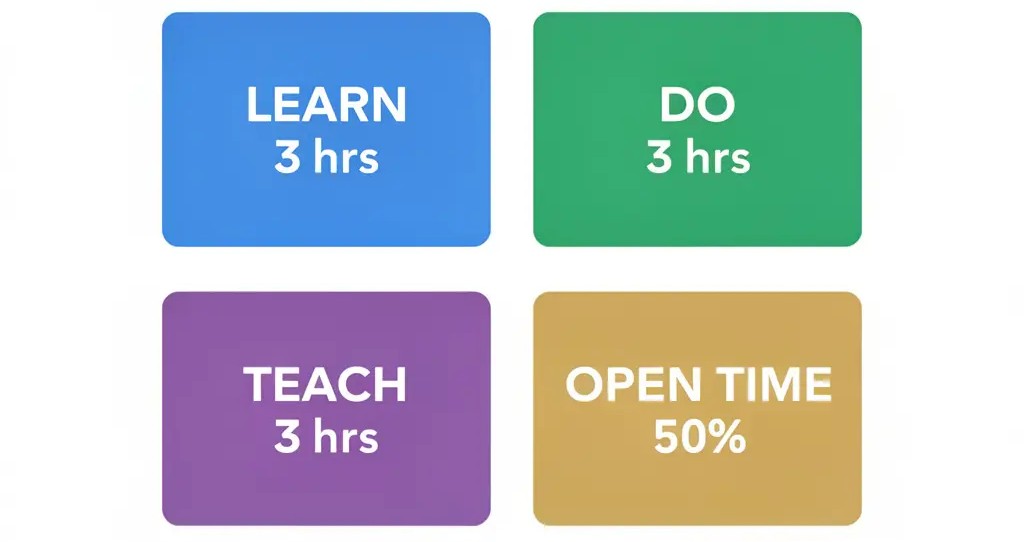
If your inbox is full and you’re feeling overwhelmed, that’s a sign you’re not being proactive. It’s like Tetris on the highest level where the blocks are falling so fast you can’t even turn them around and they stack up at the top and you die. You’ve got to have at least half your time available as thinking open time.
Why half your day should be open
If you do this right, at least half your day should be open. Not “free” as in doing nothing. Open as in available for high-value thinking, relationship building, and strategic work.
One of my mentors was Al Casey, the CEO of American Airlines.

He would literally kick his legs up in his corner office on the sixth floor of the headquarters building and look out the window at the planes flying. He’d spend half his day doing that. The younger executives and VPs would say he doesn’t really do anything, he should be busy, he should be in meetings. I asked Al about it and he said, “No, that’s what they’re paying me to do. I’m the CEO. I’m planning, strategizing, thinking. You’re paying me to think. You’re not paying me to attend meetings.”
That’s what you need to be doing too. Don’t worry about how it looks.
Yesterday I had a three-hour lunch with one of the most successful businessmen in Utah. He sold his last business for a huge sum. He’s retired now, I think around 65. We had all the time in the world and I learned so much. If my time was so jammed with meetings that I didn’t have that open availability, I would have missed out on spending time with someone incredibly valuable.
My buddy Bill Harish funded Best Buy and Costco. One time we were in the Costco parking lot after buying those giant blueberry muffin six-packs. I saw the Nike outlet store in the same lot and said I’d love to get running shoes. He told me to go ahead, he’d wait. I made a billionaire wait 40 minutes while I saved $15 on shoes. Of course, he wasn’t just sitting there. He was trading stocks and making calls. But it’s a reminder that successful people understand the time-versus-money trade-off deeply. He’ll fly on a private jet but wait patiently in a parking lot. It’s always time for money.
The bottom line
You 10X the value of your time by auditing your tasks into the 3×3 grid of value times time horizon. Then you delegate everything in the $10/hour column. Hire a VA. One of the best life hacks I know is that we actually hire maids to clean the houses of our team members or deliver their groceries. It’s the same reason Google and Facebook provide food on campus. It costs them an extra $15 but saves an hour and a half of productivity from their engineers. That hour and a half is probably worth $200, and the employees feel valued on top of it.
You eliminate context switching and constant interruptions. You stop opening social media multiple times a day. You don’t touch your phone within an hour of going to bed. You stop saying yes to everything and start saying no so you can say yes to the things that actually matter. You keep your calendar open, not because you’re free, but because you need the time to think. You put big rocks first, important over urgent. You build a process, something like our thousand-item checklist that documents anything and everything we could ever do so that the business runs whether or not you’re there.
You can’t manufacture more time. But you can make every hour worth dramatically more. Stop trading hours for dollars and start building systems, relationships, and leverage that compound over time. When you realize that you can’t get back more time but you can always make more money, it changes how you treat every single hour.
Download the Skill File
This article has a companion Claude skill file that automates the process described above. Download it below, rename from .zip to .skill, and install it in Claude to get step-by-step guidance.
Dennis Yu
Dennis Yu is the CEO of Local Service Spotlight, a platform that amplifies the reputations of contractors and local service businesses using the Content Factory process. He is a former search engine engineer who has spent a billion dollars on Google and Facebook ads for Nike, Quiznos, Ashley Furniture, Red Bull, State Farm, and other brands.
Dennis has achieved 25% of his goal of creating a million digital marketing jobs by partnering with universities, professional organizations, and agencies. Through Local Service Spotlight, he teaches the Dollar a Day strategy and Content Factory training to help local service businesses enhance their existing local reputation and make the phone ring.
Dennis coaches young adult agency owners serving plumbers, AC technicians, landscapers, roofers, electricians, and believes there should be a standard in measuring local marketing efforts, much like doctors and plumbers must be certified.